
Translated material
To make a fairy tale by past. How much actually voted for the preservation of the USSR in 1991
Mainstream. The famous political scientist S. A. Markov writes on Echo of Moscow: “On March 17, 1991, there was a referendum on the preservation of the USSR. 80% of the population took part in it, 76% of the population voted to preserve the Union. Therefore, the collapse of the Union has become the greatest geopolitical tragedy. And a huge crime against democracy. ”

Lord, how tired! I who have not yet learned to distinguish between propaganda and reality, politely clarifying the famous political scientist and everyone who has not yet learned. For a third or fifth time. Although, probably, it is still in vain.
1. “Taken” was not the population, but by voters. There were 90 million voters in the USSR than the population.
2. Not 80 percent, but it is not known how much. Six republics of the European flank (it is good that S. A. Markov remembers this - it is a pity that he does not understand) in the referendum did not participate and the voter lists were not represented to Moscow. Consequently, no one knows how many voters were in the USSR for March 17, 1991. Reasoning about the percentage of turnout in this case is an empty chatter.
3. not 76% of the “population” voted for the union, but 76% of the number of voters registered in the nine republics of the Center and the eastern flank of the USSR and who came to polling stations . These republics presented lists for 185.6 million; 148.5 million took part from them (here a small fraction includes military personnel and part of the Soviet state employees who voted in the reporting republics at departmental sites); “Yes” said 113.5 million even if we count 185.6 million “The population of the USSR”, it turns out not 76%, but 61.2% of the total. In classic plebiscites, the total percentage is considered not from the number of voters, but from the number of citizens who have the right to vote. Since the total number of voters in the Union was hardly more than 205 million, the result would still be positive. But not three quarters, but less than 60%.
A referendum on the preservation of the USSR 1991. Distribution of support by regions in terms of the list of voters
The values for the six republics on the left wing of the diagram are calculated according to the official figures of “electoral consultations” or polls that the republics conducted synchronously with a referendum. The gap of priorities on the conditional border of Europe-Asia is obvious.
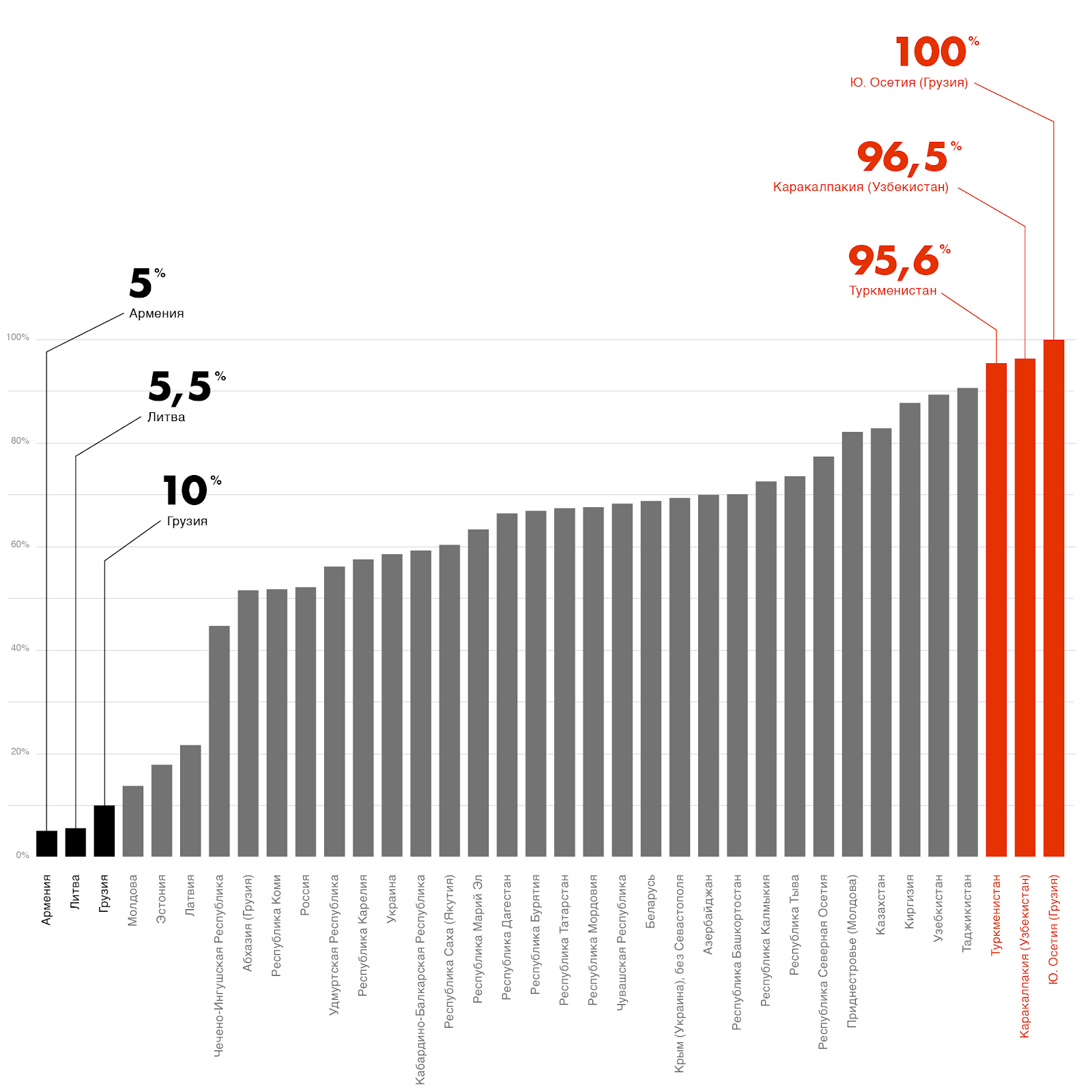
4. Now not about quantity, but about quality. In South Ossetia (it was part of Georgia, but spite Tbilisi decided to participate in a referendum - in the hope of divorce), 100% of voters told the Union yes. That is, everyone came to one and all voted to one. You decide for yourself - this is democracy or a falsification recorded in official numbers. The Karakalpak Autonomous Soviet Socialist Republic, rounded, showed the turnout 99% and 98% for. That is, 97% of the list. Turkmenistan, with a jaed of 98%, issued 98% for. Or 96% of the list. Next comes Tajikistan - 90% of the list; Uzbekistan - 88% of the list; Kyrgyzstan 83% of the list, etc.
The miraculous scoop believers will probably say that the Soviet 99.9% for the indestructible block of communists and non -partisans were also a manifestation of democracy. But in reality there is no: at the cost of large blood, the largest European country was bent to the level of Asian despotism (in the terminology of Marx) - and it, unlike pre -revolutionary times, began to show electoral numbers typical of such regimes. Now the similar results are demonstrated by Chechnya, Tuva, Kabardino-Balkaria, Ingushetia, Dagestan, Kalmykia and another dozen regions of the Russian Federation (mainly republics) called electoral sultanates. It is no secret that the total percentage is simply drawn there, and observers and independent candidates are touched. However, the storytellers, of course, will not agree.
5. In the RSFSR, 105.6 million voters were registered in the Gorbachev referendum. 56.9 million spoke out for the preservation of the USSR - 54% of the list rounded. If you dig deeper, in “Russia of national autonomies” 64% of the list spoke out for the USSR, and in the actual Russian Russia (without autonomous republics) about 52%. If you deepen a little more, we will see that no more than 35-40% of the list of list voted in the largest cities for the Union. The most striking example is Sverdlovsk (the factor of Yeltsin played a large role here: for the USSR only 34% of the number of voting or about 25% of the list. That is, in the understanding of S. A. Markov, from the "population."
6. The higher the urbanization, education, independence and income of citizens - the less electoral falsifier and the more distinguished craving for European standards. For a few exceptions such as the Khanty-Mansiysky or Yamal-Nenets Autonomous Okrug. And vice versa: the more depressing the hinterland, the more influential the administrative resource, the poorer people, the bulk of the press and the insolence of the electoral falsifiers.
The catastrophe of Gorbachev, among other things, was determined by the fact that he, having intended to move the USSR to a single “pan -European house”, was forced to rely on the Asian periphery for the sake of preserving the territorial framework. Without the Bay-Sultan falsifiers, he would not have seen him a confident majority! Like many others, he seriously believed in fairy tales about Ilyich, folk democracy, advantages of socialism and the Unified-Mogy Soviet Union. Which was actually forcibly sewn by Lenin-Stalin in a simple Horde pattern and kept on nuker-shits from the GPU/NKVD/KGB/. Where in his “pan -European house” Gorbachev of affairs would Turkmenistan with Tajikistan? Unless to spread on the porch in the form of a beautiful oriental carpet ... And in the USSR they were quite appropriate - though, due to the suppression and operation of the relatively advanced territories of the center and the western flank. Which were the first to rush to Europe, as soon as the CC was weakened by the grip.
The referendum was designed to prove the monolist of Soviet society. Instead, he demonstrated a deep split in the basic values of the population and on the electoral practices of local leadership.
7. Citizens did not even vote for the overall tale of the Union, but each for their own.
The question itself was deliberately complex and (according to national tradition?) Three -story. Someone voted for the image of the great, cramped, someone was fascinated by the federation of sovereign (already non-imperial and non-socialist?) Republics, and someone guarantees of human rights and freedoms of any nationality.
Is this, excuse me, in Chechnya or in Turkmenistan, a guarantee?
It is even more important that two key players, Ukraine (38 million voters) and Kazakhstan (10 million) agreed to participate in a referendum only on their individual conditions.
The formula for which they voted in Kazakhstan: "Do you consider it necessary to preserve the Union of the SSR as an union of equal sovereign states?"
The formula for which they voted in Ukraine: “Do you agree that Ukraine should be part of the Union of Soviet sovereign states on the basis of a declaration of state sovereignty of Ukraine?”
Both options are simpler and more honest Gorbachevsky; Both emphasize sovereignty. If without him - no, thanks, no. So, about 40 million votes (31 in Ukraine and nine in Kazakhstan) out of 113.5 million were actually burdened with the condition: if the Kremlin tries to command them in a Soviet way-sorry, we did not agree so ... And then what to enter the troops? To strangle with sanctions?
Fortunately or unfortunately, the center had no strength for this for a long time: the Soviet model has long burned the territory that is approved. (This is if you keep in mind reality. If a fairy tale is, of course, the opposite). Gorbachev’s reality was perhaps even worse than today's fake about the Union State of the Russian Federation and Belarus: in 1991, Belarus, at least, did not put forward any special conditions and voted for the union friendly of Russia: 69% of the list.
30 years have passed, and it seems that there is already nowhere else. But millions of people still earnestly believe in Lukashenko, in the Union and Brotherly Friendship. The flesh burned out, and the fairy tale lives.
8. Gorbachev, since he was more smarter than the sovereign propagandists and directly communicated with the heads of the republics, he understood more sharply than others what kind of living thread this whole design was bold. He persuaded, maneuvered, inferior. Six dissident republics were put on it with the device. Yeltsin and Nazarbayev demanded a confederation on the Swiss model. He rested and insisted on the “real federation” of the remaining nine republics - rather on the model of the United Kingdom, Germany or the USA. The matter ended that a few days before the agreement, conservatives crawled out onto the stage, who were not interested in the Swiss or American options, but only the former party-glass vertical. The only suitable for their picture of the world.
All of them then together spoke about 76 (others even about 78) percent of popular support. Have you also believed their own propaganda? It seemed to them that it was worth elevating the kumachi party banner, and the working masses would immediately flock with a full -flowing stream ... Alas. If they were more interested in the device of reality and less with a heroic epic, they would know that there are actually no 76 percent close. Especially in Moscow. A maximum of a third of the list.
9. These napaline jackets realized their cognitive dissonance simultaneously with political defeat. But for their heirs, who went the other way and properly saddled the restoration wave, the cognitive dissonance (and political defeat, too) is only ahead. Not so soon. And, most likely, not so bloodless. Although the basic prerequisites are already ripe.
As before the collapse of the USSR, the electoral support of power left the center and large cities to the electoral sultanates (where it is actually not, but the corrupt chiefs are drawn). The fake gut of television victories is gradually becoming more and more obvious. The mountain of weapons, along with the swelling class of security forces, turns into an unbearable load. The economic hole is deepening. The population is reduced half a million per year. The territory dies.
Orthodoxons cannot or want to see this - but this is also an element of the trajectory. Cognitive dissonance is an extremely unceremonious type, climbs into the soul without asking at the most inopportune moment. When the fairy tale once again collapses, they again have to complain about traitors and a blow to the back.
10. Against this background, stories about 76% are not only stupid, but also dangerous. They disorient and lead to a dead end.
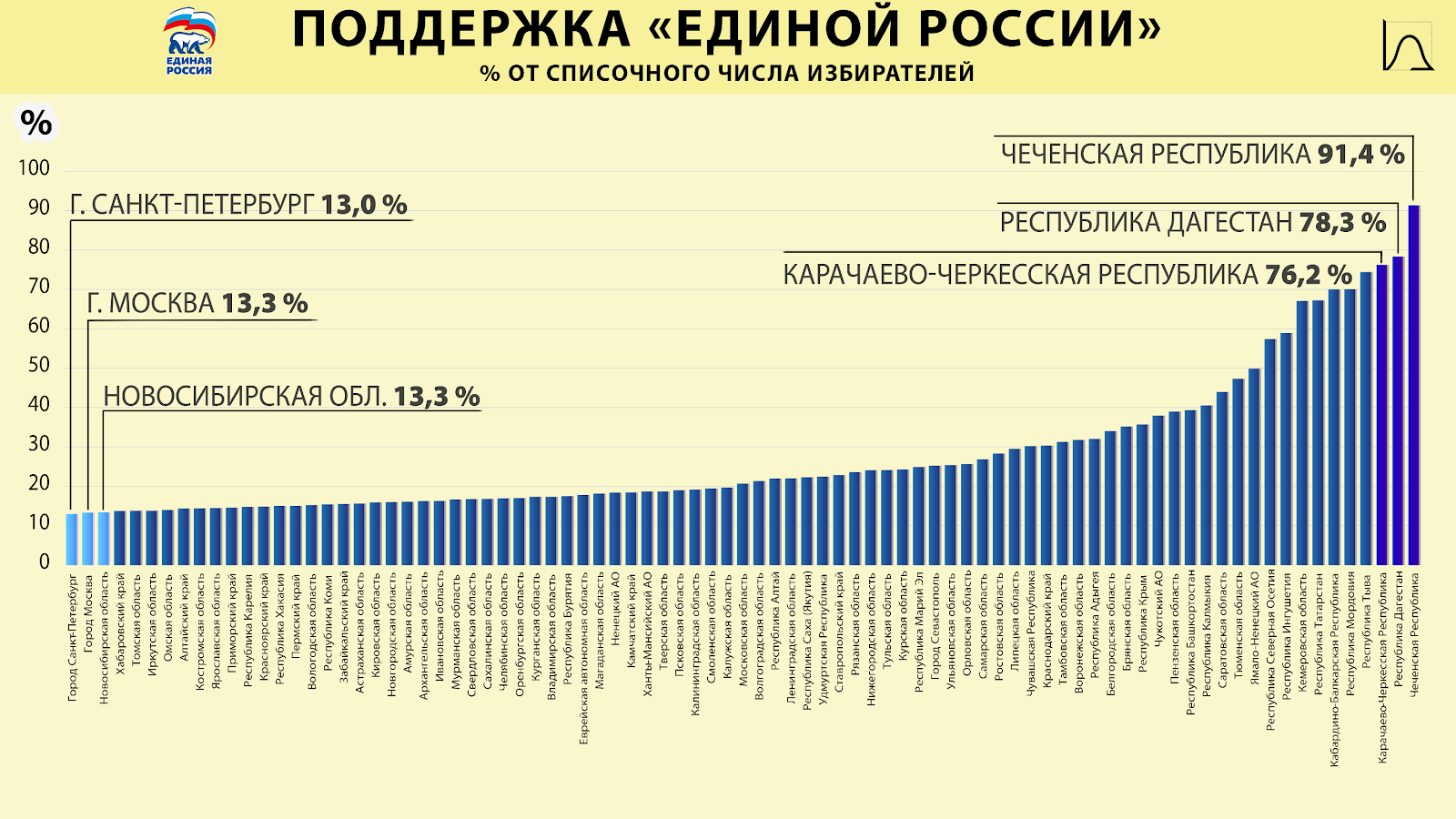
Elections to the State Duma in 2016. Distribution of support for the party in the regions in terms of the list of voters
The gap between the political center and the political periphery in the person of the "electoral sultanates" is obvious.
If in 1991 the sovereigns from the State Emergency Committee took the top, they would have to deploy military operations against the six separatist republics on the background of a household disaster on the western flank: they would not return without force compulsory coercion. Is this a way out?
If the top were taken by the more adequate Gorbachev’s idea of the “real federation” of the three Slavic and six Asian republics (“Union of Three Ushaki and Six Tubetecs”, according to V.P. Lukin), today there would not be 17-18 electoral sultanates with the total number of voters of 15 million, but at least 23-24, with the total volume of the controlled electorate of 65 Mill. (Now in the post -Soviet republics of Central Asia and in Azerbaijan to a circle of about 50 million voters).
This is already this, given their ability to depict an incredible turnout and monolithic, through the parliament it blocks any market transformations that, at the very least by the middle of the zero years, brought Russia to the eight of the leaders. The collapse back to the standards of Soviet despotism would have occurred earlier and tougher; Today, instead of Putin in the Kremlin, conditional Kadyrov, Aliyev or Nazarbayev could sit. Or, more likely, the conditional Putin in political manners became similar to the conditional Kadyrov 10 years earlier. Until the full identification.
11. It is clear that many are oil in the heart - but there is such a thing as an economy. It is not customary to talk about this, but the economic jerk of Russia by the beginning of the zero was due not only to the transition to solid currency, private property and the market, not only by increasing prices for raw materials, but also by exemption from ballast in the form of conservative periphery.
Like it or not, according to GDP/PPS in terms of per capita (current IMF data, 2020), Tajikistan takes 151st place in the world, Uzbekistan 121st, Azerbaijan 84, Turkmenistan 74th, China 75th, Russia 50s. And Latvia, Estonia and Lithuania, which our storytellers promised inevitable ruin without the Kremlin custody-respectively 43rd, 37th and 34th.
Portugal, which, according to this indicator, we undertook to catch up with in 1999, is still ahead of Russia by 12-15 steps. And it is unlikely that in the medium term the distance will be reduced. Rather, on the contrary.
12. Soviet fairy tales - including the referendum - are destructive, because they interfere with the main thing: in the modern world, the greatness of the country is determined not by size, but by filling. For those who are interested in reality, it is clear that a tragedy and a crime against democracy would not be the collapse of the Soviet Union, but stupid attempts to preserve it.