
Translated material
At a rally in Moscow, police did without mass detentions. But they came to protesters and journalists immediately after - the persons of recognition system helped the security forces
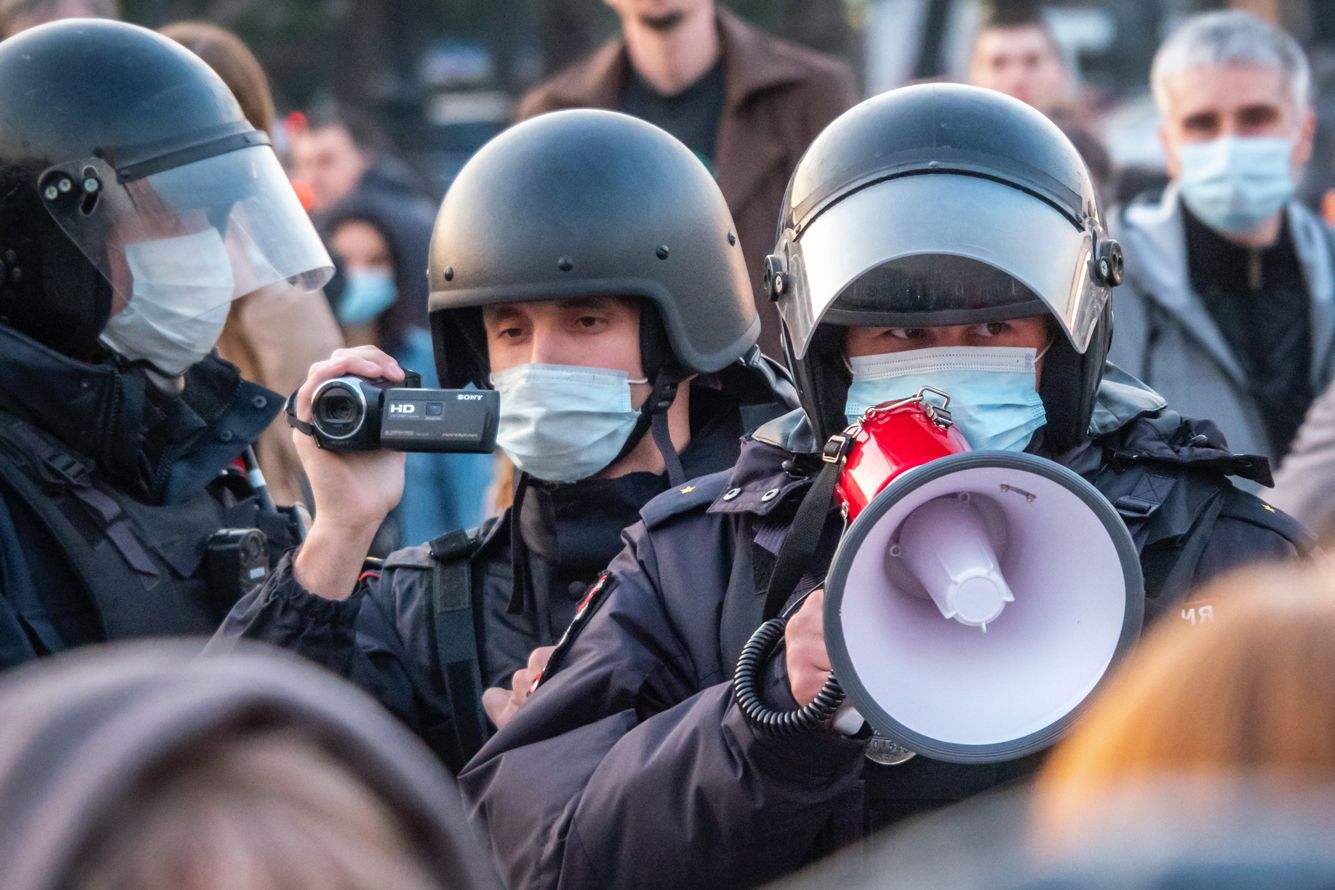
The action of solidarity with Alexei Navalny on April 21 in Moscow was relatively peacefully. About 60 people were detained at the rally - there were more than a thousand on the January actions of the detainees each time.
On the eve of the shares on April 21, there was a recommendation to apply to protesting power to the Kremlin, the interlocutor of Medusa, close to the Russian government, emphasized . His information was confirmed by a source close to the presidential administration: according to him, this was explained by the fact that the Kremlin did not want to create a negative agenda against the backdrop of the message of Vladimir Putin to the Federal Assembly. The same assumption was put forward by the interlocutor of Medusa at the Moscow City Hall.
But it seems that the police simply had a new tactic on this action, and it consists in holding the protesters accountable after the action, Meduza said Dmitry Piskunov lawyer Dmitry Piskunov.
“We already have five cases, the applicants on which we turned to us because of the detention in administrative affairs after the protest. One in Moscow, three - in Nizhny Novgorod, one in St. Petersburg. People are calculated using a person recognition system. Selective visits to ordinary shares participants produce even a more gloomy and demoralizing effect on citizens than tough detention during protest, ”Piskunov explained.
Similar stories occurred in other cities
In the regions, the strategy for writing out fines and visits of police officers after relatively peacefully completed rallies was practiced back in January 2021, during the period of mass protests in support of Alexei Navalny. In most cases, the police presented to people notes from cameras with the recognition of persons whose personnel were used as evidence of participation in an unanvented event.
So, in Tomsk, the police used a similar approach after rallies on January 23 and 31: then about 50 people were detained and fined . Already after the shares of people, more were detained than during the action itself.
The Sepaza Sepaza, Andrei Serafimov, who illuminated the rally on January 31 in Tomsk, faced this. Hewas called to the police a few weeks after the rally to draw up the protocol, although he had an editorial task from the editorial office of Medusa. The case file also was also attended by a black and white screenshot from the recording of operational shooting. The protocol was not drawn up in the end, and the employees took an explanatory note from Serafimov.
In Novosibirsk, on April 21, the action participants began to come a couple of days later.
“On April 22, they called me from the police department, they invited me to allegedly take an explanation [about the past action], but in fact the protocol was drawn up and the case was already ready. The case materials were three videos from the police cameras, where they shot the rally itself. The moment of warning was also on the record that the event is illegal, ”says Tatyana Pushkina, one of the participants in the action.
As a result, the girl was fined 75 thousand rubles to 20.2 h. 8 (usually the fine is from 150 to 300 thousand, but Pushkin one brings up the child, therefore the amount was reduced for her).
But such innovation did not extend to all Russian regions - it is probably associated with the introduction of persons recognition systems. For example, in the Tomsk Kemerovo region neighboring cases, there were no fines after rallies recorded.
Among the others, the police, looking at the recordings from the cameras of April 21, came to Anna Borzenko - the teacher, the mother of the former Medusa employee Alexander Borzenko.
In Moscow, police officers used data from the chambers of the information technology department (DIT) of the city hall to search for protesters. Earlier, it was stated that more than 100 thousand video surveillance chambers throughout the city are connected to the person recognition system. The Medusa source, close to the AP, confirmed that recently the authorities have been more attentive to the recordings from cameras - if about a year ago the city hall and the Main Directorate of the Ministry of Internal Affairs in Moscow passed the videos from the rallies “people from the“ children's world ”” (the store is near the Lubyanskaya Square - approx. Medusa) on their own initiative, now they themselves require these videos.
In addition to the applicants of the OVD-Info, after the rally, the police came to several journalists at once. On the afternoon of April 27, Kristina Safonova, who worked at the last protest rally, was home to the Medusa specialist, the district police officer Evgeny Reshetnyak came . The district police officer phoned his leadership, after which he left, passing Safonova that they would “call” her. The police officer said that he did not know why he was sent to the journalist. Later, the Medusa journalist contacted the police department in the Molzhaninovsky district of Moscow and asked to send documents confirming that she was on April 21 as a journalist. In addition, tomorrow by 12 o’clock she should come to the police department to talk about the rally.
In the morning of the same day, the police came to the Rain correspondent Alexei Korostelev and the journalist of Echo of Moscow Oleg Ovcharenko. Both journalists, like Kristina Safonova, worked for shares on April 21.
Ovcharenko police accused of work without a press card-the chief of Echo Alexei Venediktov has already stated that on April 21, the journalist illuminated the protest in Moscow "in accordance with the editorial mission." In turn, Korostelev police showed a video from the action and reported that they would draw up an administrative protocol on him for participating in protests. The journalist himself claims that he is not on the record shown by the police. “Rain” said that on the day of the action, the journalist illuminated protests with the editorial task, press card and the “Press” vest. Despite this, the journalist was taken to the police department, and then released with an obligation about the turnout on April 30.
It also is also known about at least one visit by the police to the journalist who worked for the action on April 21. The military correspondent of Komsomolskaya Pravda, Alexander Kotz, announced about him: “Cool, this morning to our journalist [Alexander Rogoza], with whom we worked on an inconsistent campaign, the district police officers came and took it to the department. Correctly, without tin. Apparently, he got somewhere on the cameras, and he was calculated. The department was very surprised that he was a journalist, took explanations, an editorial task and other papers confirming professional activity and released with God. But this, of course, is primarily a story about technology. The future is already here. ”
New old tactics
According to Dmitry Piskunov, the OVD-Info suggests that the new police tactics may be due to the fact that during previous mass shares in the support of Navalny, the bodies were faced with the problem of overloading special receivers for administratively detainees.
In Moscow, due to lack of places in people's insulators, they began to bring to the deportation center for migrants in the village of Sakharovo in New Moscow. At first there were so many people that the buses with them stood in the cold for hours: the employees did not have time to decorate them. They were planted on the cameras too very slowly, so 28 people were in the eight -seater cell. At first, the arrested did not give out elementary products of hygiene, mattresses and dishes. As a result, Sakharovo became a symbol of an inhuman attitude towards the detainees - people were threatened there, they were beaten and did not let them out in time after serving the arrest.
After the action on April 21, the interlocutor of the Medusa, close to the “anti-extremist” police department, assured that there was no fundamentally new tactic in the actions of the police during these protests: “In fact, the team is always given to act as correctly in mass events. When there are gross violations, they are suppressed. The instigators are delayed. Yesterday no one threw stones at riot police. They conducted several detention of provocateurs, and that’s all. The rest of the most active will be installed on the cameras and a fine will be written out. ”
Press Secretary of the President of the Russian Federation Dmitry Peskov found another explanation for police visits-at least to journalists who were also shown a video from cameras. He suggested that this is due to the case when a person who is not a journalist worked for a protest with a journalistic certificate.
“This is a completely acting act ... and it probably causes no less concern among representatives of law enforcement agencies,” Peskov said. He did not specify what kind of “egregious act” he meant - but “rain” suggested that this was due to RIA Novosti that the coordinator of the local headquarters of Navalny Denis Kabakov was detained in St. Petersburg with the Rain Certificate and in the vest of the press.
It is noteworthy that a month before the last protest in Moscow, the key security official was replaced by the responsible for organizing the police at mass events, the escort of the detainees and the work of special receptions. It was the former deputy chief of the traffic police of Moscow Alexei Diokin. Vladimir Putin signed a decree on his appointment to the post of head of the public order protection department on March 18 (a document on a series of personnel permutations was not published, but mentioned on the website of the capital's head of the Ministry of Internal Affairs, Kommersant wrote about its content).
Prior to his appointment, 43-year-old Diokin served more than 20 years in the divisions of the traffic police of the Central Administrative District of Moscow and at the city level, engaged in organizational and analytical work. In May 2016, Diokin was appointed Moscow as deputy chief of the Moscow traffic police. Among other things, his tasks included interaction with the Center for the Road Traffic Organization (Central Department of Internal Affairs) of the Moscow City Hall, including the functioning of the system of digital gaps for drivers during the pandemic.
The new place of work of Diokin - the public order protection department (UOOP) - is responsible for planning work, the interaction and coordination of units involved in mass events, including the operational regiments of the police, the guards in the metro and in the territorial police. WAOP supervises the operation of the convoy service, temporary detentional insulators and special receptions, and also interacts with the Moscow authorities “in the field of crime prevention” and the execution of regional administrative legislation.
The protest action on April 21 was the first mass protest for Diokin in a new position. His predecessor, General Andrei Zakharov , began his career in the system of temporary insulators. He led the UOOP since 2017, and in 2019 he received the general rank and additional status of the deputy head of the Moscow headquarters. From his post, Zakharov left against the backdrop of a scandal with the prosecution of subordinates of corruption.
In December, the Presnensky court of Moscow sent under house arrest the supervisor of the mass events of the deputy Zakharov Sergey Kulishov and the deputy head of the relevant 3rd department of UOOP Igor Fayzulina. According to Kommersant, they pleaded guilty to get bribes for overlapping streets for filming one of the film projects about the serial killer Andrei Chikatilo.
According to investigators, in October, police received from the general director of Kinogrop LLC Dmitry Bolshakov 140 thousand rubles for the filming in the larch alley area, 180 thousand rubles in Krivoarbatsky Lane, and another 80 thousand rubles on Theater Square. The materials of the criminal case clarified that the arrested officers committed a crime "together with unidentified officials of the Main Directorate of the Ministry of Internal Affairs in Moscow."
The interlocutor of Medusa, who participated in operational work on mass promotions in Moscow in the 2010s, emphasized that the new position of Diokin does not imply independent political decisions on protests. According to him, the head of the UOOP really oversees the functioning and willingness of all units to do his job. But directly on the day of the action, the role of the headquarters is more important, to which all involved units are subordinate, including those sent from other regions.
The headquarters includes representatives of the leadership of the Ministry of Internal Affairs, the Russian Guard, the City Hall, as well as the Office for the Protection of the Constitutional Organization of the FSB. The head of the UOOP is also participating in the work of the headquarters, but is led by him, as a rule, the deputy chief of the Main Directorate of the Ministry of Internal Affairs.
“To think that [the deputy head of the presidential administration, Sergei] Kiriyenko or the Minister of [internal affairs] is handing instructions to the headquarters how to act riot police is a delusion. There is always one indication - to act in accordance with the situation, ”says the interlocutor of Medusa. - For this situation, its governor is responsible in a particular territory. Of course, the approach to Dagestan and Khabarovsk will be different. The same thing in the case of Moscow and St. Petersburg. "
Maxim Solopov with the participation of Svetlana Reuters and Andrei Serafimov