
Translated material
Secret governor. Secret Minister
"Medusa" tells the biography of Evgeny Zinichev, who had tried to avoid publicity all his life, but was forced to be in sight
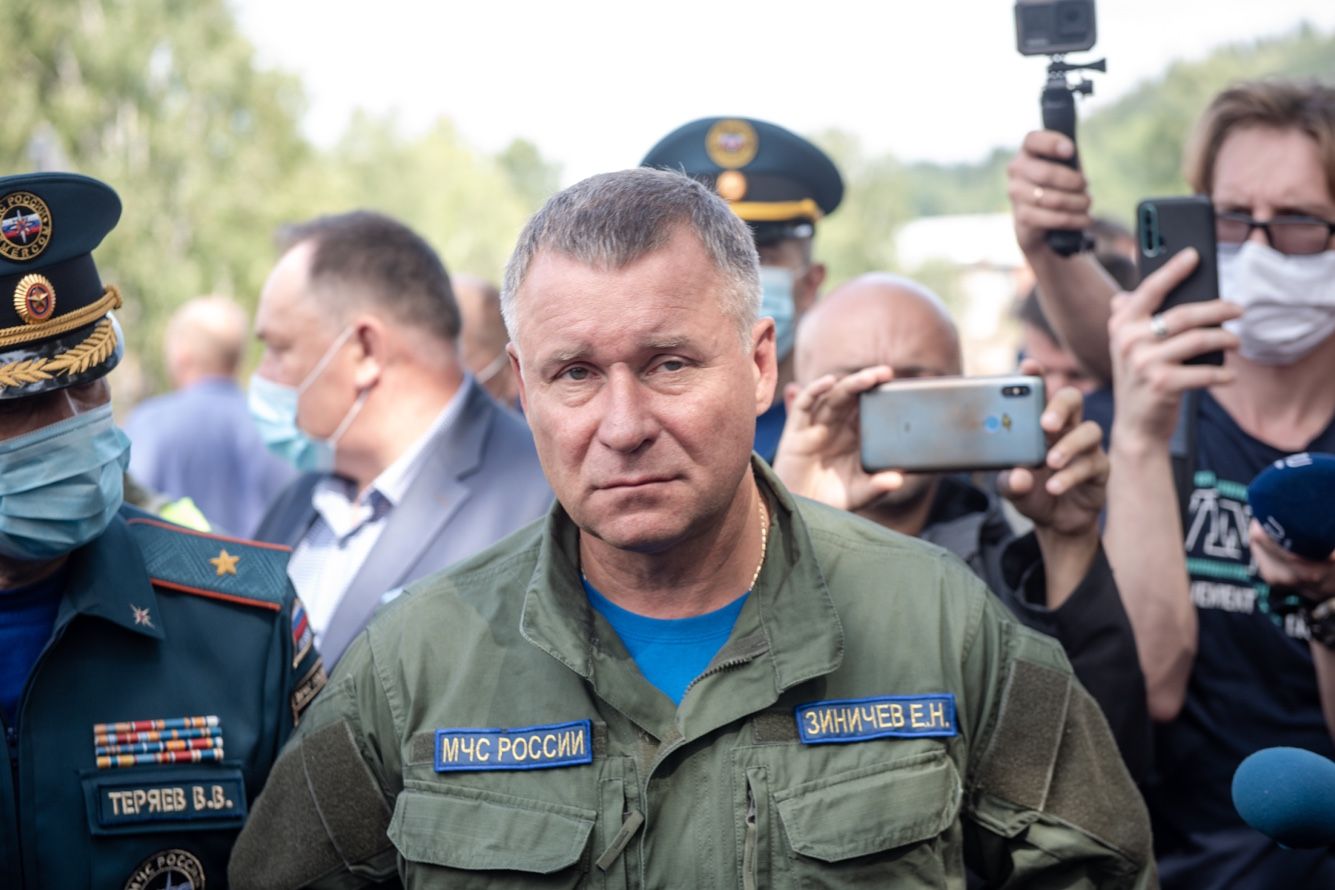
On Wednesday, September 8, on Lake Lama, 120 kilometers from Norilsk, the head of the Ministry of Emergencies Evgeny Zinichev died. The press service of the ministry reported that the incident occurred “during the exercises”: Zinichev tried to save director Alexander Melnik, who stood with Zinichev “on the edge of the ledge”. The miller slipped and fell into the water. The same version (without indicating the source) in his telegram channel was presented by the head of RT Margarita Simonyan. Melnik (the author of the films “New Earth” and “Territory”) came to Norilsk to prepare for the filming of a new documentary dedicated to the development of the Arctic and the Northern Sea Route. The director also died. Medusa tells the biography of Evgeny Zinichev - “Former Putin’s guard”, who had tried to avoid publicity all his life, but in recent years he was forced to be in sight all the time.
Evgeny Zinichev has a significant short official biography - like all people of his profession. Born in 1966 in Leningrad, served in the Northern Fleet-and immediately after that, in 1987, he began working in the State Security Committee of the USSR, and after the collapse of the Union-in the state security bodies of Russia, including the Federal Security Service ( FSO ) created in 1996.
In 2012-2013, Zinichev took a course of retraining at the Military Academy of the General Staff of the Armed Forces, in 2014 the deputy head of the FSB terrorism service was appointed, and in June 2015, in the rank of Major General, he became the head of the FSB department for the Kaliningrad region.
The public was known to the public in the summer of 2016, when President Vladimir Putin unexpectedly appointed him the acting governor of the Kaliningrad region. Then Putin’s press secretary Dmitry Peskov even had to officially confirm that Zinichev really worked in the Presidential Security Service-a new figure was so unknown and. O. Governor. The interlocutor of RBC close to the Kremlin then called Zinichev one of the adjutants of Vladimir Putin.
Evgeny Zinichev is one of the four former guards of the President of Russia, whom Putin appointed the acting governors of the regions of the country: in February 2016, Alexei Dyumin headed the Tula region, in July 2016, Evgeny Zinichev and Dmitry Mironov began managing the Kaliningrad and Yaroslavl regions, and in September 2018 and. O. The governor of the Astrakhan region was Sergey Morozov.
Dyumin and Mironov continue to lead the regions so far, two more former presidential guards left their posts quite quickly: Zinichev - after two months, Morozov - eight months later.
At the post and. O. Governor Zinichev was remembered by a very short first press conference (he spent 49 seconds to communicate with journalists), which also became the last. Two months later, Putin fired Zinichev from the post of acting governor “for family reasons”.
Having worked in this position, Zinichev quickly realized that the civilian public position is not for him, said the interlocutor of Medusa, who worked at that time in the administration of the President of Russia: “Honestly said this to the president, asking for understandable service. Putin appreciated honesty. "
The fact that Zinichev “did not find himself in the governor's work,” said in 2016 the sources of RBC, close to the Kremlin and to the leadership of the FSB. “Zinichev had huge problems with publicity, he avoided her,” one of them reasoned.
One of the few decisions that Zinichev managed to make in the region was the appointment of Anton Alikhanov to the post of deputy prime minister of the regional government-this position has been empty for six years since its creation. Alikhanov headed the Kaliningrad region immediately after the resignation of Zinichev, becoming the youngest and. O. The governor in Russia: he then turned only 30 years old, according to the law, this is the minimum possible age for a person in such a position.
“There are rumors that Zinichev“ warmed up a place ”for Alikhanov, until he was the right number of years. But this is not so, he initially tried to integrate, it was clear that he was going to work, but it was evident how difficult it was for him to be publicity, ”says the interlocutor of Medusa in the deputy corps of the region.
“Zinichev is one of the closest people to Vladimir Putin. He is confident in him and believes that he is able to grow. And the fact that Zinichev acted like a manly, faced with unusual publicity, and did not try to hold on to the governor’s post with any forces, but asked him to free him-this was also credited to him, ”the former deputy plenipotentiary of the Ural Federal District Andrei Kolyadin told him . “There is no need to PR here, but you need to fulfill instructions. Zinichev is working, loyal and non -public, he is suitable for the tasks, ”he added.
Almost immediately after the resignation of Zinichev, already in the rank of Lieutenant General, was appointed Deputy Director of the FSB. In this position, he worked for about a year and a half and in May 2018 he became a member of the Russian government: Putinmade Zinichev as Minister of Emergency Situations. In the same May 2018, by decree of Putin Zinichev became part of the Russian Security Council.
The source of Vedomosti said that the specific tasks of Zinichev in the FSB were really unknown: he organized his own small apparatus, which "lived his life." Political scientist Yevgeny Minkchenko also said that Zinichev was considered as one of the possible candidates for the post of director of the FSB, so his appointment to the Ministry of Emergencies was important “not by itself”: the main thing that he did not become the director of the FSB, reasoned Minchenko about intrigues within the department.
Immediately after joining the new position, Zinichev gave several duty orders such as the need to “develop the optimal structure of the department so that the organization of regional heads of the Ministry of Emergencies was in accordance with the structure of the central apparatus.”
The post of head of the federal ministry does not make it possible to remain silent and remain in the shadows, but Zinichev tried to minimize public speeches and spoke more and more streamlined official phrases. “It is extremely important to increase the confidence of the population against the persons of the Russian Emergencies Ministry and continue the traditions that have developed in the ministry over the long years of its existence,” Zinichev said at the EMERCOM selector meeting.
But a week later, the new minister began to violate some “prevailing traditions”, abolishing several orders and orders of the former Minister Vladimir Puchkov. Zinichev, for example, was canceled the ban on the movement of employees between the units, and instead of orange berets (also the innovation of Puchkov), he returned the former uniforms.
“The berets were for us like a red rag for a bull. They were perceived as a complete surrender of positions - the victory flooding the leadership of the EMERCOM of the military over the fire department, ”the fireman told Kommersant, asking him not to mention his name. - The officers did not wear berets, receiving penalties from their superiors for this. So their cancellation has a symbolic meaning: this is a signal that the policy is completely changing. ”
Then Zinichev conducted a full audit of the ministry, which revealed systemic defects in his work. In particular, according to RBC, it turned out that more than 23 thousand employees were lacking in the personnel of the fire department, and almost 11 thousand in the guard on duty. “For example, the number of combat calculation in a fire car is two or three people instead of six,” said Viktor Yatsuzenko, head of the National Management Center in Crisis situations of the Ministry of Emergencies. According to him, now there are about a thousand objects per inspector.
Yatsuzenko said that the management decisions made by Puchkov also led to the "destruction of the system of material and technical support", as well as "to the destruction of the vertical control of the rear of the Ministry of Emergencies."
The new head of the Ministry of Emergencies was actively involved in the department of officials of the power block. So, in early June 2018, the former assistant to the prosecutor general for special assignments Alexei Serko became the deputy head of the Ministry of Emergencies.
In the same June, the Main Directorate of Own Security with a staff of 40 people appeared in the Ministry of Emergencies, which replaced a very small department involved in these issues. In addition to security, the new management should have dealt with corruption and control the remaining units of the Ministry of Emergencies.
In 2019, Zinichev announced the beginning of the next structural reform of the Ministry; True, the previous structural reform ended in the previous year, and the Ministry of Emergencies constantly spoke about the new reforms later.
One of Zinichev’s last initiatives was a proposal to return to the federal level of control of forest protection. “Return the control and supervisory functions of the protection, protection and reproduction of forests to the federal level. Currently, all this is transferred to the subjects, ” said the head of the Ministry of Emergencies during a meeting with Putin.
And in his last interview, Zinichev talked about the Arctic about “one of the most important priorities of both the socio-economic development of Russia and its national security.” The exercises in Norilsk, at which, according to official information, Zinichev died, were one of the stages of the security system for the development of a system of security in the Arctic region.
Andrey Serafimov with the participation of Andrei Pertsev