
Translated material
The adventure of electronic
Is it true that online voting played into the hands of power not only in Moscow? Analysis of Dmitry Oreshkin and Alexander Condia
Electronic voting defenders in Moscow explain its scandalous results (exclusive support of candidates from the Sobyanin list in all 15 districts) by the fact that the Communists, they say, campaigned against the “electronics”, and therefore the online vote remained at the regeneration of power. For greater conviction, there is a link to American experience, where Trump had an advantage in the traditional vote in the areas, but the voices of the mail gave the advantage of Biden. It seems? At first glance - yes. However, let's try to check.
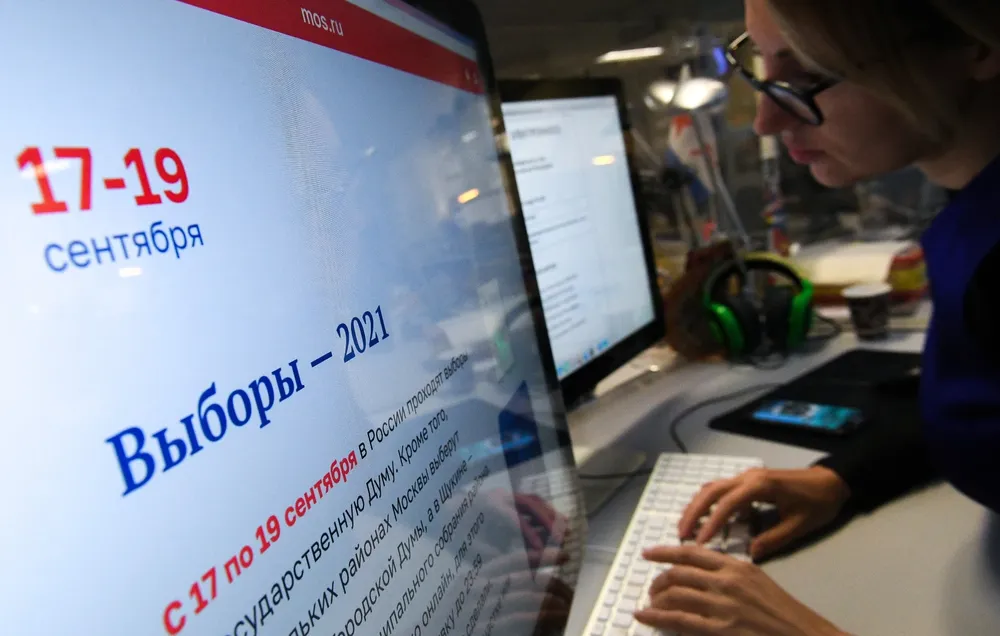
In addition to Moscow, electronic (or remote, abbreviated - DEG) voting took place in 18 single -mandate districts in the Kursk, Murmansk, Nizhny Novgorod, Rostov, Yaroslavl regions and in Sevastopol. If the hypothesis is true that the "electronic voters" so depended on the recommendations of the Communist Party, then it is logical to assume that they avoided DEG in other regions by analogy with Moscow. We take the official results of the winners and silver medalists and compare who gained how many percent to the usual (“paper”) voting and with the help of DEG, for whom DEG played a plus, and for whom - to minus.
The question of what is the share of coercion, direct falsification and other manifestations of the “administrative resource” in routine paper voting, we leave aside. We focus on the DEG contribution. It is clear that all 15 Moscow districts at the end of the table turned out to be red - the electronic vote clearly spoke out in favor of the candidates from the Sobyanin List. The candidates who took second place in Moscow, supported by a “smart vote”, on the contrary, suffered fatal damage from electronic voting. Again, we do not go into the discussion about how it was possible to achieve such an amazing unanimity of Moscow “online recruits”-this is a separate topic.

The first conclusion beaten in the eye immediately overturning the hypothesis that the system opposition avoided the “electronics” and, therefore, this field was completely inherited by the supporters of the party. No:
In 13 of the 18 Nemoskovsky districts covered by DEG, candidates from United Russia were short of online heads in comparison with “paper”. The amazing unanimity shown in Moscow is not close.
Obviously, for the Moscow anomaly, you will have to invent some other explanation in the very narrowed corridor of opportunities.

The American analogy does not work: in the States, the post office brought Biden a more or less significant plus almost everywhere, and this has a logical explanation: among Trump's supporters, dashing anti -Vaxeres dominated, and Biden more restrained virges preferred not to exchange viruses in plots and took advantage of the right to remote voting. For some reason, Moscow is amazingly broken out of the overall picture.
There are not so painful, but also important conclusions. In the district No. 129 (Nizhny Novgorod region), DEG played plus both the winner and his closest pursuer, which is hardly possible subject to purposeful tossing online heads to one of the candidates. Much more often (in 9 Nemoskovsky districts of 18) there is essentially similar, although the situation opposite in sign, when electronic voting, on the contrary, “bitten” the voice of both leaders. This means that the regional online collector more willingly supported some third force, showing an obvious tendency to independence of judgments. This also works against the hypothesis about his herd behavior (they say, the Communists did not tell, so he did not go).
And again, there is a sharp difference from the Moscow template, where electronic voices break down into two diametrically opposite groups: the candidates supported by “smart voting” clearly seize about 10%, and Sobyanin’s members are just as unambiguously added.
It is worth noting the scope of deviations. In the regions, as a rule (for several eloquent exceptions, about which a little later), the rebound of the results of DEG from the “paper” is noticeably smaller than Moscow. If, without delving into the details, it is assumed that the permissible statistical error of the selective method in this case is a plus minus 3% (we take with a margin), then sometimes the discrepancy between DEG and “papers” can simply be neglected, especially against the background of the cyclopic achievements of Moscow.
As for the exceptions, the most striking result was shown by the Yaroslavl region. Here, in both districts, the supported CC candidates from “SR - for truth” won and, accordingly, the candidates from the “EP” lost. At the same time, in both cases, DEG “bit off” the winners in a very significant piece and added more than 15% of the candidates from the “EP” remaining in second place! And still this was not enough for victory, because he touched the “Wed - for truth” in favor of the candidates, made by the Yaroslavl voter on paper, still outweighed. In other words, DEG in Yaroslavl played as if according to Moscow rules, but too timidly, small volumes.
In general, it is worth noting the amazing variability of DEG behavior in different subjects of the Federation, which makes us think about a different attitude of regional administrations to the new electoral technology. In the Kursk and Murmansk regions, against the backdrop of modest “paper” indicators, DEG demonstrates a clear tendency to support candidates from EP. In the Nizhny Novgorod, Rostov regions and Sevastopol, “Paper” is noticeably more favorable to the party in power, and the electronic process seemed to be launched by itself. Either they were frightened with habit in inheritance in wise electronic schemes, or they decided that they would easier and more reliably achieve the desired result with the help of repeatedly proven technologies “on Earth”.
In Moscow, it was impossible to wave his hand at the “electronics” in a similar way: against the background of the insufficient volume of the controlled electorate and mobilization of supporters of UG, the risk of losing was too large - about the way it happened in the Yaroslavl region.
It remains to note the exact targeting of “smart voting” - only in 4 of the 33 districts the candidate, supported by the Navalny team, did not reach the final. In two (Yaroslavl region, known for their critical attitude) they even won - contrary to the belated and not enough high wave of the DEG votes. They would have won in 8 Moscow districts, if not for the marvelous with electronic voting.