
Translated material
Cynical stories: Books of the Week
What to ask in book
The manifesto against activist science, the study of Pushkin’s finances, the allowance for the anatomy of religious violence, the problem in linguistics, as well as the guide to the bodily experience of the film spoke. As usual on Fridays, Ivan Navparenko talks about the most curious novelties.Helen Placarus, James Lindsay. Cynical theories. How everyone began to argue about the race, gender and identity and what is bad about that. M.: Individuum, 2021. Translation from English D. Vinogradov. Content
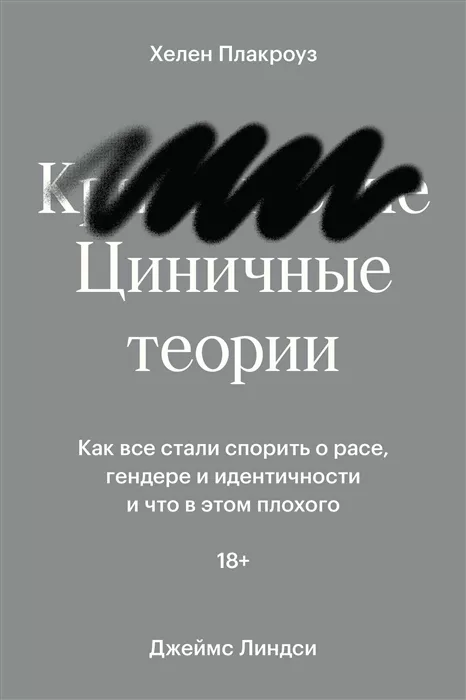 Even before the publication, this book made a scandal in the rune: some bloggers were outraged that in the hands of local fascists, enemies of social justice, as well as the worship of the masses that were not bored with the mind of the masses against the new ethics and the progressive movements of thought associated with it. The convictions of publishers sounded for irresponsibility and even unprincipled - of course, groundless.
What are we talking about? I’ll tell you a little wider than usually occurs in these reviews. “Cynical theories” are the work of literary critic Helen Placroes and mathematician James Lindsay, who became famous for the scandalous “Council of Research” (GrievANce Studies). The three of them with another American, the philosopher Peter Bogossian, they sent deliberately delusional articles to a number of academic publications specializing in feminist, stroke, Quir- and some other research areas. Several materials went through the review procedure and were even published, including the text about how anal penetration helps to reduce transfoby in men, and the first chapter of Mine Kampf, rewritten in female stylistics.
The book “Cynical Theories” from a methodological and ethical point of view raises much fewer questions than the mentioned scam - as, indeed, less fun. The authors set a goal to show the structure and genesis of American academic activism, or activist science, from French post -structuralism to the present day, when theoretical provisions have been radicalized, spilled outside the campus and, according to the authors, do more harm than benefits, including social justice. An amazing thing, the Placar and Lindsay are not at all fans of the second amendment and denote their position as levoliberal - they advocate political democracy, against slavery, patriarchy, colonialism, fascism and other forms of discrimination.
Fortunately or unfortunately, the work of Lindsay and the Placar is not as scandalous as we would like. Firstly, the analysis of the conceptual prerequisites of the SZHV-hunger are quite schematical and not inolo. Secondly, their own position is somewhat naive-at least it is not problematized, how science and value can be correlated at all. Thirdly, in Russia, where intellectual hegemony develops other than in the United States, the background of problems is quite specific and therefore the fears of researchers can really sound in unison with the stories about Putin's costume and the dangers of gay propaganda (especially if the book is not opened, but it is necessary to open it).
“Cynical theories”, of course, are criticized as overgrown social constructivists, with ridiculous radicality denying the role of biological bodies in the production of meanings, and crystallized in their righteousness of supporters of the policy of identity, in whom the abolition culture tightly cementing the future of a person with his past - by the way, the Russian authorities will also cement a history that cannot be rewritten.
However, the main, it seems, the problem of this book is that it is unlikely to be able to convince anyone of anything. On the other hand, “cynical theories” are more likely to fit the role of manifesto than a deep theoretical study. And although the book as a whole copes with the tasks of the manifesto, it is hardly possible to overcome the manis of humanitarian knowledge.
“The theory is little known, and most people never face it directly. However, many of us are under her influence, and no one is protected from her. The British pensioner with disabilities Brian Lich, working as a packager in the ASDA supermarket, was fired for sharing Billy Connolly, who considered Islamofobsky on Facebook, shared on Facebook. Post -colonial theory in action. "
Mark JurgenMaire. "I will send my horror before you." Religious violence on a global scale. M . : New Literary Review, 2021. Translation from English by A. Zygmont. Content
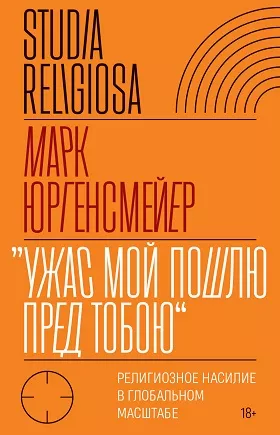 For several years, the American sociologist and the religious scholar traveled to the restless points of the planet and talked a lot with people who do not spare either their or another stomach for the speedy attack of the Kingdom of God on earth. So there was an exciting study of how the religion and violence were connected, which was translated by the Russian colleague of the Jurgendier, the leading of the telegram channel on this topic .
How is the coupling between two phenomena organized? According to Jourgen -Smother, the mirror mechanism of the “cosmic war” works here: the spiritual abuse, which underlies any religious picture - whether it is Christianity, Islam or Sikhism - may have a reflection of the “war” in our vague sorrow.
In the first part of the book, the author analyzes the logic of terrorist attacks with an ethnographer, trying to imagine the picture without any moral condemnation as its fanatic sees from his inner perspective. The stories about the new crusader Anders Breivika, the fighter with abortion of Mark Braye, the caliph of the organization ISIS Abu Bakre al-Baghdadi and other horror operators, which are banned in Russia are wonderful and terrible pages that are interesting to read, even if you are far from religious studies.
In the second part, the Jourgen -Maiger dissects the resulting material, creating a harmonious analytical structure. The bearing elements in it, in addition to the mentioned concept of the “cosmic war”, are the ideas of violence as a performance and terror as a bloody way to regain power to a religious worldview.
The world after this book does not become more comfortable, but it’s a little clearer - that's for sure.
“One monk, who was a member of brutal anti -government speeches, told me that in“ Times of Dukkhi ” - that is, in the era of suffering, which Buddhists consider the whole well -known human history - violence inevitably. At this time, he said, violence naturally gives rise to violence. Therefore, politicians who are considered ruthless enemies of religion should expect karmic retaliation in the form of bloodshed. ”
Pushkin and finances. Collection of articles. Compiled by A. Belykh. M.: Publishing House "Delo" RANEPA, 2021. Content
 There are quite detailed cards in the world of Pushkovenia, but even on them there are fragments with a small scale. Andrei Belykh refers to them the economic events in Pushkin’s life. To fill the white spots, the doctor of economic sciences collected the most significant studies on the topic of the already published and complemented them with fresh works. Attention to the financial background of literary life is back in fashion, we recall the recent book by Gillian Porter “The economy of feelings. Russian literature of the era of Nicholas I. " Pushkin and Finance work with a similar topic, but somewhat more intelligible and traditionally.
Actually, in the work that opens the publication, the editor-compiler distinguishes five economic hipsts: an official, writer and publisher, player, landowner and samyan citizen-and sorts how Alexander Sergeyevich brought the debit with a loan in each of these roles. Summarizing: in literature he earned decently, lost too much on cards, spent a lot on his family and, in general, did not go well into a deep disadvantage, which, however, was typical for his nobleman.
Detail: At the time of death, Pushkin gained 95,596 rubles of debt. For understanding, his family paid him for an apartment 358 rubles per month - that is, we are talking about debt for 22 years (Akaki Akakievich, meanwhile, at about the same time, at all earned 400 rubles a year).
One of the most curious parts of the book is Pushkin and Guys (1928), written by the largest Pushkinist of the beginning of the 20th century Pavel Schegolev. The author investigated the relationship of the poet with his serfs in the complex; It is also interesting that in today's times some episodes look more scandalous than in the midst of a completely red literary criticism.
“So, once again:“ Chervonets for a line ”is a paper chervonets, or ten rubles into banknotes.”
Thomas Elsesser, Malta Haener. Cinema theory. Eye, emotions, body. St. Petersburg: Session, 2021. Translation from English S. Afonin, I. Kushnareva, V. Lukin and others. Content . Content
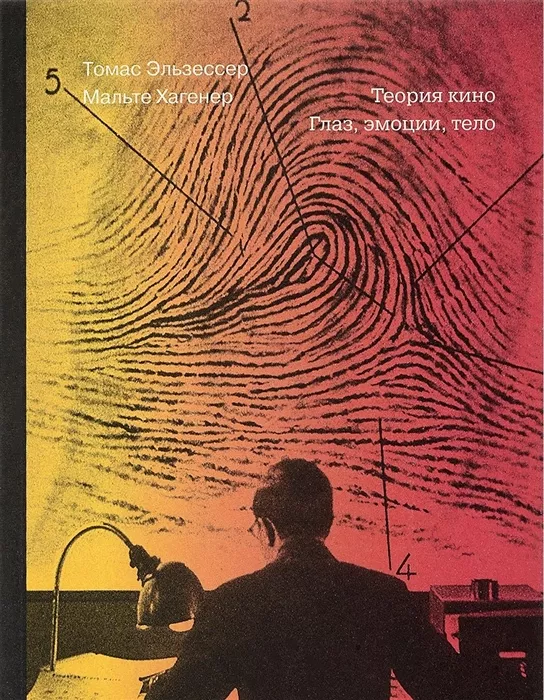 If they ask what to read in order to understand the theory of cinema, then you can safely advise this book; The first edition was released several years ago and since then, of course, it has dispersed.
Researchers Thomas Elsesser and Malta Haener are sorting out the history of thoughts about the cinema, asking in turn the question in what relations are the film and the body of the viewer, the emotions directly experienced by him. The material is structured by key metaphors that smoothly replace each other: a movie like a window or a frame, a movie like a door, a movie like a mirror, etc. All the chapter is crowned with digital cinema, which produces a “digital spectator body” - hybrid, mixed with objects, etc.
The bodily-oriented gaze of German theorists radically different than the film experts and critics usually practice: the focus is in the focus of the audience experience, not acting role, producing intrigues or, say, budgets. But examples from the “Monsters Corporation”, “Alien”, paintings by Jigi Vertov, as well as Luman and Zhezhek as suppliers of conceptual spare parts are presented in excess.
“Making the projector and the film in the opening stage“ Persons ”, Ingmar Bergman draws our attention to the fact that we will now see the film - a technical artifact that should not be confused with reality. Moreover, the close -up of the female person, which is trying to touch the boy to touch on the translucent surface, depicts the archetypal function of the movie, namely to serve as a mirror. ”
Alexander Berdichevsky, Alexander Piperski. Three guns in the afternoon and other tasks in linguistics. M.: Alpina non-fiction, 2021. Content
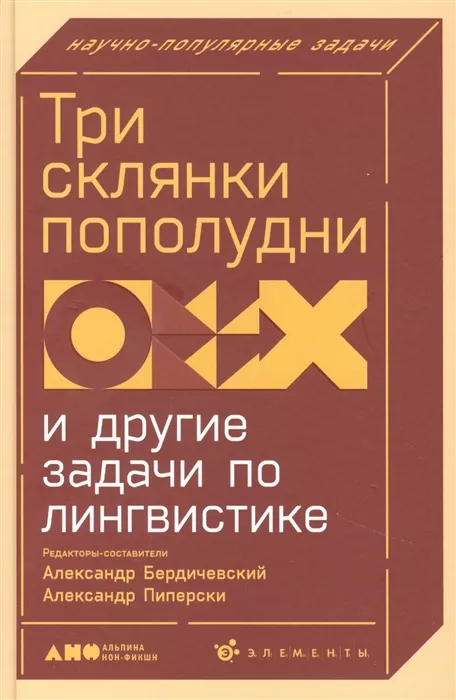 The tasks of linguistics that are collected in this edition have the elegance of films shot in the same room, or exercises with its own weight. In order to solve such tasks, you need a minimum: it is enough to know the native language, think harmoniously, well, another leaf with a pen in the addition - all other necessary information (about Japanese, German runes or a marine system for measuring time using systems) are formulated in the conditions of the task.
Who needs such entertainment? In addition to young people who think about living, and, in fact, linguists, this is a cool tool to feel specific tickling on the surface of the brain - from reflection on the basic human interface of reality, which, in fact, is the language.
The book does not come down to a dry task for a dry task, it is a collection of popular science articles (one of the co-authors recommended five publications that will help to fall in love with linguistics). The puzzles are sorted by sections with the introduction - sounds and letters, syntax, time and space, etc., each task is accompanied by hints, solution and afterword that reveals an interesting language fact that formed the basis of the task; In some places there are answers to readers' questions. So in addition to the cerebral warm -up of “Three Sides ...”, the logic of Belarusian spelling, the article in the ancient Russian and strange organization of parts of speech in the Indian Streitas can clarify.
“According to the same scheme at the beginning of the XX century. I corresponded with his correspondents by V.I. Ulyanov. So, in the correspondence with the St. Petersburg “Union of the struggle for the liberation of the working class” <...> the poem of Nekrasov “Masha” was established. <...> Since the choice of poetic keys among revolutionaries did not differ in diversity and consisted mainly of the works of the gymnasium program, cases of deciphering intercepted messages have happened repeatedly. ”