
Translated material
Putin's last attempt to solve the problem of Ukraine until 2024
Chief editor Carnegie.ru Alexander Baunov - On the negotiations of the President of Russia with the President of the United States
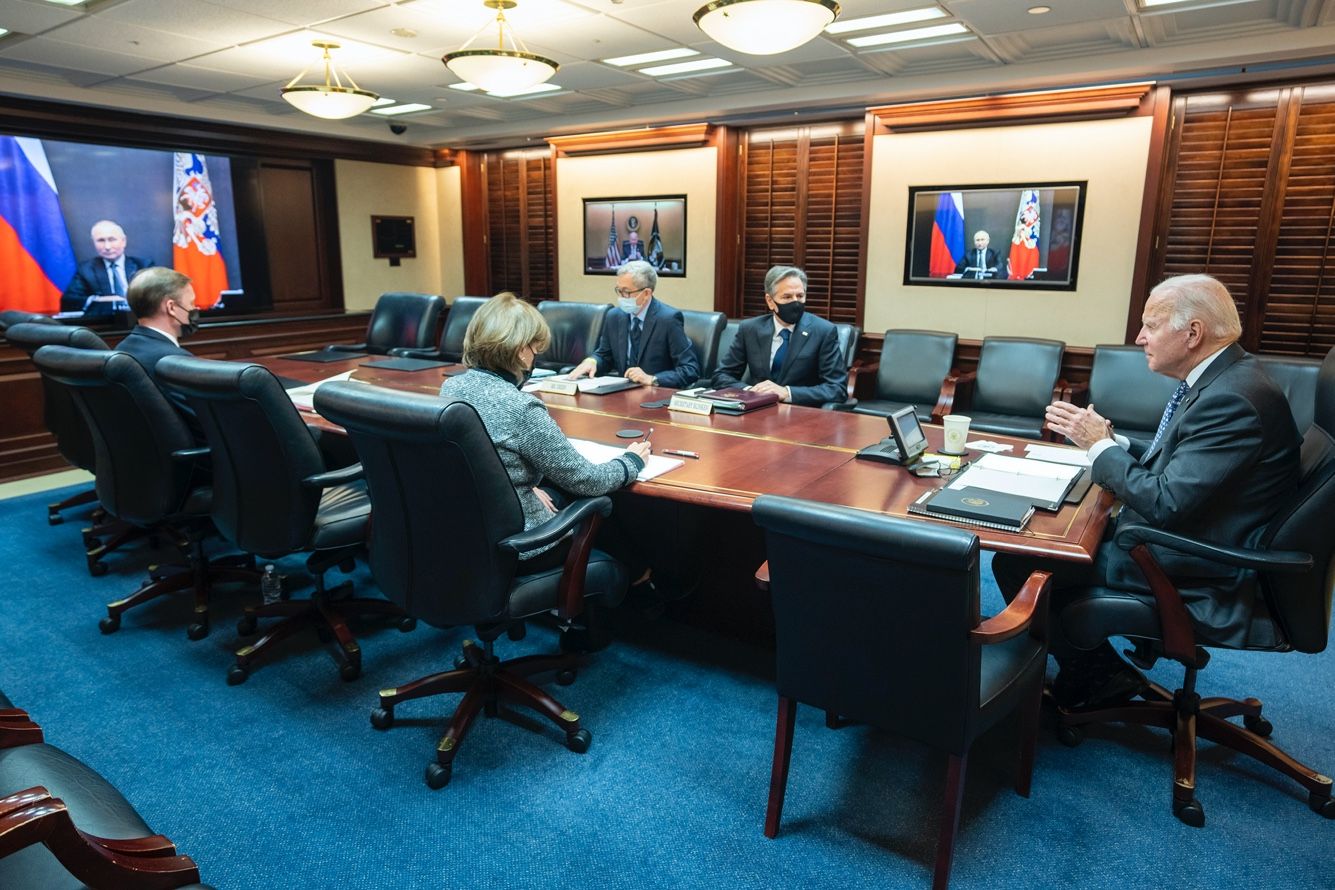
On December 7, negotiations between Russian President Vladimir Putin and US President Joe Biden were negotiated. Their main topic was the conflict in Ukraine and the buildup of Russian troops near its border. The editor -in -chief of Carnegie.ru Alexander Baunov writes that Biden “turned out to be a leader who prevented the war”, and Putin in negotiations made “the last attempt to solve the problem of Ukraine until 2024 in existing legal framework”. With the permission of Carnegie.ru "Medusa" publishes the article entirely.
At the virtual summit with Joseph Biden, Vladimir Putin wanted to convey the execution of Minsk agreements from Europeans and Ukrainians America. And in order for Biden to take them, not far from the borders of Russia with Ukraine conduct exercises and collect troops sufficient for an offensive operation. The signal is clear: when the Minsk agreements are silent, guns can speak. This is the minimum that Putin is probably ready to agree before he finds the final formula for the arrangement of the post -Soviet space.
Different in details and common in support of their own leaders, the meeting reports show that this time the presidents focused not on the fact that they could bring them closer - climate, pandemia or Iranian deal - but immediately moved to the fact that they are sharing them - Ukraine, cybersecurity, diplomatic wars. In Ukraine, there was one common point, which allowed the parties to think that here not everything was lost.
Tamers of war
The evasive answer of Peskov on the eve of the meeting that the Norman format is self -sufficient and America is not needed there, in fact, it means that Europeans do not need Moscow in a serious conversation about Ukraine and that such a conversation should take place directly between Moscow and Washington. The scandalous publication by the Russian Foreign Ministryof Correspondence between Lavrov and his French and German colleagues temporarily cuts them off from a serious trust dialogue about Ukraine: who will talk confidence with the risk of revealing publication. So Moscow shows that there is nothing to talk about with Ukraine’s lawyers, it is necessary to communicate directly with its authorized cartridge in Washington.
You can also interpret Lavrov’s complaints that Russia proposed connecting the United States to the Norman format, but Germany and France did not give, and Putin put the requirements of NATO non -expanding to east, which can only be given by the United States. The latter so far looks like an overstated negotiating position, but it clearly denotes the strategic horizon of Russian requests, after which Russia is ready to promise predictability and security. That is, we are talking about the Minsk agreements in the broad sense-a certain chain of actions and obligations, at the end of which the friendly and neutral, but not necessarily subordinate to Moscow, is something like Kazakhstan, the Western Russian borders.
Gathering troops near the borders, Russia wants to say that Kiev’s non -fulfillment of the Minsk agreements exposes his desire to take Donbass by force. But the Western allies do not believe in such a reckless courage of Kyiv, but they see Russia's intention to attack Ukraine.
The Americans do not want a war in Europe - the zone of their interests and responsibility after two world wars and one cold. A new war could lead to the defeat of their Ukrainian ally and to the need to give a crushing answer to Russia. The impossibility of a military and insufficiency of a sanctions response would be given the relative weakness of America a second time a year after Afghanistan. In these conditions, it is better to do Minsk or some other agreements.
Not only Moscow, but Washington do not bend in front of the whole world. But after all, on the other hand, after the Geneva summit, a joint cybersecurity group, which Putin proposed and which the Americans (except Trump itself), was abandoned because it was “impossible to discuss the rules of cybersecurity with their main violator”. And they talk, and just with Bayden. And under Obama, the United States began to discuss the “results of aggression with the aggressor”.
Nevertheless, Biden cannot just take responsibility for the implementation of the Minsk agreements simply because the Kremlin was disappointed in Zelensky and Europeans and wants to attract America to them. It turns out that the American president fulfills Putin’s wishes, which he promised not to give a descent. Therefore, the concentration of troops and talk about the producing from day to Russia attack on Ukraine are very useful here.
Judging by the Russian message about the meeting, as well as the press conference of Bayden adviser to Jack Sullivan, the United States is ready to push the Minsk agreements towards the implementation (this is discussed three times). Although Sullivan also mentioned the mysterious “alternative path” of advancement to the world in the Donbass. This reservation should reassure Kyiv (unpleasant Minsk is not uncontested), although it can scare: what else are Americans ready for the sake of peace?
Biden, who at the summit confirmed the participation of the United States in resolving the Ukrainian conflict, in return you need to bring something for yourself. He managed to stop Putin and prevent the war - this is a serious achievement and a significant objection to those who criticize him for the very fact of the meeting. In particular, therefore, the story of the impending war began to live my own life before the summit and determine the behavior of the parties no less than real events. The source of conversations about the western press, politicians and experts overhanging over Ukraine, and not the Kremlin, who prefers secret special operations to achieve specific goals, and uses open mobilizers to reinforce the requested positions in the negotiations.
Now Biden turned out to be a leader who prevented the war. However, the current virtual summit will not necessarily follow the de -escalation and return of the Russian troops to the barracks, as it was in the spring, after an agreement on the Geneva summit. This time, a sharp de -escalation, most likely, will not happen. Biden will be those who prevented the war, but not a threat of war, until Moscow sees Washington’s new steps in the Ukrainian direction, visible signs of work on Russian Security Concerns - Russian concern in the field of security that Sullivan mentioned, thus recognizing their existence along with Ukrainian - already flexibility.
Minsk asymmetry
Opponents of the compromise represent the case in such a way that Putin needs the occupation of all of Ukraine, and therefore it is impossible to talk with him about Ukraine for the lack of a common denominator. Thus, not only those who are really afraid of unfriendly absorption (unlikely, due to the unfriendliness of the absorbing), but also those who do not want the West and Russia to agree before the implementation of the Minsk agreements - in the form in which Ukraine signed in 2015 in order to avoid the worst.
In fact, the Minsk agreements are far from equally unacceptable for Ukraine and the United States. Washington assures that Minsk recognize Minsk as the most important and, in fact, the only way to resolve the conflict in eastern Ukraine. The United States cannot, without losing face, give public assurances that Ukraine will not enter NATO - their intentions on this issue can be explored only by indirect signs for several months, or even years. But the new life of the Minsk agreements with the participation of Washington will not cause damage to the reputation of the United States, because they recognized them before, without direct connection with the pulsating threats that Putin creates for Ukraine.
Progress in the execution of unpleasant points of the Minsk agreements for Kyiv could be a testimony for Moscow that its requests are taken seriously, and not waiting for them to be resolved by themselves.
However, the problem here is that in Kyiv they are ready to wait when the next wave of Western perseverance about Minsk is resolved by itself, if this arises at all. Just as the West overestimates Putin’s absolute influence, for example, on Lukashenko (and before that on Yanukovych), Moscow is mistaken when he considers Ukraine simply an obedient US satellite. The West has levers of influence on Kyiv, but the conflict in the Donbass as an instrument of anti -Russian mobilization within Ukraine, attracting allies and constant pressure on Moscow in international affairs, there is literally nothing to replace. And in Russia itself, many once again state the evasion of the West from their diplomatic duties and will consider their hands unleashed.
Reinstalling of Russia
In Russia, many would like to see the return of Ukraine to the Russian state, but even the Russian official version of history, which the president and historian Vladimir Putin, supports and creatively develops, says that the union of Ukraine and Moscow was voluntary in the 17th century. This is not received now. It is difficult not to see in the departure of the United States from Afghanistan a lesson not only to Americans, but also to everyone who is trying to force their orders by force.
With its current possibilities, Russia would be arranged by a variant of neutral, friendly and bilingual Ukraine. This option, however, is considered humiliating for national construction, the active part of the Ukrainian society and compromising for the Western system of allied obligations, which should not take steps back (although it is sometimes forced).
For this reason, the danger of the resumption of war in the east of Ukraine is not as virtual as the current Russian-American summit. The transfer of responsibility for the Minsk agreements is the last attempt by Putin to solve the problem of Ukraine until 2024 in the existing legal framework. If this does not succeed, Putin before 2024, consolidating his political and historical heritage, will look for other ways.
Updating the Constitution in the referendum with the help of dozens of amendments, Putin symbolically closed the period of perestroika and the 1990s with their instability, self-flagellation and concessions. Now, in order to consolidate his heritage before the inevitable, although not necessarily with an imminent transit of power in other hands, he needs a similar gesture, which will finally complete the period of perestroika and the 1990s in foreign policy and symbolically reinstall Russia in the world political system.
The requirement of NATO non -expanding, expressed with a previously unimaginable categoricality, should just be such a symbolic reinstall, especially if they go towards it. It is for this reason that it is unacceptable to the West - also not so much as symbolically. Indeed, in the case of execution - even for the sake of achieving the most useful results - it will close not only the period of Russia's weakness, but also the period of the exceptional power of the West in Europe.
Putin will seem to make the decision to leave or stay in 2024 taking into account what will be achieved in Ukraine. From his words and articles it is clear that he considers relations with Ukraine part of his historical mission, which he would not want to transfer the successor to less hardened hands, at the same time leaving them more pure for international relations and less famous in Russian history.
What a plan for Putin in case the reinstallation of Russia in the global system will not succeed, it is still unclear. However, he will be able to interpret any outcome of this attempt in his favor: it is pleasant to leave the winner, but it is even more pleasant to stay, and if the victory has not yet been achieved, it is not time to leave.
Read also on carnegie.ru
- Russian troops on the Ukrainian border: reasons and goals
- Attractive maneuver. If tomorrow the war with Ukraine
- Neighborhood or brotherhood. Pogrebinsky and training on the reassessment of the proximity of Russia and Ukraine
Alexander Baunov