
Translated material
Whether Jack Dorsie's care will help Twitter shares
On November 29, it became known that Twitter CEO Jack Dorsie will leave his post. The shares of the company immediately jumped by 11% (up to $ 52.2). What is the market expecting from Twitter and what should investors think about?
What is hype
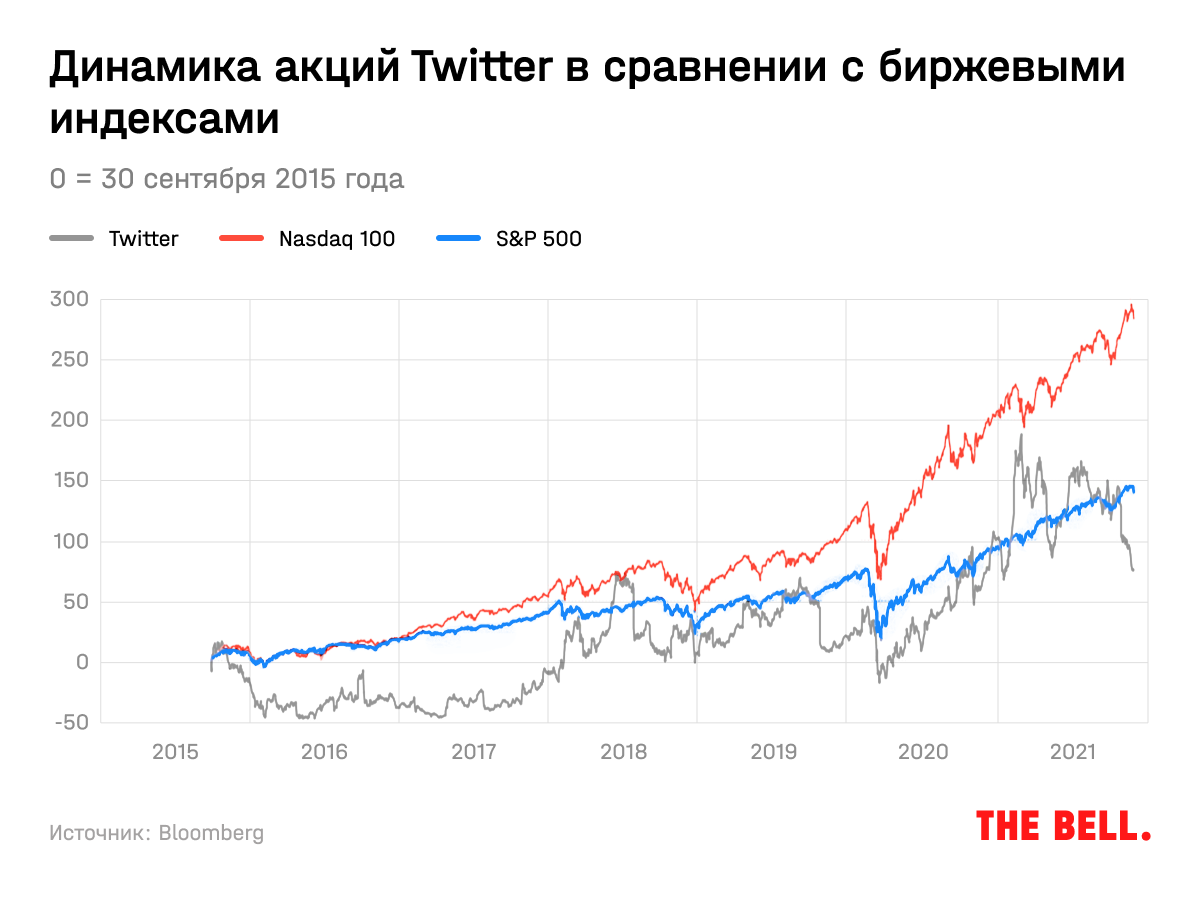
The spontaneous optimism of investors can be understood: since the second coming of Dorsy to the post of head of the company on September 30, 2015, Twitter shares have grown by only 75%. In 2008, the board of directors had already fired Dorsy from the CEO Dorsy post due to discontent with his effectiveness. The shares of other technological companies during this period experienced one of the strongest rally in history: Apple grew by 450%, Amazon - by 580%, Alphabet (owned by Google) - by 345%, Microsoft - by 640%. The founded Dorsy Fintech Company Square, which he will lead and after leaving Twitter, since the moment of IPO in 2015 has risen in price by 2000%.
About why the market was delighted with Dorsy's resignation, as well as the main claims to his management style, we also gave rise to here .
The main claims to the company are slow development and insufficient innovation. Dorsie himself recognized these problems at the bottom of the analyst in February 2021, explaining this and incorrect priority (for example, in October Twitter announced the sale of the MOPUB advertising platform for $ 1.05 billion - this should exempt the company's resources and accelerate products launches) and technical difficulties. But recently, the company has clearly experimented with new products more actively, not all of which, however, were successful.
What are these experiments
In the third quarter, Twitter launched a feature called Shop Module in a pilot mode-it allows business accounts to show their goods at the top of the profile, and users to buy them right on Twitter. In addition, this year the company launched in several countries, including in the United States, a subscription that allows you to change the design, read some news without advertising, etc., and expanded Twitter Spaces that allow you to conduct an audio conference, for all users.
At the same time in July, Twitter removed the Fleets option, which allowed users to make posts that disappeared after 24 hours.
The very next day after the resignation of Dorsy, Katie Wood technological funds bought over 1.1 million Twitter shares worth about $ 49 million. This is the largest purchase of Wood from July 23. Wood - the "star" of last year's markets, whose funds have been going through the best of times in 2021 - took advantage of the fall of the company's shares to minimums from 2020. Bloomberg tied him with a general sale as a result of the first identified case of infection with the Omicron with a strain in the United States, and not the resignation of Dorsy.
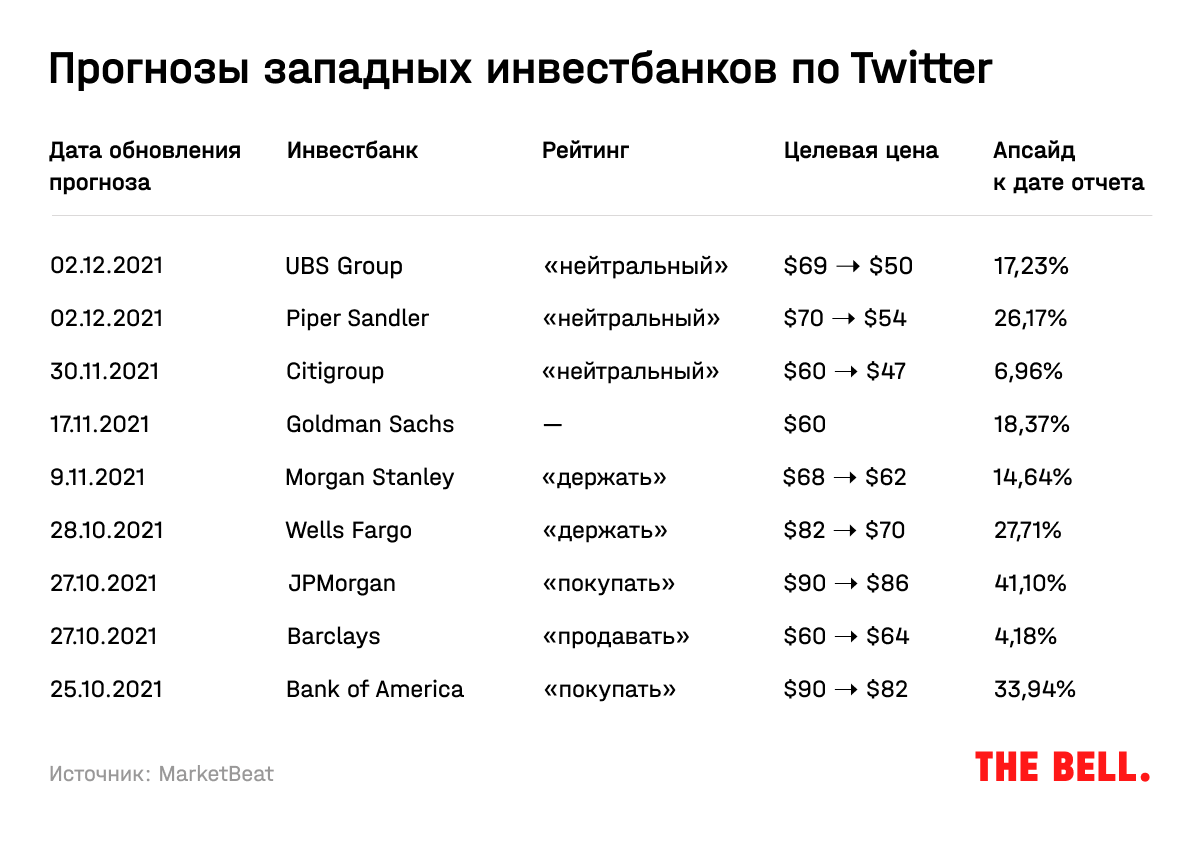
Wood believes on Twitter: she often says that her investment horizon is 5 years, which reflects the fact that the shares of technological companies can be volatile. Optimistically looks at the prospects of social networks and JPMorgan: Investbank included Twitter in the TOP-6 list of the most promising IT sector companies in 2022 with a target price of $ 86, which suggests an APSIAD of 91%.
True, most of the large investment banks, after the resignation of Dorsi, lowered their target forecasts (with a horizon by 1 year)
What is important for the investor in the Twitter case
The new CEO of the company Paras Argaval has ambitious tasks - they were voiced at the beginning of this year:
- 315 million MDAU (monetized daily audience) following the results of the IV quarter of 2023;
-The total annual revenue of $ 7.5 billion in 2023.
The number of monetized users is the key business metric of the company whose strategy (at least under Dorsy) was concentrated on improving the experience and involvement of existing users. The consensus prognosis of the Factset analysts, which quotes The Wall Street Journal, involves $ 5.1 billion revenue and 216 million MDAU in the results of 2021. This means that in the next two years, MDAU and revenue should grow by an average of 20.7% and 21.2% per year.
But it is unlikely that Goldman Sachs (GS), which the Bell has in the review of these goals, says in the review of Goldman Sachs. The target price in a year based on the GS forecast until 2026, indicated in the review, is $ 60 per share. On November 17, that is, after the release of the III quarter, when the shares fell by 10% due to the influence of Apple policy, the investment bank retained its assessment. This allows us to say that September conclusions and estimates remain in force.
As in the case of META and Netflix , the investmentBank reveals the Twitter investmentkeys through three questions, to which a long -term investor should answer.
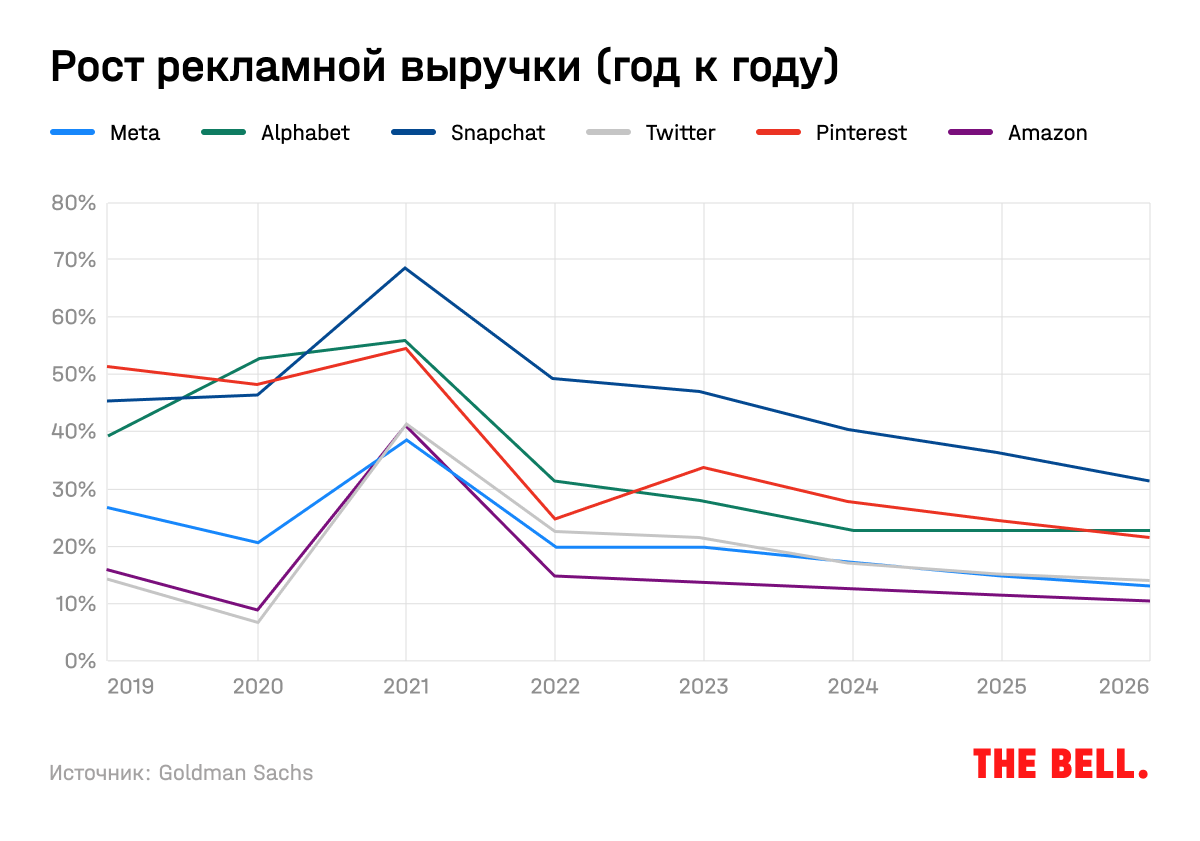
1. Can the company's revenue can steadily grow by 20% per year in 2021–2026?
It was such an increase in revenue that was laid in the animators in September, when Twitter shares cost $ 64.8-and the same growth was necessary to achieve goals by the end of 2023.
In the case of Twitter, it will not be superfluous to recall what we wrote about in a large review of the META business: the digital advertising market in the world is still far from saturation. The volume of the target market (Total Addressable Market) will increase by an average of 18% per year and by 2026 will be $ 862 billion (in the USA - 16% per year, up to $ 431 billion). Twitter, for example, more than others benefits from the transition to online media consumption and advertising of various commercial initiatives (especially for Twitter, events, such as the Olympic Games) are important).
At the same time, Twitter, according to GS analysts, gives users a unique offer in comparison with other socio-medical platforms, aggregating personalized news and interests and being a “communication layer” of the Internet, where people can discuss news, common interests, etc. (Dorsi pronounced this idea several times ).
Despite the unique position of the Online analogue of the “City Square”, the Twitter revenue, according to the GS forecast, will grow more slowly by the market - by 17% per year, which will be achieved due to MDAU growth by 10.3% per year and revenue for one user by 6.5% per year.
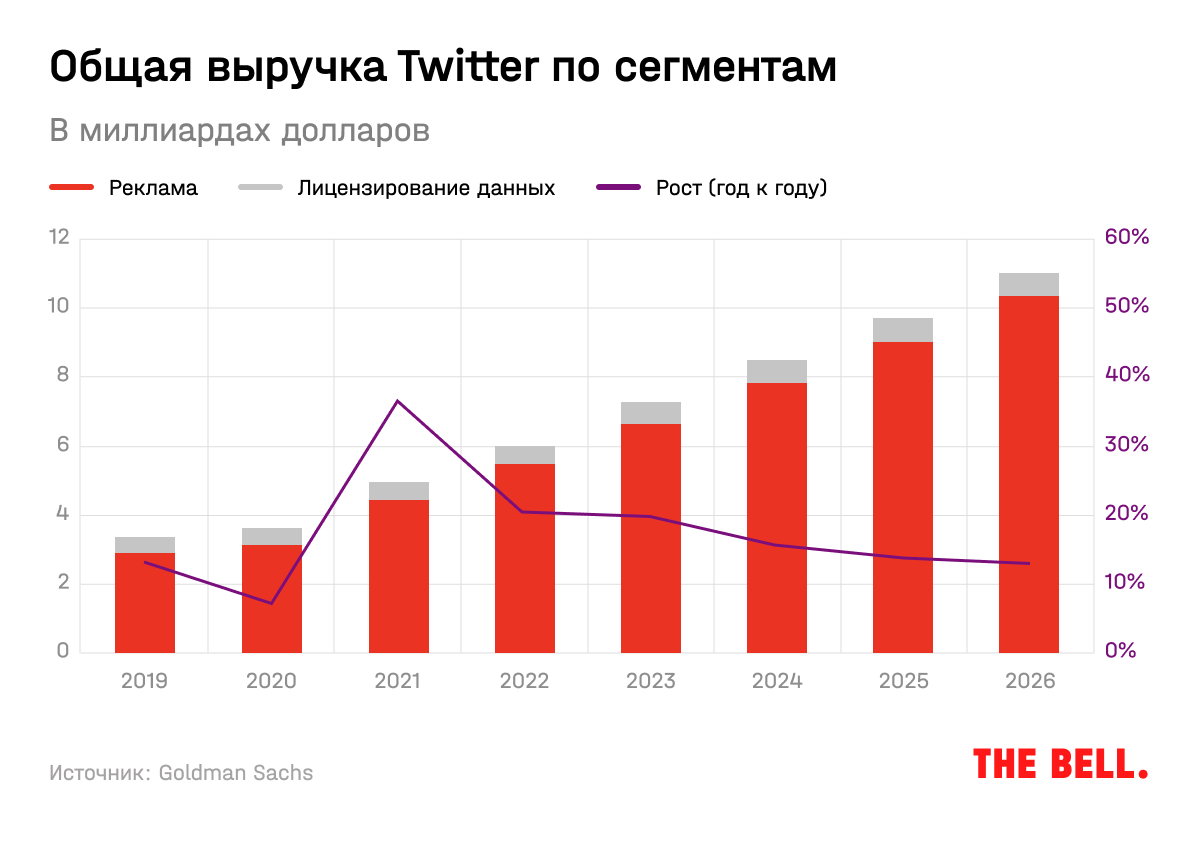
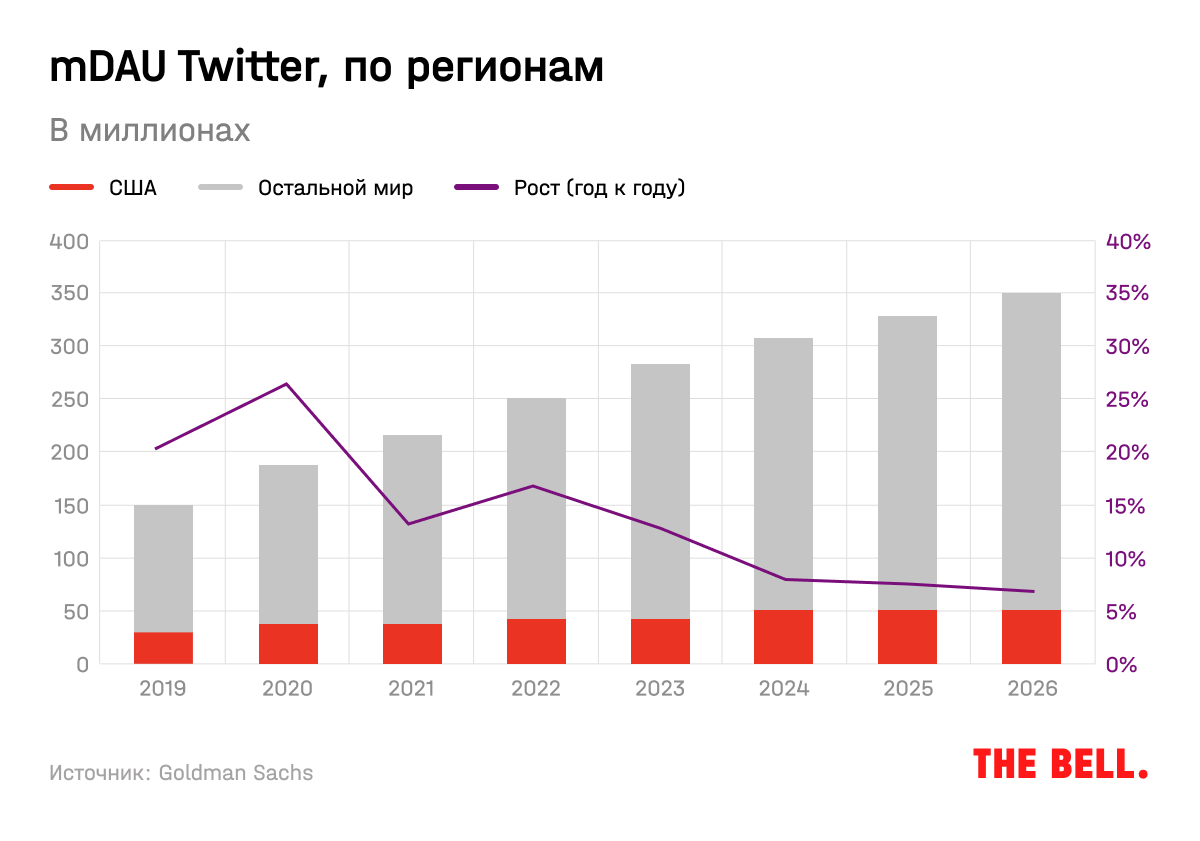
Interestingly, the predicted increase in the number of users in Twitter is the largest compared to other social networks, while the ARPU (revenue for the monetized user) will grow slower than competitors.
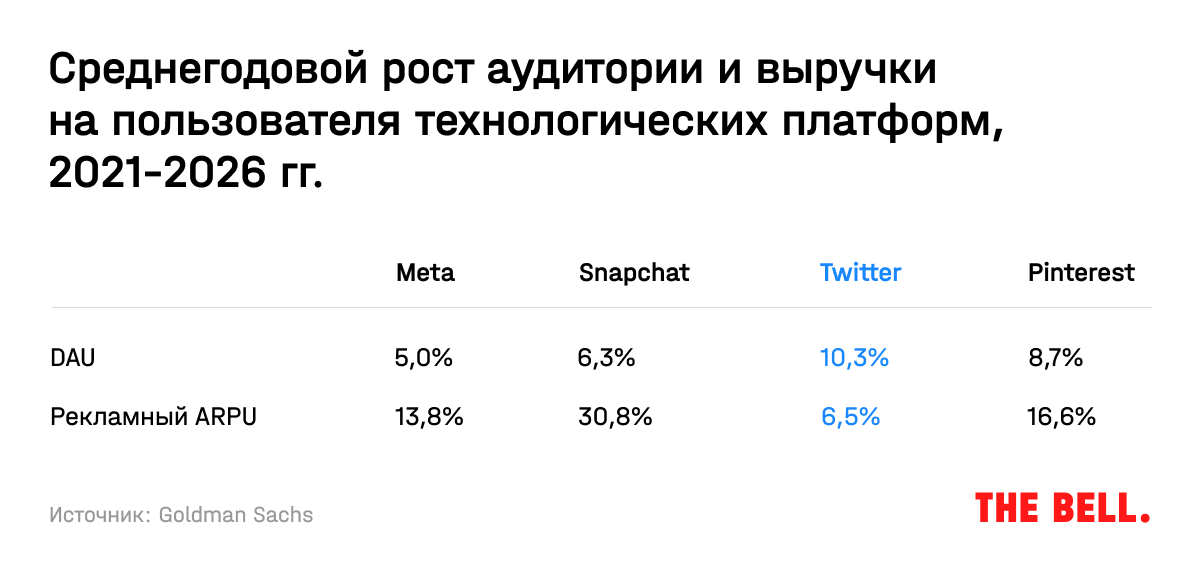
The fact is that Twitter has one of the smallest revenue of the revenue from advertising direct response (~ 10–15%, according to GS), aimed at quick generation of leads, when the product/product link is directly in the message (example - NESPressSO advertising campaign ).
At the same time, in general, budgets from brand advertising are just flowing into a direct response advertising, which complicates the scaling for Twitter advertisers and complicates the possibility of increasing the prices for advertising at auctions, analysts write. The company understands this, therefore, by the end of 2023, they plan to achieve a ratio of ~ 50/50 revenue from brand advertising and advertising direct response, but GS consider this task to be difficult.
In the future, brands will spend more on advertising in new formats (Video, AR, messengers, shops), and the launch of new products can help the company in increasing the share in the advertising market.
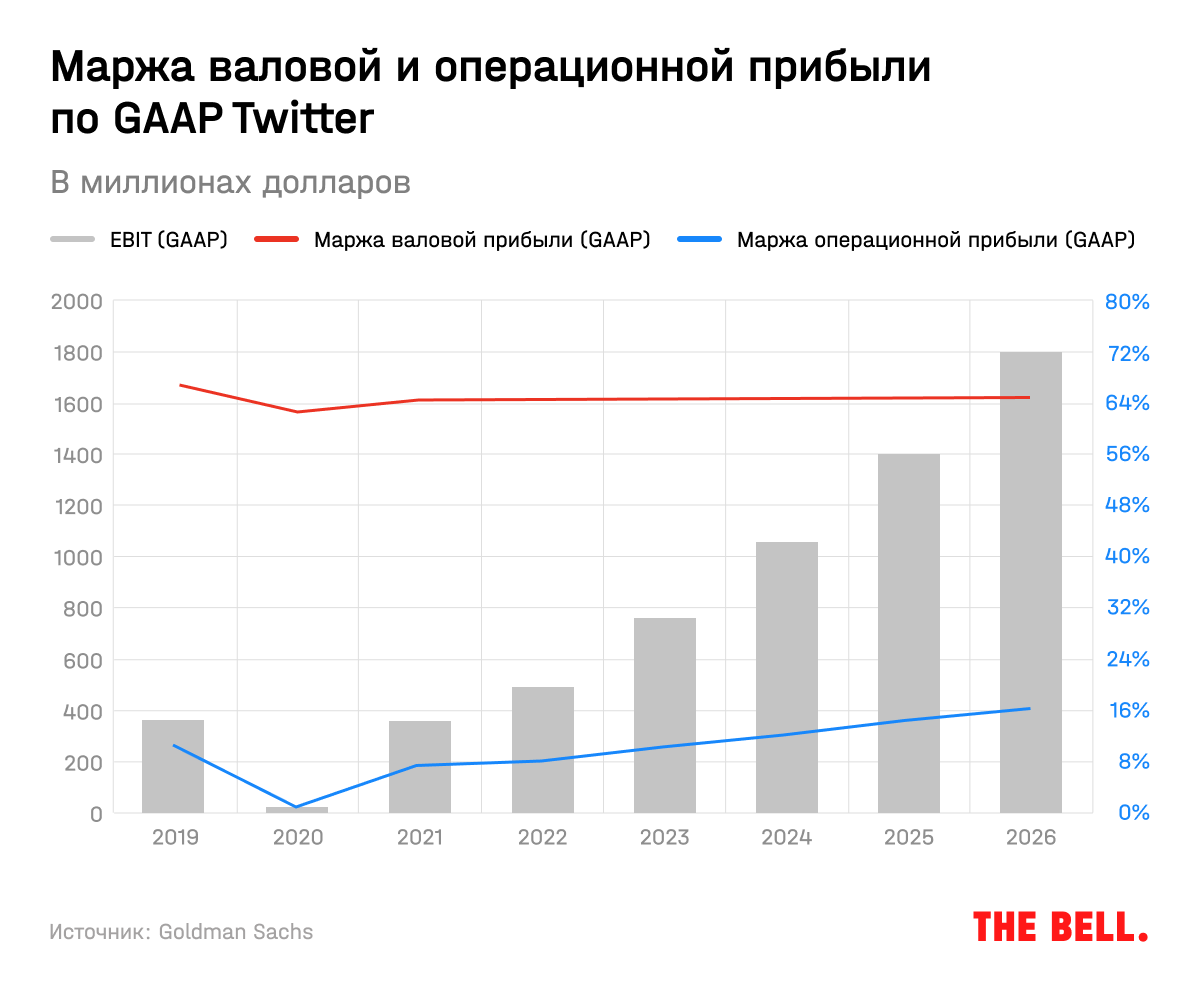
2. Can Twitter reach a profitability level of ~ 15–20% by EBIT (profit before interest and taxes) in the next 5 years?
GS answer: Yes, profitability by net profit will remain approximately at the same level, and operating profitability will grow to about 20% in 2026.
After several years of slow introduction of new products (which Twitter has also been recognized in the company) resumed investments in the data centers, the restructuring of the stack (set) of technologies (this is the most wide concept-from the selection algorithms to rewriting the system in the new language) and the development of new features-this should attract the attention of users and increase the possibilities of monetization, and the analysts write.
An interesting feature of the financial and operating model Twitter: unlike Snap, Pinterest, etc., Twitter is based on its own infrastructure and data centers, and not on cloud technologies. The Twitter approach provides more control over the technological platform, however, according to GS analysts, in the long run this gives less the effectiveness of operating activities and capital investments.
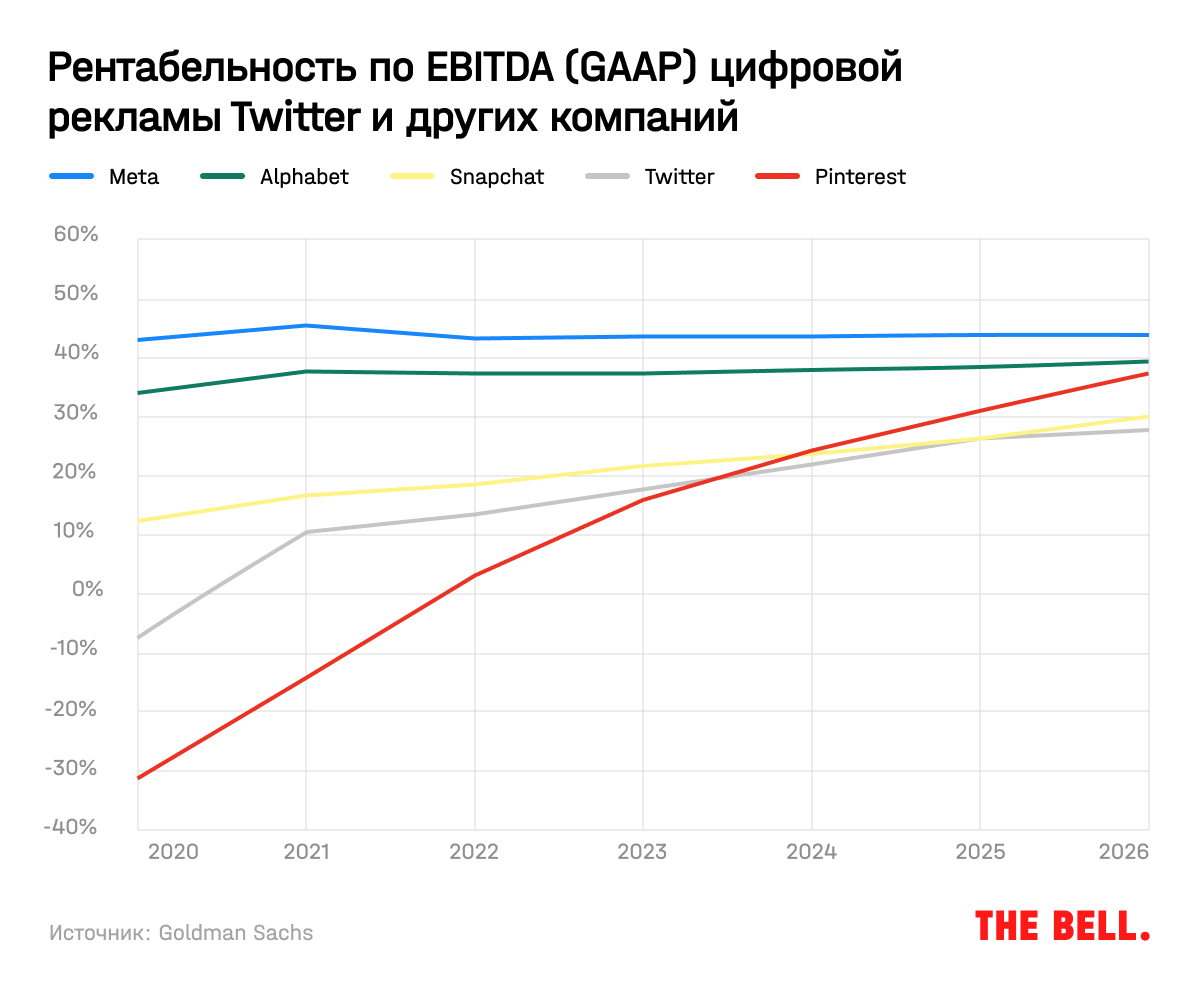
This is also recognized in the company: Twitter management in February noted that the company concludes contracts with cloud service providers and in the coming years plans to transfer some operations to their servers. However, the key factor in the choice in this direction is the speed of introduction of products, and not the financial efficiency, which was then also said by the technical director of Argaval.
In addition, the dependence on brand advertising makes the price at auctions more volatile. This was confirmed during the pandemic: large companies can quickly cut the advertising budget. The Twitter advertising revenue fell more than the rest in March-May 2020 (in the second quarter, it decreased by 23% of the year).
3. Can Twitter develop and improve various forms of monetization and involvement?
GS answer is indefinite: work on this is still going on. The company clearly accelerated the process of introducing new features, but their success is in question. For example, Spaces can increase user involvement and contribute to the growth of monetization. Analysts doubted the possibility of creating the monetized use of decentralized Internet/blockchain/bitcoin technologies (Dorsy spoke about this on a conference fee with analysts following the results of the second quarter of 2020).
In the medium -term perspective, Twitter remains in the growth phase of investment: at the call, following the results of the third quarter, the company's management retained the expectations of total cost growth for more than 30% of the year (at the beginning of the year of waiting was at the level of 25%). A free cash flow (FCF) should grow to ~ 2.2 billion in 2026 in 2026 (expectations on 2021-$ 521 billion, in the Dopandemic 2019 FCF amounted to $ 769 billion). Since 2017, the company spent ~ 69% of its FCF for ransom of shares - if this indicator is preserved, as expected in GS, this will become a significant driver of the growth of quotations.
What to look at the investor in the next 5 years
GS analysts list several indicators that, in case of exceeding forecast values, can contribute to the growth of the fair value of shares:
- The number of users and involvement (spent on Twitter) by introducing and developing products (Spaces, Newsletters, Tip Jar, Ticketed Spaces, Super Follows).
- The success of the transition to advertising a direct response using MAP (Mobile App Promotion) and other features, which can contribute to the growth of monetization and revenue. This is the most important innovation for Twitter, writes GS.
- The scaling of fixed costs, which can raise the margin of business to comparable with similar level companies.
- The volume of baibes.
Analysts are asked about the results of the introduction of new features, financial and operating indicators based on the results of each quarter, therefore, the decryption of quarterly conference-collars is Mastrid for Twitter investors. In February, an analytics day will be held, where a new general director who will now have to deal with ambitious goals in growth will probably tell in detail about his vision of the development of the company.
Obviously, investors believe that without Dorsi, who divided the time between two companies: Twitter and Square, will accelerate the introduction of innovation, writes WSJ. The activist Foundation Elliott Management, for example, has long called for a change in the company's management. In addition, as WSJ writes, Dorsy's departure can reduce the reputation, and therefore regulatory risks that GS analysts also mention.
The transition to the position of the general director of the former CTO is unusual even for the technological company, since the required skills in these two positions are different, WSJ noted . CTO usually knows the company's product deeply, but special leadership qualities are also required at the CEO position, the publication was given by experts.
The main strategist in the Saxo Bank shares Peter Garnry compares the current moment on Twitter with the advent of Microsoft from Microsoft Nadalla in 2014, which relatively quickly and successfully changed the company's strategy, making it, among other things, one of the leaders of the cloud services market. According to Garnry, Dorsy from the Board of Directors, outlined at the 2022nd departure of Dorsy, opens the way to ensure that Twitter is absorbed in another companies. Her Garnry does not directly call her, but Salesforce clearly guesses her description-the company wanted to absorb Twitter back in 2016. This is indirectly indicated by the fact that on December 1, a day after the appointment by the chairman of the board of directors of Twitter, Bret Taylor, he was appointed SalesForce co -director.
But whoever is the general director of Twitter, he will have to deal with the objective difficulties facing the company. Management is important, but not as much as all investors think-the company depends much more on economic and business cigns, writes Jason Zweig in WSJ, editing the latest edition of Benjamin Graham, a reasonable investor.
Photo: Shutterstock