
Translated material
The lag of space scale. Roscosmos ceased to earn money, suffers from sanctions, but blackmails the West


The lag of space scale. Roscosmos ceased to earn money, suffers from sanctions, but blackmails the West
Pavel Lusin
January 4, 2022In the light of closing in the late 1920s, Roscosmos is desperately trying to maintain the international status of the country in space. At the same time, old technologies are outlined, the implementation of new programs is constantly delayed, and the structure of expenses for space will soon become closed. Roscosmos does not bring money, so key projects depend on the Kremlin’s political will and the militarization of the industry.
Content
Financial planning-2030
"Angara", GLONASS and Lunar Program: Prospects and sanctions
Foreign policy: is there life after the ISS
Briefly the main results of the year for Roscosmos can be described like this. Firstly, the plans for Russia's development of space are now much more closed from prying eyes. Secondly, officials finally delayed the critical significance of sanctions against the backdrop of the obvious lag of key projects from the plan, as well as rethinking the manned program and the GLONASS program. Thirdly, new attempts were made to turn private cosmonautics from its imitation into a viable sector, with the inviolability of the basic foundations of both the astronautics itself, and the relations of the authorities with the business. Fourth, Russia tightened bargaining with the United States and other ISS partners regarding future cooperation in anticipation of the closure of the station. The main thing here is the announced project of its own space station.
It can be added that Russia, its destruction during the exercises of the old Soviet satellite, "Zelendin-D" also strengthened its position in the field of space safety. The Kremlin is trying to persuade the United States to the new restrictions on the military space program and the missile defense program, but Roscosmos actually have nothing to do with this.
Financial planning-2030
In 2020, the Basic State Program "Space Activities of Russia" for 2013–2020 came to an end. a total volume of 1.8 trillion rubles, as well as one of its parts, the federal target program for the development of GLONASS for 280 billion rubles.
The turbulent interdepartmental discussion about the plans of the Russian cosmonautics until 2030 ended that the old state program in 2021 was extended for a decade, but the volume of its new financing has not yet been published. Moreover, all its components of its federal target programs (space program, GLONASS and the development program of cosmodromes), as each of them is completed, will cease to stand out from this state program.
Simply put, if the current approach does not change, after 2025, information about the structure of space expenses will become closed. For example, we know only a ten -year amount of planned costs for the GLONASS system - 484 billion rubles. The whole state program can hardly cost less than 3-3.5 trillion rubles, but we do not have accurate numbers.
The financial indicators of the State Corporation itself Roscosmos are far from the initial plans. According to the plan, according to the results of 2019, the revenue was supposed to amount to 444–445 billion rubles, and net profit - to reach 10-12.5 billion rubles, but the corporation did not even come close to these indicators.
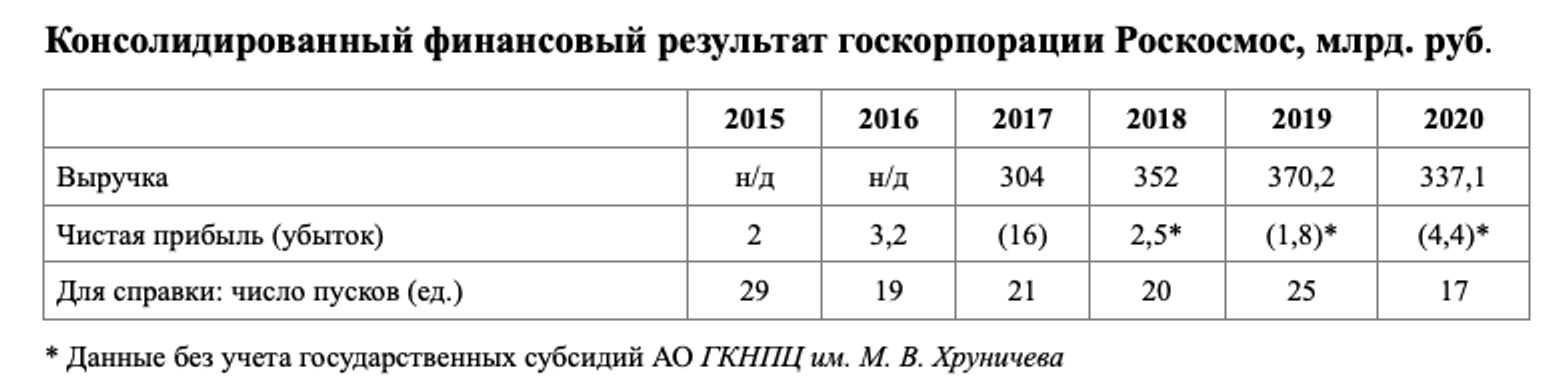
There is no financial data for 2021 yet, but the number of launches is known - this suggests that the revenue of Roscosmos remained below 400 billion rubles, and if there are net profit, it is unlikely to exceed the indicators of past years. Both the authorities and Roscosmos himself again spoke about attracting capital to Russian cosmonautics. It is interesting both the receipt by the state corporation of the national credit rating and the construction of Gazprom Space Systems by the assembly production of satellites in the suburbs, and the interest of AFK companies, Megafon and Rostelecom in the astronautics suddenly woke up at the end of this year.
The course taken means that Roscosmos is focused on the performance of “homework” and will continue to develop according to a conservative scenario, not promising any breakthroughs. The main tasks here: to complete old projects and develop satellite systems in conditions of strict sanctions.
"Angara", GLONASS and Lunar Program: Prospects and sanctions
What technologies and industrial base does Russia have today? For example, the Angara launch vehicles family has been created since the mid-1990s. And is still at the stage of flight tests (during the latest launch on December 27, a refusal of the new overclocking block “Perseus” took place). At the same time, Russia does not have a choice and will not be in the next 20 years, since the whole family is tied to the RD-191 engine (derivative from the Soviet RD-170). The same can be said about the Middle class carrier of the Soyuz-5 middle class with the RD-171MV engine (also a derivative from RD-170). Russia also does not have other more advanced engines and will not be in the foreseeable perspective.
A similar situation with other long-term construction-the Eagle piloted ship and the scientific and energy module (NEM) for the orbital station. The new ship has been created since the late 2000s, and the work on creating a replacement for the old Ships "Soyuz" has begun even earlier. Roscosmos will definitely not be able to create anything but the “eagle” even in the most optimistic situation.
As for the module, at first it was assumed for the Russian ISS segment, but many years of delays with its creation do this already inappropriate, since it will be ready only to close the station in 2028–2030. Nevertheless, Russia also does not have other options - NEM will either be built, or the country will not produce large orbital modules at all. Launched with adventures in 2021 to the ISS, the Russian Module “Science” was the last full -fledged module created from the Soviet material rescue and NEM - the only chance of Russia to stay among the players on the field of orbital stations.
Another situation is formed with GLONASS, which has a military purpose. The translation of the system into a new generation of satellites (Glonass-K and Glonass-K2 instead of GLONASS-M) is clearly delayed due to problems with Russia's access to electronic components and the impossibility of their complete import substitution. Satellites of the previous generation work in their own way outside the warranty period and in the coming years should be deducted. And if in 2020 the penultimate of the built Glonass-M and one GLONASS-K apparatus was launched (another such device was then at the final stage of production), then in 2021 the GLONASS system was not replenished with any new apparatus. Although the original plan assumed that by 2022 9 such devices would go into space. The first of Glonass-K2 satellites should be launched only in 2022.
The transfer of GLONASS to a new generation of satellites is delayed due to the inaccessibility of the Western components
Therefore, today Russia is working, in fact, “Plan B” for its satellite navigation system. Here, an option of 6 navigation satellites in a high -elliptical orbit is considered , which would allow the country's territory by 2030 (now you need 18 satellites in the middle orbit) and even in the most negative scenario without a global option. By the same type, the Japanese and Indian regional navigation satellite systems are arranged. An alternative option is to create a network of small navigation devices in a low orbit. In any case, Glonass remains one of the most painful points for Roscosmos, and in the past year this problem only aggravated. However, the military system will be supported by any cost.
Another direction predetermined for the Russian astronautics is the moon. This year, the Luna-25 automatic mission was supposed to fly to the Earth's satellite (the project began back in the mid-2000s), which was called, first of all, to work out soft landing technology. However, it was once again postponed - to 2022. The project is connected with the planned in the mid-20s, Luna-26 and Luna-27 and is of political importance, so that Roscosmos deals with priority and continue to do this, even if other scientific projects will have to be shifted or completely abandon them.
Foreign policy: is there life after the ISS
In general, many actions of Roscosmos, as well as the rhetoric of its leadership in the past year, were aimed at maintaining space partnerships with the United States and the West after the completion of the ISS. This remains a symbolic pillar of the high status of Russia in the modern world, contrary to the features of its political system, specific relations with neighbors and comparative economic weakness. Even the current confrontation with the West, in the context of maintaining space cooperation, does not allow to finally burn all bridges and supports the high degree of interdependence of the parties.
By and large, Moscow is interested in taking part in the project of the American manned Gateway station in the Luna orbit of the ISS. And even the announcement of the Russian orbital station is aimed at this. Initially, the federal space program considered the possibility of preserving the new modules of the Russian ISS segment as a separate station after the flooding of the ISS itself. However, this is technically impossible without NEM, and there is no belief that this module will be ready by the time the ISS was stopped.
In addition, if the probability of a small Russian orbital station can still be allowed at least in theory, then the probability of an independent Russian manned lunar program cannot be assumed for sure. Russia has neither appropriate technologies, no specialists, no industrial base, no financial resources in order to implement such a project. Therefore, for the sake of maintaining its high foreign policy status through new space agreements with the United States, Russia is traded harshly and does not even neglect blackmail .