
Translated material
Why Russia does not protest: to the genesis of the myth of "bad people"
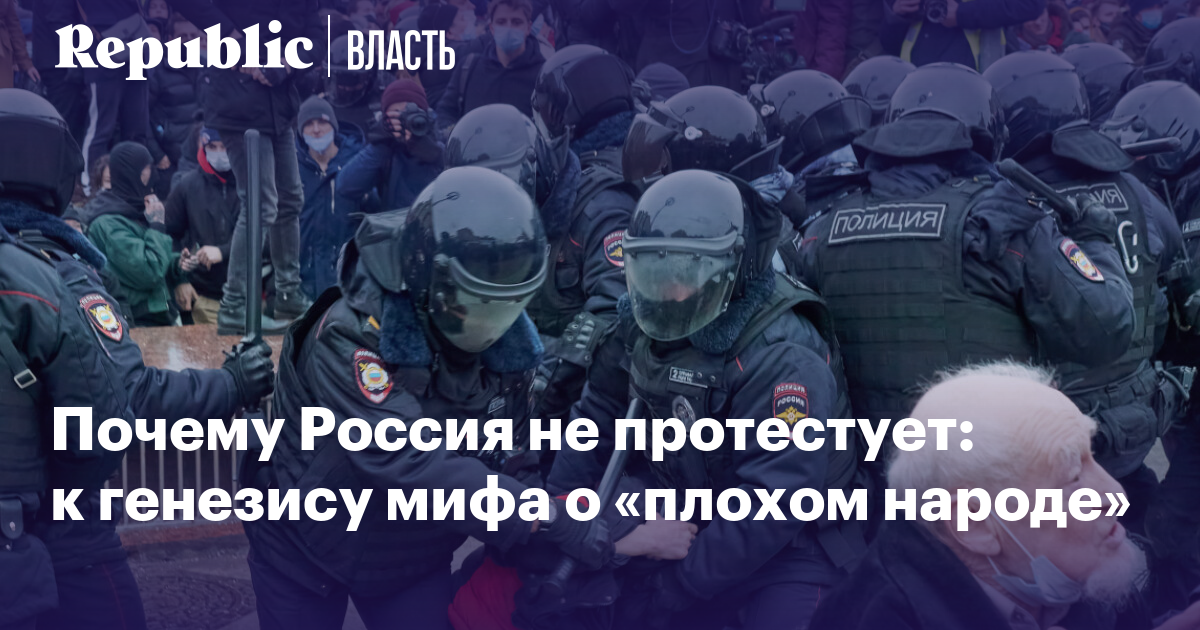
Why is Russia not protesting? After all, there are so many reasons - they again judge Navalny, the war on the threshold, the human rights are being trampled and much more. Why did Russia stop protesting? After all, even last January, people took to the streets and tried to rally. These questions can be safely called one of the most popular on the Internet and in personal communication on political topics. They are set by citizens of other countries, they are set for a long time and not even a long time left, and from their presentation - the Russians themselves. Often they sound like rhetorical, implying in advance and the answer-they say, some special people live in Russia, a clogged people, not like brave Ukrainians, Kazakhs, Kyrgyz, Armenians, Georgians or Belarusians.
However, the list of positive examples is constantly changing - depending on the bursts of protest activity in other countries. And if you are careful and consistent, it will be found that countries and peoples, glorified by network radicals yesterday as examples of worthy behavior of citizens, then disappear somewhere-both from discussions and from the pantheon of democrats. At the same time, no one shouts curses in the trace, does not accuse of cowardice and mental inability to protest.
Here, for example, Belarus - how many fierce and beautiful words were said about what Belarusians well done and what cowards are citizens of Russia. All this was said, however, in 2020, at the peak of Belarusian protest. Then the mass protests in Belarus ended, replacing the endless stream of news about the detentions and courts over their real and imaginary organizers and participants. And the first to whom it simply cannot occur to it to be surprised at this or shame Belarusians are Russians. Because everything is quite understandable to us: Belarusians did well and did what they could-so far it was possible.
Inhabitants and protests
You do not have to be a genius to find a completely obvious pattern: the layman is generally rarely ready to protest, and does it more willingly where they do not punish such behavior at all, and if punished, it is rarely and slightly. However, at some moments of history, the layman is ready to join the activists and for some time even to protest even contrary to the prohibitions of the authorities and risking stronger than usual. But for a long time this condition cannot last: as soon as the authorities begin to systematically punish participants in protests, and the chances of a quick change in the regime are reduced, they quickly come to naught.
This, in fact, is the answer to the question of why no one goes in large quantities in Russia now: because after the last surge of the rally activity in January 2021, repressions fell on the country, despite the fact that by January 2021 it was no longer safe.
It is easy to even calculate when there was a turning point in relation to the authorities to protests - in 2012. Before the protests of 2011-2012, the Russian authorities did not believe that people were able to protest en masse and under political slogans, and therefore not so much criminalized the protest itself as such as small political shares suppressed pointarily.
Since 2012, with mass political protest, they began to fight systematically, constantly tightening legislation. And although the measures taken were already severe enough, everything has finally changed precisely in 2021, when the authorities actually took the course on the criminalization of any protest activity. Obviously, the main trigger here was preparation for elections to the State Duma, who found hysterical and even ominous features after the story with the poisoning of Alexei Navalny.
Subscribe to read the whole
Make a subscription Redefine.media to read Republic
Subscribe [you can pay for a Russian or foreign card. The subscription is extended automatically. You can unsubscribe at any time.]
Where are the money subscribers going