
Translated material
Z in Russia
How protests and searches from human rights activists took place. Chronicle of current repression. Issue 11
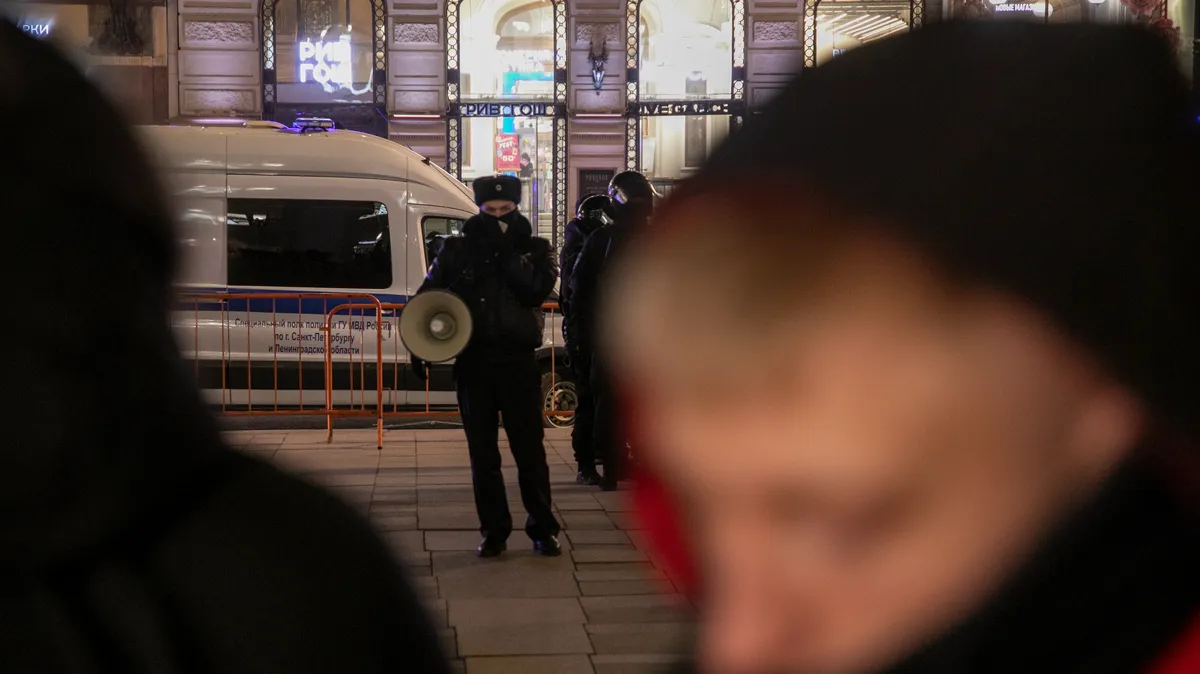
Residents of Russia continue to reach protests against themselves, you know what (such words in Russia are prohibited). The security forces harshly suppress the shares and almost immediately detain the disagreements. And on the eve of the FSB, they came to the Memorial office*and the Civil Assistance Committee **. They have passed many hours of searches that ended with the seizure of a server, hard drives, various printed products and other materials. During this time, OMON fighters drained the safe from the wall of the wall, and someone sprinkled the walls with the Z with a symbol of Z. After the break, we continue to release the “chronicle of current repressions”.
... equated to extremism
Since February 24, according to the OVD-Info ***, over 8,200 people were detained throughout the country. According to human rights activists, the detentions are harshly, the facts of non -permit to the detainees of lawyers are recorded. According to human rights activists, more than 3,800 people were detained in Moscow in Moscow, more than 2700 in St. Petersburg, in Yekaterinburg, Nizhny Novgorod and Krasnodar. The Ministry of Internal Affairs reported the number of detainees only on February 24 (the Main Directorate of the Ministry of Internal Affairs in Moscow called the number 600).
There are many cases of detention for single pickets, they delayed people and simply when they went out with balls or flowers of a neighboring country. The police come for people who hang out posters in their windows and on balconies. More reasons for detention are posts and reposts with promotions announcements, distribution of leaflets or applying inscriptions on the wall.
In Moscow, the detainees talked about overflowing autosaks. In St. Petersburg and in Nizhny Novgorod, instead of autosaks, city buses were sometimes used. Human rights activists recorded numerous examples of the harsh actions of the police, which lawyers regard as unlawful.
On February 24, human rights activist Leo Ponomarev was detained (the Ministry of Justice included him in the register of “media-foreigners”). A protocol was drawn up under Part 5 of Art. 20.2 Administrative Code of the Russian Federation (“Violation by a participant in the public event of the established procedure for holding a meeting or rally”) for calls for participation in protest. The court fined it for 30 thousand rubles. And on March 3, unknown people attacked the human rights activist.
On March 4, among the detained participants was the former municipal deputy of the Timiryazevsky district, Julia Galyamin. The Savelovsky Court of Moscow appointed her 30 days of administrative arrest under the article on a repeated violation of the rules of the inconsistent action.
Not without criminal cases. Currently, the excitation of the three is known. The first is against a 22-year-old girl for an abandoned bottle of incendiary mixture towards police officers (Art. 318 of the Criminal Code). The record published by the Investigative Committee shows how the girl throws a bottle that falls on the asphalt and does not break. The next day, February 25, SK posted a video on which the detained girl apologizes to the police. On the same day, the Tver court of Moscow sent her into custody.
The second case (hooliganism, Article 213 of the Criminal Code) was brought up on February 27 after the man crashed in a car with slogans into a fence on Pushkinskaya Square, and then set fire to the car. There is no information about the chosen measure for him.
Another thing was in place in St. Petersburg against a 24-year-old protest. He is accused of applying violence to a representative of the authorities (Article 318 of the Criminal Code). According to the investigation, on March 2, he grabbed the security forces, after which he sprayed the pepper spray in his face. On March 4, the Kuibyshevsky court of St. Petersburg sent the accused in jail for two months.
Soon after the start of protests, the Prosecutor General’s Office threatened criminal cases for going to such shares. The expression of pacifist moods can be qualified as participation in extremist activity with subsequent punishment under Part 2 of Art. 282.2 of the Criminal Code - up to six years of imprisonment.
"We examined the room - found nothing"
On March 4, searches were held in two offices of Memorial and the Committee “Civil Assistance”. The security forces broke into human rights organizations closer to noon. Investigative actions in “Civil assistance” lasted almost five hours, and in the “Memorial” ended late at night. No one was released from the office, employees were forbidden to use communications, no one was allowed. Lawyers were deprived of the opportunity to participate in investigative actions.
According to the employees of the Memorial, the basis for searches was the case of human rights activist Bakhrom Khamroev, accused of public justification of terrorism (Article 205.2 of the Criminal Code), on February 25, the court in Moscow took into account for two months. The organization notes that he does not work in the PC "Memorial" and "Civil assistance", but he is a member of the human rights center.
According to employees of Civil Assistance, the search conducted the FSB. “I work in the Federal Security Service. Investigative actions are carried out, they do not try to anyone. Do not worry, ”the human rights activists quote the word of the employee who left the“ Civil Assistance ”office to smoke. Only the head of the committee Svetlana Gannushkina was able to get a search. In a conversation with the “New”, she noted that the FSB officers were extremely polite, but “an offer to drink tea was rejected by them,” she jokes.
"The search protocol looks something like this:" We examined the room - they did not find anything. " And so in other offices. And it was impossible to find any traces of the fringe of Khamroev. He worked for us 17 years ago and only a year, ”Gannushkina explained.
The search in the committee ended closer to 16 o’clock, the security forces took the server and carried out part of the equipment. First, the investigator was going to send the head of “civil assistance” for interrogation, but then he postponed the meeting on March 9.
At this time, the security forces continued the investigative actions in the Memorial. The inputs and outputs were guarded by machine gunners in masks, drove a car carrier and two vans. Later, riot police brought a grinder to the building in the small Karet Lane, as it turned out later, the security forces tried to open the safe. There the search ended closer to 22 o’clock. As they write in the Telegram channel “Full PC”, the search protocol was handed over to the duty officer and took a non-disclosure subscription from it.
In another office of the Memorial in the carriage, the search lasted 14 hours and ended at 2 a.m. As a result, several hard drives were seized, a lot of printed products: books, leaflets and posters. What else could the security forces be taken with them, the office employees who were waiting on the street did not see, the security forces lined up at the exit so as to block the review. But what then saw inside the office was someone left by someone's inscription at the stand “Memoreal-all!” (Then they fixed it on and), several times on posters and walls they painted a symbol Z. According to human rights activists, a search in a criminal case is just an excuse to gain access to the documents of the “memorial”.