
Translated material
Default, currency control and oil embargo. What is behind the news of the week
From last week, international rating agencies have reduced the sovereign rating of Russia to the pre -ending level, and Fitch has already stated that the default is inevitable. The word “default” itself causes an instant association among Russians since August 1998 - the collapse of the ruble, the collapse of the banking system and the loss of savings. But the analogy is hardly applicable to 2022: in 1998, the default became the direct cause of the crisis, and today it will become only one of its formal signs. It’s not worth being afraid of the default-all the worst market events have already occurred, and the income of Russians will not collapse because of it, the economists say.
Why they started talking about default
On March 5, Vladimir Putin signed a decree on the temporary procedure for payments on external debt. It allows you to pay currency debts to creditors from states who have made “unfriendly actions” against Russia, in rubles, through special accounts in Russian banks. The Ministry of Finance, according to the text of the presidential decree, still has the right to pay external debt in the currency - but the decree allows this and not to do this.
By definition, default - non -fulfillment by the borrower of his debt obligations, both in terms of interest payments and when repaying the main debt, in a timely and full in the currency that is indicated in the documents for the issue of debt obligations.
The conversion of currency obligations into rubles will mean inevitable default (Imminent Default), explains The Bell, the chief economist of one of the major Russian analytical centers.
The first key date you have to follow is March 16. On this day, Russia will have to pay external creditors about $ 117 million coupon income for sovereign bonds with a maturity of 2023 and 2043, counted in Bloomberg. Payments of coupons for some OFZ nominated in currency can be made in rubles - but specifically for these releases, Russia does not have such an option, the publication notes. Russia will have 30 days (that is, until April 15) to pay coupons. If this is not done, default will be officially announced, Bloomberg writes with reference to the Morgan Stanley strategist Simon Wever.
Investors have the opportunity to get a coupon income, despite the sanctions - the United States, until May 25, 2022, allowed American companies to receive payments from Russian government agencies. On March 3, the US Department of Finance issued a Genlicenzia, which is allowed by transactions with the Central Bank, FNB and the Ministry of Finance, necessary for "receiving interest, dividends or payments for debt or promotions."
On March 6, the Ministry of Finance reported that he plans to act in servicing Eurobligations in the framework of emission documentation. “In my opinion, taking into account the updated OFAC license, this theoretically allows you to make all the necessary payments - for example, using frozen means of international reserves of the Central Bank, and thus avoid default,” says Alexander Kudrin, the main strategist of Aton.
On March 10, Minister of Finance of Russia Anton Siluanov spoke about the plans of the department regarding the payments on external debt:
“First we will give all the necessary payment orders to our agents on transactions in accordance with the issue of issue in order to make a payment in the currency. This will be possible only if the “defrosting” of currency accounts of the Central Bank and the Government. Upon receipt of a refusal or a non-rejection of a response from agents banks, we will repay and serve our obligations in rubles. ”
The decision to calculate in rubles on foreign exchange duty will automatically mean the sovereign default of Russia.
In case of non -payment, the court that foreign lenders of Russia will turn to, may officially recognize the default of the government. In this case, they can get access to all frozen assets outside the country to satisfy their requirements - including the Central Bank gold and foreign exchange reserves, said Morgan Stanley strategist.
Based on the data on June 30, 2021 (the last affordable date), up to $ 380 billion financial assets of the Bank of Russia could be paralyzed (only gold and Chinese yuann remained in access). Non -resident as of January 1, 2022 owned approximately $ 20 billion of Russian state Euro -blocking (51% of all applicants). That is, with such a scenario, foreign lenders will be able to return the invested money even taking into account interest.
On March 31, the Ministry of Finance will have to make another payment of Eurobonds with repayment in 2030 - already $ 359 million. And on April 4, Russia should pay $ 2 billion of the main debt when repaying Eurobonds, Reuters noted .
What is the probability of default
The markets almost have no doubt that the default of Russia will happen. The government bonds with repayment in 2023 at the beginning of this week cost a record low - 29% of the face value (there were no transactions on them). Before the start of the "military operation" they cost more than the face value. Morgan Stanley believes that the cost of papers can fall below 10% - so much in recent history there were only sovereign bonds of Venezuela and Lebanon. The compiled Bloomberg index of sovereign Russian bonds from the beginning of the year has decreased by 81%, worse - only in Belarus (falling by 93%).
The cost of credit default swaps (CDS) insured by $ 10 million payments for Russian sovereign bonds for 5 years, on Monday amounted to $ 5.8 million, which is equivalent to the probability of default of 80%.
On the night of March 9, the Fitch rating agency reduced Russia's rating in foreign currency to the pre -end level “C”. “The rating“ C ”reflects the opinion of Fitch that the sovereign default is inevitable,” the agency said in a statement.
On March 6, the Moody's agency reduced the sovereign rating of Russia from the “bin” level of “B3” to the pre -end “CA” - this implies some probability of paying the main amount of the debt and interest on it, but indicates that the issuer is extremely close to default. The position of Moody's confirms the message of the National Settlement Depository (NRD) that “coupon payments for OFZ, the deadline of which expired on March 2, were paid only to local papers” due to the ban on the payment of non-residents. Although the NRD on Wednesday received 11.2 billion rubles from the Ministry of Finance for payments for coupons for ruble OFZ with repayment in February 2024.
The default can be announced within 10 days after the Mosbirzha announces the technical default (officially it was not announced) for Russian OFZ, Bloomberg notes . This caused the debate which event should be recognized as a full -fledged default.
What is the difference from 1998
For Russians, after August 1998, the word "default" causes an immediate direct association with the collapse of the economy and the collapse of the ruble. Then the default really became a direct cause of the sharp drop in the ruble, explosive acceleration of inflation, the collapse of the largest private banks and the forced conversion of foreign exchange contributions to ruble. But now the situation is completely different.
“Defolt attracts attention as a symbol of the 1998 crisis, but a sharp increase in prices, the devaluation of the ruble and the drop in income and the standard of living of Russians in 2022 will not occur due to default,” explains The Bell, the chief economist of one of the major Russian analytical centers. In 2022, the refusal of the payment of external debt itself is on the periphery of what is happening with the economy in reality.
All negative market events have already happened, the economist of the authoritative foreign organization agrees. Many investors will stay away from Russian assets and without default on external duty. In the end, foreign portfolio investments in ruble assets are already frozen, and new investments will not come for political reasons, he notes.
The main difference is that in 1998, Russia really did not have a financial opportunity to serve its debts. Now the possibility of default is caused not by a soft budget policy, a short debt or even an economic crisis, but is a consequence of mutual financial restrictions, a “political decision”, says one interlocutor of The Bell. The case in the technical and legal uncertainty, which put the duty of the debt dependent on the position of foreign and Russian regulators, the second agrees.
Against the background of the general economic crisis, which will be caused by trade restrictions, external and internal restrictions on capital flows and other sanctions and counter -sanctions, default itself will become only one of the formal recognition of the existence of an economic confrontation, he notes.
Under the current conditions, much greater risks have changed economic conditions than the possible default of the government, which, based on the actual volume of debt, is more likely to look like a problem associated with the technical impossibility of using the available reserves for payments than the credit quality of the borrower, Alexander Kudrin from Aton agrees.
Will companies be able to pay
Introduced by the United States, EC, Great Britain and other sanctions prohibiting any transactions with the Russian Central Bank, the Federal Tax Service and the Ministry of Finance, including currency exchange operations, as well as the disposal of the Central Bank on the mandatory sale of 80% of the foreign exchange earnings, complicate access to funding and increase the risks of the default of individual Russian companies for long -term obligations in a foreign currency, It is said in the Barslas review of March 3 (The Bell has).
At the same time, for most companies that have fallen into the review (and these are mainly exporters), the remaining 20% of the currency revenue, which can be left abroad, cover the necessary payments for debts and capital costs in the currency, and calculated in the bank. Russian exporters as a whole have strong fundamental indicators, a positive story of improving credit ratings and the appeal of Eurobonds, they benefit from the fall of the ruble exchange rate, and also strive to pay debts, and analyzes analysts.
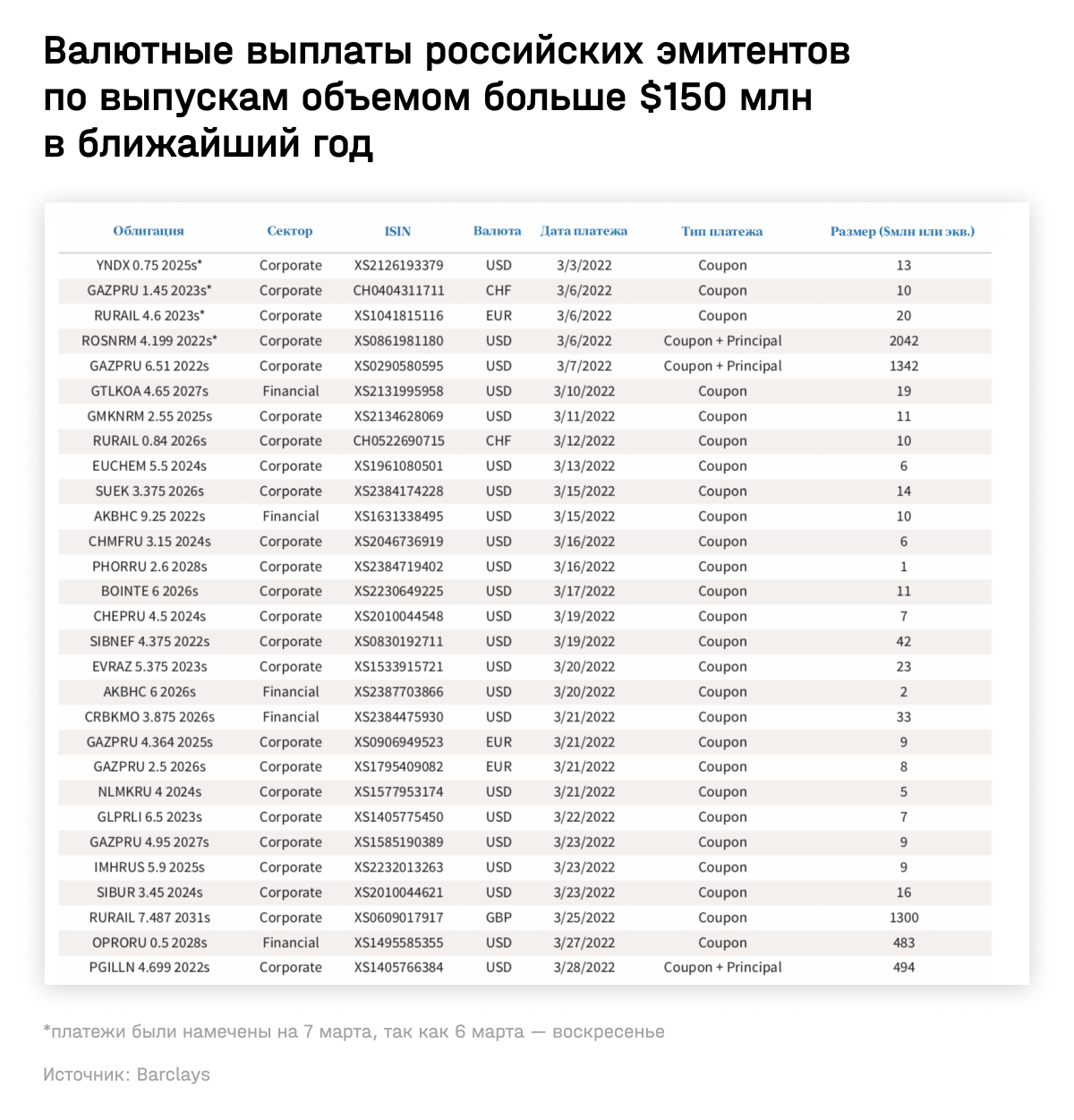
So far, Russian issuers do not allow delays in payouts of foreign currency debts. On March 10, Rosneft announced the payment of coupons and repayment of the main debt of $ 2 billion, Gazprom on Monday - about $ 1.3 billion payments. This is with a wide margin of the largest payments from the Eurobonds of Russian companies for the next year, follows from Barclays data.
Given the size of the payment, as well as the fact that this is state -owned companies (and therefore, the risk of non -payment above), investors monitored the fate of these payments with special attention, the JPMorgan noted. However, there are no guarantees that in the future the companies will continue to pay debts, the report said.
But some companies still have to reduce dividends and capital expenses, as well as use reserves, expect in investment bank. The most difficult thing will have to have companies with a significant degree of revenue within the country and foreign exchange obligations and expenses. The economy of Russia is highly likely to be in the recession, and ruble revenue will fall, explained in the report.
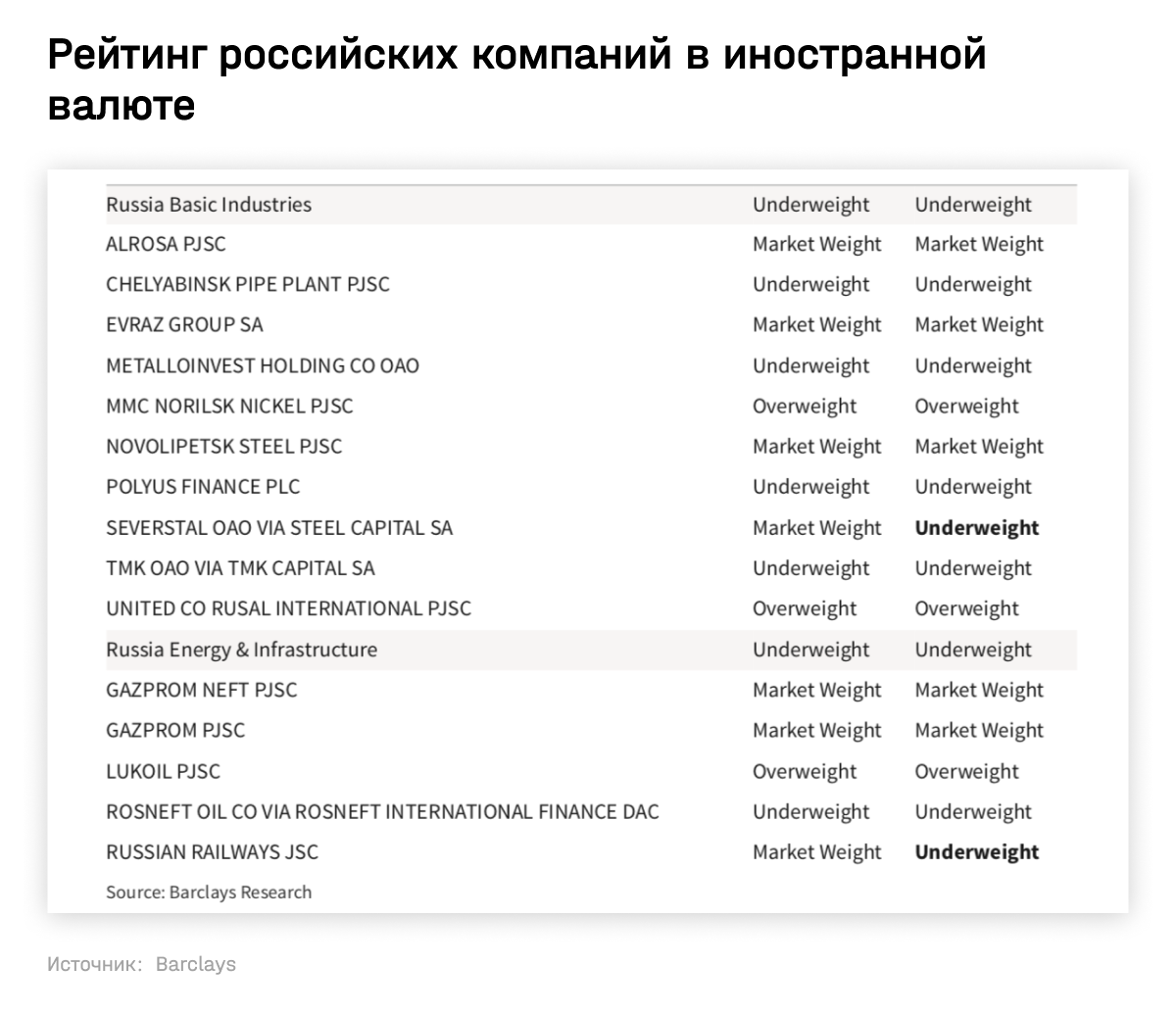
The disadvantage of these forecasts is that not all Russian companies disclose the currency structure of capital costs. One of the few companies who do this is Norilikel, noted in Barclays. He has 95% of the revenue abroad, and 85% of capture in rubles. The company occupies a large share in the market of important metals, and it is quickly impossible to replace its volumes. Bank analysts positively evaluate the financial stability of Norilsk Nickel, as well as UC Rusal and Lukoil, which have a significant margin of foreign exchange liquidity, and give the recommendation to “buy” their Eurobligation.
In JPMorgan, they are sure that investors in currency debt will be able to somehow receive payments from LUKOIL, NLMK and MMK - a company with assets abroad and a noticeable share of foreign revenue. The rating of Eurobonds of these three companies was increased to “buy”.
In theory, in the case of default of Russian companies in Eurobonds, lenders may try to file a penalty to their international assets or foreign revenue, according to investment bank. There were no precedents yet, but creditors can achieve transfer to paying off the debt of interest on export revenue, JPMorgan analysts agree.
At the same time, Barclays lowered the Severstal rating to “selling” (Underweight), explaining this to the departure of the company from the European market after the introduction of sanctions against Alexei Mordashov, and Russian Railways-due to the low fraction of foreign exchange earnings, small monetary reserves, as well as “proximity to the Russian state”.
In the Investbank, it is stipulated that sanctions can adversely affect the ability to serve debt in several cases:
- imposition of sanctions on business owners, as is the case with Severstal;
- Sanctions against banks can adversely affect companies: for example, Veon management at a call with analysts on February 28 noted that the company would have to pay off the debt to the VTB sanctions until the end of March. This kind of consequences can negatively affect the ability to make bond payments in case of refinancing problems, Barclays note;
- violations of supply chains, which can lead to a decrease in sales;
- The embargo for deliveries from Russia: according to Barclays, the biggest risk is for non -energy goods for which the share of Russia in the general world proposal is small. At the same time, even the informal sanctions that the sellers of Russian oil faced can influence the revenue of companies, remind in JPMorgan.
What will happen to the Russian market further
The “train” of a possible sovereign default will undoubtedly increase the cost of raising funds by Russian companies in the Eurobond market, says Alexey Kovalev, an analyst with FG Finams. It will be very problematic to place banks in the near future.
But in the current conditions, the cost of external financing for Russian enterprises does not play a big role, since they cannot produce new Eurobonds due to the lack of infrastructure: not a single bank will act as an underputing under the possible secondary sanctions, says Alexander Dzhioev, an analyst at Alfa Capital. In addition, without special permission (according to the Decree of the President of the Russian Federation), companies legally limit the possibility of serving external currency obligations, which automatically does not allow a new debt, the expert notes.
From the point of view of assessing the prospects of non -residents relations to Russian debt papers, the presence in global indices is important, Kovalev notes. So far, there is a surrender of positions: for example, JPMorgan has already announced the exclusion of all corporate and sovereign debt papers in Russia from their bond indices from March 31 (JPMorgan indices are tracking corporate and sovereign bonds for a total of over $ 840 billion, and the share of Russian papers in this volume is 1.03%).
If Russia, a large raw material country, remains a country with a market economy and enterprises that will generate profit and pay dividends, investors will also say, Mikhail Ganelin, senior ATOT analyst. Perhaps the domestic market will continue to develop, investors from other regions will come, a shift in the direction of internal bonds will occur, but the market will become less liquid, the expert reflects.
“Now the economy and the stock market are not in the market state, many measures of manual management, and there are significant restrictions for foreigners. Perhaps, over time, when part of the sanctions will roll back and restrictions on the movement of capital will begin to act, speculative capital will return, although intuitively now it seems that a lot of time will pass before, ”says Natalya Malykh, the head of the FG FG stock analysis. It is still difficult to give a forecast, [whether the Russian market will survive], now there is not even bidding either in the OFZ market or in the stock market, the expert notes. In her opinion, the stock market will most likely exist, but without the influx of large foreign investors from China and the Middle East you should not count on serious recovery.
What other conifold consequences will be
The effect of default of 2022 (if it is announced) for income and expenses of the federal budget will be neutral, one of the interlocutors of The Bell is sure. In 1998, Russia directly depended on external debt. In 2022, the country's financial resources do not depend on it to such an extent.
The short -term consequences of the default directly lie in the formal plane. But it can lead to the fact that part of the Central Bank’s assets will not be defrosted, says the interlocutor of The Bell from the Russian analytical center. The long -term consequences of default are higher rates on borrowing in foreign currencies for the state and companies (not only dollars and euros) for the next decades, he is sure.
The only potentially positive point is that if the 1998 default caused the same reaction around the world, now foreign policy features can allow investors from the remaining “friendly” countries to use the moment to enter Russian assets, he says. “But this will not be a market history, but a“ special investment operation ”,” the interlocutor of The Bell emphasizes.
“In 2022, Russia has things worse than default. This is the political toxicity of the Russian economy in the eyes of other countries - the global isolation of the country, the total absence of foreign investment, a destructive technological lag, ”concludes an economist in one of foreign organizations.