
Translated material
TELEGRAM rapid growth, accommodating Yandex Bondholders and new cleaning in Sberbank
The topic of release is how Telegram has doubled in Russia and what will work on this

The times when Roskomnadzor tried to block Telegram, and the Pavel Durov team heroically reflected the attacks of the authorities - for a long time in the past. Now Telegram is one of the few social networks that has not yet been blocked and not recognized as extremist in Russia. We tell you what Telegram has grown on and how are you with its monetization.
How Telegram grew after February 24
Since February 24, Telegram has doubled in Russia. The number of users who at least once a day opened the messenger's application increased by June to 40 million, counted at The Bell in Mediascope. Since April, this indicator has increased by almost 10 million.
After Instagram and Facebook were recognized as extremist organizations and blocked in Russia, Russian Telegram channels received more than 40 million new subscriptions, the analytical service of TGSTAT calculated.
Blocked social networks predictably continue to lose users. If there were almost 39 million people before the war in Russia, then by mid -April it fell to 14.5 million, and by the end of May - to 11.7 million. Facebook covers from 6.7 million users per day first to 2.9 million people, and then up to 1.9 million, calculated in Mediascope.
In fact, everything is even worse. As the researchers explain, these numbers include sessions lasting less than five minutes. This means that part of the users, going to the application and seeing that nothing happens in it due to locks, they immediately go out, explained to Mediascope. If you exclude such sessions, it turns out that the average daily entry of Instagram is now only 5.5 million users, Facebook is 370 thousand even.
Telegram took the freed niche without any problems. “After February 24, people have greatly increased demand for information. Telegram has become the main platform where this information can be obtained, ”explains TGSTAT founder Yuri Kizhikin.
In March, in March, for the first time in its history, WhatsApp, becoming the most popular messenger in the country, by the first time in its history, the Megafon press service reported with reference to data on its own subscribers. The share of Telegram in the total traffic in instant messengers in the early days of March increased from 48% to 63%.
In Telegram - at least for now - the channels of independent media, whose sites were blocked by the authorities, and pro -government resources of all stripes coexist calmly. Literally the day after the start of the war, at least 35 new channels appeared in the messenger, supporting the “special operation”, and over the next two months there were already more than 500 of them.
Here are the top 20 telegram channels for the gross subscribers for a month before May 25 (according to TGSTAT):
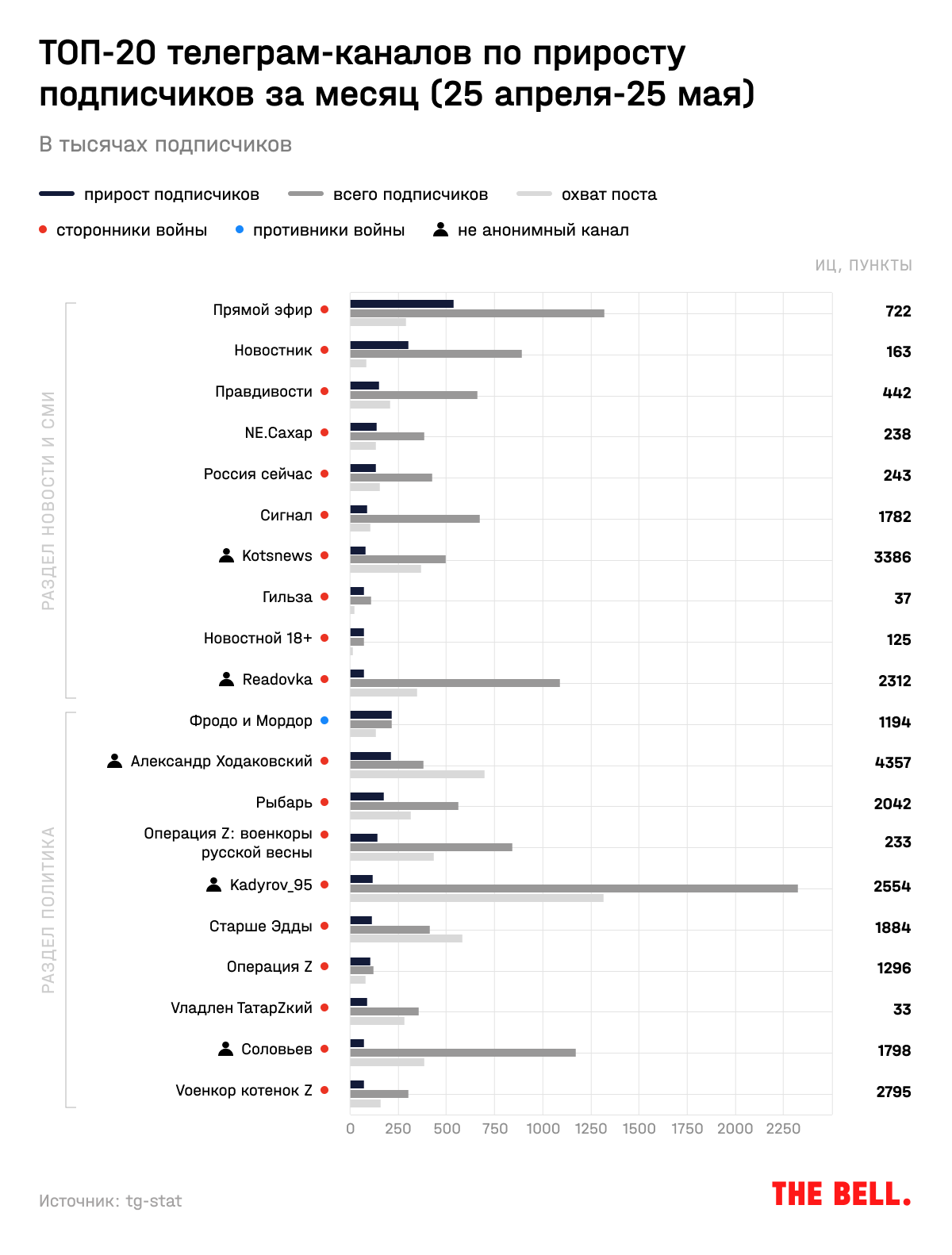
The main ascending "star" in the Russian military Telegram is an anonymous telegram channel " Live " with 1.3 million subscribers. The channel appeared only on February 25 and became the fastest growing in Russian Telegram.
The “live broadcast” content first consisted of military chronicle and news about sanctions, but by April to this, ridicule of anti -war actions, refugees and regular posts with the phrase “Ukrainian Nazis” were added to this.
Some of these posts with a minimum fact is fakes. For example, the “live broadcast” published a screenshot of a commentary, supposedly belonging to Ukrainian politics, Dmitry Yarosh, where he argued that the APU could shell his population if desired. This screenshot quickly spread to dozens of dubious sites and accounts. But the account, captured in the screenshot, is easy to find on Facebook. He is fake and does not belong to Yarosh.
More about how the TELEGRAM wire and promotion is arranged in the investigation of the special correspondent of The Bell Irina Pankratova this week.
Telegram money
The rapid growth of the last months of Telegram has yet to learn how to monetize. All the pleasant “chips” of the messenger - a free storage for photos and videos, a huge number of chats and channels - are provided by infrastructure, which was worth impressively and until recently, rapid growth. From the testimony of Pavel Durov during trials with the US Securities Commission (SEC), it became known that in 2018 Telegram spent about $ 89 million on equipment and server. From October 2019 to January 2020, the team paid another $ 10 million for the infrastructure. At the end of 2020, Durov said that the support of the messenger costs hundreds of millions of dollars a year.
With the monetization of Telegram from the very beginning, everything was difficult. First, the project lived with the money of its founder from the sale of VKontakte. Then the team came up with an ambitious way to provide Telegram with money and conducted the ICO of the Ton blockchain project. However, due to the SEC intervention, this venture had to be abandoned, and the collected money was returned to investors.
After that, at the end of 2022, Pavel Durov announced that the messenger would be monetized, and his team began working on his own advertising platform. In the spring of 2021, the company placed bonds of $ 1 billion at 7% per annum with a maturity after five years.
In November last year, almost a year after the announcement , Telegram launched a platform for advertising in the channels, but for advertisers the pleasure turned out to be expensive. Telegram set for them a hard threshold of the budget - at least € 1 million, plus a deposit for another € 1 million, which can be returned only after the purchase of advertising is at least € 10 million. The minimum cost of advertising message was € 2 per thousand shows - cheaper than the average price of the Facebook. True, Telegram did not provide any tools for targeting and tuning the advertising: the only tool for targeting was the theme of the channels, the personal data of users were not used. Advertising itself is short texts (160 characters) without external links or photos.
The introduction of the minimum budget was most likely explained by the desire of Telegram to collect the pool of advertising agencies, which would take over advertising sales and work with clients. Telegram himself had no resources for this - in January 2020, during the proceedings with the SEC, Durov said that only 25-30 people work in the company.
At the start of the platform launch in the channels, advertising began to be shown predominantly unknown small channels about the crypt, later large crypto projects, but the Ton Community project, the heir to the Brothers Durovs, became the main advertiser of the entire platform (we talked about it here ). At the end of 2021, several large Russian brands decided to experiment with advertising in Telegram, including Yandex and Sber (they told Forbes about their experience at the end of February). But both companies stopped buying advertising on the platform on February 27, follows from TGSTAT data.
In just eight months, advertising through the Telegram platform around the world placed 220 channels, follows from TGSTAT data. A noticeable part of them are participants in one grid in different languages. So, for example, 26 channels associated with Toncoin were advertised through the platform, and the Toncoin_rus community became a record holder for launching campaigns on the platform: 133 pieces. The second and third places - 67 and 65 campaigns - share three channels of the same project in different languages. Another large platform advertiser is the NFTInsider channel grid: 8 channels, each of which placed 20 or more campaigns. 89 channels from the list were placed on the platform along only one campaign, it follows from TGSTAT data.
How much Telegram could make money on this is unknown. The company itself has not yet disclosed any information about the results of the work of the platform, and TGStat cannot evaluate how often this or that advertising message was shown to users. At the end of February, three months after the launch of the platform, the chief executive director of Digitalbudget Alexander Stepanov believed for Forbes that advertisers could spend about $ 900 thousand or a little more than 70 million rubles at the rate on February 22 on the platform.
How much Telegram received in reality, this figure does not reflect, since it is not known how many advertisers themselves introduced a deposit of € 2 million, and who worked through the agencies. The interlocutor The Bell, who is familiar with the details of the platform, assures that the estimate of $ 900 thousand is far from reality and in fact we are talking about "dozens and hundreds of millions of dollars." He calls the launch of the advertising platform for Telegram very successful.
By the end of last year, the Telegram team collected the first statistics, and then began to actively finalize the product, says Realweb Managing Partner Emin Avetisyan, whose agency was the first to place advertising through Durov's platform.
“In recent months, the active work of the team and partners of the advertising platform has been going on. And in the coming months we can see a noticeable surge in advertising, advertisers and ads on the platform, ”he assures. According to him, next year, Telegram can earn about 2 billion rubles on an advertisement, or about $ 350 million.
Other market participants are still at a difficult time to evaluate the results of the Telegram advertising platform. “Either this is some kind of protracted experiment and the team is still testing the product, or a deposit of € 2 million was unbearable for most advertisers and agencies,” says TGSTAT founder Yuri Kizhikin. In addition, it is difficult to judge how this tool turned out to be effective for the advertisers themselves, he continues: on the one hand, channels that are actively buying advertising from Telegram are able to gain more than a million subscribers. On the other hand, the question remains, how much they actually cost their involvement.
“The platform did not fly,” one of the participants in the advertising market, which also considered the opportunity to buy advertising from Telegram, is more categorical. “The general crisis in the advertising market prevented, but the logic of sales, in my opinion, was too ambitious,” he argues. “I don’t really understand how companies that have taken on a commander of € 10 million are going to fulfill it in the current context.”
In Telegram itself, apparently, they decided not to fold all the eggs in one basket. On Friday, Pavel Durov officially announced that this month Telegram would launch a premium subscription. It will be called Telegram Premium. He explained this by the desire to please the most demanding users and preserve for the rest the existing functions free.
Although there are no official conditions yet, the parameters of the future subscription are described in detail in detail in the network. It will cost $ 4.99 per month. The subscription will make it possible to disconnect the very built -in advertising, and also increase the limits in folders, get 2 GB more in the storage and automatically decipher the howls (more about the conditions here ).
Almost simultaneously with the advent of news about a paid premium subscription from the description of the messenger, the phrase “Free Forever” disappeared .
SANCTIONS
Yandex agreed on the terms of bond ransom
The first good news for Yandex for a long time: last week the company announced that she had previously agreed with bond holders for $ 1.25 billion on the terms of their redemption. Judging by the message , they agreed to such conditions:
- For every $ 200 thousand nominal value of Yandex bonds will pay holders $ 140 thousand and 957 shares of Yandex NV
- Part of rewards in the form of shares can be paid after the transfer of bonds, as soon as regulatory restrictions give such an opportunity.
- If the final agreements are reached, Yandex plans to sign an agreement on the redemption.
- If Yandex redeems bonds from 75% of bond holders and more than June 30 of this year, the company will receive the right to redeem all other convertible bonds on the same conditions until July 29.
Most likely, Yandex will have to be occupied again for this deal. The company had $ 1.25 billion bonds. Even taking into account the fact that the company will give part of their value by shares (the auction is still frozen), it still does not have enough money.
Ecosystems
I will not take the games "
This week it became known that Sber is closing its game unit Sbergames. The official reason is external restrictions for Russian developers in the world market. It lasted a little more than a year, it was planned to spend $ 100 million on the development of the game business in SBER. Probably, this decision is part of a large -scale audit of the assets, which, according to the interlocutors of The Bell, is conducted by Sberes. “They take each project in turn and look very carefully at the indicators, expenses, team and prospects. What to do next with each of the businesses, Gref decides personally, ”said the chief analyst Raek Karen Ghazaryan. “Cleaning” began back in March: the first thing wasdecided to get rid of the Citimobil taxi aggregator, which was part of the Sberbian and VK joint venture. Also, Sberus and VK planned to sell the food delivery service “Kitchen in the area”. Part of the services during further revision can also be sold or closed. Among the candidates for the flight, the interlocutors of The Bell called just the games, and also - “Sberdevas” “OKKO SPORT”, which was left without broadcasts.