
Translated material
The world is against justice
The upcoming schism of Europe because of the war in Ukraine
A survey of the European Council on International Relations (ECFR), which revealed the differences in the views of Europeans in the war in Ukraine and the prospects for its end, caused a significant resonance. Meanwhile, as often happens, the interpretation of data and the conclusions themselves, which are made by ECFR experts Ivan Krastev and Mark Leonard, turned out to be somewhat displaced in this discussion. Many perceived them as a statement of the presence in the European society of a relatively large camp of the “world” - supporters of the speedy end of the war, even at the cost of concessions to Vladimir Putin from Ukraine (35%), and much lower in size of the “Justice” camp, advocating the continuation of the struggle (22%).
In fact, in the ECFR review, we are talking about three camps: in addition to the “Mira” camp and the “Justice” camp in public opinion, there is also an almost equal camp of “oscillating” (20%) - this is a group that generally shares the opinion of the justice camp, but fearing the further escalation of the conflict and therefore not so consistent in the demands of “justice”. According to the authors of the review, it is she who, under the pressure of economic factors and fatigue from the war, can more and more to drift towards the Mira camp. The attentive attitude of politicians to the concern of this third camp is written by the authors - the necessary condition is that the discrepancies in European public opinion not to turn into a new “schism of Europe”.
With the permission of the authors, Re: Russia publishes a Russian translation of this review.
Introduction
For weeks and months after the invasion of Ukraine, Europeans surprised both Vladimir Putin and themselves with their own unity and determination. The postheroic European societies, outraged by Russia's aggression and fascinated by the valor of Ukrainians, forced Europe to make an unexpected reversal. They inspired their governments on steps of a historical scale, opened their homes for millions of Ukrainians, demanded strict economic sanctions for Russia and forced Western companies to leave it as quickly as possible. If the previous moments of “European glory” were characterized by the fact that the European flag mobilized people outside the European Union (including in Ukraine), then this time, on the contrary, the Ukrainian flag mobilized people within the EU.
Europeans discovered that they were a more serious power than they themselves thought. The outstanding commentator Moses Wem wrote : "Europe discovered that she is superpower." But will this impressive European unity be preserved as the war is approaching its fifth month? Or will certain cracks begin to appear between the EU countries and inside them?
The European Council on International Relations conducted a pan -European public opinion poll in ten countries to find answers to these questions. The survey was conducted in mid -May - at a time when the citizens had already moved a little from the first shock of the invasion and the focus of discussion began to shift from the events on the battlefield to discuss what the conflict could end, how it will affect people's lives, their countries and the EU as a whole. It was also the moment when the Europeans began to feel more and more to realize the global economic and social consequences of the war: high inflation, energy and food crises. Therefore, the task of the survey was to more likely understand the degree of stability of public moods than to fix the anger that at first caused Europeans to aggression Putin.
The survey was attended by about 8,000 people from different countries of Europe, among which were Poland and Romania - front -line, traditionally skeptical of Russia of Central Europe, France, Germany and Italy - large Western European states, which previously earned the reputation of RusSlandverstehers ("related to Russia with understanding"), Portugal and Spain - South European - South European - South European. The states that used to be generally less involved in the problems of the “Russian politics” of the EU, Finland and Sweden are the northern countries, which submitted an application for membership to NATO as a result of the invasion of the UK, and, finally, Great Britain.
In general, the survey results show that European public opinion is changing and that the most difficult days for him, perhaps, are still ahead. The stability of European democracy will largely depend on the ability of governments to consolidate public support regarding the policy that will ultimately bring problems and deprivation of many social groups in Europe. This will force governments to seek a balance between the task of maintaining European unity in pressure on Moscow and those opinions that a split into this unity both within individual member countries and between countries. The survey reveals the growing gap between the declared position of many European governments and the mood of society in their countries. And the main planned deep split rises between those who want to end the war as soon as possible, and those who want to continue it until the defeat of Russia.
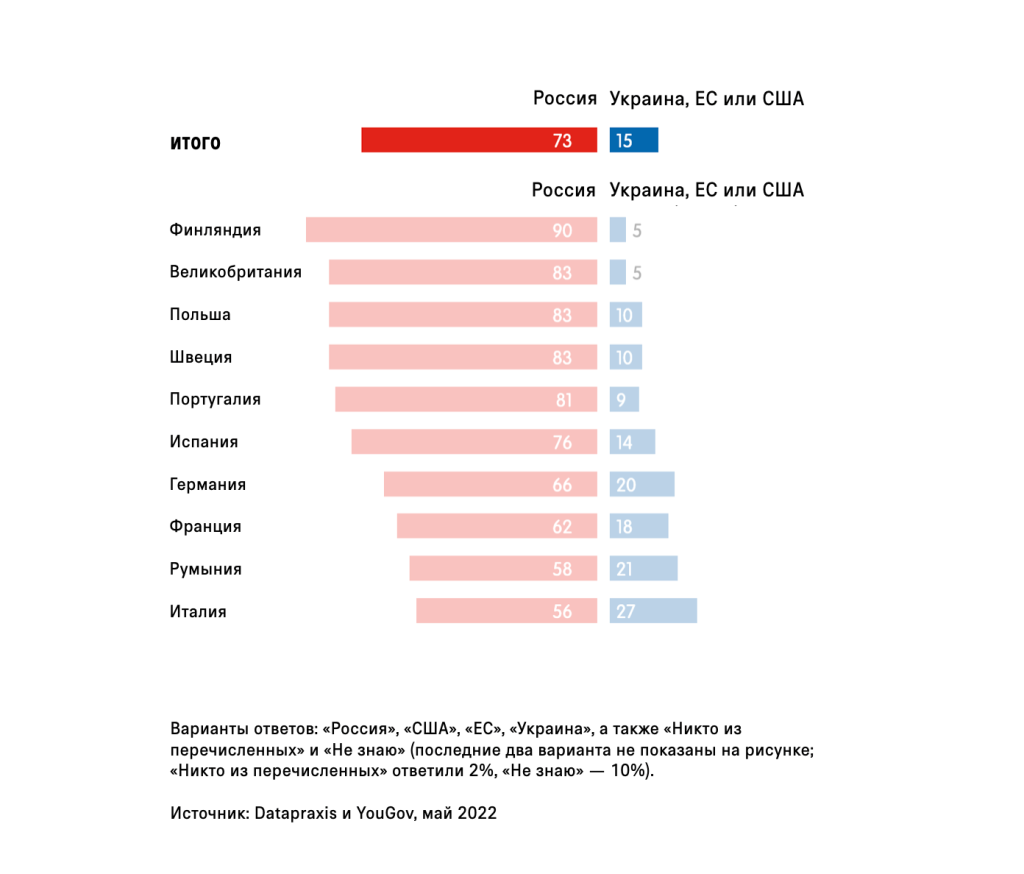
Who is responsible for the beginning of the war in Ukraine? % of the number of respondents
Europe after Russian invasion
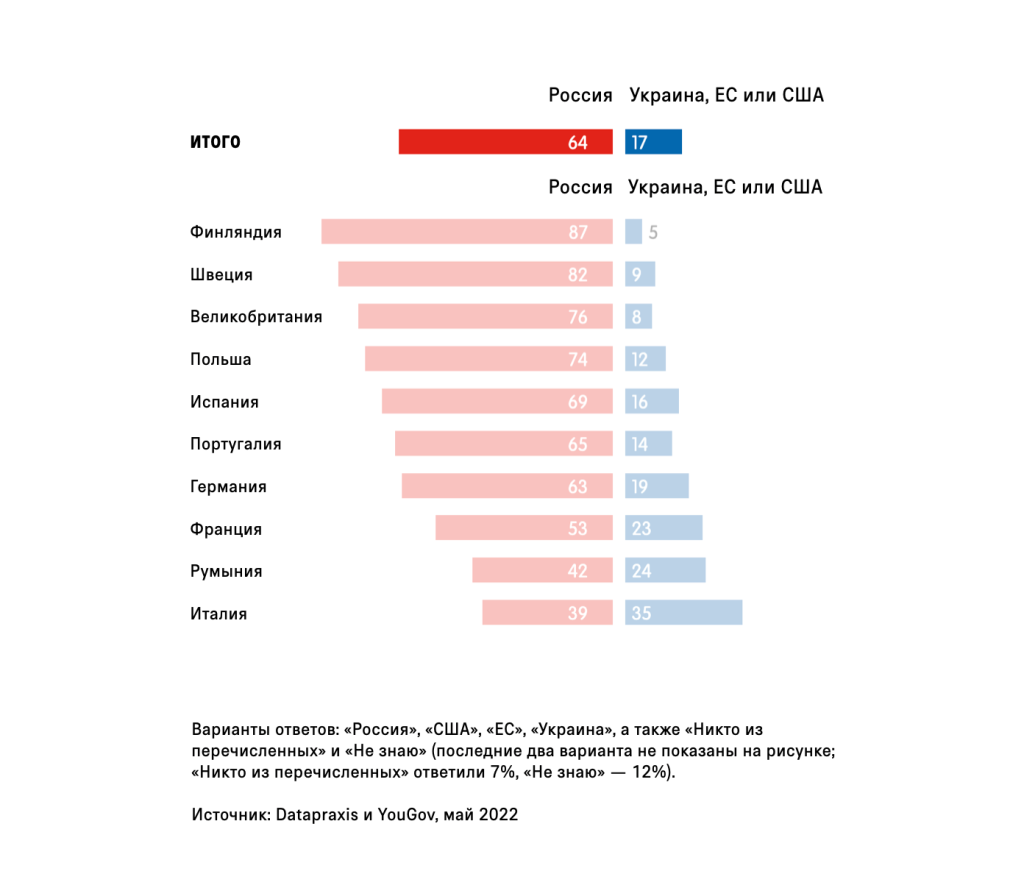
Europeans are not divided on the question of who to blame in the war - three quarters of the respondents believe that Russia is responsible for the conflict. They were not divided on the question of who is the main obstacle to the world - two -thirds of the respondents also indicate Russia. The only exception here is Italy, where opinions were divided between three groups close in size, which, respectively, Russia, Ukraine and the West, the main obstacle to the end of the war.
Which of the countries is the greatest obstacle to the world between Russia and Ukraine? % of the number of respondents
In general, Europeans do not hesitate in whose side they are: they want Ukraine to win. And they are ready to help her protect themselves. Moreover, our survey shows that most Europeans are ready to demonstrate solidarity with Ukraine in the form of providing it with economic assistance and weapons, supporting its membership in the EU and the reception of Ukrainian refugees. At the same time, they support strict measures against Russia, which include the use of economic sanctions, the termination of Russian imports of fossil fuel and the deployment of additional troops in Eastern Europe (but not in Ukraine itself).
Would you support the EU in the full stop of imports of fossil fuel from Russia? % of the number of respondents
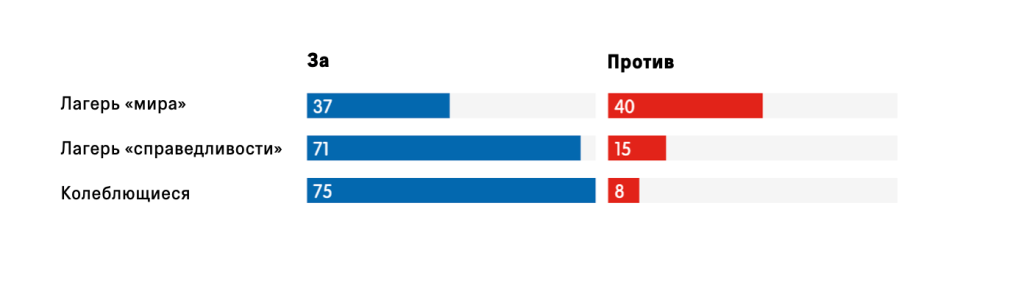
If the EU supported Ukraine’s entry into NATO, would you be for or against? % of the number of respondents
However, despite the fact that Europeans blame Russia in this war and hope for the victory of Ukraine, European countries and societies differ in how they see the possible end of the war.
The world is against justice
In theory, all Europeans agree that it is Ukrainians who must decide when to stop the war and agree on the parameters of the world. But in the survey, obvious differences in the understanding of whether Europe should strive to end the war as soon as possible - even if this implies concessions from Ukraine - or the main goal is Russia to punish for its aggression and the restoration of the territorial integrity of Ukraine, even if such a way leads to a protracted conflict and even greater human suffering.
In the survey data, Europeans look divided into two groups - to the Mira camp and the justice camp. Those who are united by the Mira camp want to end the war right now, even at the cost of concessions from Ukraine of Russia. The justice camp believes that only a clear defeat of Russia can lead to the world. This demarcation takes place inside many European countries and between them. And since the conflict in Ukraine turns into a long war of exhaustion, it risks in the future to become the main dividing line of Europe. And if political leaders are not attentive to the differences in positions that have shown in the survey, this may become a foreshadow of the end of the surprising unity of Europe that we observed.
A third (35%) respondents in those 10 countries where the survey was conducted can be attributed to the Mira camp, and the fifth part (22%) to the justice camp. Another fifth (20%) refuses to make a certain choice between the “world” and “justice”, but at the same time mainly supports how the EU meets Russian aggression in Ukraine. Representatives of this group mainly share the anti -Russian sentiments of the justice camp, but at the same time they fear escalations like representatives of the Mira camp. In the coming months, the pressure on this third group will increase, forcing it to change its position. And therefore their opinion and their voice can play a decisive role in determining the further steps of Europe.
The dimensions of the Mira camp and the justice camp are significantly varying in different EU countries, in different generations and among supporters of different political parties. It is noteworthy that while in all ten countries the “Mira” camp of the “Mira” camp is equally divided between men and women, a clear predominance of men is observed in the “Justice” camp: 62% against 38% of women. With regard to partisanship, it can be concluded that right -wing voters are more likely to belong to the justice camp than left. But this relationship is not manifested so strictly. In Germany, the preference of “peace” dominates both among the legal entertainers of the CDU/CSS, and among the left-gossket voters of social democrats, while “green” differs in that they have the greatest number of fluctuating voters.
In Finland, supporters of the ruling Social Democrats give preference to “justice”, while voters of the legal national coalition party were divided approximately equally. In Spain, the greatest share of supporters of “justice” falls on the radical-right VOX. Similarly, in Sweden, voters of radical-right “Swedish democrats” are the hottest supporters of “justice” from voters of the three largest parties. Meanwhile, in France, the far -rights advocate the “world”, and many left -wing voters are in the “oscillating” group. And although voters of all parties in Italy prefer the “world” of “justice”, supporters of the “brothers of Italy” and “League of the North” provide the greatest support to the “world” (more than 60%).
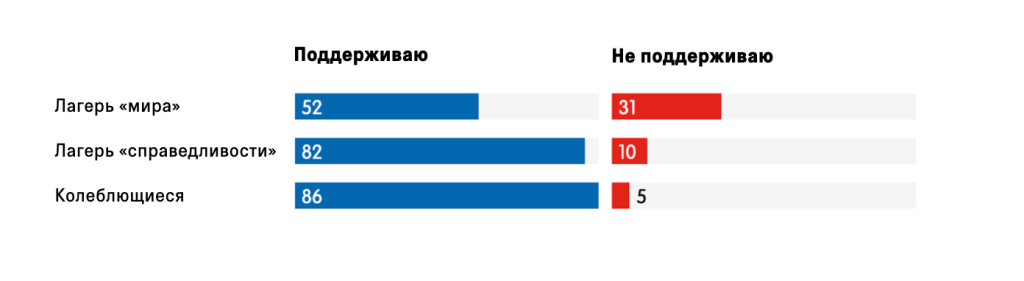
The camp of “Mira” and the “Justice” camp of a different attitude to the war. Although everyone accuses Russia of conflict, there are fewer of the Mira camp (64% compared with 86% in the justice camp). And of all three groups, it is the oscillating respondents to a greater extent that impose responsibility to Russia (92%). Similarly, the majority in the Mira camp and in the justice camp mainly consider Russia the main obstacle to the world, but at the same time in the Mira camp adhering to such a position much less: 53% compared to 79% in the justice camp. Among the fluctuating main obstacle to the world, the again the vast majority considers Russia.
Despite the fact that some pro -Russian (or anti -American) configured respondents can belong to the Mira camp, this does not at all make this camp friendly Russia. While the Mira camp and the justice camp agree that Russia and Ukraine will equally suffer as a result of this war, the justice camp believes that Russia will suffer “much more”, while representatives of the Mira camp believe that Ukraine will suffer more. That is, representatives of the Mira camp may be endured by the cessation of the war, because they believe that it causes Ukraine excessive suffering. The Mira camp also expresses a more joint conviction that the EU will suffer as a result of this conflict. This may be another reason why the supporters of the “world” want the war to stop. The Mira camp is largely a pessimistic camp.
As for the political and practical reaction of Europe to the war, the majority in all three main groups support the breakdown of economic ties with Russia. But the dimensions of this majority differ: in the Mira camp, 50% maintain a complete gap, and 37% not, in the justice camp the difference is 83% versus 11%, and among the oscillating respondents - 83% versus 7%. The “Mira” camp and the “Justice” camp also disagree with regard to a possible breakdown of diplomatic relations with Russia: the justice camp definitely supports this (70% “for” and 23% “against”), oscillating - also (60% “for” and 30% “against”), and the Mira camp is rather not supported (40% “for” and 49% “against”). In the same way, the justice camp and the hesitation supports the breakdown of cultural ties with Russia, while the Mira camp is rather not supporting.
Military issues also cause significant discrepancies. Three groups look at the question in different ways whether the useless zone over Ukraine should be introduced. The justice camp and the oscillating maintain such a proposal (54% “for” and 24% “against” and 41% “for” and 23% “against”, respectively), while the Mira camp is skeptical (25% “for” and 48% “against”). The question of sending troops to Ukraine also shares two camps: the justice camp and the oscillating supports this proposal (52% for the pros and 32% “against” and 49% “for” and 31% “against”, respectively), and the Mira camp is resolutely against (59% with 24% “FOR”).
As for Ukraine’s entry into NATO, the justice camp and the oscillating supports it with a great advantage (71% versus 15% and 75% versus 8%, respectively), while in the Mira camp, opinions were divided almost equal to the proportion: 37% support and 40% opposed. On the question of whether additional troops should be sent to the eastern NATO countries, the justice camp and fluctuating again decisively stand (75% versus 14% and 75% versus 8%,
As for the potential membership of Ukraine in the EU, all the camps are “for”, but in the camp of “peace” the superiority of supporters is quite insignificant.
In addition, representatives of the Mira camp and the justice camp came to radically different conclusions on the question of whether their countries should now increase defense costs. Most of the Justice camp (53%) supports an increase in military expenses, even if it means a reduction in financing of areas such as healthcare, education and crime prevention. And only 29% of supporters of “justice” said that their country should not increase defense costs despite the war, as this may require reduction in expenses in other areas. In the Mira camp, the proportions are almost completely opposite: 29% “for” increase in defense costs and 51% “against”. The opinions of the hesitating camp on this issue were divided approximately equally, with a slight advantage in favor of refusing to increase defense costs (35% versus 30%). Other answers to this question were “neither one” or “I don’t know”, while a significant number of fluctuating (26%) chose the first option.
Thus, the oscillating respondents are equally tough, if not tougher than the representatives of the justice camp, criticize Russia - they consider it primarily guilty of the war, see the main obstacle to the world and believe that Europe should break all the connections with it. At the same time, they do not share the moral indignation of the camp of “justice” and his desire for escalation. For issues such as the negative consequences of the war for Ukraine and the EU or an increase in defense costs, they are much closer to the Mira camp. In some ways, hesitating have the instincts of Kissinger realists. They are openly hostile to Russia and support a strict policy towards it, but they fear that a protracted war will be too expensive to Europe.
Speaking at the end of May at the World Economic Forum in Davos, the President of Ukraine Vladimir Zelensky said that his "task is that the world is not tired of the war." This is a difficult task. 50% of Mira supporters believe that their government pays too much attention to the conflict, while 38% - that it is enough or too little. Conversely, in the justice camp, 52% believe that the war is given either enough or too little attention, and only 38% believe that there is too much attention. Obigating the respondents closer to the justice camp: only 35% of them agree that the war is paid too much attention, while 47% believe that it is enough or too little. Therefore, it is unlikely that it is the fatigue from the war that makes them hesitate between the “world” and “justice”. The rest of the respondents more often say that this war is given too much attention (38%), less often - that enough or too little (22%), and most of them simply do not know what to answer (40%).
These data also demonstrate that even in the justice camp, a kind of “fatigue from solidarity” may soon arise. Две наиболее подверженные риску прифронтовые страны — Румыния и Польша — являются единственными странами, где более 50% людей говорят, что их правительства слишком много внимания уделяют войне в ущерб другим насущным проблемам. Поскольку многие сторонники «мира» считают, что в результате этого конфликта в худшем положении окажется Украина, а не Россия, дальнейшие военные успехи России также могут заставить еще больше людей присоединиться к лагерю «мира».
Separated Europe
Между странами — членами ЕС, граждане которых уже считают себя участниками войны, и теми, где люди все еще хотят избежать вовлеченности в конфликт, наметился значительный раскол.
Явным исключением является Польша, где респонденты предпочитают «справедливость» «миру» — 41% против 16%. В то же время предпочтение «мира» наиболее сильно проявляет себя в Италии (52%) и Германии (49%).
Взгляды европейцев на причины войны значительно различаются. Например, более 80% жителей Польши, Швеции, Финляндии, Португалии и Великобритании считают, что основную ответственность за развязывание конфликта несет Россия, однако в Италии таких 56%, во Франции — 62%, а в Германии — 66%. На вопрос о том, кто представляет собой самое большое препятствие на пути к миру, 64% опрошенных по всем странам ответили, что это Россия, но в Италии только 39%, а в Румынии 42% согласны с этим. В Италии более четверти опрошенных (28%) считают, что виноваты США — против 9% считающих так в остальных девяти странах опроса.
Тем не менее, полный разрыв с Москвой реален и останется какое-то время на повестке дня, независимо от того, как и когда закончится война. Все страны решительно выступают за разрыв всех экономических связей с Россией (62% к 22%), и ни одна страна, даже Италия, не возражает против такого курса. Также значительная поддержка — хотя и не столь сильная, как в случае с экономическими отношениями, — наблюдается в отношении разрыва культурных и дипломатических связей с Россией. В некоторых странах респонденты выступают против прекращения таких связей (Италия против прекращения культурных контактов; Италия, Франция и Германия против прекращения дипломатических отношений).
В целом, европейцы считают, что Россия и Украина проиграют от этой войны. Большинство европейцев — вопреки оптимистичным разговорам во многих европейских столицах, которые рассматривают войну как «час Европы», — также считают, что ЕС окажется в результате войны в худшем положении, чем была до нее. В то же время в большинстве стран преобладает мнение, что война не окажет никакого влияния на США или Китай.
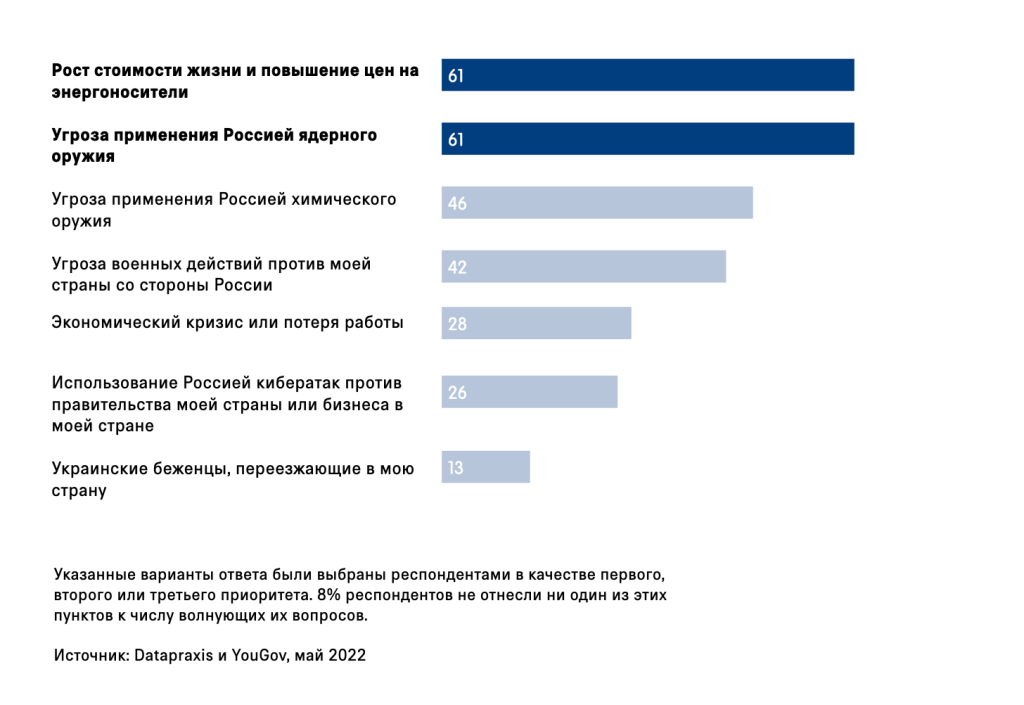
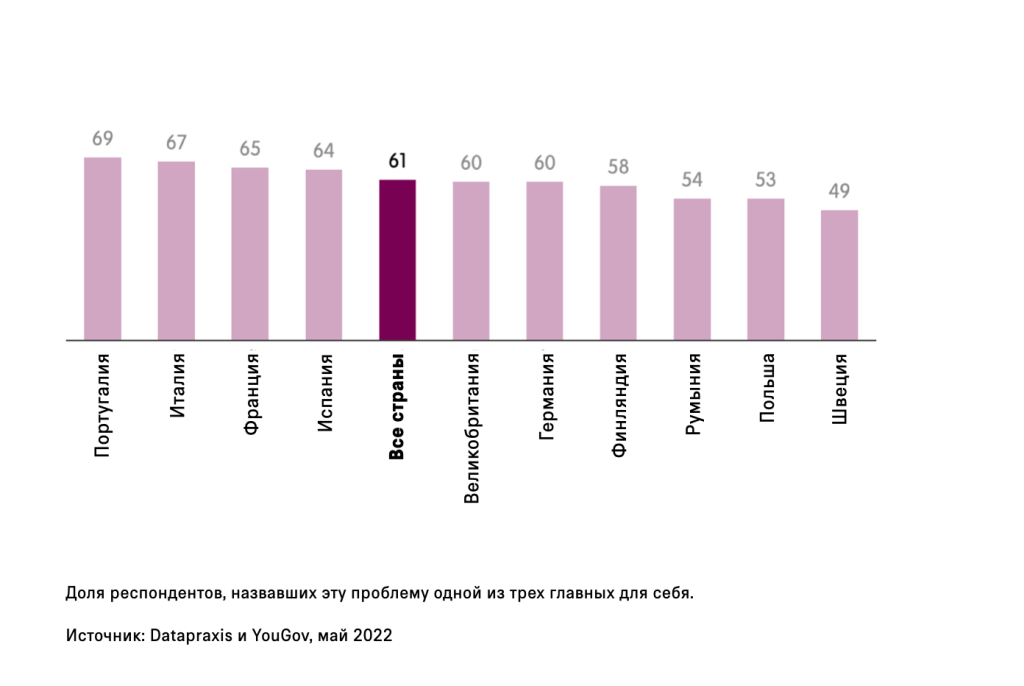
Два вопроса, которые больше всего волнуют европейцев в связи с продолжающимся конфликтом, — это рост стоимости жизни (в том числе повышение цен на энергоносители) и угроза применения Россией ядерного оружия. Но, несмотря на то, что беспокойство по этим вопросам существует во всех странах, в очередности основных проблем наблюдаются значительные различия. В Португалии, Италии и Франции люди больше всего обеспокоены влиянием войны на стоимость жизни и цены на энергоносители. Напротив, в Швеции, Польше и Румынии граждане меньше всего обеспокоены этим вопросом. Шведы, финны и французы больше, чем жители других стран, озабочены угрозой российских кибератак. А страны, расположенные ближе всего к России, — Финляндия, Польша, Румыния и Швеция — больше обеспокоены угрозой российских военных действий против них. Похоже ближайшие соседи России больше опасаются оккупации, в то время как жители прочих стран обеспокоены риском ядерной войны.
Что вас больше всего беспокоит в отношении войны в Украине? % of the number of respondents
Что вас больше всего беспокоит в отношении войны в Украине? Ответ «Рост стоимости жизни и повышение цен на энергоносители», % от числа опрошенных по странам
Раскол внутри Восточной Европы: Польша против Румынии
Пытаясь представить себе возможные будущие разногласия в Европе, вызванные войной, аналитики часто ссылаются на «разрыв между Востоком и Западом» и на различия между прифронтовыми странами и теми странами, которые географически находятся дальше от конфликта. Исследование ECFR дает гораздо более детализированную карту. Например, оно показывает значительные различия между Польшей и Румынией — двумя прифронтовыми странами, принимающими большое количество беженцев и исторически подозрительно и враждебно относящимися к России.
Несмотря на то, что Польша и Румыния граничат с Украиной, а их правительства являются наиболее последовательными сторонниками Киева, их граждане демонстрируют совершенно разное отношение к войне. 83% жителей Польши обвиняют Россию в конфликте, в то время как в Румынии эту позицию поддерживают всего 58% опрошенных. Что еще более важно, 74% жителей Польши считают Россию самым большим препятствием на пути к миру, в то время как в Румынии это мнение разделяет только 42%.
Также эти две страны выглядят фактически двумя разными планетами, когда речь заходит о предпочтении «мира» или «справедливости». Как уже отмечалось, Польша — единственная страна, где лагерь «справедливости» явно существенно больше лагеря «мира» (41% против 16%). В то время как Румыния, наряду с Францией, Германией, Италией, Швецией и Испанией, демонстрирует явное предпочтение «мира» «справедливости» (42% против 23%).
Поляки — одни из главных «ястребов» Европы, а румыны — ее главные «голуби». В Польше 77% опрошенных хотят разорвать все экономические связи с Россией, а в Румынии — только 45%. 74% поляков поддерживает полное прекращение импорта ископаемого топлива из России, в то время как в Румынии этот показатель составляет 51%. Аналогичным образом, 71% жителей Польши хотят разорвать с Россией все дипломатические связи, в Румынии — только 39% . И 73% опрошенных в Польше (по сравнению с 40% в Румынии) поддерживают прекращение всех культурных контактов с Россией.
Поляки и румыны также различаются в степени солидарности с Украиной. Например, предоставление Украине большей экономической помощи поддерживают 71% жителей Польши и лишь 54% жителей Румынии. Что касается вопроса об отправке дополнительных вооружений в Украину, то в Польше за это выступают 78%, а в Румынии — только 46%. Наиболее существенные различия между двумя странами наблюдаются в отношении идеи отправки войск в Украину: Польша — одна из немногих стран, где поддержка этого решения преобладает над оппозицией ему — 46% против 30%; румыны определенно выступают против отправки войск — 44% против 26% сторонников этого шага.
В то время как Польша — одна из двух стран, где более 50% опрошенных согласны, что эта война должна стать поводом к увеличению военных расходов, румыны гораздо менее убеждены в этом. Как видно, география — это не всегда судьба, когда речь идет об отношении граждан к войне.
Разделенный Запад: Германия против Италии
Взгляд на некоторые европейские страны, ранее наиболее дружелюбно относившиеся к России, также позволяет увидеть существенные различия в отношении к войне. В то время как восточноевропейцы регулярно обвиняют Германию в умиротворении России, новый опрос показывает, что граждане Германии являются намного большими «ястребами», чем, например, итальянцы.
Так, даже при том, что большинство немцев (66%) и итальянцев (56%) склонны в основном винить в войне Россию, они существенно расходятся во мнении о том, кто представляет собой самое большое препятствие на пути к миру. 63% в Германии считают, что это Россия, в Италии же с этим согласны только 39%. Италия также является страной с наибольшим числом респондентов, утверждающих, что в основном в войне виноваты США (20%) и что именно Соединенные Штаты являются самым большим препятствием для мира (28%); в Германии таких респондентов гораздо меньше — 11% и 9% соответственно.
В обеих странах преобладает поддержка разрыва экономических связей с Россией: 57% в Германии и 47% в Италии поддерживают эту идею, в то время как 29% и 36% соответственно выступают против. По ряду других вопросов немцы также оказываются большими «ястребами», чем итальянцы. Например, когда итальянцев спрашивают, что важнее — уменьшить энергетическую зависимость Европы от России или придерживаться климатических целей ЕС, их мнения сильно разделены. При этом большинство немцев считает необходимым прежде всего решить проблему энергетической зависимости Европы. И наоборот, жители Германии разделены в вопросе о том, следует ли разорвать культурные связи с Россией, в то время как итальянцы однозначно предпочитают их сохранить; Италия — единственная страна в этом исследовании, которая поддерживает такую позицию.
Немцы поддерживают (52% против 33%) отправку дополнительных вооружений украинскому правительству. Итальянцы — единственная нация, которая в основном выступает против этой идеи (45% против 33%). Аналогичным образом, в Германии преобладает мнение, что дополнительные войска должны быть направлены в восточные страны — члены НАТО (45% против 32%), а итальянцы в большинстве выступают против такого шага — 45% против 30%.
Возможно, самое разительное различие между Германией и Италией заключается в позиции их граждан в отношении расходов на оборону. Италия является исключением среди всех стран опроса: 63% респондентов заявили, что, несмотря на войну, расходы на оборону увеличивать не нужно; их повышения хотят лишь 14%. Между тем, Германия входит в число тех четырех стран (наряду с Финляндией, Польшей и Швецией), где население в основном поддерживает увеличение расходов на оборону (41% против 32%).
Таким образом, прежняя относительно дружественная позиция правительств по отношению к Москве также не является надежным ориентиром для общественного мнения в условиях войны.
Грозит ли Европе новый кризис беженцев?
Война в Украине разрушила привычные представления о «расколе Европы». Одним из поразительных последствий войны стала метаморфоза Восточной Европы в отношении к тем, кто спасается от насилия: некоторые из государств, во время кризиса 2015 года стремившихся не пускать к себе сирийских беженцев, теперь принимают наибольшее число беженцев из Украины.
Однако результаты опроса ECFR намекают на то, что миграция все еще может стать причиной разногласий на востоке, как это произошло в Турции после того, как Анкара открыла свои границы для сирийских беженцев. В то время как большинство европейцев рады принять украинских беженцев, Румыния, Польша и Франция относятся к числу стран, наименее открытых к этому. Возможно, на это влияет тот факт, что Румыния и Польша уже приняли большое число украинских беженцев, а Франции, стране, которая до сих пор почти не принимала украинцев, присуща токсичная иммиграционная политика. И тот факт, что беженцы в Польше живут в основном в частных домах, возможно, влияет на представления поляков о том, какую позицию их страна должна занимать дальше в отношении этого конфликта.
Conclusion
Война похожа на американские горки: общественное мнение может меняться при каждом повороте, и в то же время это очень мощная движущая сила. Как недавно написал Гидеон Рахман из Financial Times, «война в Украине, по сути, ведется на трех фронтах и между тремя действующими лицами. Первый фронт — это само поле боя. Второй фронт — экономический. Третий фронт — это битва воль. Три ее участника — это Россия, Украина и западный альянс, поддерживающий Украину».
То, что происходит на любом из трех фронтов, влияет на два других. Военные успехи Украины имеют решающее значение для увеличения численности лагеря «справедливости» (неформальный лидер которого, Зеленский, обладает удивительной способностью разговаривать с европейской общественностью). В свою очередь сторонники лагеря «мира» уже сегодня являются самой большой группой среди европейских граждан и, вероятно, будут расти в числе, если усилится ощущение, что жесткие экономические санкции против России не приносят результатов.
Итак, что нам говорят результаты этого опроса о продолжающейся битве воль и о том, как сохранить поддержку мер, принятых для вооружения Украины, и поддержку санкций против России? Зависимость Украины от действий ее европейских соседей означает, что исход битвы воль, вероятно, будет даже более важен, чем то, что произойдет на экономическом и военном фронтах.
Следующие несколько недель будут решающими, и результаты опроса показывают, что при правильном политическом подходе единство Европы можно сохранить. Результаты опроса свидетельствуют, что разрыв Европы с Россией необратим, по крайней мере, в краткосрочной и среднесрочной перспективе. Теперь у европейцев нет никаких мотивов мечтать об интеграции России в свои структуры или политическое сообщество. Похоже, они стремятся к миру, в котором Европа полностью отделится от России.
Но европейский консенсус в отношении России не означает автоматически общей позиции относительно того, какую роль ЕС должен играть в войне. Данные свидетельствуют о растущем расхождении между лагерем «мира» и лагерем «справедливости» по мере затягивания войны и роста связанных с ней расходов. Опрос выявляет потенциальные разногласия по вопросам беженцев, вступления Украины в ЕС, влияния войны на уровень жизни и угрозы ядерной эскалации. Все это вместе принимает форму раскола между лагерями «мира» и «справедливости». Во многих европейских странах дело Украины из объединяющего национального проекта может превратиться в политическую проблему, вызывающую разногласия. Но, помимо возникновения напряженности внутри отдельных стран, война может также привести к тому, что политические позиции таких государств, как Польша и Италия, будут все больше расходиться.
На ранних этапах войны страны Центральной и Восточной Европы почувствовали, что их извечное «ястребиное» отношение к России оказалось оправданным, и их уверенность в себе и вес в ЕС возросли. Но на следующем этапе такие страны, как Польша, могут оказаться на обочине, если лагерь «мира» станет более привлекательным и для других стран — членов ЕС.
Ключом к сохранению европейского единства в поддержку Украины является серьезное отношение к опасениям эскалации и представление конфликта как оборонительной борьбы против российской агрессии, а не разговоры о победе Украины и поражении России.
Хотя украинский конфликт может стать повивальной бабкой гораздо более мускулистого Евросоюза, исследование ECFR показывает, что поддержка увеличения расходов на оборону среди населения слабее, чем может показаться, если слушать только политических лидеров. И возможно, самым тревожным признаком является то, что большинство европейцев считают ЕС главным проигравшим в войне и не рассматривают его относительное единство как признак укрепления.
Существует опасность, что противоречия между лагерем «мира» и лагерем «справедливости» могут стать таким же фактором поляризации, как позиции должников и кредиторов во время кризиса евро в начале 2010-х годов. Если это допустить и если ЕС, в результате, окажется парализован собственными внутренними разногласиями, война может стать предвестником дальнейшей маргинализации Европы на мировой арене.
Европейское общественное мнение укрепило единство ЕС перед лицом вторжения России в Украину. И теперь от европейских лидеров зависит сохранение этого единства. Поиск языка, привлекательного для тех, кто колеблется в своей позиции, то есть жесткого по отношению к России, но в то же время осторожного в отношении рисков эскалации, и является решением проблемы «квадратуры круга» общественного мнения.
Если ЕС удастся сохранить тот широкий фронт, который он демонстрировал до сих пор, и если правительства его стран будут прикладывать усилия к тому, чтобы сохранить единство, а не пытаться унизить друг друга, то из тени этой войны все еще может выйти более геополитически сильная Европа. И то, чем закончится российское вторжение в Украину, будет иметь далеко идущие последствия для назревающего конфликта между США и Китаем.
Источник: European Council on Foreign Relations