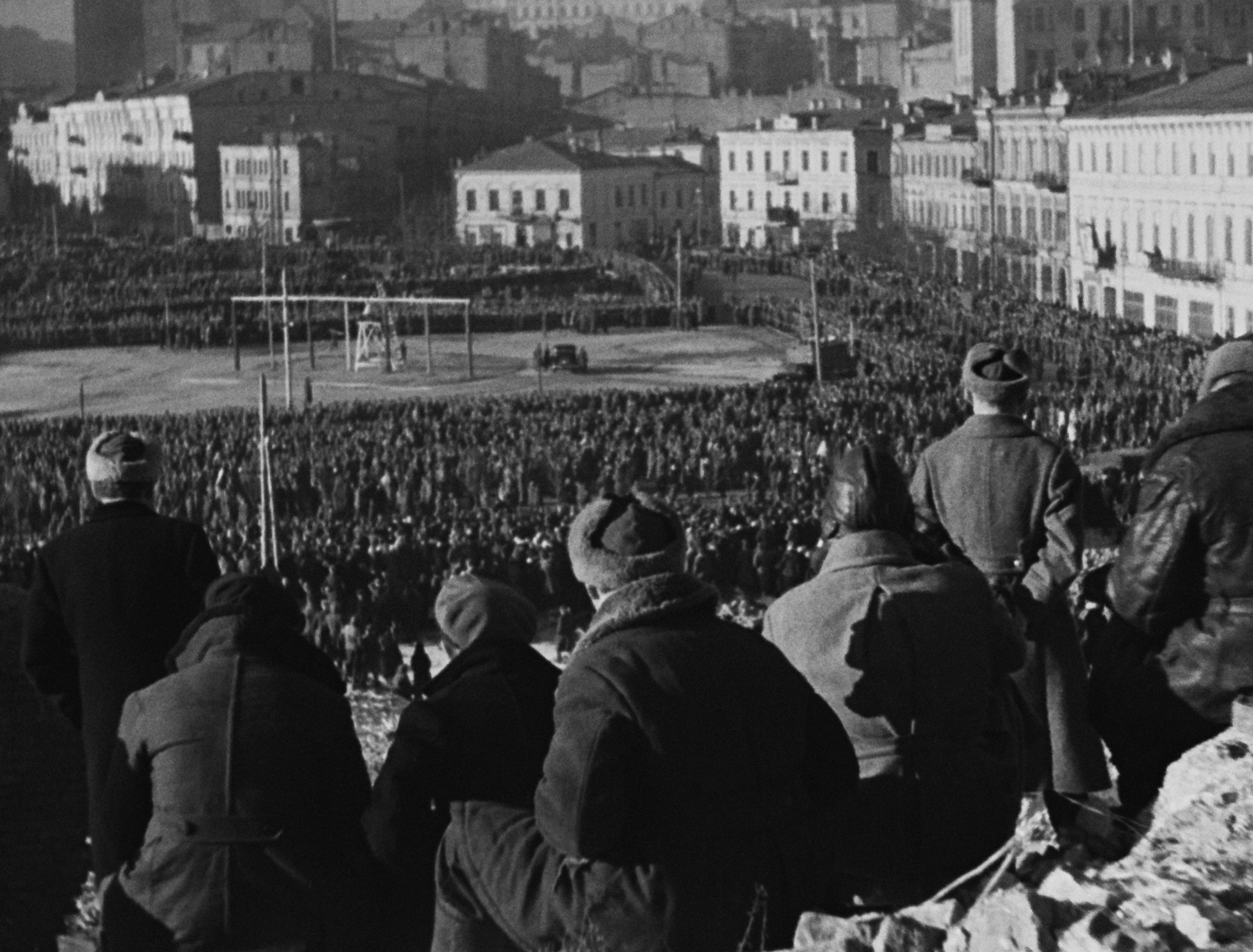
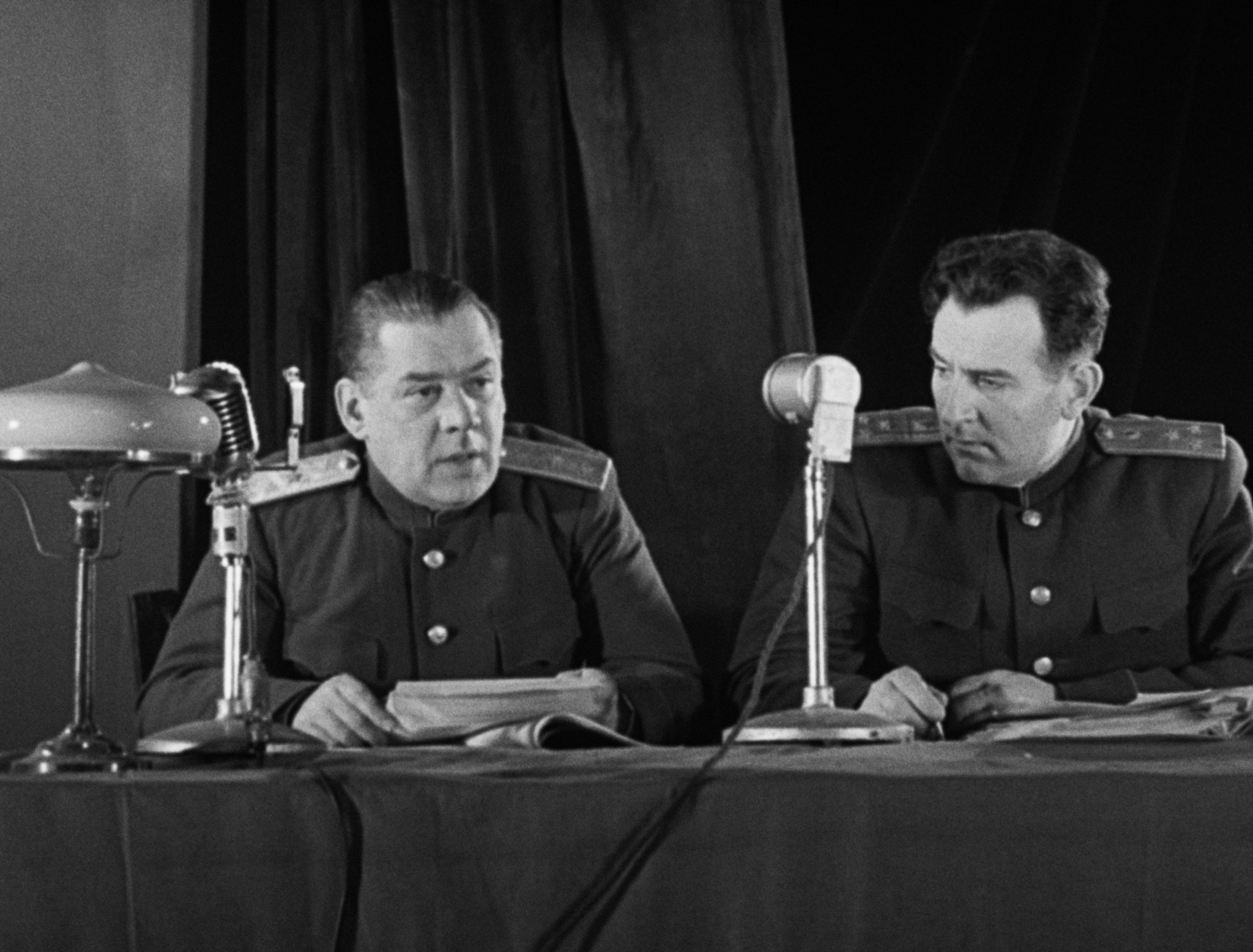
From January 17 to January 28, 1946, a trial of Nazi criminals was held in the Kiev House of Officers. The court was faced with the former chief of the Kyiv police, Lieutenant General Paul Scheer, Lieutenant General Karl Burkhardt, SS officer George Haynish and another 12 people who were accused of massive extermination of the civilian population in the Ukrainian SSR. Three defendants were sent to the camps, the rest were sentenced to hang. The public execution - with a large gathering of the people - took place on January 29 on Kalinin Square (now - the Maidan of Nezalevniy). Similar processes took place in Minsk, Riga, Kharkov, Sevastopol, Leningrad and other cities. On all ships over the military personnel of the Nazi coalition, 252 people were sentenced to the highest degree of punishment and the long term of imprisonment.
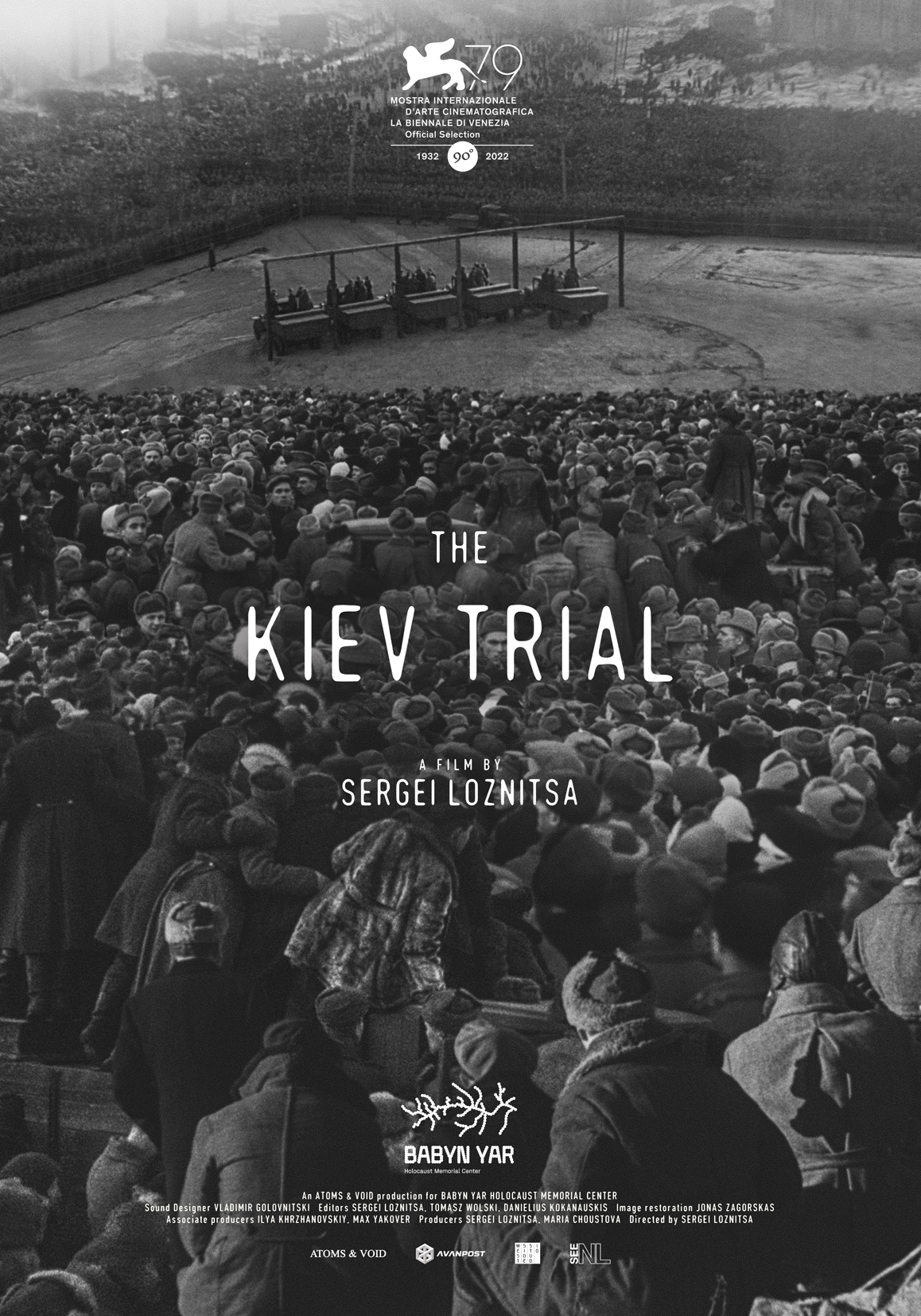
Poster to the film "Kyiv process" by Sergey Loznitsa
The courts were open, they were lit in the Soviet press, they were shot by movie operators. The film “Kiev process” mounted from archival materials continues the cycle of documentary tapes by Sergey Loznitsa dedicated to the key events of Soviet history (“Blockade” (2005), “Event” (2015), “Process” (2018), “State Fast” (2019), and is directly related to the film “Babiy Yar. Context”, even up to the repeat of several scenes - For example, the testimony of Dina Pronicheva, who survived during the massacre of Kyiv Jews in 1941.
During the year sharing two films about the Hitler occupation of Ukraine, events have occurred that change the perception of the chronicle of 1946. Looking at the Nazis answering the questions of prosecutors, the viewer thinks about the war unleashed by Putin, and the murders of civilians of the same cities, whose names sounded in the hall of the Soviet court. Will another Kyiv process take place over those who attacked Ukraine on February 24?
An interview with Sergey Loznitsa was recorded before the premiere of the film, which took place on September 4 at the Venice Film Festival.
- “Babi Yar. Context” was assembled from the materials that you found in the archives of different countries, and here all the material is obviously in the Soviet archive. Who took off the court and did Soviet spectators see these shootings? Was there a plan in 1946 to make a documentary out of this, as from the materials that were shot during the Stalin's funeral?
Through all this stagnantism, the true nightmare of the war is peering
- These materials are in the Krasnogorsk archive. The process was removed with the participation of the CSDF, a movie magazine was made in Ukraine, 17 minutes, it is stored in the Archive named after Pshenichniki in Kyiv. Thus, the material was divided: the magazine is in Kyiv, and Kyiv operators were filmed, and all the material left for Moscow. It seems that no one was going to do anything from this material. The archive has 13 boxes plus two boxes of the mounted movie magazine in the Pshenichniki archive, only 150 minutes.
- That is, most of the material entered your film?
- Yes, the film is 1 hour 45 minutes, most of them came in. I tried to preserve as many evidence as possible and the personnel of the destroyed city. All that could be mounted without destroying the structure of the film, I turned on.
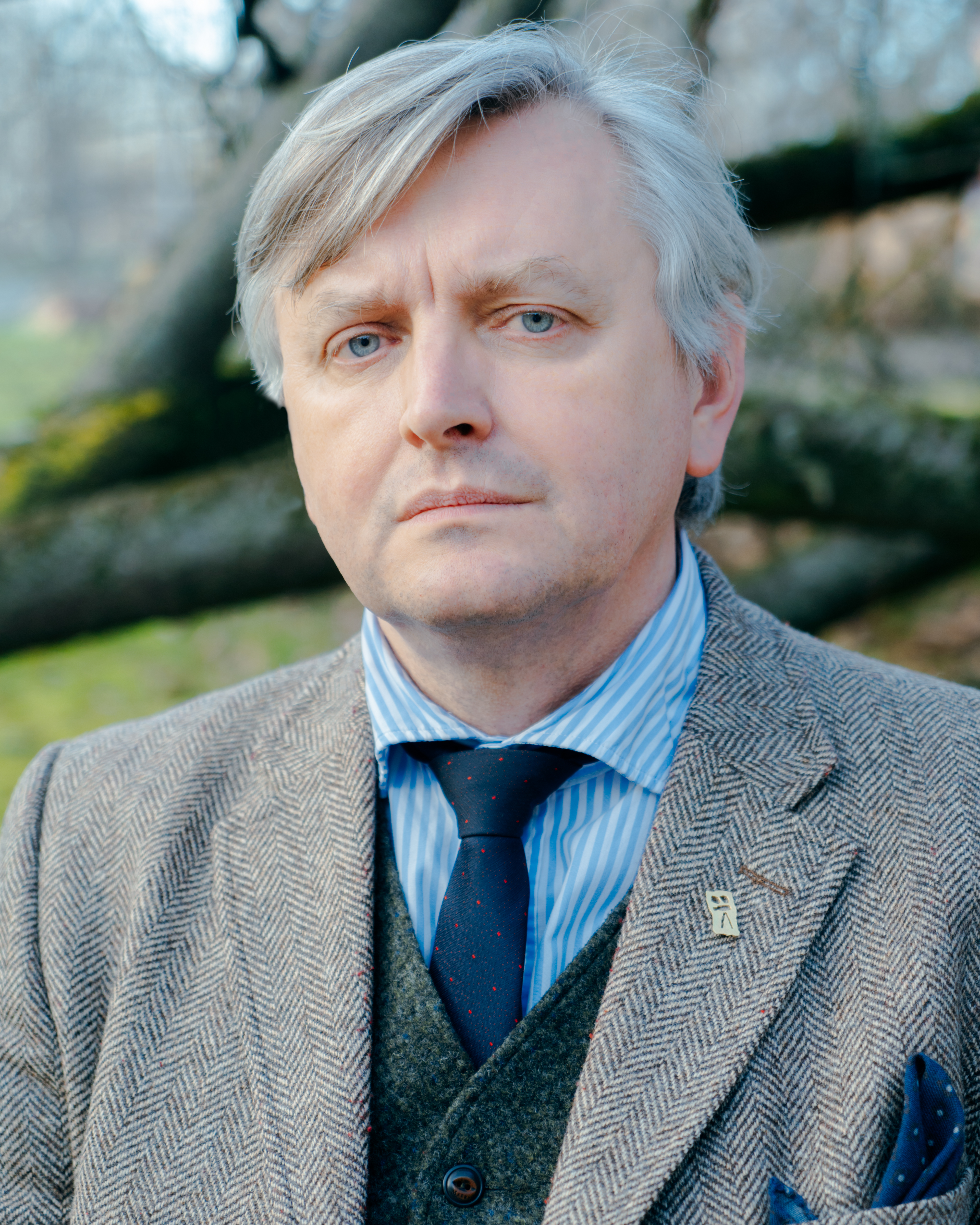
Sergey Loznitsa
- The Kyiv process is similar to the performance. The defendants and witnesses know their roles, there are no - at least in these materials - emergency incidents. We know how the Stalinist processes were directed, you have a film about the case of the industrial party, where everything is also very theatrical and supposedly reliable, but in fact a fake. And now the modern viewer has a question: what if it’s not true here? To what extent can we believe this material?
- Two extreme points, one - we believe absolutely in what happened, and the other - all this is the fantasy of Comrade Stalin and investigators of the military prosecutor's office. I think that the truth is in the middle, as usual. We have found a transcript of the process, this is a unique document. She was not deciphered and was in the archives of the SBU. We deciphered it, the Kiev memorial center of the Holocaust "Babi Yar" was going to release a book about the process and publish a transcript. Ten days there was a process, we have one fiftieth of what was said there. It can be seen that German criminals read some answers on paper. The choice of the defendants was specific, it was necessary to show the whole spectrum - from a Wehrmacht soldier, Lieutenant SS to General Wehrmacht or SD. Some defendants - for example Heinish, a close friend of Hitler - took part in other processes. There was a general who tried to defend himself, he even refuted the testimony of witnesses, did not agree. On some days he was not present at the process, they said that he was sick, but we can assume that his behavior interfered with the judges. That is, not everything went so smoothly. The task of the process is to entrust all the guilt for everything that happened to Nazi Germany in order to avoid responsibility on the Soviet authorities - responsibility for the beginning of the war, for the wildness with which it passed in relation to the local population, to the infrastructure of cities. After all, Kyiv was blown up by the Soviet authorities. All this tried to put on the Germans and did it very successfully, propaganda worked well. The value of the Kyiv process, in any case for me: through all this staged, through the absent nature of the main military prosecutor, judges, lawyers who were at some of the defendants, visible the true nightmare of the war. The composure with which German officers who participated in mass destruction are amazing, they tell everyone about this. But witnesses cannot restrain their emotions. Despite the fact that the process was prepared for certain purposes, the human one can’t restrain the human here, the camera grabs it. That is, this is not pure propaganda, we cannot say that this is all a fake.
Frame from the film "Kyiv Process"
- The scene that you included in the film "Babi Yar. Context" and in this film - the execution of the defendants, it is amazing in every way. There were many such executions at that time - both secret and public. Now a monument of the Soviet Army has been demolished in Riga, it was installed on the field where the same execution was held in 1946. I don’t know if there were other such shootings.
- Were. I have the material of executions in Melitopol, there is material of execution in Kharkov, there is material of execution in Riga. By the way, the Governor-General of Kyiv was executed in Riga. Everywhere where the processes were carried out, they ended with execution, and this execution was shot. In the film "Blockade" I used such material - execution in the square near the Giant cinema, also after the process, about which the film director, Pope Alexei Teacher made the film.
- You have long been planning to make the phenomenon of Babi Yar, shooting is postponed for various reasons. These two documentary films are like two planets around the luminar, which still does not exist?
We are now again starting to experience the circumstances that people experienced in the late 30s-early 40s
- These are independent films that are associated with the idea of a big film. I really hope that we will still make Babi Yar next year. I don’t know where the shooting will be, because it is not clear where the war will be and in what light we will live. This is a very important topic. We are now again starting to experience the circumstances that people experienced in the late 30s and early 40s. We are faced with the same challenges, which, unfortunately, we answer exactly the same. It is amazing that we continue to respond to everything that once reformatted by the European community and Soviet people. It is necessary to talk about this, everything must be comprehended.
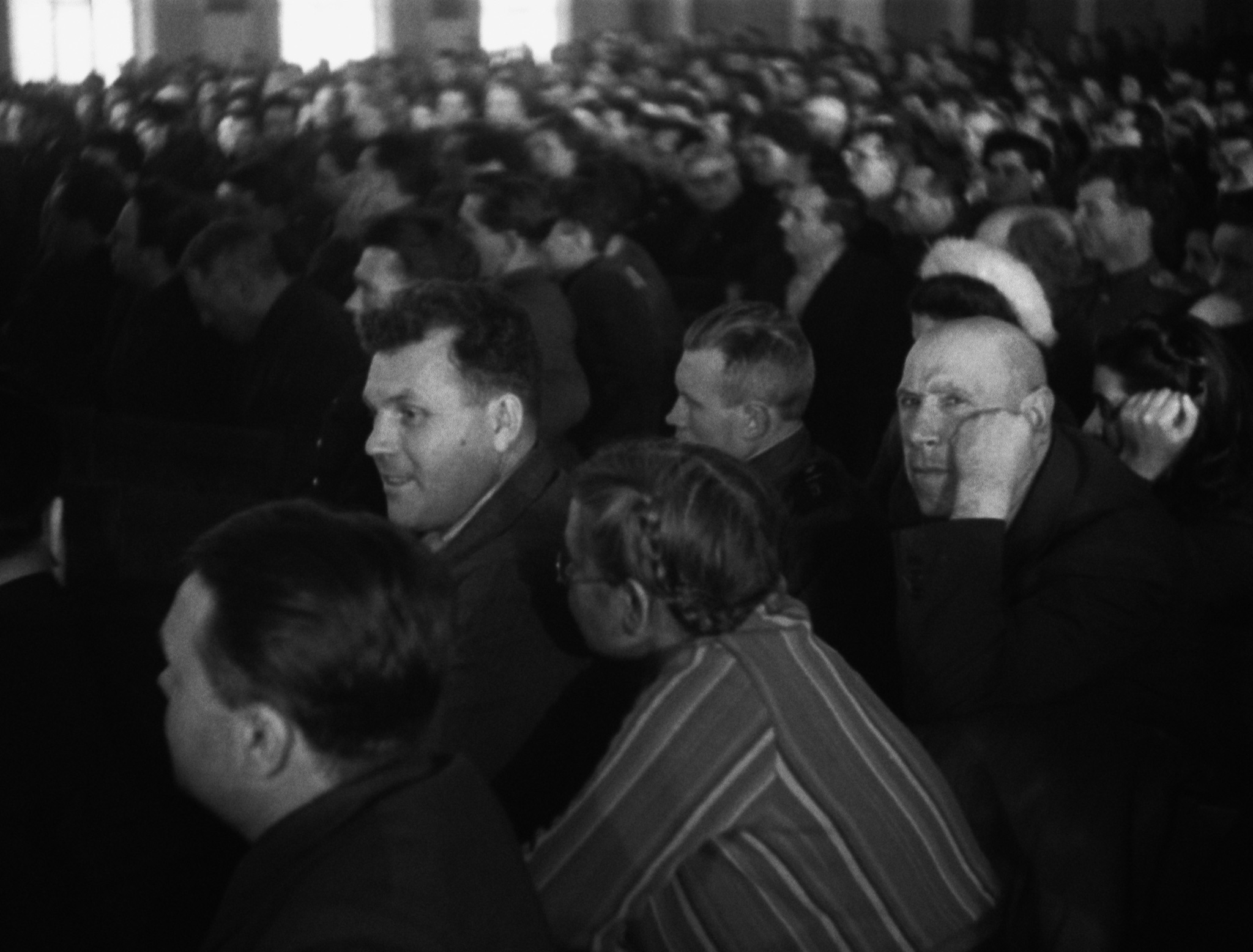
Frame from the film "Kyiv Process"
- How to watch your film from the inside of a walking war? Should the viewer, in your plan, should draw parallels?
we were covered with the ninth shaft of hatred, and it returned us 80 years ago
- I think that if the court takes place after this war, then it will be very similar in terms of evidence that it was in Kiev in 1946 and the Nuremberg process. It would be good if the future process was carried out comprehensive, covering all the issues that someone would not really like to affect. In terms of testimony, we will hear evidence of the same savagery, which is part of human nature. I hope here on neurobiologists, physiologists who are engaged in the brain, on their ability to explore chains that lead to aggression, and somehow localize in time, including medical methods, unwanted aggression in the human body. I hope this more than on any moral and other effects on a person.
- I know your idea that this is a psychosis that attacks a person, then disappears.
- This is all very sad. As soon as bombs began to fall as soon as people began to destroy - we can confidently talk about tens of thousands of victims - they roseWaves of the oncoming hatred, we were covered with this ninth shaft of hatred, and this returned us 80 years ago. Moreover, 80 years ago there was no such powerful weapon and such a powerful impact on people. It is very difficult for us to evaluate this impact now, because we ourselves are its victims. We will see the results later, this will all leave a long mark in our lives. The film appears at the moment when the same wave covers us again. This is the plague that comes from nowhere and disappears nowhere, lives of his own free will. We are not able to resist this plague - this thought is terrible. We are forced to worry about her, to look for our place in this stream, in which I really would not like to be present at all. The power of hatred is great - it is terrible.
“When I watched your film, I thought about the process that was also now in Kiev,” in the case of the Russian ordinary Shishimarin , who killed a civilian resident. Maybe this is the prototype of those vessels that we just talked about.
Among the countries of the Alliance, which fought with Hitler Germany, there was a terrorist state
- You can recall the film Stanley Kramer "Nuremberg process." After all, the question is insoluble there. The German judge, who is judged , is played by Bert Lancaster, - has such protection: he swore allegiance to his people. And if the people adopt laws such as the law on castration directed against the insane, if the people adopt the laws, trusting their government, then he is forced to follow this, because they gave the oath. But what to do with the people who agree to the authorities adopting inhuman laws? This is a fundamental question of our time. This question has no answer yet. On the other hand, there is a personal dimension in such a situation. This judge could resign, feeling that he was committing a crime. So, when such processes are carried out, these questions will also arise. Justice is to some extent restoring the status quo. What is the Kyiv process, such a status quo was restored. I hope that all these processes of the future will not end with public execution.
“We can say here that some criminals are judging other criminals.”
- You have touched on a very important problem that was not solved. Due to the political interests of different countries, the crimes of the Soviet Union were not considered in the Nuremberg process, the beginning of World War II was not considered. Among the countries of the Alliance, which fought with Hitler Germany, there was a prisoner country, there was a terrorist state that fought with another terrorist state, and it remained a winner. 80 years passed, and this state blossomed again as a terrorist at the moment when it allowed him to make an economic situation. I consider this war a continuation of the Second World War, since then the possibility of the existence of a unitary terrorist state was not eradicated, which was the Soviet Union, and then the part that became the Russian Federation. This unresolved problem has come back again, and it must be solved. This is not even the case of Ukraine to protect itself separately from everyone, this is the matter of the entire world community - to complete this story. This is still the story of the twentieth century, it is impossible to live with her. So it is no coincidence that Putin insists all his ideology on the idea of the winning state, the Liberator state, on all this lies, which we have heard from each iron for several decades. This must be taken seriously. Just as seriously as this reacted to the Armed Forces of Ukraine.
Frame from the film "Kyiv Process"
- I know that in addition to Babyeu Yar, you planned to make several documentary films. Did the war affect your plans?
What to do with the people who agree to the authorities adopting inhuman laws?
- Now I am starting to make a play, which I wrote from Jonathan Littlel's novel. I put her in Vilnius in Lithuanian. This is the same topic - the Holocaust in the territory of the Soviet Union. I concentrated only on this line in the novel, on crimes and an attempt to comprehend them. In the next three months, we will be rehearsed, the premiere of the performance is planned for December. In parallel, I started shooting in Ukraine. I am again interested in war crimes that have been committed in the last six months. A lot of organizations are engaged in investigations, in addition to the Ukrainian prosecutor's office. I am interested in what are the possibilities of international justice. As you can see in the case of the MH-17 aircraft, the possibilities are not so great. Everything will depend on how the war ends. I am also interested in how the war transforms people's lives. I think that next year a documentary will be made. We prepare the shooting of the film "Babi Yar", watch locations. And I also wrote a script for the story of George Demidov “Two Prosecutors”, I also think that in a year or two I will make this picture. It is very important to return and explore the Stalinist period, which laid the foundation of those societies in which most of the citizens of the former Soviet Union now lives. George Demidov has three amazing novels about 1937, I would like to make a film based on these stories - about the Soviet punitive system at the time of its formation. What Demidov narrates about is echoing with what is happening now.
- And all these films are formed in a large structure, complement each other.
- I would very much like to add this mosaic. Judging by how the authorities of different countries are acting now, they often do not understand the essence of the problem. Their actions are dictated by momentary political interests, but they strategically begin to lose. You need to have something that you can lean on to prove your case. And so - all with the flow float, and nothing good comes out of this, and good efforts spray and disappear.
"Children before ..." Artemy Trinity, erotica and music September 04, 2022
Get 'Em Off! Music for Strippers - From Burlesque to Strip Clubs. Fragment of the envelope of thematic compilation
Two hundred and forty-year output and radio program "Music at Free" are devoted to the most summer and vacation topic: erotica and sexuality in pop and rock and rolling packaging. Rock Critic Artemy Troitsky , a major expert on the subject of research, considers the similarities and differences of the American, French and Italian musical and erotic traditions.
"Kyiv process" at the Venice Film Festival
Each woman and every man has his own, purely individual attitude to sexuality in music. Who likes Natasha Korolev A, to whom Leonard Cohen , and to whom Kenny Gi instrumental. On a stimulating (or vice versa) role of music in love, there are also different points of view. Personally, I, for example, preferred silence: if I did not like accompanying music, then it annoyed; If you liked it, it was distracted; In any case, it created interference. Many, on the contrary, consider certain music the ideal instrument of seduction. In the United States in the 1950-1960s, the term Bachelor Pad Music, "Music for the Bachelor Berlog," even existed. It was meant particularly sensual music, as a rule, an instrumental orchestra, specially "sharpened" to bring the guest of a predatory bachelor into a proper state.
In different countries, the traditions of musical eroticism are different and the same ultimate goal is achieved in different ways
Interestingly, in different countries, the traditions of musical eroticism are different and the same ultimate goal is achieved in different ways and in different contexts. I will explain this mysterious thesis with specific examples. Long before the "Music of the Bachelor Berlogi" in the USA there was a tradition of the so-called "Burleske show", which by the forty years of the last century grew into a more familiar striptease. If erotic scenes in Burleske were part of a general theatrical performance with the participation of singers and stand-up comics, then the striptease focused exclusively on the process of artistic undressing and passed to specially selected music. As a rule, it was an orchestral jazz at a slow or medium pace, with penetrated solo on a sax or pipe. The orchestras of David Rose (author of the famous play by The Stripper ), Sonny Leicester and Ernie Freeman specialized in this, for example.
David Rose orchestra. The Stripper
Many samples of such music are available on the thematic compilation "Take off everything! Music for striptease" ( Get 'Em Off! Music for Strippers ). For my taste, the plays are all the same and rather boring. Therefore, I chose two atypical tracks. Firstly, the PAD of the guitarist and arranger Bobby Summers : 1959 recording in the style of the vocal surf. Musician from California, brother of the famous singer Mary Ford . He continued to release albums of virtuoso guitar music in different styles for another two decades, but no longer marked on the field of strip-hits.
Bobby Simmons and his Pad
The second funny American track is called Take It Off! - Fulfill him The Genteeels . Also recording actually the Dogatlov era, 1962. An completely unknown group, which released only 2-3 single (“Take it!” - the first of them) in his entire short career. This is already, I would say, an early garage rock for especially cheeky striptezers!
The Genteeels with the composition Take It OFF!
But in France, everything is completely different. The Anglo-Saxon striptease and its musical derivatives in the country of gallant Chevalier categorically did not vaccinate, but the spirit of eroticism permeated the entire local pop singer, which is called by the French chanson. From the tender "undress me" performed by the incomparable "muse of the existentialists" Juliette Greco to the cyberurotism of the Air group Boy . Well, of course, it was in France that the indisputable main sex hit of all times and peoples Je T'aime ... Moi Non PlusSerge Gensbur and Jane Birkin .
I picked up French material on the recently released Sex-O-Rama retrospric. Alain Gorager is a composer, a pianist and an arranger who worked a lot, among others, and with Gensbur. He became famous primarily as the author of very eccentric music for the cult film "Wild Planet" (1973). A sense of humor is present, and a sense of proportion is also absent on the later (1976) its records of the Sexy Dracula , released under the transparent pseudonym Monsieur Gorager . This composition is in two versions - neutral instrumental and much more bloodthirsty vocal. I would define the style as "French horror-disk."
Monsieur Goraguer with the Sexy Dracula theme
Unlike Alena Gorager, the duet Jacques Frands and Sonya Reeph is not known to anyone. The song "Big Secret" was released on a single in 1970, the calculation was clearly that this sensual bed dialogue would continue the success of the scandalous duo of Hensbur - Birkin. But it did not work ... The record, nevertheless, is amusing.
Jacques Frençay & Sonia Reef with the composition Top Secret
Italian pop music-for my taste, for the most part, sweet, pathos, completely devoid of humor, and eroticism there is clearly not enough, which you can’t say about Italian cinema. I mean light erotic comedies, of which an incredible amount was removed on appenins in the 1960-1980s, and they were all accompanied by wonderful music. A lot of this material was reprinted in the 1990s, but something continues to be released now-in particular, the compilation "naked: 21 exciting fragment from the Italian sex-comedies in the style of disco (1975–1981)." Let's just say: the selection is not outstanding, but here a couple of tracks attracted my attention. In particular, the theme of the composer and saxophonist Wittorio Pensel from the movie "Lyceumist" (1975). This is a classic of sounding erotica: whisper, timid breath, trills of a languid solo instrument. Probably, most people have the phrase "music and sex" inspires just such associations. Interestingly, YouTube does not allow the transfer of this entry without age -related restrictions. Therefore, in the text version of the podcast, listen to the musical topics La Liceale , but in the sound you will find all ohs and sighs.
Musical themes La Liceale
By the way, welcome to the new, sixth season of "Free music"! 240 episodes of podcast and radio programs are ten days of continuous sound of the highest quality world music and mine, I am not afraid of this definition, unobtrusive and at the same time exhaustive entertaining.
Playlist of the 240th release of "music at large":
1. Jane Weaver (UK). Flock, LP FLOCK
2. Samba Touré (Mali). Kola cissé, lp binga
3. Reb Founin (New Zealand). The Last Word, LP Reb Foundin
4. Reb Founin (New Zealand). Invisible Man, Lp Iris
5. Cosmo Jones Beat Machine (Finland). Dr. Butt's Dispensary, LP Skeleton Elevator
6. Bobby Summers (USA). Pad, lp get'em off! Music for Strippers
7. The Genteeels (USA). Take It OFF! LP get'em off! Music for Strippers