
Translated material
Baby Pu
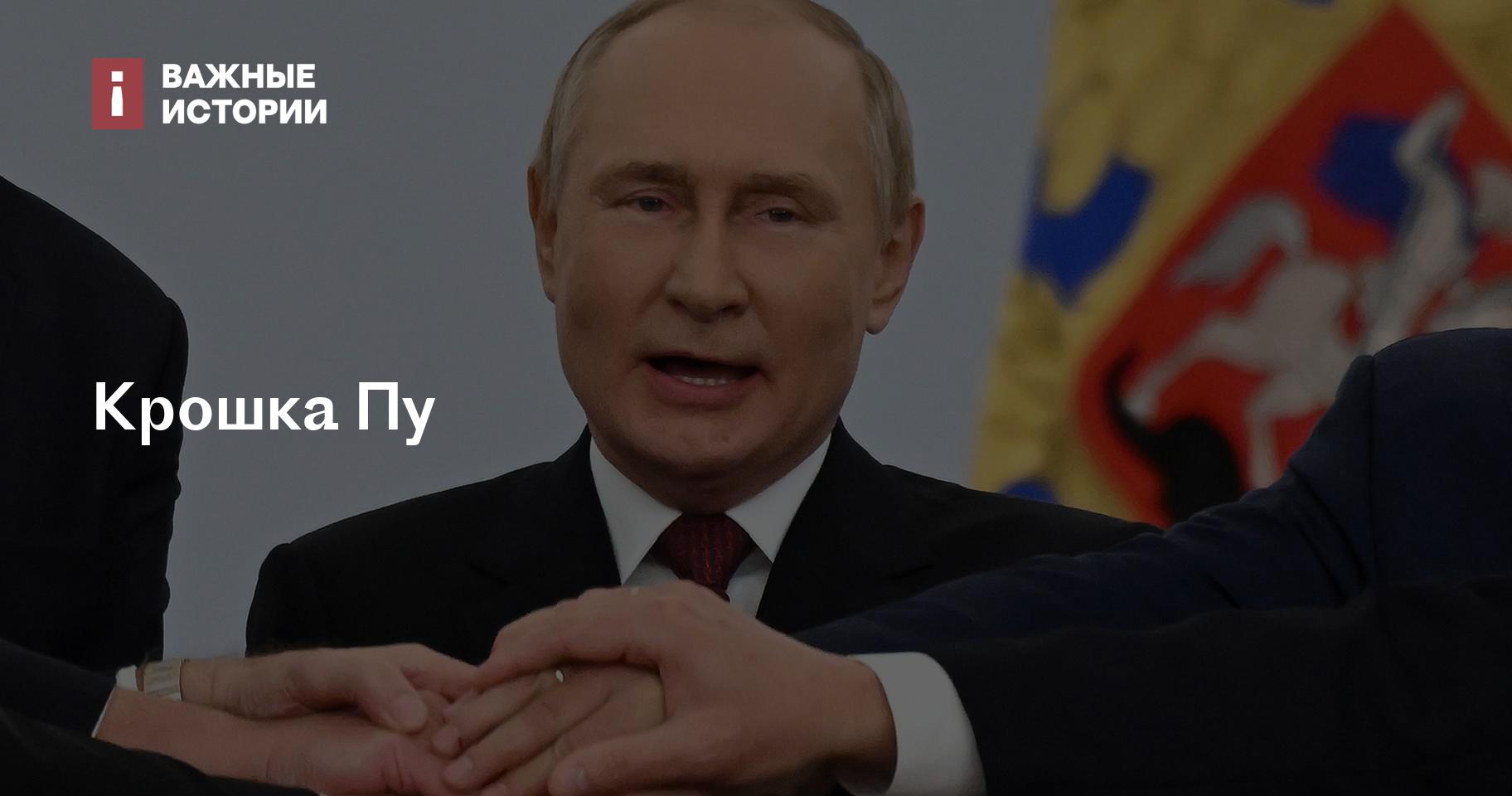
In the spring, Vladimir Putin was at the top of power. His troops stood near Kiev, Western leaders caught each of his words anxiously, his Foreign Ministry was ready to repeat his “MANECH and Get out!” His Foreign Ministry. The Moscow Bomond anticipated the distribution of bonuses and awards, and the townsfolk - victorious celebrations. Today, the Russian army suffers a defeat in Ukraine. Mobilization destroys the unspoken packet between society and the authorities - "we do not interfere with you to fight, but this war should not affect us." The consequences may turn out to be fatal for the ruling elite. Nuclear blackmail did not stop Western assistance to Ukraine, and an attempt to use nuclear weapons will turn into monstrous consequences for the world, Russia and Putin himself. This failure was the result of a series of errors that are explained by the features of Putin’s psyche, according to the political observer Yuri Fedorov .
Putin's myth
At first, everything went well. Like the characters of the ancient legends about the artificially created monster, who got out of control of the Creator, Putin removed the rivals from the political life of the call to challenge him in the struggle for power, as well as many of those who nominated him for the highest post. Those who saw a person of more than average ambitions that can be controlled from behind the curtains were mistaken.
Already in the early 2000s in Russia and abroad, Putin's myth formed.
Many in Russia still believe that it was Putin that prevented the collapse of the country: he returned the “primordially belonging to it” Crimea and protects the Russians in the Donbass, builds the “Russian world”, the new empire of the Russian nation, and is opposed by the US attempts to turn Russia into a colony. The average Russian is confident that the multiple growth of the living standards since 2000 is the merit of Putin personally, that the current difficulties are transient. Most people in Russia still do not understand that Putin is surprisingly lucky: he came to power on the eve of a long period of high oil prices.
Putin was not given to understand: “Napoleon cannot become, they need to be born,” as Belinsky wrote
Outside Russia, a Putin myth has appeared. There are sweet Success Stories about a boy from a people who has become a president that revives a great power. A lot of people consider Putin an outstanding politician and urge to meet him. Some see in him the leader of a huge Eurasian power. Others are a fighter with a hated globalization that undermines the traditional foundations of life. Still others admire how, boldly, Putin challenged America herself. Finally, fear, until recently, covering Western politicians at the thought of Putin's nuclear weapons, paralyzed their will.
But most importantly, Putin himself believes in his own myth. He sees himself called up to divide with one or two other leaders the burden of the world control, decaying on the way to globalization. It is not harmful to dream, but, as the Russian critic Belinsky noted, Napoleon cannot become, they need to be born. Putin, as it was, remained the middle hand of a secret political police official, who fiddled denunciations and gossip in the dossier, and then bore a portfolio behind Sobchak. As a result, a deep conflict arose between reality and the illusory representation of Putin about himself. The farther the reality and its ideas about it diverge, the worse for reality and the stronger the desire to correct it.
Triple Versailles syndrome
We must give Putin the due: he knows how to hide his true face. But when it is born, disgust covers people. On June 25, 2004, Vladimir Putin presented state awards in the Kremlin. Among the awarded was academician Vyacheslav Ivanov. Taking advantage of the case, he tried to stand before Putin for the arrested Mikhail Khodorkovsky. “When I said the name of Khodorkovsky, he was green. The reaction was biological. There was no longer a mask in front of me, but there was a terrible, bloody man, ”Ivanov recalled and clarified:“ I read a mixture of cowardice, small mind, mediocrity and some suppressed complexes in his face, which make it a very dangerous personality. ” I'm afraid that he imagined himself to be the embodiment of the national spirit or something like that. "
The reasons for this were explained by the famous Swiss psychologist Philip Zhaff. Putin, he remarked , "survived a serious injury in childhood ... He needs to prove that it is better not to enter into a quarrel with him." At the same time, many dictators “grow in such a way that they lose a sense of reality. The loss of a sense of reality can lead to the fact that they become more and more irrational and do more and more strange acts, become unpredictable and extremely dangerous. ” This is Hubris Syndrome, or excess syndrome, which is based on hypertrophied pride, generated by the fact that for a long time a person in his hands was too much power.
Thousands of people read our newsletter. Join! We do not spam readers with meaningless letters and talk only about the most importantThe Israeli graphologist Inessa Goldberg was asked to analyze the passage of the text written by Putin in adulthood without saying to whom he belongs. “Wanting ... to hide the hated uncertainty and underestimated self -esteem,” she wrote about the author of the passage, he “is trying by all means to compensate for his problems in the intellectual, spiritual, rational spheres. He seems to seek to become even higher and more significant - to achieve respect, and above all self -esteem. ” He is clearly expressed by the “victim syndrome”, his “personality all the time feels in the role of offended, insulted, discriminated.” The constant experience of real and fictional insults explains Putin's long excited monologues, in which he accuses the West of all conceivable and unthinkable sins that he "does not hear Russia."
Putin’s victim syndrome is a reaction to poverty and the inferiority of childhood. The famous psychologist Vladimir Levy wrote that Putin “was a stunted, pike teenager, shy, cowardly, but with a quick, unclaimed mind, with a strong will and very vindictive. He went in for sports intensely, went to the organs. ” This, according to Levy, is "a familiar path of hypercompensation." It can last all her life and ultimately "turns a person into a slave of his super -brose." He has to endlessly prove how powerful he is, "remaining inside all the same anxiously unequest, cowardly, psychologically and spiritually underdeveloped infantil."
A sense of inferiority
Mental abnormalities of childhood are often found in biography of cruel dictators. Among them are Caligula and Genghis Khan, Ivan the Terrible, Hitler, Stalin and Saddam Hussein. But Putin, unlike Stalin or Saddam, did not try to compensate for children's injuries with a risky struggle for power. He preferred a different way to get rid of social inferiority - to enter the omnipotent KGB, to overcome a set of inferiority, to obtain secret power over others.
The creators of the Putin myth loved to write about his spy feats. But James Bond from Putin did not work. Former deputy chief of Soviet intelligence, General Nikolai Leonov, recalled : “Putin has always been a rather mediocre agent. <...> When we had a cadet who fluid German, as was the case with Putin, and if he was really sensible, he was sent to West Germany or Austria. ” But Putin was in East Germany, where second -rate employees were "sent." Upon returning to Leningrad, Putin "was appointed to a local university to spy on foreign students, most of whom were quite faithful communists." For KGB lieutenant colonel, this was a humiliating purpose. This is another reason for the appearance of the President of Russia, a sense of resentment.
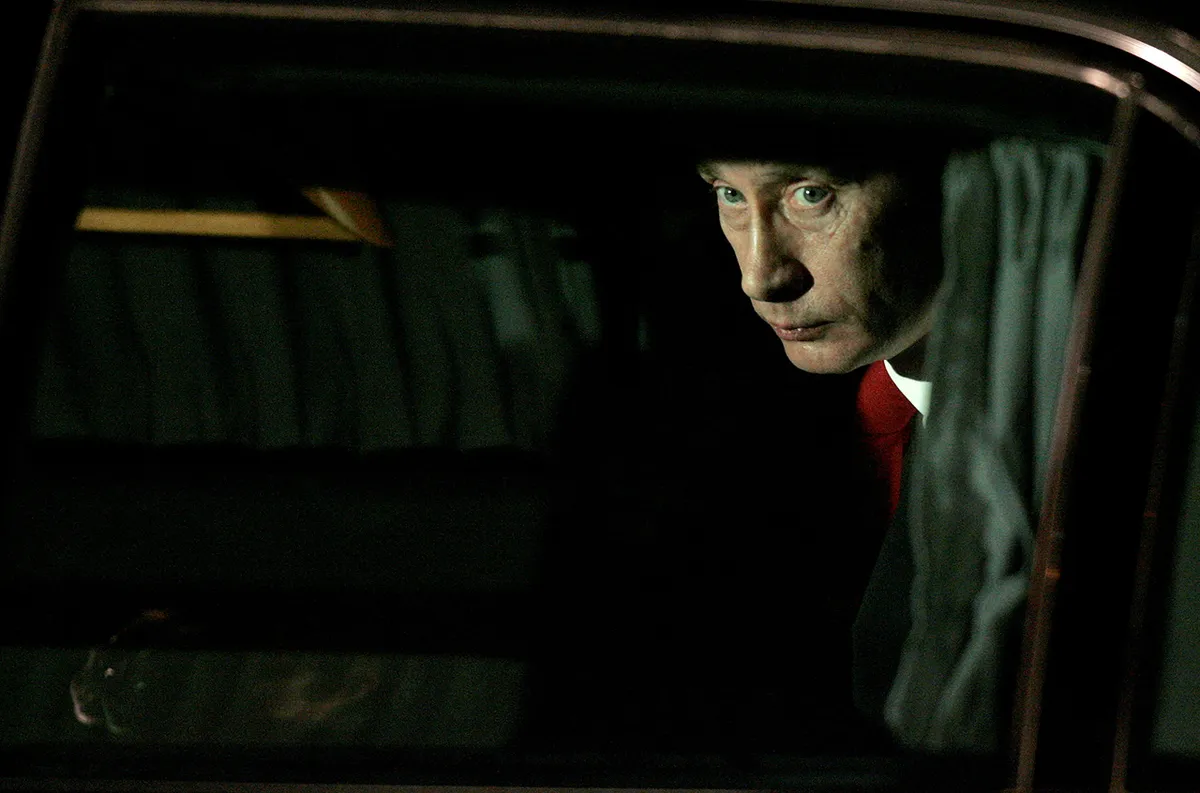 Photo: Stoyan Nenov / Reuters / Scanpix / Leta
Two mania
Putin is sure that foreign intelligence is constantly watching him. The Russian filmmaker Nikita Mikhalkov, close to him, said that one day he was walking with him in the park: “He says:“ You can imagine, all intelligence of the world now know that you and I are walking along this path. You imagine what kind of life this is? ”” This is a typical sign of the disease: it seems to the patient that enemies, colleagues, neighbors, and so on are constantly monitored. The patient may accurately indicate the date of the beginning of the persecution, who pursues him and for what purpose. Such people perceive unpleasant accidents or failures as making spies and enemies.
Putin is always accompanied by numerous security. On foreign trips, he eats food only from products brought from Russia, prepared by his own cooks. People who are familiar with the life of the Kremlin are talking about the mania of the persecution of the Russian president: “Putin is very afraid of an attempt. Drivers, cleaners, cooks, gardeners - all men, Putin does not trust women. ”
The mania of Putin’s persecution would not cause concern if she had not applied to military directives. If he likes to surround himself with a guard armed to the teeth, this is his personal matter. But if a nuclear state is headed by a leader with painful ideas about the world, this may end poorly.
Putin suffers from paranoia Vike Vick-Freberguga President of the Republic of Latvia “The Russian leadership shows signs of the disease that psychiatrists call paranoia. Vladimir Putin constantly feels the threat of attack. In one of his speeches, he mentioned that he was attacking the Swedes ... The Swedes remain neutral for a long time. And he tells his people that [the Swedes] attack them ... He constantly tells his people that Russia is attacked. This is paranoia. "
In people suffering from paranoia, the persecution mania is complemented by a mania of greatness. The desire to overcome the complex of inferiority, self -doubt and low self -esteem often lead to increased aggressiveness and at the same time to emphasize their own significance and high status, sometimes real, but more often fictional. This is an attempt to suppress in yourself a depressing sense of inferiority. As a result, a complex of superiority is developing. It is very likely that such a combination is inherent in Putin. He associates himself with outstanding Russian autocrats, considers himself a successor to their business. Putin, noted the former director of the Moscow Center of Carnegie Dmitry Train, “believed in his God this historical mission. A person known for his pragmatism, who called himself a servant of society, the manager, has turned into a messenger of higher powers. Putin not only began to mention God in public performances, but also behaved like a man doing what the Almighty entrusted him with. ”
The mania of the greatness of the leader is always dangerous. It is associated with a reassessment of its own forces, and this pushes to adventures. People with overstated ideas about themselves often do not realize their mistakes, tend to consider the result of hostile machinations of some evil forces that be comprehended, but not the result of their own inability to adequately assess the situation.
Apology of power
In Putin’s speeches, the idea of politics as a rigid struggle for power, resources and influence in which the strongest conquers and destroy and destroy it. Russia should not be weak, he believes, otherwise it will be destroyed. We, he said , “showed weakness, and they beat the weak”: “Some want to tear a bitter piece from us, others help them.” This is an almost literal repetition of Stalin's thought: "The weak are beaten, they are considered strong."
According to Thomas Gomart , director of the French Institute of International Relations, “Vladimir Putin, a young gopnik, who returned to the true path thanks to judo and jurisprudence, and then settled to work in security agencies, considers physical force the last argument, because in Russia, as well as everywhere,“ the weak are beaten ”. If he believes in law, then only in the right of the strongest. ” The conviction that power - the main and only argument of politics - leads Putin to the perception of a compromise as manifestations of weakness. The tendency of Western elites to the search for political solutions of international problems, he believes, is nothing more than the result of the weakness of the West.
“The elders were riding over the younger ones. They lived like in the zone: there were plowmen and their servants. Putin was part of the company of the younger guys. "
Such an idea of the world was formed under the influence of experience gained in childhood. The courtyard of the house where the young Putin was brought up, “existed according to wolf laws,” Putin's former neighborrecalled . - The elders were riding over the younger ones. They lived like in the zone: there were plowmen and their servants. " In this environment, reproducing relationships in prisons, the belief was formed that aggressiveness, cruelty, willingness to take risk, less sensitivity to pain and losses can compensate for physical weakness in the event of a collision. Such behavioral models acquired in childhood to a certain extent explain the features of Putin's foreign policy.
The apology of the force inherent in Putin manifests itself when, being distracted from the previously written text, he speaks of “Western partners”, but actually reveals his own attitudes. This is called projection. It is inherent in a person to unconsciously attribute his own motives, experiences, feelings and ideas to other people. Psychoanalysts call the projection a protective mechanism that allows you to relieve themselves of responsibility for their own actions. So, in May 2006, distracted from the text, Putin said in his hearts: “Their [USA] military budget in absolute values is almost 25 times more than that of Russia ... and well done. Well done! .. As they say, "Comrade Wolf knows who to eat." He eats - and does not listen to anyone ... It turns out that everything is possible, there are no restrictions. ” The image of a wolf who knows who to eat and does not listen to anyone, does not apply to the USA. This is the ideal image of Russia inherent in Putin. And when he ascribes to the Western elites to ignore international law and moral norms, the use of strength, deception of partners and so on, he, in fact, reveals his own, partially conscious, and partially subconscious motives and attitudes.
Four mistakes
The usual, not -out -handed person is often forgiven for a person, and punish the crimes. Politics, especially the authoritarian leader of the victorious state, often forgive crimes. But the mistakes that led to defeat will not be forgiven such a leader.
Putin, having unleashed the war with Ukraine, made at least four gross mistakes.
1. He overestimated the power of his army. Among other things, it was formed as the Blitzkrig army, and it turned out to be incapable of a protracted war. Attempts to increase its combat power, for example, by chaotic mobilization, only tighten the agony.
2. He underestimated the determination and ability of Ukrainian society, the army and power to resist aggression. Despite the most difficult victims and losses, Ukraine is not going to surrender.
3. The calculation for the weakness and split of the Western countries turned out to be insolvent. Despite the opportunistic position of a number of political figures, the West was consolidated and provides Ukraine with increasing military assistance.
4. China took, in fact, a neutral position instead of supporting its strategic partner.
These miscalculations of Putin are far from the first. He intervened in the Civil War in Syria, hoping that this would allow him to restore relations with the West, but was mistaken. He hoped that, "turning to the east", Russia could create a military-political union with China-again a mistake. He relied on the coming to power Donald Trump. But under Trump, the United States adopted the most stringent, in pre -war times, sanctions against Russia.
Putin's mistakes are natural. They are a consequence of his mental aberration: inability to learn from the past experience, inadequate assessment of the consequences of decisions made, high self -esteem and at the same time a monstrous complex of inferiority, paranoia, projection of partners of their own motivation and attitudes, a tendency to aggression as the only means of getting out of real or imaginary dead ends. And therefore, the 70th anniversary can be the last birthday, which Vladimir Putin celebrates as the President of Russia.