
Translated material
"The peasant went to war because he was used to fulfilling what the authorities demanded." How was mobilization in Russia 1914


"The peasant went to war because he was used to fulfilling what the authorities demanded." How was mobilization in Russia 1914
14 October 2022Ilya Klishin
Journalist, media consultant
On the services of reselling things like “Avito” you can find an interesting medal about which few have heard. It is called "for the works on the excellent implementation of the general mobilization of 1914." You can buy it for only 5000 rubles. It seems that no one values this award today.
Such medals were minted in February 1915 with a huge circulation - at least 50 thousand pieces - and presented everyone in a row: from sports instructors to ordinary local officials who then performed the functions of the current military commissars.
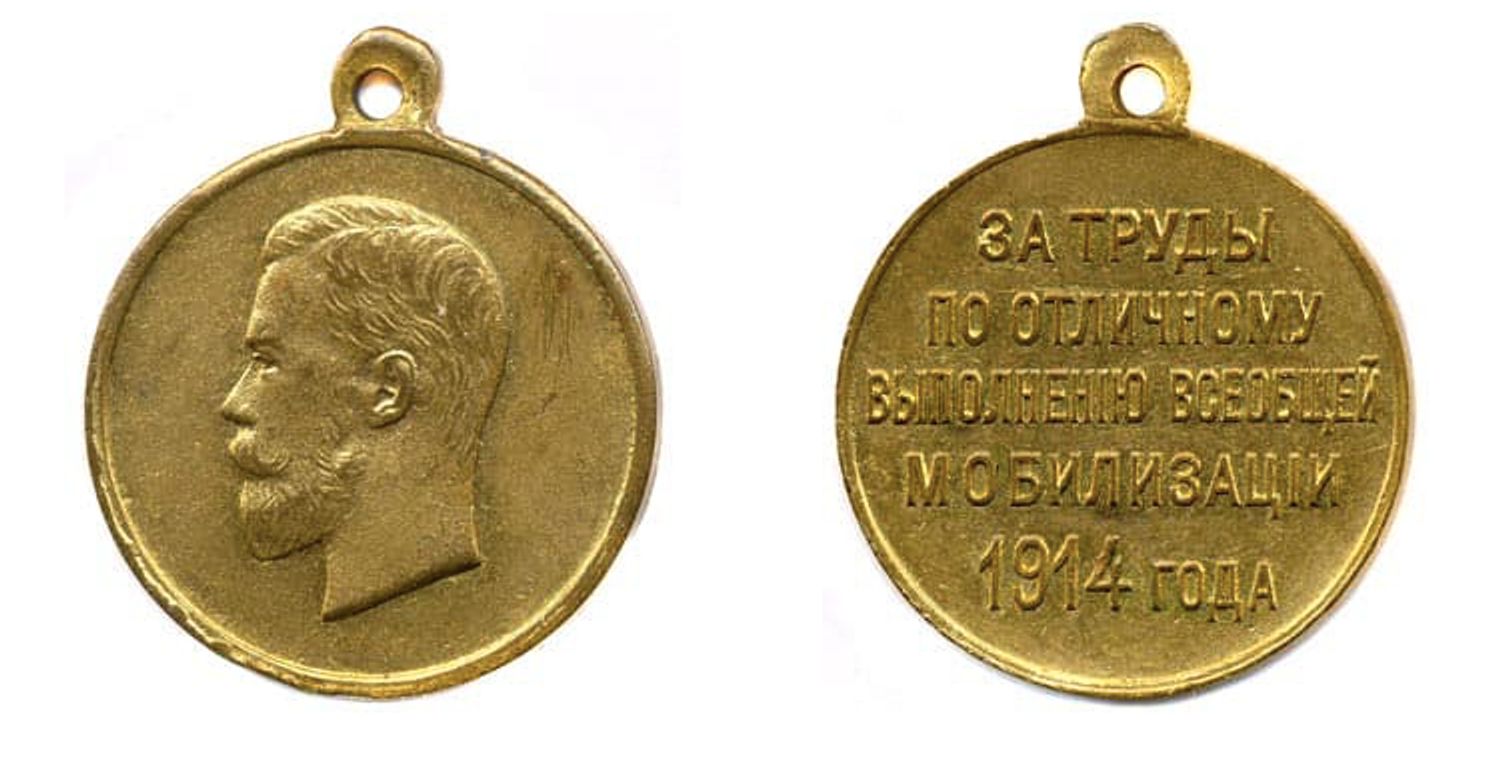
Medal "For the works on excellent implementation of the general mobilization of 1914"
Why are there so many medals? And why is the medal in general? The fact is that the incredible success of the mobilization of 1914 - the first universal mobilization since the military reform of Alexander the Second to canceled the recruitment - was an extremely important thesis for Russian propaganda. If you read the newspapers of that time, it may seem that the whole country in a single impulse rushed to the draft points in order to rather fulfill its duty to the emperor and power.
The seal of the first days of the war reports how bravura rallies and demonstrations with portraits of the tsar, crosses, banners and banners of the patriotic content like “Victory of Russia and Slavs!” Pass the central streets and squares of Moscow and St. Petersburg. Again, according to official messages, the success of mobilization was confirmed not only by loyal slogans, but also by numbers.
The tsarist government joyfully reported on the phenomenal indicators of mobilization (therefore, in fact, medals were minted): they say, they collected everyone they wanted in 45 days, and even moreover, it was 15% more on their own initiative!
The tsarist government joyfully reported on the phenomenal indicators of mobilization
The peacetime army then amounted to a little more than 1.4 million people. This was not enough for the war with Germany, Austria-Hungary and Turkey.
According to official reports, in July - August, 3.1 million military officials were called up from the reserve. Plus, until the end of the year, the “draft sheets” (as the summons were called then) received even more than 700 thousand people aged 20–21 and 900 thousand militia warriors (that is, those who had not served in the army before, they, in theory, were supposed to use military warehouses and objects in the rear, but this rule, of course, was often violated). In addition, in the framework of mobilization, the population requisition 1.3 million horses for the needs of the army.
This version, we repeat, from the pages of the then official newspapers, not just passing on hard military censorship, but also engaged in conscious propaganda, became a canon. The Soviet textbooks of history uncritically retold (yes, they say, the war was imperialist and meaningless, but the glory of Russian weapons did not cancel anyone), it continues to tell it in today's Russian schools - the mobilization of 1914 was a superuspace and filled with patriotic enthusiasm.
The war was imperialist and meaningless, but the glory of Russian weapons did not cancel anyone
Here is another example. "Evening time" reported on the second day of mobilization:
“Today, by six in the morning, the whole capital took an unusual look. From all over the city, the groups of those who were heading to the police were drawn ... The rise of the spirit among the conscripts is extraordinary ... The more you peer into the crowd, the calmer it becomes in the soul. Serious, sober people who gathered to earnestly fulfill their duty, without noise, without hysterical cries. And it seems that everyone's eyes darkened from inner thought, from determination. ”
But it seems to be a distortion. Well, let's say this: would you like to judge Solovyov and Kiselev about the mobilization of 2022? The question is rhetorical.
By the way, another fact about the same medal for successful mobilization, on the obverse of which the profile of the king himself was also knocked out. So it happened - and this, undoubtedly, is a beautiful irony of history with a capital letter - that it was literally the last medal in the history of the Russian Empire. Further, only the revolution, the renunciation of the bottom at the station, the civil war-and all these patriotic people seemed like inspired people for some reason turned the bayonets in the other direction in three years.
There was nothing surprising in this. Modern historians who work with diaries, memories and private letters from 1914 gradually restore the real picture of what was happening. It is still impossible to prove the fabrication of numbers (three million in 45 days), but such a probability remains - this is indirectly indicated by defeats at the front. Like, there was a division on paper, and an undercurrent on the field. But most likely, people really mobilized to a large extent. Like today, first of all, from villages, villages, permanent district towns.
People were mobilized, as today, first of all, from villages, villages and shocking county towns
Here's what General Danilov wrote:
“The Russian people turned out to be psychologically unprepared for the war. His main mass - the peasantry - hardly realized a clear report, why his name is for war. The goals of the war were unclear. The peasant was calling for a call because he was accustomed to fulfill everything that the authorities demanded of him; He patiently but passively carried his cross until great trials came up. ”
More than half of the mobilized not only did not know who the Archduke Ferdinand is and where Sarajevo is, they were simply illiterate. This is the worst indicator among the European powers, which then entered the world war.
The misunderstanding turned into longing, sadness - and even anger and despair. One of the mobilized, Perm peasant Ivan Zyryanov, recalled the call as follows:
“Woe struck the woman. The faces of the women are red and swollen from tears ... The women detained the train sent for two hours. They definitely went crazy ... After the third call, many laid down under the wheels of the train, spread on the rails, climbed onto the buffer, on the shoots of heat. It was impossible to tear them from husbands. These are wires ... All county authorities fled to the station. The views of the authorities are bewildered, miserable. They don’t know how to be with women ... they called a special outfit from the local convoy team. The convoy carefully took into the arms of women who had fallen to the rails and wagons, carried them off the platform somewhere to the depths of the station. The women shouted as if they were cut. ”
The crying woman was generally one of the brightest symbols of that mobilization. The Riga worker, called by mobilization, A. Pireiko recalled the sending of his train:
“When we began to immerse us in wagons, the heartbreaking screams and crying of women, relatives and close mobilized were heard ... wives mobilized from burning their hair, clinging to the buffer of wagons to stop the retreating train with loved ones. The howl rose such that it seemed as if they were being sent people to the cemetery. "
Not only women cried. Vologda peasant I. Yurov, credited to the warriors of the militia due to a sore leg, describes the sending of the first parties of the mobilized:
“A huge crowd of common people - men, women and children. For many men, no matter how they attached them, tears poured from their eyes, and all women sobbed hysterically or whined in some inhuman voice, holding both hands with both hands. Men with some kind of dead look looked at the wives and children left. Looking at all this, I also wanted to howl from the opponent from the powerless against this great and terrible disaster ... In Ustyug, we were told how a woman who had five children, saying goodbye to her husband, went crazy, and her husband, seeing this, strangled him out of despair. One young rural clerk told how he burst into tears, observing the sending of his parish reserve: “They took N, you know, he had a wife with five children. He goes, but he’s not at the face. One child is on his hands, his wife carries the other, and the others grabbed his father and mother and run on the sides. Mother worships, and children are terrible.
And similar scenes unfolded throughout the country. Sofya Andreevna, the widow of Leo Tolstoy, said about the discontent of the peasants in Yasnaya Polyana: “Everything is in despondency; Those who are torn from the Earth and the family say a strike: “Do not go to war!”.
Nurse S. Fedorchenko, who collected characteristic statements of the people, folklore of the First World War, brought the typical words of the peasant about the beginning of the war:
“How thunder that war was made by me. Just coped with the house-Paul settled it, blocked the roof, I got hold of the money. Here, I think, I’ll become on my feet, no worse than people. And then please! At first it was planned to drink, but only restrained - for such trouble vodka is not a medicine. "
Resistance was not limited to tears and words. There were attempts to “mow”, dodge and even rebel. So, some draftees chopped their fingers, drank poisons or chopped them for themselves, gave bribes to the volosts and rural elders, so as not to go to the front. But there were still not very many of them.
Some draftees chopped fingers, drank poisons, gave bribes to the volost elders and rural elders
The future marshal of Victory Georgy Zhukov, whom the war found in Moscow, where he worked as a scorch, recalled that at first many young citizens left volunteers to war, volunteered to go and his friend, whom he wanted to support first, and then changed his mind, not understanding the reasons why it could become a crumpled:
“I told Sasha that I would not go to war. Having scolding me, he fled from house to front in the evening, and two months later he was brought to Moscow with seriously wounded. ”
It is curious (and the obvious parallel suggests itself) that most of the indignation was not associated with the very fact of sending people to war (and potential death), but with the fact that everything was poorly organized in the sense of equipment and delivery of draftees. There were not enough uniforms, and the transports did not come on time.
From hand, everything was poorly organized in the sense of equipment and delivery of draftees
The “dry law”, which they guessed to introduce for the duration of mobilization, also added oil into the fire. As a result, the newly -minted warriors and warriors went to rob tales and wine shops. And the wires with alcohol continued with drinking points at the assembly points.
For example, in the Pskov province at the DNO station (the very one where, three years later, the law enforcement agencies would reflect from the throne on July 22 that the warriors had “stormed the wing shop, broke the door, carried away the wine for 190 rubles. (50 buckets of vodka). " As the captain Tatarinov reported, “part of the vodka was immediately drunk, the rest was selected. It was not possible to identify the perpetrators, because the whole echelon (700 people) took part. ”
And such “vodka riots” occurred literally throughout the country - historical evidence is about similar incidents of at least half of the provinces. Thus, the historian M. Shilovsky only in four Siberian provinces (Tobolsk, Tomsk, Yenisei and Irkutsk) counted 157 (!) Protests mobilized at the beginning of the war. In 9 cases, soldiers smashed volost reasons, in 136 - taverns.
The unrest reached a special scope in Barnaul of the Tomsk province, I recalled them. D. Dragunovsky: “Screams between the soldiers were heard:“ Let's break the Kazenka! Why don’t they give vodka? .. We have to drink goodbye to your relatives! ”” Lagunovich’s excise taxion manager of the Tomsk province beat the alarm and conveyed to St. Petersburg: “The indignation of the spare Tomsk province takes the character of the rebellion.” Those who tried to reassure the pogroms to reassure, these attempts sometimes bypassed expensive - bailiffs and officers were beaten, in some cases to death.
One way or another, in general, mobilization, rather, was really crowned with success (it was simply not so joyful). Even those who grumble (“It’s time to clean up soon, but here it is! Who to leave the household! They also took the horse!”), As a rule, soldier’s boots were humbly put on. All the same General Danilov from the headquarters of the Supreme Commander -in -Chief summed up: "Our people turned out to be law -abiding, and up to 96% of all those called up, more than according to the calculations of peacetime, it was expected."
Our people turned out to be law -abiding, and up to 96% of all called up for the call
It is noteworthy that by the fall - literally a few months later - the people had a word for a military atmosphere, and in the future, mobilization and draft events went much more calmly than the July and August.
So, in 1915, 3.6 million people were sent to the front, in 1916 another 2.5 million. In total, over the years of the First World War (until the fall of 1917), the Russian Empire mobilized 15 million 798 thousand lower ranks and officers, of which 12.8 million were inhabitants of villages and villages. For comparison: the entire Entente (including Russia) put 48 million people under the gun, its opponents - 25 million.