
Translated material
The end of the era of continuous growth. What will happen to the real estate market and housing prices
After the start of the war and the collapse of the real estate market on the exchange, many seemed to be a quiet harbor: in February, the demand for housing in Moscow set a historical record, apartments throughout the country continued to rise in the entire first quarter. But now the situation has changed so much that experts predict the market a deep fall and a return to a well -end level. Prices for new buildings in Moscow and the Moscow Region in October already crawled down, and with a record speed in the history of observations. What will happen to the real estate market further?
This material was written specifically for the weekly newsletter of Bell. Investments. Subscribe !
What is with a mortgage
Mortgage is the main driver of the growth of housing prices. According to Dom.rf, in 2021 the share of transactions with a mortgage in the primary market was 70%, in the first half of 2022 - 65%. Last year for the mortgage market was a record: banks issued 1.9 million loans totaling 5.7 trillion rubles. After this year, the Central Bank in February sharply raised the key rate to 20%in February, the mortgage sank sharply. In January - September, the number of loans issued fell by a year by 36%, up to 895 thousand, calculated Dom.rf. In monetary terms, the volume of issuance amounted to 3.2 trillion rubles - 21% less compared to the same period last year.
Banks try to support the market with all their might. The regulator has already paid attention to the growth in the issuance of more risky loans. The share of a mortgage with an initial contribution of 10 to 20% in the second quarter took off by 40%, and in the primary market reached a historical record of 58% (+19 pp per quarter). The share of extradition to borrowers with an indicator of debt load above 80% was 36%, adding 5 percentage points. Regarding the end of 2021. The urgency of the loan since the beginning of the year has increased by almost three years, and the average mortgage is a quarter, up to 3.8 million rubles.
The weighted average rates for market mortgage programs amounted to 10-10.2%in September, but taking into account a variety of preferential programs - the indicator drops to 6.71%, and at all buildings - at all 3.49%, follows from the data of the Central Bank. Such a gap is explained by numerous state support programs (a mortgage under 7%, family mortgages, a mortgage for IT specialists, etc.), as well as new programs from developers (“zero” and a trancheic mortgage), the regulator notes.
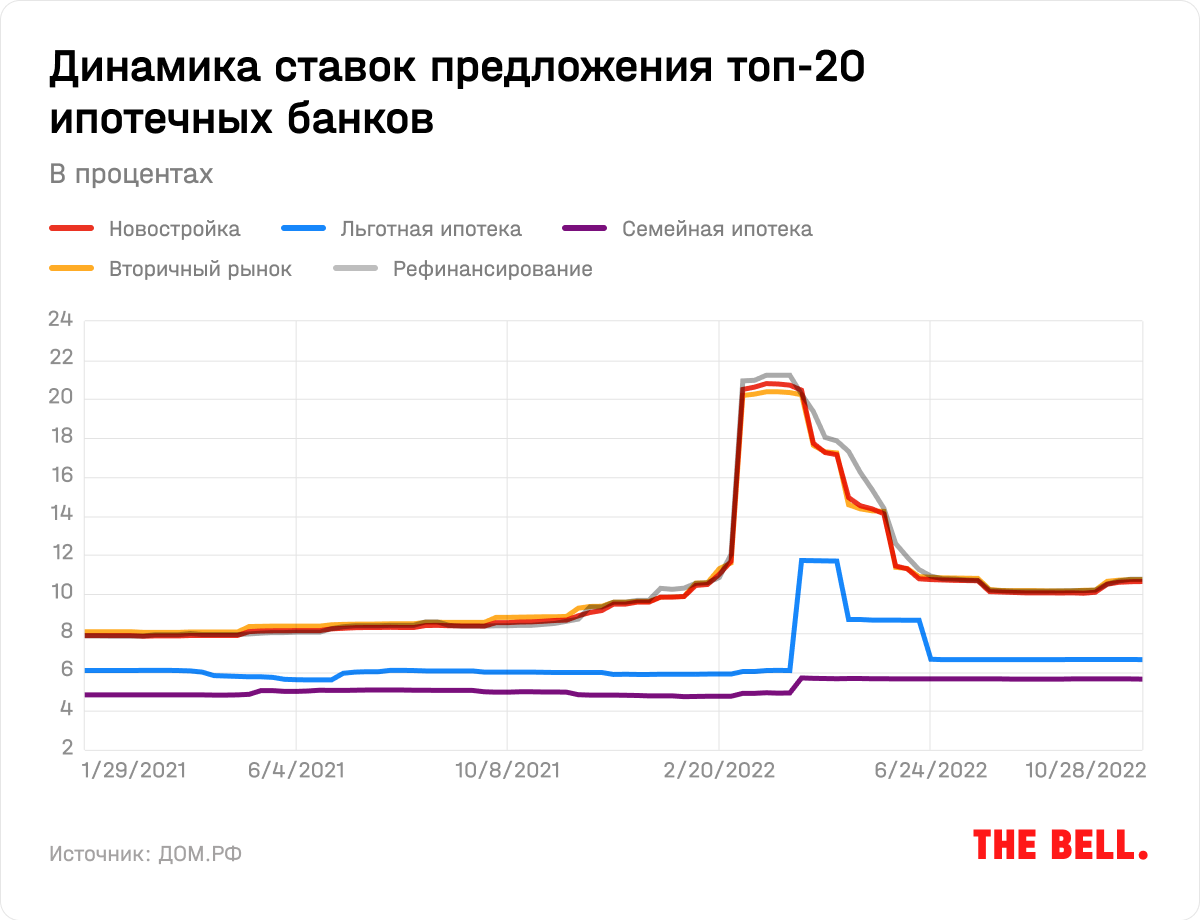
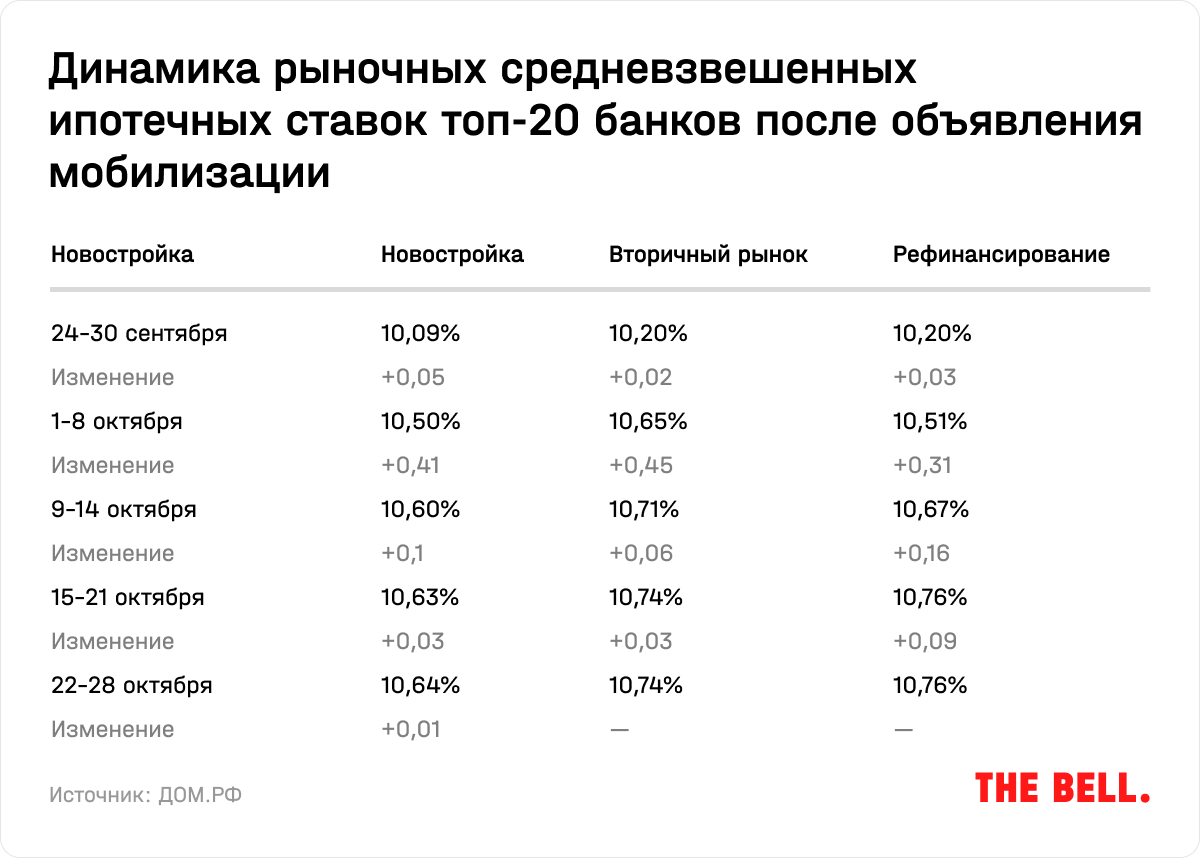
Following the decrease in the key rate, the mortgage market began to recover by the end of summer. In August and September, he even managed to show growth in monetary terms compared to last year. But the mobilization announced at the end of September broke this trend. According to Nabiullina, in October, the issuance of a mortgage collapsed by about 20%. The Frank RG express monitoring showed that in monetary terms the volume of mortgages in October was 12.8% less than the September result and 10.2% less than in October last year.
Demand in the real estate market in October also fell. According to Dataflat, in the Moscow region, in the new buildings market, sales decreased by 37% in lots and 38% of revenue compared to September, and 43% and 39% a year by the year. In this case, the proposal is growing. In the market of new buildings of the mass segment of the capital, the number of lots increased by 5.4% over the past month, and from the beginning of the year - 1.5 times, Counted Metrium. This led to the fact that in October the cost of the “square” of the new building in Moscow, according to cyan estimates , decreased by 1.7%, in the suburbs - by 1.3% - the maximum fall over the entire history of observations. And there is nothing to support the market.
Despite the September decrease in the key rate to 7.5%, the mortgage for market programs valued all October. “A decrease in real disposable incomes of the population against the backdrop of a deterioration in the geopolitical situation can lead to an increase in insolvent customers, so banks lay such risks in the cost of loans,” explains Anatoly Perfiliev, junior director of banking Ra Agency.
After the mobilization of the banks, the banks also began to refuse to issue loans more often . The level of approval of applications for a mortgage by October 10 fell to 59.1%, dropping in three weeks by 13.7 percentage points. Some banks began to refuse a mortgage to those whom, in their opinion, they can mobilize, wrote Forbes.
In early November, mortgage rates in Russia were stabilized and will probably remain approximately at the current levels until the December meeting of the Central Bank, if nothing extraordinary, Igor Dodon, analyst, believes during this time. In his opinion, in the coming months, the issuance of a mortgage will remain weak because of the cautious approach of people to buy housing on credit and a more stringent approach of banks to borrowers.
The level of bets will be dependent on further decisions of the Central Bank at the rate, Perciliev notes. But he does not expect significant growth. By the end of the year, the demand for a mortgage can stimulate the folding of a preferential program with a rate of 7%. At the same time, at the end of subsidizing a mortgage in 2023, demand can significantly decrease against the background of a more conservative approach of banks and a difficult market situation, the expert adds.
How developers and banks try to stimulate demand
According to the results of 2020–2021, about 90% of all mortgage loans in the primary market were issued as part of mortgage programs with state support. The most popular program - a preferential mortgage at 7% - will end in two months. Some banks have already begun to turn it over due to the exhaustion of the credit limit. For example, the acceptance of applications for a preferential mortgage was suspended by Rosbank.
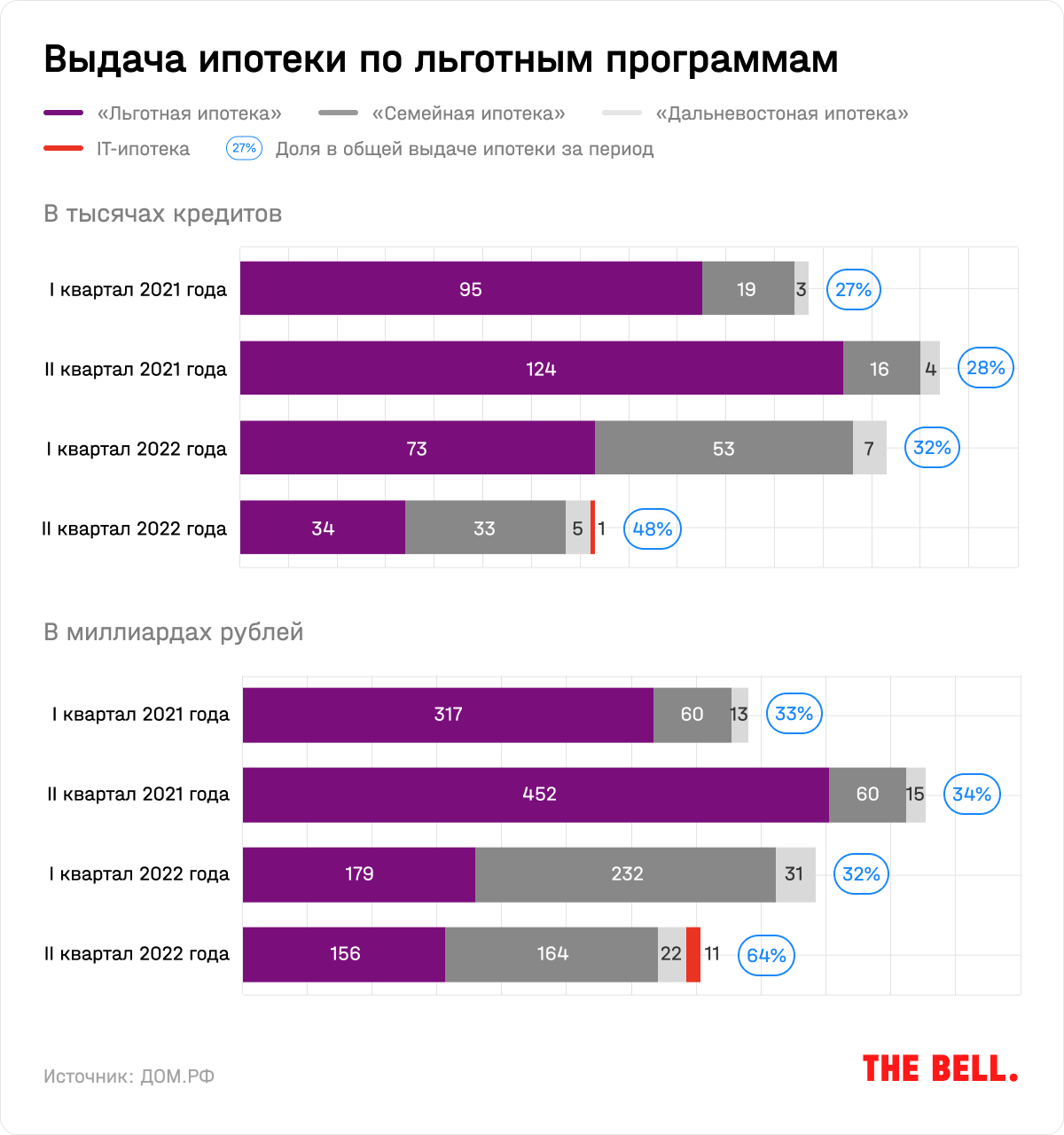
To support the market, developers, along with banks, began to bring new mortgage products to the market. Thanks to joint efforts, a mortgage appeared with the nearol (0.01%) bets in early summer. And by July, as part of such programs, almost 2/3 of the total mortgage in the primary market was issued, the Central Bank found out, interviewing the five largest mortgage banks.
But do not be deceived. Developers manage to achieve such low rates at the expense of three factors, the regulator described:
- overstatement of the apartment of the apartment by 20-30%, due to which the bank is compensated for falling interest income;
- reinvestment of this commission by the bank;
- The use of a subsidized rate from the state.
All participants in this scheme, including the main beneficiaries - developers, carry additional risks, emphasized the Central Bank. It makes no sense to repay the borrowers to repay such a mortgage, and it will be very difficult to sell real estate in the secondary market without loss. In addition, the scheme creates systemic risks for the entire real estate and mortgage market, in particular, increases the risks of the formation of a bubble due to the “technical” dispersal of housing prices.
Correction of housing prices after growth over the past years would increase the availability of real estate for the population, the Central Bank notes. But due to preferential programs, prices in the primary market were overpriced. “In fact, there is a disguise of a decrease in real estate prices,” the regulator writes.
The Central Bank has already offered several measures to limit the near -mowl mortgage from developers - including introducing increased allowances for such programs. The developers asked the Central Bank not to ban the near -Death mortgage, and the banks suggested introducing milder restrictions.
In the fall, another credit product began to gain popularity - a tranchel mortgage. It essentially involves dividing a loan into two periods. After registration of the contract, the bank first transfers the developer part of the amount from which the borrower pays small monthly payments, up to 1 ruble. And after receiving the keys, he transfers the rest of the loan, and then the borrower begins to pay in full. For example, the LSR offers a mortgage with a monthly payment of 1 ruble until the end of construction, and then begins to operate in the framework of the selected mortgage program.
The Central Bank has already criticized this program. According to Nabiullina, for developers this is the risk of a rise in the cost of project financing, because the escrow account will be filled more slowly. A tranket mortgage can help increase investment demand for housing and lead to price growth. In addition, there is a risk of Misseling, when buyers will not be fully aware of the future value of a loan service.
The developers launched the transmitted mortgage as an alternative to the near -lieva, which completes its existence, says Nadezhda Korkka, managing partner of Metrium. Despite the fact that the Central Bank called the risks of this type of lending, this does not mean that the regulator will begin to counteract its implementation, she said. The number of shares and special offers from developers who stimulate consumer demand is now actively growing. This is not only a tranchel mortgage, but also long-term interest-free installments, trad-in with accommodation and others, the expert lists.
How all this will affect the real estate market
Most customers are morally ready for a small increase in mortgage rates, Korkka believes. The non -proceeding of a preferential mortgage, of course, will affect consumer activity, but will not become an irreparable loss for the market, the expert believes. It recalls that a number of mortgage programs subsidized by the state will continue to operate. If there are no new global shocks, the real estate market in the coming months is quite capable of returning to the indicators of the third quarter of 2022 and again demonstrate positive dynamics, the expert concludes.
By the end of the year, the sales of new buildings in the Moscow region will be slowly recovered, but the possibilities of recovery at the expense of the mortgage are almost exhausted, the Dataflat service notes. At the same time, the market has become less attractive to investment, but began to be used more often to improve housing conditions, including thanks to new mortgage tools.
Fluctuations in mortgage rates in the range of 0.5–1.5 percentage points It will not have a significant impact on the market, given that in the spring the bets jumped immediately by 10 percentage points, the analysts of the project “Indicators of the Real Estate market” (IRN) agree . In their opinion, the struggle of the Central Bank with the near -Solia mortgage from developers is more significant, since it was she who revived sales in recent months and it accounted for a significant part of mortgage demand. At the same time, IRN experts do not consider the growth of bets a negative factor, since, in their opinion, “inadequately cheap mortgages blown up prices and made housing inaccessible to most potential buyers.”
The “covid” increase in prices looks more and more inadequate, they note. Demand in the market is increasingly lagging behind last year. The proposal in the secondary market over the past three months has grown by more than 60% and has reached a historical maximum. Discounts on the “secondary” are 10–20%, and 30%reach the primary market. Back in early summer, IrN predicted that real estate prices in the Moscow region on the horizon of 1-2 years will fall by 30% and return to the well level. Then this forecast was pessimistic, now it has become basic, experts indicate.
A sharp drop in demand with an unchanged level of supply in the primary market indicates a strong overheating of prices, says independent financial analyst Sergei Skatov. But, in his opinion, this will not lead to a decrease in prices, although for their growth, the possibilities are very limited. “Thanks to the mechanism of project financing, developers have no strong incentive to reduce the price, since banks in any case finance construction, and developers will hope to normalize the situation over the next 2-3 years, reducing or delaying new launches,” he explains. Developers do not have the opportunity to significantly reduce prices, because the cost of construction is constantly growing, and import substitution has not yet been established to stop this process, adds the commercial director of Optima Development Dmitry Golev.