
Translated material
As a “team against torture” will investigate the crimes of the security forces in St. Petersburg
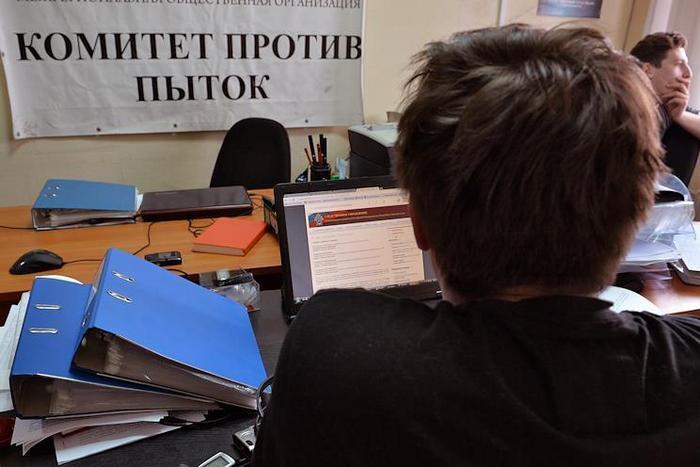
In 2022, the founder of the "Committee against torture" Igor Kalyapin left the organization
Because of disagreements with colleagues about the strategy of work.
The operating mode of the police department, which is announced at the threat of an attack: then no one should be passed into the department. The Fortress plan is often used during protest shares so as not to let the defenders to the detainees.
PMCs protect the rights of prisoners in pre -trial detention centers and other places of imprisonment
In St. Petersburg, the branch of the human rights “team against torture” was opened. This is the new name of the “Committee against torture”, which has been engaged in legal assistance to the victims of the police violence for more than 20 years. He achieved the conviction of 163 employees of law enforcement agencies and payments of more than 300 million rubles of compensation.
In June, the Ministry of Justice recognized the “Committee against torture” by the “foreign agent” and his employees created a new organization.
The head of the “team against torture” Sergey Babinets and the head of the St. Petersburg branch Julia Fedotova told “Paper” , how the police violence in St. Petersburg is distinguished, why soon throughout the country it can become more and whether they are afraid to stay in Russia, engaged in human rights work.
"Our task is to grow good specialists from St. Petersburg investigators"
- What is the “team against torture” doing now?
Sergey: We are engaged in the protection of the rights of citizens affected by torture by officials of state bodies. This includes complaints about physical violence and torture from the police and other security forces, but not only.
Julia: “Team” is also engaged in other types of state violence: forced abortions, sterilization, violence in hospitals, schools and kindergartens - wherever the state appears and where it interacts with a person.
We provide medical assistance and provide rehabilitation to the victims of state violence: we acquire medications, direct people to doctors for diagnostics, medical procedures and sanatorium-resort treatment. When it is difficult for a person to live the negative experience of torture, then we provide him with consultations with a psychologist. This happens often, since psychological injuries are heavier than physical: it is difficult to forget them.
S: In addition, we are investigating torture in those regions where our branches are located. But we need to deal with this problem throughout Russia. If you leave it somewhere, it will only become worse throughout the country. Now we will carry out this activity in St. Petersburg.
- Why did you decide to open a branch in St. Petersburg?
Since 2013–2014, it began to catch a lot of things that law enforcement officers have been particularly strictly acting on protest shares precisely in St. Petersburg.
For us, this is a big riddle, why exactly in St. Petersburg such cruel detentions are taking place. Of course, this happened in Moscow too, but not with such systematicity. In St. Petersburg, every action - as if the rink leaves and begins to iron the whole crowd indiscriminately: women, men, adolescents, old people.
There were a lot of complaints about the beating of the protesters. We compared these complaints with other regions and realized that Petersburg is one of those large cities that need our help. Including due to the lack of systemic human rights organizations in St. Petersburg that would deal with violations of the rights of detainees and prisoners.
We realized that there is a very big problem that needs to be solved, but the city does not have our own resources. That is why we decided to come to St. Petersburg. We already have ten statements, three of which are in the active phase. Julia Fedotova is active in the investigation of these torture. I think that in the wake of the opening of the branch, the number of applications and complaints will only grow.
Plus, now in Russia an extremely unstable political situation that can cause an increase in violence within the country. In addition, the media, activists are now faced with great pressure and repression. They will not receive help from the state, which means that only human rights activists remain. Therefore, our presence in the capitals is now necessary.
- How does the situation with torture in St. Petersburg differ from the situation in other regions?
C: The practice of the “team” says that in regions where there were no systematic work of human rights organizations, there is absolute freedom of action of law enforcement and there is no fear of criminal prosecutions. “The land of the non-frighted idiots”, if we say in a simple way. In St. Petersburg, so.
We will need to teach investigators to properly investigate cases related to torture. It's like a child: you teach him to eat from a spoon, then go, talk, lead him to school. In the end, an adult grows out of it who serves himself. Our task is to grow good specialists from St. Petersburg investigators. I think this is in our power.
Yu: I can only compare with the Krasnodar Territory and the Sverdlovsk region where I worked. The Sverdlovsk region is actually one of the safest regions: there was almost no violence and detention at rallies, not to mention torture. Only in recent years, everything began to change for the worse. If we take the Krasnodar Territory, then this is hell on earth. Bureaucracy, knowledge, skills - nothing worked normally. The use of physical strength and torture was terribly common there, and it is very difficult to achieve a response to complaints.
In St. Petersburg, the level of police violence is standard. In my opinion, there is a systematicity in the excessive use of physical strength precisely during detention at rallies. Basically, security forces are used by the fact that they have in service: special products according to the type of electric shockers and batons. We have not yet discovered more cruel methods of torture here. But our branch has just begun its work. I think we still have to collect a lot of statistics to say exactly about the specifics of the police violence in the city.
"There are people to whom no one but us will help"
- Are you afraid to stay in Russia now, doing human rights work?
C: to protect human rights, remaining in Russia, is the only effective way to provide real support to citizens. It is impossible to be abroad and help the victims of violence in our country. We will not force the investigator to interrogate the police officers, sending him a letter by e -mail. It is necessary to write complaints, pull it to the court, participate in investigative actions, send petitions, and only then will it work.
We are well aware that now there is a great threat to be again recognized “foreign agents” in a personal physical quality or as a legal entity. There is a risk of criminal and administrative prosecution. But there are people who are torture who turn to us every day and to whom no one but us will help. We know all the risks and are ready to be here to the very end. Even if it comes to the point that everyone is transplanted, there will still be people who will continue our work.
- How does the “team against torture” ensure the safety of employees?
Yu: We have separate instructions for employees who teach information and other security. There is also our own IT team, which makes sure that we can continue our activities without undergoing great risk. The offices are observing cameras for some extreme situations.
If there is a need, of course, the “team against torture” will help employees with a move, but so far it has not been. This is mainly required in the North Caucasus, there the work is much more rigid and intense.
- What is the “team against torture” for?
S: Due to the donations that we collect from people, philanthropists, organizations. This is exclusively Russian financing. Our charity fund cannot accept foreign sources - this is prohibited by law. We are very grateful to all the people who support the “team against torture”. Only together we can go through this troubled time.
In 2022, the number of donations changed: the number of donors is growing in us. We believe that this is due to the fact that in the current conditions, Russians are ready to support organizations that protect human rights are much more significant than in the same period a year ago.
- Are there any officials who support the “team against torture” at the federal level?
C: Let's just say, now there are people who support us, including in power. This is not necessarily material support. Many help and do what in their power.
We have quite good relations with the Commissioner for Human Rights in Russia Tatyana Moskalkova, who helps us in solving various issues. We are pleased to work with the Commissioner for Human Rights in the Nizhny Novgorod Region. But there are people with whom it is difficult to build relationships: for example, the Commissioner for Human Rights in the Chechen Republic.
We were supported by some officials when we sought to make a new article “torture” in the Criminal Code of the Russian Federation. But it was before the beginning of his. As officials think now, it is not entirely clear.
Public assistance to civil society is now so stigmatized that if you begin to talk about it in the state environment, they will twist a finger at the temple or are tapping a “comrade major”. Therefore, to talk about who helps us is how to shoot yourself and substitute other people. Nevertheless, there is support, and it is growing. It seems that this is one of the indicators of the failure of the state policy regarding the rights and freedoms of man and citizen - more and more people want to live in a free country.
- How has the work in the “team” changed after Igor Kalyapin's departure ?
S: For me it was a cardinal update. I was a lawyer and led the Orenburg branch, where I had a maximum of three people subordinate. Now - more than 40 people.
After a year after my election, we can say that the “team” has not stopped engaged in its activities and did not “die”. We began to develop in new directions for us, and it seems to me that updates are beneficial for us.
- Do you continue to communicate with Igor Kalyapin?
S: Yes, we communicate with him sometimes. We exchange information and points of view on various issues that appear in public space. Now we have a couple of ideas of joint projects, but so far we are not ready to disclose them. In addition, Igor Alexandrovich is our applicant for the attack that was committed on him this summer. In this case, we also often contact him.
"Demobilized will be eliminated psychological injuries on civilian detained "
- After February 24, the “team against torture” had to adjust the work?
S: In the main areas of activity, nothing has changed. The only thing is that we had to cancel the Utuub-Show “Human Rights”, in which we discussed different human rights info for Russia and the world. With the beginning, it became clear that it was impossible to continue to release a video in a half -joking manner when people die. You can’t touch the topic of it, too, but talk about it, avoiding a novel, is very dangerous.
The work of the Ministry of Justice continues to recognize us with “foreign agents”, which began after amending this law. Now this is happening more by inertia. Until February 24, everyone thought that “foreign agents” are the main problem that needs to be fought. Now I think that the authorities have completely different risks and other problems. We are far from the first ten of those who can bring them any problems.
Naturally, we will help people who will be brought from the zone of Svo, or the Ukrainian prisoner of war located in Russia, if we will receive complaints about torture and violence towards them. Whether you are a prisoner of war or a local resident - torture should not be applied to anyone.
- And now there are complaints related to military operations or mobilization?
C: Until that moment, there were no complaints of physical violence in connection with his own. According to open sources, the “partial mobilization” passed, although voluntarily, accurately, but without the use of mass violence towards draftees. If you have encountered such a situation, then be sure to write to us - we will conduct an investigation and provide legal assistance.
It must be taken into account that we do not work throughout the country, but in several regions and specialize only in torture and cruelty. Everything related to other violations more concerns the observance of the rights of military personnel and military liability. Other organizations succeed in this area: Agora, Military Ombudsman, the Committee of Soldiers' Mothers.
-Because of the war, Ramzan Kadyrov, the main opponent of the “team”-gained “political points”. Can he or his supporters take advantage of this to deal with his enemies, including human rights activists?
S: Ramzan Kadyrov called us enemies of the entire Chechen people, but I think that he is wrong. No one made so much benefit for ordinary citizens of the Chechen Republic as all human rights defenders brought.
Ramzan Akhmatovich simply looks at it from his bell tower and understands that there are people who can help, but he cannot help. It seems to me that because of this, his envy takes, so he treats us so badly.
Ramzan Kadyrov has recently really gained political weight. But he and everyone who increases this political weight to him, understands that for them this is the game of Va-Bank. Trying to extend their political future, they just began to cut the bitch on which they sit even faster.
They see a threat to me not in human rights activists, journalists and activists, but in their own clans and “towers” of the Kremlin. The risk of being substituted with those with whom you are sitting at the same table is much higher than from those who walk around the courts and are exclusively trying to achieve justice. Now I think that Kadyrov and the authorities have completely different risks.
- Are there any changes in compliance with the rights of detainees and prisoners in recent years and after the beginning of his?
S: So far, the law enforcement system has not noticed any changes. This is probably due to the fact that its own is in the active phase and the demobilized ones have not yet had time to return to the citizen and get to law enforcement agencies.
We assume that demobilized people all their psychological injuries obtained on his will be removed on the detained civilian, as it was after the Chechen war. Already now cases with offenses that participants in military operations are made in the information field. All this from the border territories is blurred throughout Russia. I think we will be able to observe the consequences next year.
Yu : It seems to me that there is no progress in this area. The “fortress” plan was as it was: the detainees are sitting without food and water for days in the police departments, cannot wash normally, go to the toilet, sleep. It seems that the situation even worsens every year.
- What is the vector of federal policy in compliance with the rights of detainees?
C: It seems to me that in the direction of protecting the rights of the detainees, we have a complete fiasco. The state now does not intend to play a boring game called "observance of human rights." Everything that happens in the police and investigative insulators, now has gone to such a distant plan that few people care about.
Moreover, we see an ongoing policy to destroy public observation. The elections to public observation commissions this year ended with the fact that human rights activists did not get there. Including lawyers from our team, who always went to the PMC. Even Kalyapin did not pass. Mostly former veterans, officers and security forces were typed there.
We also witnessed the cleansing in the Human Rights Council, when prominent human rights defenders were excluded from the composition, including the founder of the “Committee against torture” Igor Kalyapin.
- What can help solve the problem of police violence and torture in Russia?
Yu: I think that it is possible to solve the problem of torture in Russia in only one way: to make the state torture was unprofitable.
A big problem is in the stick system, which descends from above by law enforcement agencies. Imagine you have a strict plan for ten rape per month. Naturally, the police use violence to achieve recognition of the innocent crimes. This is supplemented by the Russian judicial system, where the recognition of the accused or suspect is still a queen of evidence. In such a system, it is beneficial to torture people.
Then, it is necessary that the head of each police department, pre -trial detention center, colony and other institutions be afraid of violence punishment. Now the bosses are not afraid of this, because state control mechanisms do not work in this area.
S: One of the main goals of the “team against torture” is the fight against the source of the problem. Many people think that this hides the fight against torture in the police, but in fact the source of the problem is the Investigative Committee.
Law enforcement officers need to replace the stick system with a system for evaluating the efficiency of work. Включить туда показатели по типу эффективности расследования, количества проведенных экспертиз, количества опрошенных свидетелей.
И самое важное — обществу нужно перестать ставить насилие во главу угла. Насилие — это не тот столп, вокруг которого можно построить счастливое государство. Если начнем с этого понимания, то уже сделаем полдела.
What else to read:
- «Фраза Довлатова про „четыре миллиона доносов“ — опасная неправда». Разговор с экс-главой «Мемориала» — о репрессиях, Нобелевской премии и современной правозащите.
- Пригожин дважды пожаловался на Беглова в прокуратуру. Что известно о конфликте создателя ЧВК «Вагнер» и губернатора Петербурга.