
Translated material
“Inside is emptiness. As if the soul was pulled out "
In Kyiv for more than a month, power outages have been going on. "Medusa" learned from the Kiev how they survive in the dark (and many in the cold)
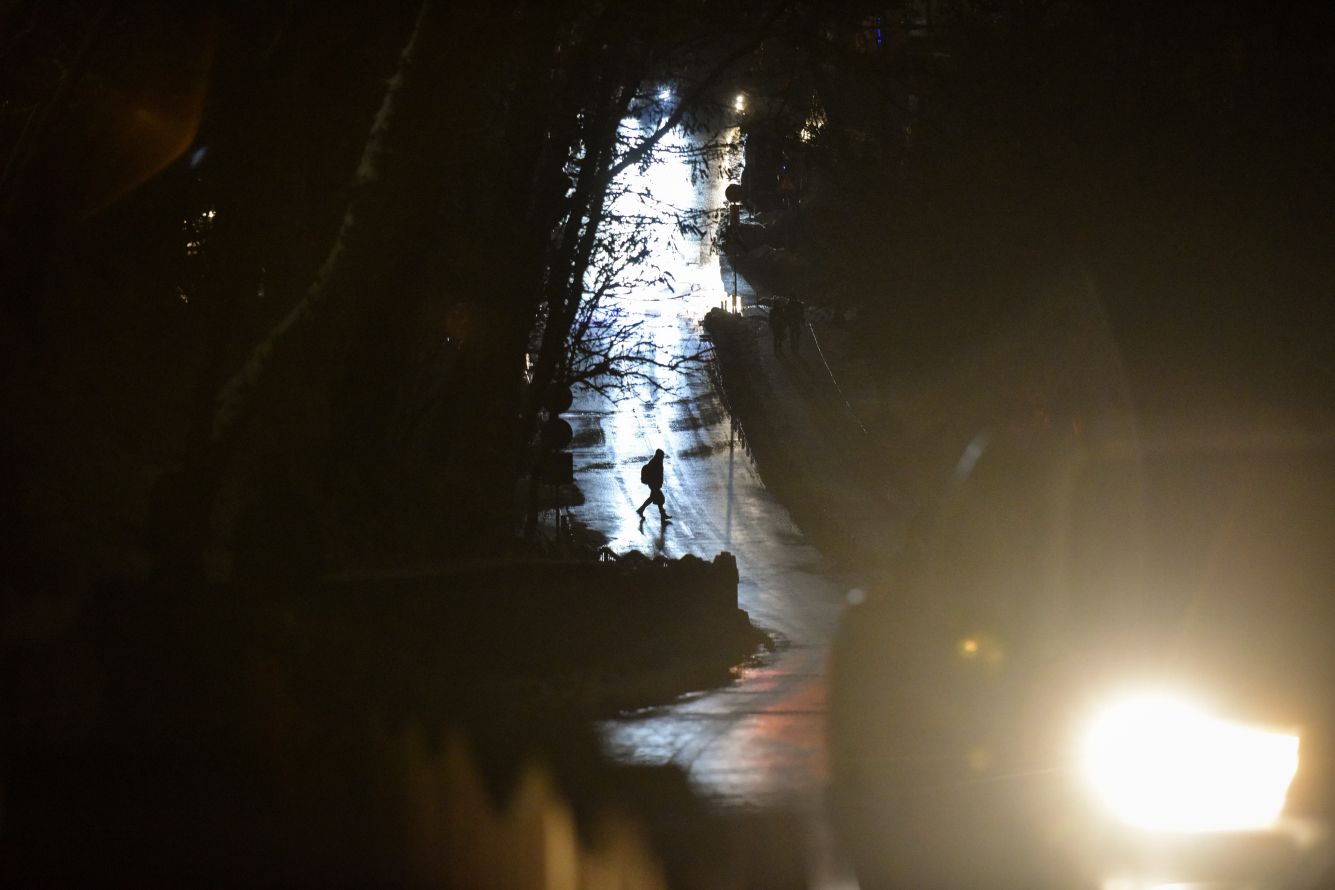
After the massive blows that Russian troops were carried on October 10 in many regions of Ukraine, from Kiev to the Lviv region, the country's energy system suffered so much that the Ukrainian authorities were forced to introduce a planned disconnection of electricity and heating. The situation was aggravated by subsequent attacks throughout the country, the last of which occurred on November 23. Ukrainians have to sit without light, communication and heating for hours-the latter is especially alarming due to the onset of winter. Medusa talked with the inhabitants of Kyiv about how they save from the cold and try not to lose heart in the dark.
Elizaveta Surnachev
Journalist of the joint project of the TV channel "Present" and "Radio Liberty" . Declared in Russia a "foreign agent"
I am a journalist, I lived all my life and worked in Moscow. I moved to Kyiv in 2020 to my husband. Already here I began to work on the Currently television channel.
In recent weeks, everything happens according to one scenario: first shelling, after interruptions in water, light and heating begin, then everything is restored a little, and then new shelling. Now we are at the point when everything begins to work again: I basically have light, water and warm, and traffic lights even work on the streets - recently it happened infrequently.
The last mass shelling occurred in the last Wednesday [November 23], after which there was a total blackout, and the light and communication were completely. Then I had no heating for several days, Sveta, for some time there was no water.
When the heating was turned off, it was not so that you immediately ended up in the ice desert. I live in the panel, and although these houses are traditionally poorly held by heat, all the same, until the temperature drops very low, it should take several days. It felt like in a European apartment in winter: it is unusually cool, but in socks, a sweater and under a warm blanket it is quite possible to live.
I have a gas stove at home, and it helps a lot: you can warm up dinner, boil water. Those who have no gas in the houses, of course, are much more complicated. People buy hiking gas burners or even build mini-sections from improvised materials: candles, pallets, stones.
Blackout last week [after shelling on November 23] differed from previous disconnects (and the light and communications in Kyiv lasted a month and a half, after Russia began to fire the Ukrainian infrastructure in October weekly). For the first time, it became scary for hospitals who had previously tried not to turn off [from electricity] as objects of critical infrastructure. This time, the Blackauts in the city were larger - it was then that the famous video with an open heart in a child in the light of pace lanterns got into the network.
It is worse than just sit at home in the dark. It must be understood that now there are often ice on the streets, this is a fairly traumatic period in peacetime. I constantly imagine a grandmother who goes in pitch darkness, grows and breaks the neck of the thigh. She cannot call an ambulance, because the connection lay down, and even if she reaches the hospital, she still won’t make an X -ray, because there is no electricity. I don’t know if people often get into hospitals because of such domestic injuries in the dark on ice, but I think there is a separate danger in this.
Everyone understands that winter can be heavy, prepared and stored by products. The life of everyone looks very different. Those who live in private houses can put generators, cook food in the barbecue in the yard. In apartments, life is very much tied to electricity, and here everyone has their own life hacks. For example, I have LED garlands hang: they can work on batteries for quite some time and at least not stumble with them in the corridor. To have dinner in the evening, you can light candles. Some buy portable charging stations - in fact, large Powerbanks, from which, for example, you can charge a laptop. Residents of high-rise buildings try not to use elevators (which can stop at any time), but in case someone still gets stuck, leave the box with the most necessary: water, snack, a toy for a child, an empty capacity.
Shops and cafes are trying to continue to work, although they have a hard time. The generators buy small points and switch to cash (when the connection is laid, the terminals also do not work). Large supermarkets have more problems: they need a lot of electricity to illuminate large spaces to work cash register. There was a week when I never got into a supermarket where I was used to going.
But I have not seen such that it was impossible to buy food or it was not on the shelves at all. News about empty shelves appeared in Russian pro -government media: look, they say, Kievites are buying products in a panic! But I think that this was more due to the fact that while shelling and air anxiety are going on, no one can go to the store. And then in the evening all those who were going to buy something in the morning come there in the evening, and there are queues.
A separate problem with the fact that the connection often disappears and you live as if in a digital desert. You can’t read the news (which is especially important if at the moment the city is anxious and you need to understand where and what has arrived), you cannot call loved ones and find out if they are all right, you cannot call a taxi, an ambulance or the police. I'm not talking about how many people the work is connected with the Internet and whose working day is now compressed until several hours. In the evenings, in the transitions in the subway, you can see people who simply stand and write messages, because the subway almost always catches in touch. Several times I saw people sitting on the steps with a laptop.
In the city, heating points are deployed where you can come and charge the phone. The largest online retailer "Roset" opened such points around the city. There you can also buy first -case goods. The authorities announced that only in Kiev there are now several hundred points where people can be warm and drink hot tea. It can be anything, from kindergarten to gas stations.
Of course, this is not the way of life that we wanted to lead in the 21st century, and no one sees anything normal or good in this, but there is already some kind of feeling of adaptation to this. You just perceive it for the current given and plan your life in these new realities.
It is probably impossible to get used to only the very fact of war and constant attacks on infrastructure, which no one is already shy in Russia. When you hear the explosion, this is still scary. Probably, not so much for yourself as because you understand how much more pain, deaths and suffering will follow this.
Elizaveta Bogolyubov
Freelander
Our apartment is not often turned off from electricity. It is clear that when there was a blackout on Wednesday [November 23], everything disappeared - there was neither light, no water, nor even communication. We once managed to catch a signal and get through to someone, but I know that many did not even have this. After a day and a half, they began to return water again, and then electricity.
We were lucky: we have accumulated water, electricity, in principle, too. We bought all kinds of options for lamps with batteries and batteries. We have gas heating at home, and it was not disconnected - and this is usually the most with this. A friend came to us to warm, he has an electric heating. But he still went to the night. The temperature was then zero or minus one, but it is very difficult to imagine what would be in minus 15. Batteries cool in two hours, every other day the cold is felt much.
We have a gas stove at our place, and I could calmly boil water. Friends had to do this at charging stations, and then store hot water in thermos to at least do tea. It’s hard for me to say how it was in the city as a whole, I almost did not leave the house. You look at the street - it is empty. Just sit and try to wait.
The day after Blackout, the husband tried to go to work. Then there were very foggy days, and he got into an accident due to the fact that traffic lights did not work. He was lucky, only the car suffered a little. But in the news, I often see that someone is knocked down . In the evening, everyone made it a rule to walk with a flashlight on on the phone, some buy reflective tapes.
Everything is fine with products, many stores work on generators. People try to stay together, we have a chat where we communicate and share things, if there is such a necessity. There are a drill in the city, there you can also get water. But if the heating completely disappears, it will be the largest collapse.
There are periods during disconnects when it is dark, quiet - and scary. But it seems to me that the city has more or less adapted. There is no such thing that he is dying for a long time. You always prepare for new shelling, try to charge everything, do cleaning, wash things before there is a blackout again. The general condition, of course, is serious, but so far we are holding on.
Edward
Sales Manager Elektrokarov
I work in Kyiv, but I live in Brovary, a city 26 kilometers from Kyiv. I have a wife and a three -month -old child. Disaches of electricity in our city do not occur at all according to schedule. If you count, in fact everything works 8–9 hours per day, they turn off 3-4 times a day. For these one and a half to two hours [between disconnects], we, a family with a small child, have to have time: wait until the boiler is warming up, cook food, work, wash the baby, charge the powerbans and the rest of the equipment.
We had to abandon normal products - cheeses, milk, meat, from all perishable, because in the non -working refrigerator the food simply lies and deteriorates. It is not possible to cook for a few days ahead, you need to cook once a day. With the advent of cold weather, we began to put products out the window.
Our house, like most new buildings, is not gasified. To heat baby food, you have to use tourist burners. In the apartment, most of the time is cold. The rooms do not have time to warm up from electric batteries, but they cool very quickly at night.
Another problem is that we have an electric car. In a situation where there is constantly no light, the car turned into a monument. If the light is turned off, then in the whole city, and charging on the streets stop working. You have to sit in a discharged car without a stove and wait for the voltage on the network.
The shelling has already stopped scaring, they cause only anger and anxiety for the future of my child. I don’t understand why some distraught dictator, whom the Russian people launched to the steering wheel, decides how to live, and so godlessly deprives us of basic things, such as electricity, water and warmth.
📄 Dear readers! Military censorship has been introduced in Russia: millions of people are deprived of access to independent information. But right now, journalism helps to save lives. Any article “Medusa” is easy to turn into a PDF file. It is very convenient to send such a file in a messenger or by Imail to friends and relatives - especially those who do not know how to use the VPN (and who, most likely, do not have our application). And PDF can be printed - so that the Medusa materials can read even those who do not have the Internet at all. Read more about this here .
Andrey
builder
I was born and raised in Druzhkovka , a city in the Donetsk region. In 2011, he moved to Donetsk, engaged in construction, married. When [in 2014] the war in the Donbass began, my wife and I moved to the unoccupied part of the Donetsk region-to Kramatorsk. And at the end of this summer, we moved again - to Kyiv. In Kyiv itself, housing could not be found because of the influx of refugees from different regions. You call on a fresh ad, and you are already fifth in line for viewing. We settled in Sofievskaya Borshchagovka , a village near Kiev.
I sent my wife and child to Europe in October - after strikes at the intersection in the city center, on people who went to work. I have long understood that nowhere in Ukraine it is impossible to feel safe, but this [massive shelling on October 10] played a key role. Now my family is in Germany, and I stayed here to sell the car and go to them for the proceeds. I hope that before the New Year I will succeed.
With heating, the trouble is as follows: in our house, all gas speakers have the so -called boilers. But they begin to heat up not when you twist the pen and flint gives a light, but from electricity. That is, they do not work without light. Nobody observes the shutdowns, they can turn off the light for the day throughout the [Sofievskaya] Borshchagovka, it was such as two. Communication and the Internet disappear.
I sold the car, I can’t go to Kyiv. I do not read the books, and I don’t have them here. From entertainment - alcohol. Well, I found comrades in misfortune among the neighbors, communicate with them, waiting for the departure. Inside is a void, as if the soul was pulled out. Very much crushes morally when you wake up alone, in a cold apartment, there is no connection, hot water too. And for a month for a month, the cough has not passed and the nose has been constantly laid. I lie and remember from a hangover, how good everything was good. Although then it didn't seem so. Obviously did not appreciate what they had.
Kirill Mikhailov
Researcher of military conflicts, until recently, worked in Conflict Intelligence Team
I have been living in Kyiv since 2014. I decided to leave Russia because of hysteria around the annexation of Crimea. I am engaged in research of military conflicts, now I am following what is happening around the Russian-Ukrainian war. From the first days of the war, until the end of April, I lived with a friend in Vinnitsa, then returned to Kyiv.
The last large -scale Russian attack was last week [November 23]. Then the light went out suddenly and it was not a day, and heating was even longer. The apartment managed to cool. After that shelling the system is still in a fever, the authorities introduced an emergency [planned] disconnection [electricity]. Everyone except hospitals and metro can turn off at any time. Now everything is returning to a relatively familiar course: in most areas of the city, lighting and heating are again given according to schedule, albeit with interruptions. But the most unpleasant - we can assume that it will not be better further.
As I said, until the last big attack, we relied on graphs [power outage]. You could go to the site and find out when the light was turned off. They [the authorities of Kyiv] try to ensure that everyone is informed and that everything is predictable.
[When they turned off the light in my house] I watched a shutdown schedule in areas in one or two stations [metro] from me and went to some cafe to sit with the light. Now, when everything has become so unpredictable, it is easier to use cards on which the points where the generators work are shown. Most often these are cafes, gas stations, large malls.
All this is quite surrealistic, in fact. I went for the insulation [to seal the slots in the windows], because I do not want to repeat the situation with the heating. Mall works, there are people there - but there is no lighting. Everyone goes with flashlights as if nothing had happened, pay cards. [Small] supermarkets also work, but large almost all are closed, and there are always large queues. Small business buys generators: you go to the local market, there every second kiosk has them.
People adapt. The other day, I worked for three hours at the gas station: I came to recharge, warm up, I see that people are starting to sit down near the sockets. I also sat down and began to work, connecting to the local Internet. Of course, I prefer a cafe, but there are more gas stations, and there are definitely generators.
There are those who are serious about all this and buy generators. I bought a couple of flashlights, a USB lamp and a powerful headlight for a bicycle, and also a mobile router: it works a little better than mobile Internet. At home I am sitting in thermal underwear under clothes. So far, everything is enough. When there is light and warm, I warm up my room for the future. It is not very powerful, but in the evening it remains warm.
Everywhere they advertise a film that must be glued to the window: it gives additional protection, it is called the “third glass”. I did not find it in the store, I will order by mail - the branches work, albeit without light. Everyone is trying to provide at least some service.
If anything, I will move to a friend to Vinnitsa again. Buy a generator, Starlink and a couple of gas cylinders to drown the house.
Alevtina
American insurance company manager
I rent an apartment in the Goloseevsky district of Kiev, in a new house, which was rented one and a half to two years ago. I work remotely as a customer manager in one American insurance company. My working day lasts from three in the afternoon until one in the morning in Kyiv. Payment, as in all American companies, hourly. As you know, this [disconnection of electricity] brought me huge problems. The fact is that if the area is “turned off”, both the Internet and mobile communications disappear.
At first I was looking for institutions in which it would be possible to sit down and work. I will not say that this is convenient, because most of my work is to call customers and hospitals. At 23:00 in the city, a commandant hour begins, and I could not modify my shifts, which annoyed the bosses. They do not say this directly, but we understand it. From Ukraine in our “Tim” [team] there are only two people, the rest of the guys from Tajikistan, Kazakhstan and other countries. And they do not have such problems.
Recently, I can not replace at all, because the disconnects have become emergency and unpredictable. You wake up - there is no light, work begins - there is still no, they give it at one in the morning. Why do I need it? I already have more than 20 hours of “passes”, and I and I and I live - he lives in another city - we are riding that it is not today that tomorrow they will definitely dismiss us tomorrow.
As I already said, I live in a new house, and in Kyiv there are practically no new buildings in which gas was carried out. У всех стоят индукционные печи, бойлеры, электрические батареи — все это не работает без питания. Недавно я заболела, потому что электричества не было почти двое суток. Я пришла промерзшая с улицы, но так и не смогла согреться. [У меня была] температура 39, связи не было, интернета тоже. Я даже скорую вызвать не смогла.
Переезжать я не хочу, дом недалеко от метро, хорошая шумоизоляция. После начала войны я не строю слишком далеких планов. С работой — как получится, так и получится. Одно знаю точно — лучше жить без света и воды, чем с русней.
Записали Алексей Славин, Александр Рыбин