
Translated material
Damned old house
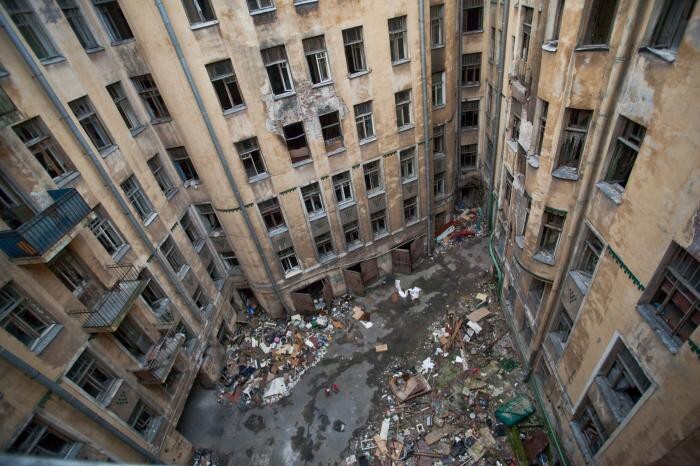
Basevich’s house on Bolshaya Pushkarskaya is one of the most famous abandonment of St. Petersburg. After long disputes and numerous fires, the building, which smells of burning, is prepared for radical reconstruction in the interests of the Dance Academy Boris Eifman. Work began on the demolition of the neighboring Soviet kindergarten.
Journalist and local historian Alexei Shishkin specifically talks about the fate of the house: from the “skyscraper” of the early twentieth century and communal services to material evidence in the trial, boarding school and apartments.
1912. Hind house with an engineering office
Basevich’s house was built in 1912 according to the project of civil engineer Alexei Zasorsky. This was one of the advanced architects of the era, the author of the architectural project of the 1st stage of the city electric tram and the first houses of permanent apartments in St. Petersburg. The customer himself also helped in the work - the ally of the manager, the manager of the Technical Construction Office of Issahar (Ivan) Basevich.
At the time of construction, this was one of the most impressive buildings of the district. Considering the attic, there were seven floors in his courtyard outbuilding - almost a height for his time. The facades were performed in the spirit of the late Finland Northern Art Nouveau. The first floors were occupied by the Basevich engineering office itself, and the apartments and rooms for renting were above. In some sources, we can find the mention that part of the building was occupied by workers of construction artels.
1918. Communal apartments
In August 1918, Basyevich’s apartment building - like another thousands of buildings throughout Russia - was nationalized and turned to the authorities of Petrograd. Soviet employees and workers were populated there, rental apartments were turned into communal ones.
The most former owner of the house, who adopted the revolution, allocated housing at a different address. The Basevich family remained in Petrograd, the descendants of the engineer live in the city now.
1991. Emergency housing
Over 70 years of communal life, the former Basevich’s house was strongly dilapidated. In 1991, it was decided to resettle him as an emergency, but the process dragged on for almost two decades.
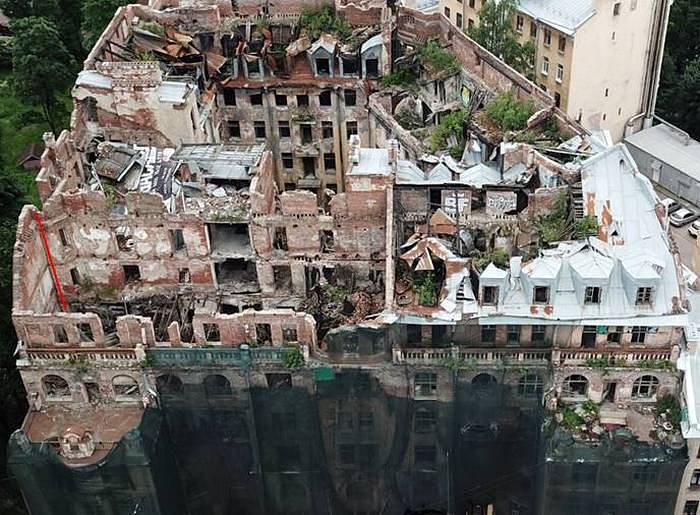
On September 3, 2002, in the middle of the day, freed from the tenants of the attic caught fire, the reason was not established. The fire blazed for more than 12 hours, it was extinguished by an increased, third complexity number of crews from several areas. There were no victims, only one of the firefighters was very scratched during the salvation of the cat. The newspapers wrote about the “evil rock”, which pursues the Petrograd district: shortly before that large fires arose on a large multifaceted, 6 and large monetary, 23.
But for the house of Basevich, the misadventures were just beginning. The fire flashed either in already empty, then in still residential communal apartments. When on October 2, 2009, in the house for stewing the next fire, the roof had to open, firefighters stated that this was the fifth fire at the same address in several years.
It was possible to resettle the last apartments only in 2014. By the way, that year in Basevich’s house there was also a strong fire.
2014. Apartments for young families
On April 11, 2014, the St. Petersburg Center for Available Housing announced a competition for examining the building. It was decided to include the house in the program "Youth - Affordable Housing." Her idea is to rebuild from the inside, preserving the facades, emergency houses in historical areas, and then sell apartments at a preferential price for young families in need of housing. According to this program, for example, Krutikov’s house was restored to the 11th Krasnoarmeyskaya, 7, on Fontanka, 133, Serpukhovskaya, 2, several houses in Kronstadt. In total - several dozen addresses.
The housing committee planned that the repair of the building would start in 2015 and end in the second quarter of 2017. But the work never began.
2016. Boarding school for Academy Ephman
Choreographer Boris Eifman and his dance Academy began to master the surrounding quarters of the Petrograd side back in the early 2010s. In 2011, on Lisa Tchaikina Street, 2 demolished the Assembly pre -revolutionary cinema. Before that, he was deprived of the status of an object of cultural heritage. In its place, the main building of the academy was built. In addition, for the needs of a ballet university, they restored the Steinman mansion on Bolshaya Pushkarskaya Street, 14 and former school on Vvedenskaya 3.
In July 2016, it became known that the property relations committee decided to give the Afman Academy and Basevich’s house, along with a typov Soviet kindergarten on the corner of Lisa Tchaikina and Bolshaya Pushkarskaya Street.
After another three years, the project culture LLC, the former bureau of the chief architect of St. Petersburg Vladimir Grigoryev, presented a project for the reconstruction of the revenue house and the demolition of the kindergarten with the square surrounding it for the construction of the hostel-boarding school of the Academy. In the original version, Basevich’s house was also planned to be completely demolished, and then to build a new building in its place, recreating the facade in Pushkarskaya. Over time, plans adjusted the plans: the designers agreed to preserve four genuine floors of the facial corps. However, this option still involves disassembling most of the house.
The partner of the Afman Academy in the project was the Setl City LLC, part of Setl Group, a large St. Petersburg construction corporation. This, like the monumentality of buildings depicted on design sketches, forced many critics to suspect that the hostel would only take part of the future complex, and the remaining premises would be given to apartments or apartments for sale. At the same time, it was planned to pay demolition and reconstruction from the city budget.
2020. Central address of the city -protective campaign
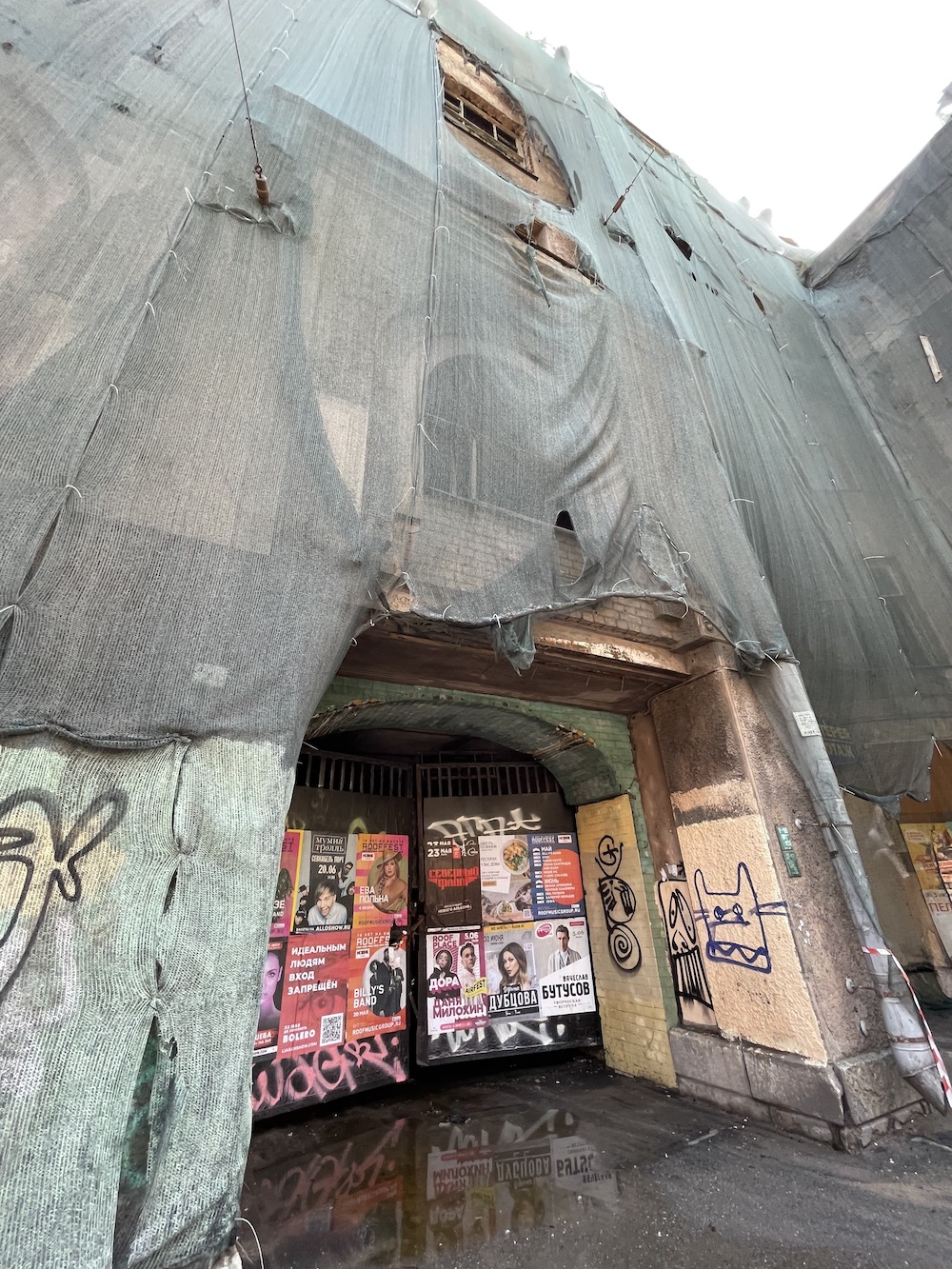
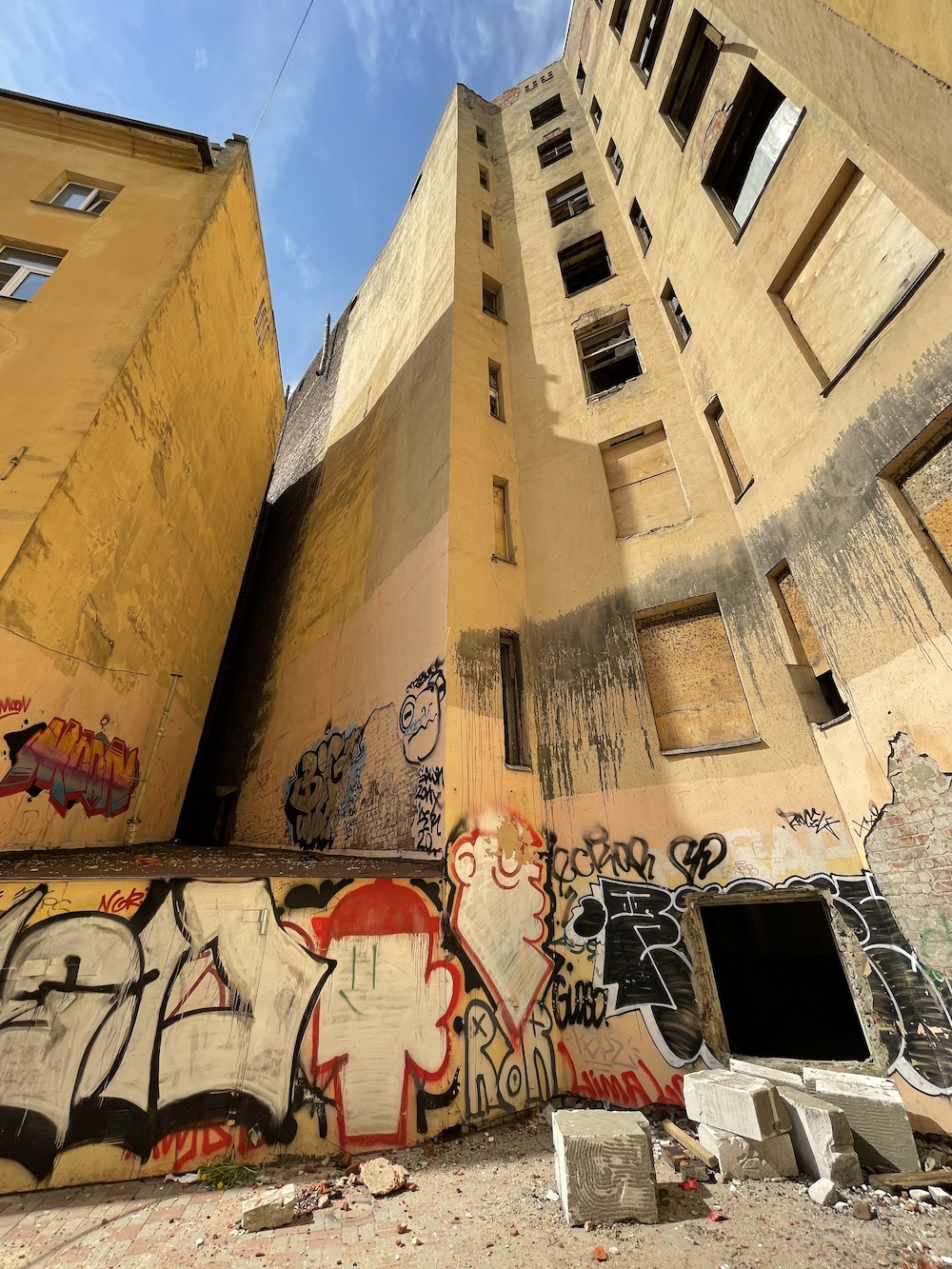
While there was a resettlement and discussion of possible options for further use of the building, the house itself continued to collapse. By the end of the 2010s, the upper floors of the courtyard outbuilding, especially the injured from fires, practically turned to the ruins. Even at a distance of several houses, the smell of burning and decay, emanating from the long -suffering building, is felt.
In 2020, the granddaughter of engineer Basevich, a pensioner, in the past, builder technician Marianna Guseva turned to the governor Alexander Beglov with a request to save the building: “Until recently, the house was residential, in Soviet times many beautiful people lived in it who left warm memories. Although we are now not living on Bolshoi Pushkarskaya, 7, I carefully follow the fate of the house. For a long time, he stood abandoned unattended and care. House repair plans were hope for me. And the news about his demolition plans for the construction of apartments for the dance theater Boris Eifman was a heavy blow. ”
Basevich’s house has become one of the key addresses for urban protection campaigns of the last two years. In February 2020, activists lined up a living chain around the building, thus protesting against the then potential demolition. In March, a festival of excursions in defense of the building took place.
After the beginning of the covid quarantine, part of the action moved online. On the site "City Protection of Petersburg" published a video message cycle designed to draw attention to Basevich’s house. For example, the architect Olga Bogdanova spoke about the innovative solutions applied during the construction of the building, the writer and poet Boris Lichtenfeld shared his memories of his youth in Basevich’s house, and the researcher of St. Petersburg Valentina Titova gave a lecture on the monuments of the Modern era.
At the same time, activists raised money for an alternative technical examination of the state of construction. It showed only 3 % of the structures and the need to replace ten sections of the walls. At the same time, activists did not announce specific options for further transformation of this address, concentrating on the prevention of direct demolition.
2022. Foreign evidence or apartments
The campaign in defense of the house continued even after the activists failed to challenge in court the conclusion of the KGIOP about the possibility of a radical reconstruction of the building. In 2022, several more street and online actions took place. In November, the city defender and coordinator of the Living City movement Dmitry Litvinov said that the police put pressure on the participants in the pickets in defense of the building, threatening them with arrest.
Nevertheless, in mid -autumn, the Investigative Committee granted the petition of activist Oleg Mukhin to recognize Basevich’s house with material evidence in the KGIOP case - an investigation into abuse in the St. Petersburg Monument Protection Committee. In the period while this status acts, any demolition or reconstruction of the building is impossible.
Basevich’s house became one of a number of buildings, against the backdrop of the attention to which the St. Petersburg city protection movement became close to the head of the UK, Alexander Bastrykin. “Of the whole variety of state authorities, only the Investigative Committee headed by you and you personally became an obstacle on the path of officials affiliated with developers, by the first click of historical buildings and monuments, ready to remove from protection. Your role in the formation of the law of the law regarding the preservation of the cultural and historical heritage of St. Petersburg is difficult to overestimate, ”says the congratulatory post published in the group“ Save Basevich’s House ”on the birthday of the security forces.
In parallel, Smolny and the Afman Academy leave no attempts to start work. On December 15, the construction supervision service issued a building permit on Bolshaya Pushkarskaya, 7a, which implies the appearance of 87 studios and six rooms of the assembly rooms at this address of the residential building, the house was surrounded by a construction fence. On December 19, the demolition of a nearby building of the former kindergarten, also falling into the development zone, began .
It is possible that litigation or other wires for some time will detain work and house No. 7 will continue to collapse in the middle of the Petrograd side.
Photo on the cover: administration of St. Petersburg
✨🐰 Support “paper” and give the stranger the year of free Internet
become a secret SantaWhat else to read: