
Translated material
It got worse. 2022 in numbers
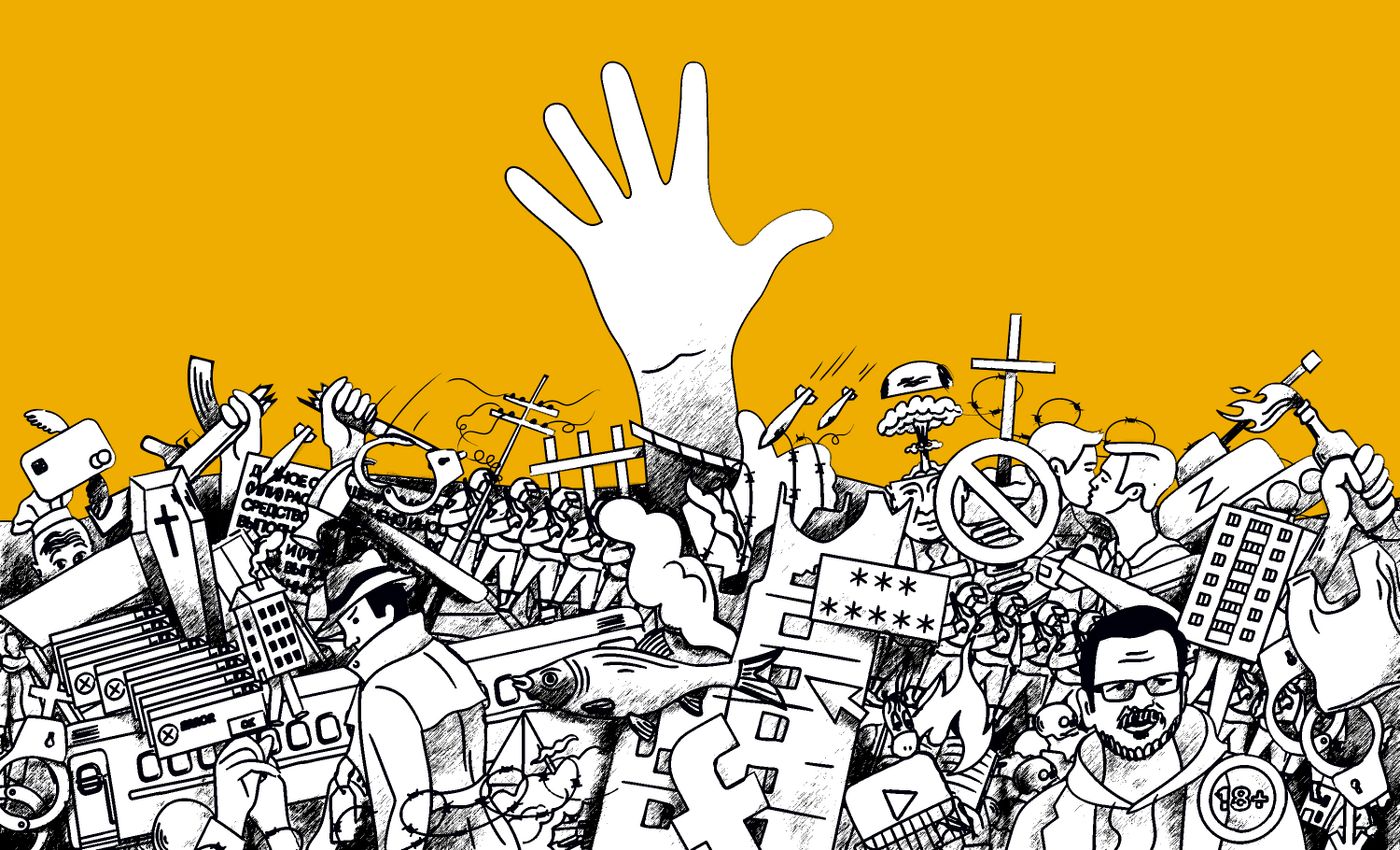
The war in Ukraine is the eleventh month. During this time, thousands of civilians died under Russian shelling, millions became refugees. Ukrainian cities are blocked daily, some are already destroyed to the ground. The protests against the invasion of Russia were quickly suppressed, the word “war” itself was prohibited - for this sites are blocked, and people are fined or sent to prison. Other repressive laws appeared, for example, a ban on actually any mention of LGBT, tightening punishment for those whom the authorities considered “foreign agents”, and new sanctions for refuseniks among the military. "Mediazona" shows on the numbers how 2022 passed.

On the morning of February 24, the Russian army, by order of Vladimir Putin, invaded Ukraine. Officially, the purpose of the “special military operation”, as the Kremlin calls the war, is still the destruction of military facilities, but from the first day of the war, Russia shall cause missile strikes in residential buildings, schools and hospitals.
According to the UN on December 26, 6,884 peaceful residents of Ukraine were killed under shelling, 429 children were killed. In fact, there are more victims, in the conditions of ongoing battles and occupation, information about the victims of the war is difficult to quickly check and confirm.
Since February, the Prosecutor General of Ukraine has already registered more than 60 thousand crimes committed by the Russian military: the shelling of cities, the murder of civilian, torture, rape and looting . A gloomy symbol of the war was Bucha - a city near Kiev, which stayed under the occupation from March 5 to March 31. According to the Ukrainian authorities, during this time more than 400 people were killed there, some were tortured before death. In September, the Armed Forces of Ukraine were able to free the part of the Kharkov region seized in the spring and found mass graves and dungeons there, where peoplewere tortured . The Kharkiv residents talked about brutal bullying and looting. The Russian side calls all such messages “fakes”, but the soldiers themselves were recognized in crimes.

According to the Ukrainian Ombudsman Dmitry Lubinz, from the beginning of the war, 4.9 million people moved to the less dangerous areas of the country, and 7.9 million - about 20% of the population - went abroad. At the same time, more than 13 million remain in the occupied territories and in the fighting zone. Fleeing from the war, many Ukrainians were forced to flee to Russia, others were taken by force, and then they found themselves in a pre -trial detention center.
The cities of Donetsk and Lugansk regions of Ukraine were most affected by the shelling, some of them were actually destroyed. So, in the occupied Mariupol, according to the UN, damaged up to 90% of multi -storey buildings; The Ukrainian authorities believe that more than 22 thousand Mariupol residents died under shelling. Volnovakha, a small city 60 kilometers from Mariupol, in two weeks of fighting turned into ruins. “Volnovakh as a city no longer exists,” the Ukrainian border service stated back in March.
Having suffered several major failures at the front, Russia has passed to the targeted destruction of the energy infrastructure of Ukraine. Missile strikes leave cities without light, water and heat. In early December, the Prime Minister of Ukraine Denis Shmygal said that all thermal and hydroelectric power plants were damaged in the country. “Each of us must realize that we will pass this winter with significant restrictions on electricity consumption,” he said.

Due to the invasion of Ukraine, Russia became the world leader in the number of sanctions imposed on it by early March. Dozens of countries joined them. The European Union introduced nine packages of restrictions against Russia regarding the financial, energy and transport industries, as well as technologies. The largest Russian banks were disconnected from the SWIFT system, Mastercard and Visa payment systems stopped working in Russia, foreign assets of the Central Bank are frozen. Many Russian companies fell under the sanctions. According to the estimates of the Leadership Institute for the leaders of Yale University, more than 1,200 foreign companies left Russia or limited Russia from manufacturers of sweets to automotive industries .
State Duma, ministers and officials of different levels, Russian state media, military leadership, relatives of officials and people close to the Kremlin fell under the sanctions. Several European countries closed the entrance to Russians with tourist visas and suspended the design of new ones, Russian athletes were removed from the participation of almost all international competitions.

The Russian army suffered serious losses already in the early days of the war - and from the very first days of the Ministry of Defense hid them. Sergei Shoigu called these numbers only twice, the last time in September. According to him, 5,937 Russian military were killed in Ukraine. The Mediazon is a list of soldiers and officers, whose death is reliably known. On December 30, we know the names of more than 10 thousand dead military. These data do not reflect the actual level of losses, we take into account only verified messages from relatives, local authorities, regional media and volunteers.
In the early days of the war, the first refuseniks appeared - the military, who were not ready to comply with the orders of the commanders. Some of them are sent to illegal prisons and “pits”, beaten and forced to return to the front line by force, others became defendants in criminal cases of unauthorized abandonment of the part and failure to fulfill the order.
In July, it became known that Russian prisoners were recruited to the war: representatives of the “PMC Wagner” and its creator Evgeny Prigozhin himself frequent in the colony. It is difficult to reliably assess the number of recruited prisoners, but the statistics of the FSIN shows that by the end of October, the prison population of Russia was reduced by 23 thousand people. Volunteers are promised to pay and pardon, andthey are threatened by the desertion. In November, a video of the brutal execution of the surrendered Armed Forces (and as a result of the exchange for Ukrainian military) ex-paced Evgeny Nuzhin appeared -he was crushed with a sledgehammer.
But the personnel military, volunteers and prisoners were not enough to continue the war: on September 21, Vladimir Putin announced the beginning of a “partial” mobilization, although before that he had repeatedly promised that they would not send reservists to Ukraine. They organized a real hunt for men of draft age: they tried to mobilize the homeless distribution of food, musicians at rehearsal bases and clerks in office centers. The summons, contrary to the assurances of the authorities, came to large fathers, and people with disabilities, and even dead. Mobilized immediately began to complain about poor supply, “cattle conditions” , the lack of normal preparation and the promised payments.
Mobilization has become a trap for contractors: now they cannot quit, because all contracts concluded from the Ministry of Defense, according to Putin’s decree, will act until its end. In addition, the deputies introduced the concepts of “mobilization” and “wartime” into the Criminal Code and greatly tightened articles about “crimes against military service”. Russian courts are alreadymaking sentences under new articles on desertion and unauthorized leave of the part during the mobilization period.

On the first day of the war, in dozens of Russian cities, people went out to protest . The rallies brutally dispersed the security forces. Subsequently, the OVD-Info team considered that from the beginning of the invasion of Ukraine, anti-war shares in Russia were detained 19,478 times.
On the second day of the war, the Ministry of Defense accused the independent Russian media of spreading “fakes” - this is how the department calls the news about the shelling of Ukrainian cities and the deaths of civilians. On March 4, the State Duma supplemented the Criminal Code with Article 207.3 of the Criminal Code, which provides for up to 15 years of conclusion for the "public distribution of knowingly false information" about the army. This is considered any information diverging with the official reports of the Ministry of Defense. The bill was immediately signed by Vladimir Putin.
According to human rights activist Pavel Chikov, 180 criminal cases have already been opened in Russia under Article 207.3 of the Criminal Code.
In early December, the colony was sentenced to 8.5 years, politics Ilya Yashin - for a stream about the murders of civilians in Buch. In July, seven years in the same case received a colleague Yashin Alexei Gorinov. Recently, in St. Petersburg, the court began to consider the case of the artist Alexandra Skochilenko, who was accused of “spreading fakes” for changing the price tags in shops for pieces of paper with printed reports about the war in Ukraine. Another person involved in the case of Fakes was oppositionist Vladimir Kara-Murza.

Simultaneously with the amendments on “fakes”, deputies adopted a bill on punishment for “discrediting” the army: Article 20.3.3 appeared in the Code of Administrative Offenses, providing for a fine of up to 100 thousand rubles for individuals. A repeated violation committed throughout the year is already fraught with a criminal case under the new article 280.3 of the Criminal Code.
By the end of December, Mediazon counted 5,518 the protocols received in the courts on the “discredit” of the army. They were made up for the Ukrainian song “Chervona Kalina” (and more than once), for anti -war statements in a schizo, for the video with mobilized complaints, for refusing to be convinced (then this case was stopped), for ballots with anti -war slogans and even for a poster without words: “*** *****”.
A defendant in the criminal case of the “discredit” of the army, for example, was the former mayor of Yekaterinburg, Yevgeny Roizman, before that, a protocol under a similar administrative article was drawn up for a politician three times. After several administrators, a criminal case was opened against the Yakut musician Aikhal Ammosov.
According to the OVD-Info, at least 393 people were subjected to criminal prosecution for an anti-war position in Russia. In this statistics, human rights activists took into account everyone who was under investigation against Russian invasion of Ukraine, including those whose protest was not peaceful: since the beginning of the war throughout Russia, military commissariats, police branches and administrative buildings regularly set fire to (or trying to set fire to). By the end of December, Mediazon counted 77 such cases.

On the first day of the invasion of Ukraine, Roskomnadzor demanded that the journalists publish only “data from official Russian sources” about the war. Soon blocks soon began : in Russia DOXA , “Present” , “Rain” , “Echo of Moscow”, The Village , Tomsk TV2 , “BBC ” , Deutsche Welle , Radio Liberty, Cold, Pskov Province , Caucasian Knot, 7x7, Paper, Paper, Paper , Paper, Paper, “Cold” . The Insider , “Baikal People” and other media. Mediazona fell under the blocking on March 6.
Some editions stopped work, others agreed to remove the materials that caused the complaints of censors and stopped writing about the war, others crossed abroad. According to Roskomvoboda estimates, by December 22, access to 9,300 sites was limited in Russia. Roskomnadzor blocked the service for schoolchildren “Knowledge” (for the question of the Russian invasion), the site “Kart.ru” (due to the anti-war output “Masyani”), the popular site for chess players Chess.com (for links to articles on the war) and the base of stock photos and videos of PEXels (for anti-war calls).
Facebook, Instagram and Twitter fell under the “fakes” under the blocking. In addition, at the end of March, the Tver District Court of Moscow recognized the extremist organization META - the Facebook , Instagram and WhatsApp maternal company - for the decision to change the rules and temporarily not delete posts with calls for “Russian invaders”.
Military censorship quickly stepped from the Internet to offline: back in early March, the Russian Media Group compiled a list of “undesirable” musicians who condemned the invasion, and from the textbooks of the Enlightenment publishing house, one of the largest and oldest in the country, the mentions of Ukraine and Kiev began to remove .

At the beginning of the summer, the State Duma decided to discuss the new law against LGBT: “Propaganda of homosexuality” among minors in Russia has been prohibited since 2013, but now the deputies wanted to extend the ban on people of any age. The reason was the loud success of the novel about teenage gays “Summer in the Pioneer Tip”, which was released by Popcorn Books . The book had a marking 18+, but the deputies still considered that such literature was dangerous. She “poses a threat to the demographic growth and economic development of the country,” said the author of the bill Alexander Hinshtein.
Even before the amendments entered into force, the Russian book market switched to the self -censorship mode. The Likebook publishing house in one of his books was exhausted with black paint paragraphs with a description of sex between two men.
On December 5, the bill was signed by Vladimir Putin. For legal entities for “promoting non -traditional sexual relations, preferences and sex change”, the amendments provide a fine of up to 5 million rubles, for individuals - up to 400 thousand rubles. Separately, the law provides for a fine of 10 million rubles for the distribution of content related to LGBT, among minors, as well as for "propaganda of pedophilia."
On the same day, it became known that Liters and other bookstores are withdrawn from sale (and libraries are removed from the shelves) of the Quir-Tematic Book. VKontakte began to label LGBT Ploks with a dice with a warning about “hazardous health” materials, and in the Russian-language translation of the computer game World of Warcraft: Dragonflight, a wedding of two male centaurs was renamed “fraternal”.
At the end of December, the government allowed Roskomnadzor to block sites with “information that promotes non -traditional sexual relations and (or) preferences, pedophilia, sex change”. The deputies did not stop there: the head of the State Duma committee on family issues, Nina Ostanina, prepared a bill on a repeated violation of the ban on the LGBT Propaganda, which has already implies before five years in prison.

In early December, another repressive law came into force - "On the control of the activities of persons under foreign influence." Now it has become even easier for Russians to be in the list of “foreign agents”. There are already more than 500 “foreign agents” in the combined register of the Ministry of Justice, they have many responsibilities and restrictions: you need to market your materials, regularly submit reports, prohibited participation in election campaigns, organize public events, teach children, and so on. At the end of December, on the basis of this law, the oppositionist Julia Galyamin, who taught there, fired from the RANEPS. The books of “Foreign Agents” from this year are allowed to be sold only in sealed opaque packaging with 18+ markings.
For violation of numerous and actually impossible requirements for an individual - a “foreign agent” can start an administrative or criminal case, and a legal entity can be closed. At the end of last year, on such grounds, the Supreme Court liquidated the oldest non -governmental organization of Russia “International Memorial”, founded in the Soviet Union 35 years ago. Next, the Moscow City Court made the same decision regarding the Memorial human rights center.
In total, in 2022, deputies adopted more than 650 bills . For example, a new article 275.1 of the Criminal Code has appeared in the Criminal Code, which introduces liability for “confidential cooperation” with foreigners, which is now equating to the Stateizer. The first accused was the former employee of the FSIN from Penza.
The transition to the side of the enemy during the armed conflict was also equated to the Stateismman. The first well-known case under this article was brought up on a 21-year-old Muscovite, trying to leave for Georgia. According to investigators, from there he planned to go to Ukraine to join the Legion of Freedom of Russia.
On December 29, Vladimir Putin signed the Law on the life sentences for "sabotage activities". “Pathistic sabotage” will be punished by deprivation of liberty for a period of ten to 20 years.
Editors: Maria Klimova, Dmitry Tkachev