Türkiye and Syria can normalize relations in front of one disaster, and Erdogan can use the situation before the elections - political scientist • The Insider • RIMA — Russian Independent Media Archive
Türkiye and Syria can normalize relations in front of one disaster, and Erdogan can use the situation before the elections - political scientist
6 February 2023
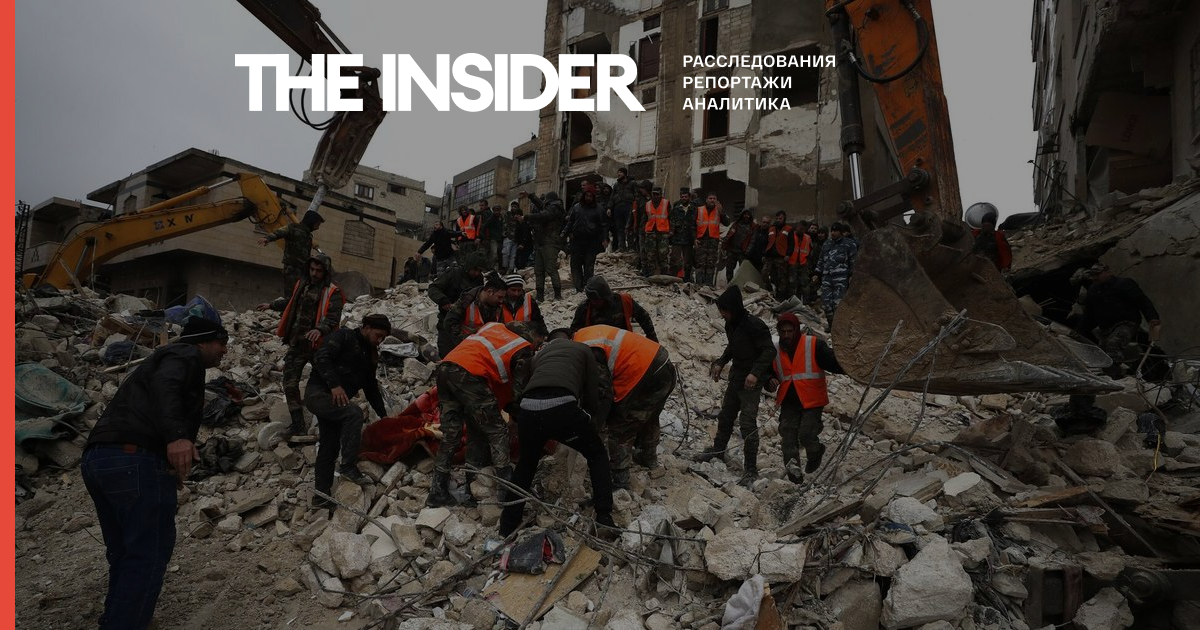
Against the background of the most large -scale earthquake in Turkey and Syria, which died, as a result of which at least 1,200 people have died , there is a possibility of reducing tension in relations between countries. This was stated in a conversation with The Insider Turkish political scientist, candidate of political sciences Karim Has. He recalled the Izmittsky earthquake on August 17, 1999, when more than 17 thousand people died, and Greece assisted Ankara.
“The previous large -scale earthquake occurred in 1999, then Greece provided great tension between Turkey and Greece. The degree of tension decreased, and until 2004-2005, Turkish-Greek relations reached their peak in a positive sense. In the case of Syria, this can now speed up the process of normalizing relations and push both countries to unite in front of one disaster. There is no need for excessive optimism, but it should be borne in mind that general troubles help the peoples unite.
It is difficult to evaluate how the tragedy will affect the rating of leaders before the elections. In any case, the government can be accused, but in general the people are inclined to blame the government, but fate. Religious feelings become more influential in Turkey than political voices. Maybe some part of the population who suffers will blame Recep Tayyip Erdogan, but, in my opinion, the Turkish leadership will react, since these elections are important for him. Erdogan may not defeat them, but he will still remain in power, because he cannot leave. Most likely, the Turkish leadership will announce some measures to support to the victims.
In 1999, the media in Turkey were at least partially free, and now 95% are already proceeding, and the remaining 5% do not particularly go beyond the rhetoric scope of the government. All these media will show the world more gently if several thousand died, they will say that 500 died. They will change real numbers, so Erdogan and Turkey’s leadership have resources to show both the internal audience and the outside world that Ankara is doing now. After the 1999 earthquake, when Istanbul and other large cities were injured, the crisis aggravated, and after 2-3 years the political elite changed.
So far, it is premature to assess the situation, because we do not know how Erdogan will use the situation. Possible candidates from the opposition are the mayor of Imbul, the Imamoglu, the head of the People's Republican Party Kemal Kylychdaroglu and the mayor of Ankara Mansur Javash, can also send support packages to the regions that have suffered from earthquakes. I expect that the mayors of Istanbul and Ankara will react even faster: they will send trucks with the help of to the region to get political bonuses.
If Erdogan does not take any measures, it will affect negatively. I think that he will say something on the air, show that he controls everything. Perhaps the government will not allow opposition parties to help and take pictures with the victims. Erdogan a lot of things may not show in the media. Most likely, Erdogan will announce some support packages and send its ministers to the injured regions to seem that they were helping there.
In May 2014, the situation was also similar to him, a coal mine exploded before the local elections. These elections were important for Erdogan, then the presidential election was held. Despite the fact that more than 300 people died, this did not affect his rating. Then people accused individuals, for example, the owner of the mine, who was then very close to Erdogan, but not himself. ”
On February 6, in the southeast of Turkey, a powerful earthquake of magnitude 7.7 occurred . The tremors also felt in Syria and Lebanon, Jordan, Israel, Palestine, Egypt, Iraq, Iran, Saudi Arabia, Georgia, Abkhazia, Azerbaijan and Armenia. According to the latest data, more than 1014 people died in Turkey, more than 800 in neighboring Syria. Rescuers continue to analyze the rubble, data on the dead and victims are constantly updated. In the province of Hatai in the south of Turkey, an explosion occurred on the gas pipeline, houses continue to collapse even after the cessation of shocks. Prime Minister Armen Nikol Pashinyan expressed his readiness to provide assistance to Turkey and Syria in overcoming the consequences of the earthquake. Turkish President Recep Tayyip Erdogan said the earthquake has become the most powerful in Turkey since 1939. Later on February 6, another earthquake occurred in Turkey and Syria.