
Translated material
"Good Germans." What the resistance in Hitler Germany looked like
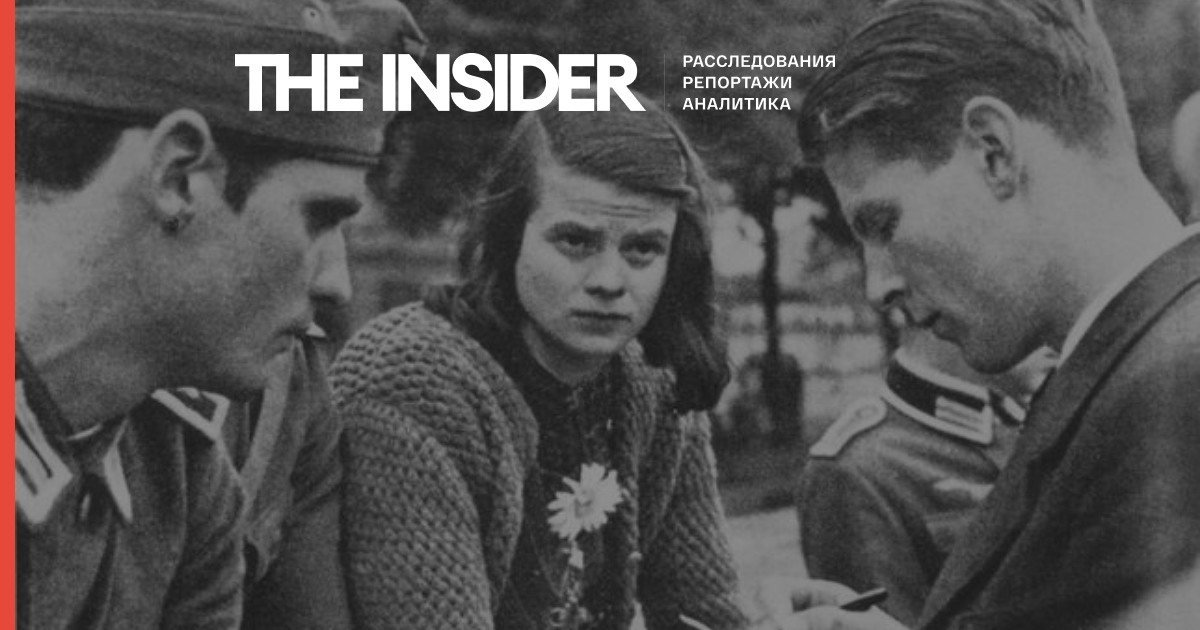

"Good Germans." What the resistance in Hitler Germany looked like
Ilya Klishin
February 10, 2023About how the Germans resisted Nazism, it is very little said in the Soviet (and Hollywood) canon, but in reality Hitler was opposed by millions of people inside and out of Germany, and antiphashista emigrants in Stockholm and Zurich after the war became the political elite of the country (you can recall at least Willy Brandt). Here are some key episodes from the history of German resistance almost today.
Content
Salvation of Jews in boxes for furniture and mini-fans
German dudes against the Hitler Youth, fights and brochures
Excitement in elites: conspirators and attempts on Hitler
Quiet church resistance: crowded services and sermons
On April 8, 1943, a few months after the defeat of the Germans near Stalingrad, but long before the moment when it became clear that Germany’s war was lost (on the same day the Soviet command reports to Stalin: the Germans were impossible, but they could go to the Liski -Voronezh - Yelets line), in Berlin in the Pletesenta prison, the family pair of workers.
Otto and Eliza Humpeli worked at the factory. After the brother of Eliza died in 1940 at the front, they decided to fight the regime in their own way: they wrote postcards with calls for the overthrow of Hitler, to refuse to cooperate with the Nazis and military service, as well as from donating money. For two years, they wrote more than 200 cards - most of them were immediately delivered to the Gestapo.
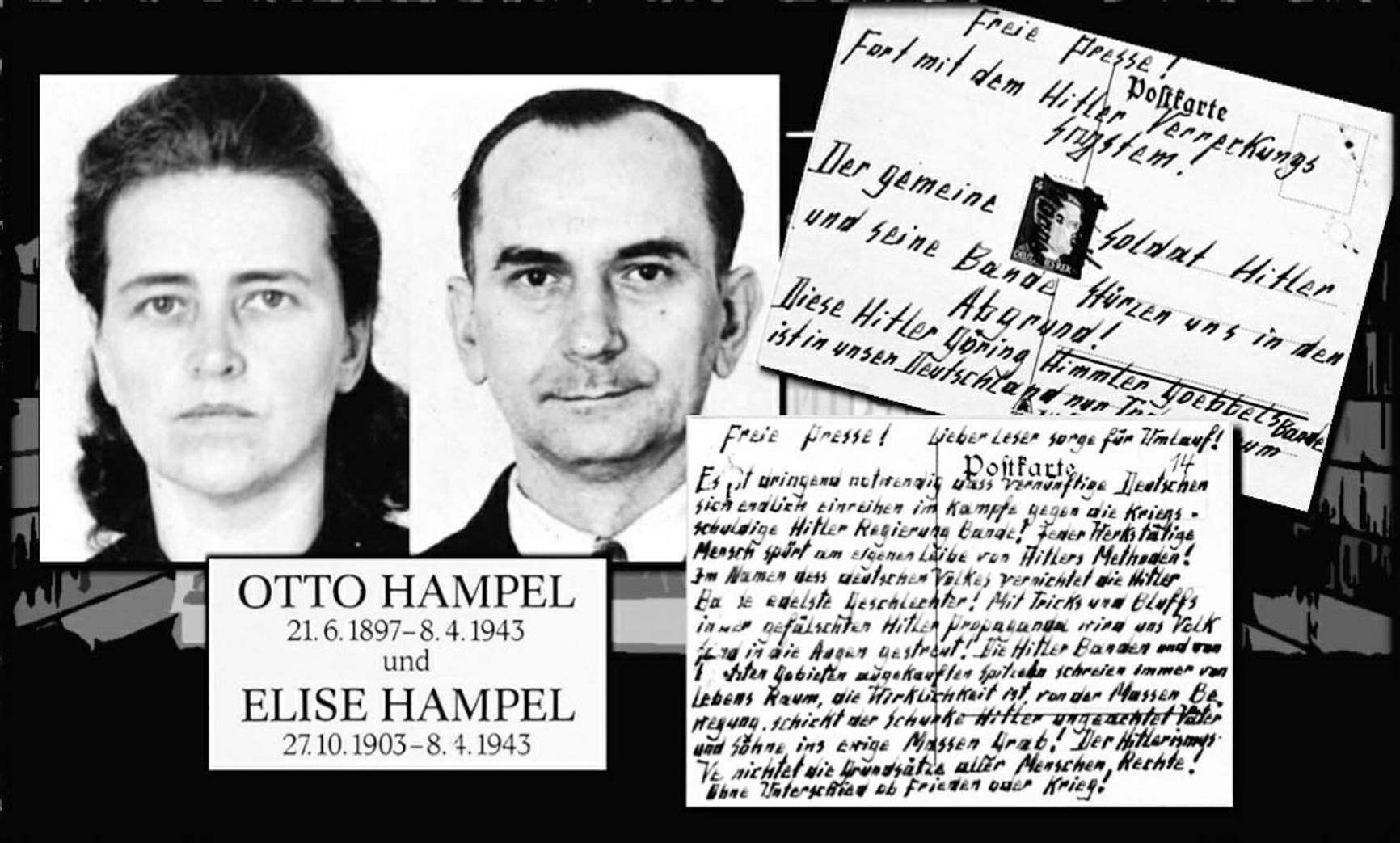
Eliza and Otto Humpeli and their anti -Hitler cards
The story of the Humpeles formed the basis of the book “Everyone Darling alone”, which was written in 1947 by the German writer Hans Fallas. This was the first novel of this kind from the author to not emigrated. In addition to a pair of silent workers with their cards, a whole gallery of resistance appears there-a youth cell of underground at the factory, a communist with a portable printing machine in a suitcase, a pension judge who hides a Jewish neighbor and so on.
It is important to assess the scale of the resistance movement inside Nazi Germany, which, of course, was heterogeneous and was not coordinated from a single center. This can be done according to indirect signs. For example, according to the numbers of the arrested and executed - like a hampeli.
During the Second World War, from 15 to 77 thousand people who fought with the regime were executed in Hitler Germany. The arrested and those who fell into the Gestapo for political reasons were up to 800 thousand people. Having fallen into the basements were almost automatically beaten and torture.
During the Second World War, from 15 to 77 thousand wrestlers with the regime were executed in Hitler Germany.
If you structure the resistance inside Nazi Germany, the following categories can be distinguished:
- Inorganized resistance: loners (like already mentioned hamples), and those who covered and saved the Jews, as well as participants in sporadic street protests, belonged to him.
- Youth groups “White Rose” and “Edelweiss Pirates”, as well as swingjug.
- Resistance in the German army and the Ministry of Foreign Affairs, including their leadership.
- Oppositional priests: both Protestants and Catholics.
Salvation of Jews in boxes for furniture and mini-fans
Resistance is a very vague term that today's historians unite a variety of people in Hitler Germany: from the “righteous of the world” to the truants of the workers' shifts (there is one more in English literature - the EVERYDAYSISTANCE, that is, everyday, household protest).
Basically, it is applied to the most ordinary Germans, whose dissatisfaction with the authorities and war most often took “passive” forms - intentional work of work, simulation of the disease, blooming rumors, listening to “enemy” radio heads, trading in the black market and evasion of semi -compulsory Nazi monetary fees (this was especially often called on their postcards).
However, this household protest was sometimes not so quiet. His more active forms are a warning of people about the upcoming arrest, their concealment or help in the escape, as well as deliberately closing their eyes and connivance of “illegal activity”. Occasionally, there were short strikes: if the requirements were purely economic, the instigators were not even much punished.
Another form of individual resistance (but with completely different risks for all involved) was the help of pursued Jews.
Despite the fact that the deportation of German and Austrian Jews to the death camp in occupied Poland remained not seen by the overwhelming majority of the Germans, the minority continued to try to help the Jews, despite serious risks for themselves and their families. This was most pronounced in Berlin, where, according to various estimates, up to two thousand Jews successfully hid until the very end of the war (and among those that covered them were both officials and army officers).
Countess Maria von Maltzan saved about 60 Jews, collaborating with the “Swedish furniture company” - the persecuted was taken out in furniture boxes under the guise of luggage of Swedish citizens. The Protestant pastor Henry Grubert took the Jews "smuggling" to the Netherlands. And the director of a private school for girls Elizabeth von Tadden, despite all the official decrees, continued to enroll Jewish girls until May 1941. When this was opened, the school was nationalized, and she was fired (three more years later she was executed).
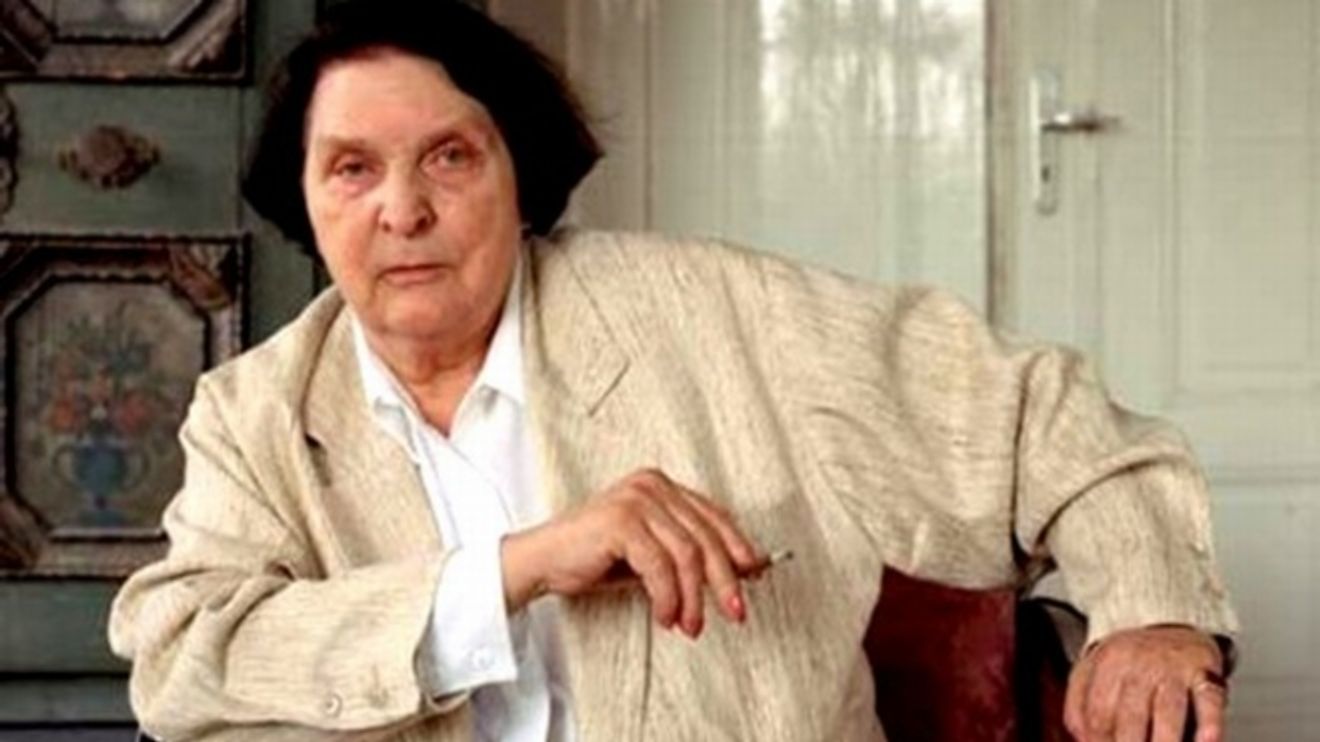
Countess Maria von Maltzan
German dudes against the Hitler Youth, fights and brochures
It is important to understand that Nazism relied from the very beginning on German youth, especially from the middle class, and at the same time had a strong influence on it. Researchers show that German universities were “strongholds of Nazism” even before Hitler’s actual coming to power.
Official youth organizations of the Nazis - first of all, the Hitler Youth - very successfully coped with the task of mobilizing children and adolescents. Some difficulties arose only in rural Catholic regions in the south of the country. But after 1938, and especially after the start of World War II, it began to change: the growing generations all with more skepticism looked at the Nazis in power.
Frankly, in most cases, their “opposition” was a passive regime - they seemed to “stay” from society, from official ideology and went into themselves, their life and their entertainment. Even the term-swing-jugend) appeared-as a kind of antithesis to the Hitler Yugen, which was especially popular in Hamburg.
German youth "left" from society, from official ideology and went into themselves, their life and their entertainment
These were a sort of German dudes. Groups of apolitical youth who were going to listen to jazz and swing and dance. Their speech was full of Englishisms, they dressed, contrary to the Prussian military, variegated and baggy, to which the girls added a defiantly bright makeup. They hardly spoke directly about politics, only in some cases they could jokingly greet each other a cry: “Swing Hale!” The Nazis first looked at this through their fingers, but later, during the years of the World War, they began to pursue a swingjugen as opponents of the regime.
However, there were much more serious youth groups - first of all, the “Edelweiss Pirates”, “Leipzig bandits” and “White Rose”.
The so -called Edelweisspiraten (“Edelweiss Pirates”) is a fragmented network of youth groups of the working class in a number of cities that held unauthorized collections and participated in street fights with a Hitler Youth. The so -called “Leipzig Meeten) was radical than the“ pirates ” - the proprietary anti -Nazi group. According to the Gestapo, on the eve of the Second World War, the Bandits totaled about 1,500 people.
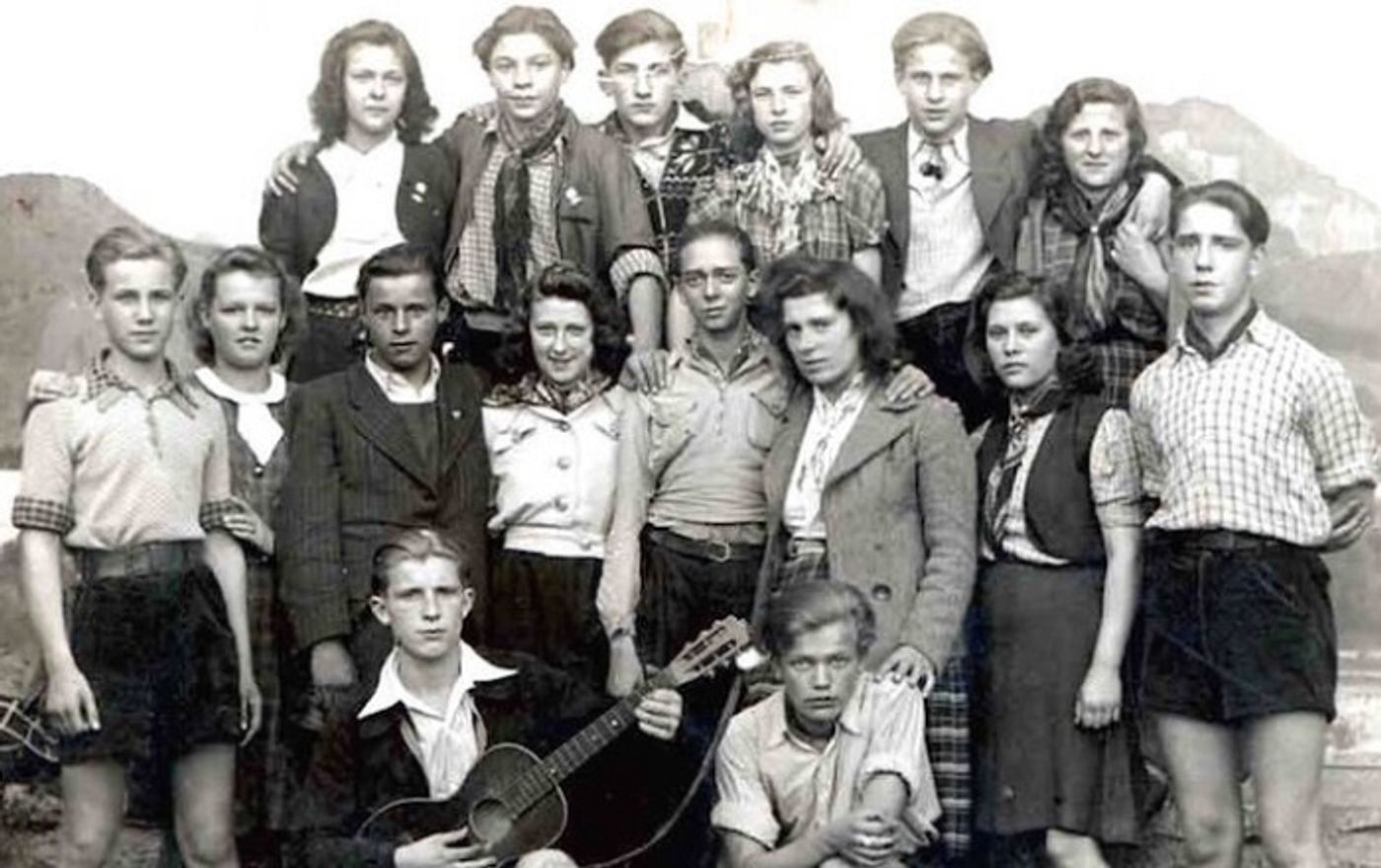
"Edelweiss pirates"
Well, perhaps the most famous was the “white rose” (Weiße Rose) - an non -violent group of intellectual resistance, headed by five students (and one professor) of the University of Munich: Willy Graf, Kurt Hubert, Christoph Probst, Alexander Shmorel, Hans Sholle and Sophie Sholle. Alexander Schmorel was, by the way, a Russian German from Orenburg. He was later canonized by the Orthodox Church.
The group conducted an anonymous campaign of leaflets and graffiti, calling for an active opposition to the Nazi regime. Their activity began in Munich on June 27, 1942 and ended with the arrest of the Gestapo -by -Gorodovites of the main group on February 18, 1943. Three times in February 1943 (in an atmosphere of defeat near Stalingrad, it is important to understand this) they wrote on the walls of the University of Munich and on other buildings in the city of slogans like: “Down with Hitler!” And "Freedom!"
Soon the "white rose" was waiting for a failure. They printed leaflets, and when one of the group members, Sophie Sholle, carried them to the university and began to scatter them from the balcony, this was seen by the guard, who called the Gestapo.
Sophie Sholle, as well as other members and supporters of the group who continued to spread brochures, appeared during demonstration processes in the Nazi People's Court ( Volksgerichtshof ); Many of them were sentenced to death.
In July 1943, the allied aircraft scattered the sixth and last leaflet of the White Rose over Germany with the heading of the Munich Students Manifesto. In total, the White Rosa released six leaflets that were propagated and widespread by a common circulation of about 15 thousand copies. They condemned the crimes and oppression created by the Nazi regime, and called for resistance. In their second leaflet, they openly condemned the persecution and mass killings of Jews. By the time of the arrest, members of the White Roses were just about to establish contacts with other German resistance groups.
Excitement in elites: conspirators and attempts on Hitler
Of course, there was no “split of the elites,” as political scientists like to say now in Nazi Germany. But they were dissatisfied - both among the military and among civilian (primarily in the Ministry of Foreign Affairs).
Several times this dissatisfaction reached the formation of real groups of conspirators who planned both couples (starting with the Czechoslovak adventure in 1938) and the attempt to kill Hitler (in 1943 and 1944, respectively).
Initially, the relations between Hitler and the military leaders aggravated after the dismissal of the military Minister-Field Marshal Werner von Blomberg and the commander-in-chief of Colonel General Werner von Frich as a result of the crisis of Blomberg-Fricha, when Hitler finally untied his hands to attack new countries.
The failed conspiracies of 1938-1939 showed both the strength and weakness of the officer corps as potential leaders of the resistance movement. Their strength was fidelity and solidarity. As the American historian noted, Professor of Colombian University, Istvan deac: “Officers, especially the highest ranks, discussed (some back in 1934) the possibility of overthrowing or even murder of Hitler.”
Officers discussed the possibility of overthrowing or even murder of Hitler
It is noteworthy that in more than two years this widespread and poorly structured conspiracy has not been disclosed. One of the explanations is that at that time Himmler was still preoccupied with the traditional enemies of the Nazis: SDPG and CCA (and, of course, Jews) - and did not suspect that the real opposition center was inside the state itself. Another factor was the success of Wilhelm Canaris (the head of the military intelligence and counterintelligence service, which, by the way, during the war also saved about 500 Jews) in defense of the conspirators.
Then the groups of the conspirators hid for a while. After the rapid victories of the Nazis in Poland, France and other European countries, the moment seemed inappropriate - Hitler was too high. But the plans for its displacement existed in the future, however, due to the indecision of the conspirators, they were not realized.
With the outbreak of war, the generals and officers of the Wehrmacht, especially on the Eastern Front, turned a blind eye to a brutal attitude to the civilian population and prisoners of war, and in some cases participated in war crimes. We are talking about the actions of the SS men and the Ainzatskroups of the Security Police and the SD, who carried out mass killings of the civilian population (in particular, engaged in the “final solution to the Jewish issue”), as well as the “order of commissars”, which provided for the immediate shooting of all the captures of the Red Army as “resistance carriers”, which violated all the rules of war of war.
Again, the idea of a conspiracy was materialized only in 1942. Then the plan developed in a two -stage operation, which included Hitler’s murder, the seizure of basic communications and the suppression of the SS resistance to the reserve army.
Repeated attempts by a group of conspirators to kill Hitler were unsuccessful. On March 13, 1943, during a visit to Hitler Smolensk, explosives were placed in his plane, but the fuse did not work. Eight days later, the Rudolph Cristofa von Gersdorf was ready to blow himself up with Hitler at the trophy Soviet weapons exhibition at the Berlin Museum of Zeichgauz, but the Führer left the exposition prematurely, and Gersdorf barely managed to deactivate the detonator.
Hitler managed to survive on July 20, 1944 during the explosion at his Headquarters of the Wolfshanets - the bribe with a bomb exploded under the table at which he was sitting: four were killed, but the leader of the Nazis survived. Soon, Nazi propaganda replicated his words about "a small clique of criminally stupid officers." This rhetoric for many years had a noticeable influence on the post -war West German society in assessing resistance participants. For a long time they were considered traitors to the country who struck the back of the fighting warriors. The allies were also not interested in a positive image of German resistance, since it contradicted their thesis about the collective fault of the German people.
The image of German resistance contradicted the thesis of the allies about the collective fault of the German people
The revaluation of German resistance began in the mid-1950s, which was facilitated by the performances of the leading representatives of the West German society. In the 1960s, this led to the fact that the pendulum swayed in a radically different direction: the attempt on Hitler became considered a heroic act, and the conspirators-impeccable heroes who defended the honor of the German army. And only in the 1980s, historians painted a more critical picture of resistance, pointing out the non-liberal, authoritarian and anti-Semitic ideas, widespread among conspirators. This trend has reached the climax at the beginning of the current millennium in the process of exposing the active participation of some resistance members in the war of destruction and the Holocaust.
Quiet church resistance: crowded services and sermons
Although neither the Catholic nor the Protestant churches as institutions were ready to openly resist the Nazi state, the clergy essentially became the first major component of the German resistance to the policy of the Third Reich, and the church as institutions provided the earliest and most stable centers of the systematic opposition of Nazi policy.
From the very beginning of the reign of the Nazis in 1933, problems arose that led the church to the conflict with the regime. They provided organized, systematic and consistent resistance to government policy, infringing church autonomy.
Being one of the few German institutions that retained some independence from the state, the Church was able to coordinate the level of opposition to the government and, according to the German historian Joachim Fest, they more than any other institutions, continued to provide a “forum at which people could distance themselves from the regime.”
The Christian morality and anti -church policy of the Nazis also motivated many German resistance participants and served as an impetus to the “moral rebellion” of individuals in their efforts to overthrow Hitler. Another historian, Wolf, writes that such events as the July conspiracy of 1944 would be "unthinkable without the spiritual support of church resistance."
The most acute public criticism of the Third Reich came from some religious leaders of Germany, since the government often did not want to oppose them. A senior clergyman could count on certain folk support from believers, and therefore the regime was to consider the possibility of national protests in the event of the arrest of such figures. Thus, the Catholic bishop of Munster Count Clemens Augustus von Galen and Dr. Theophilus Vourm, the Protestant Bishop of Württemberg, were able to cause wide public resistance to the murder of the disabled.
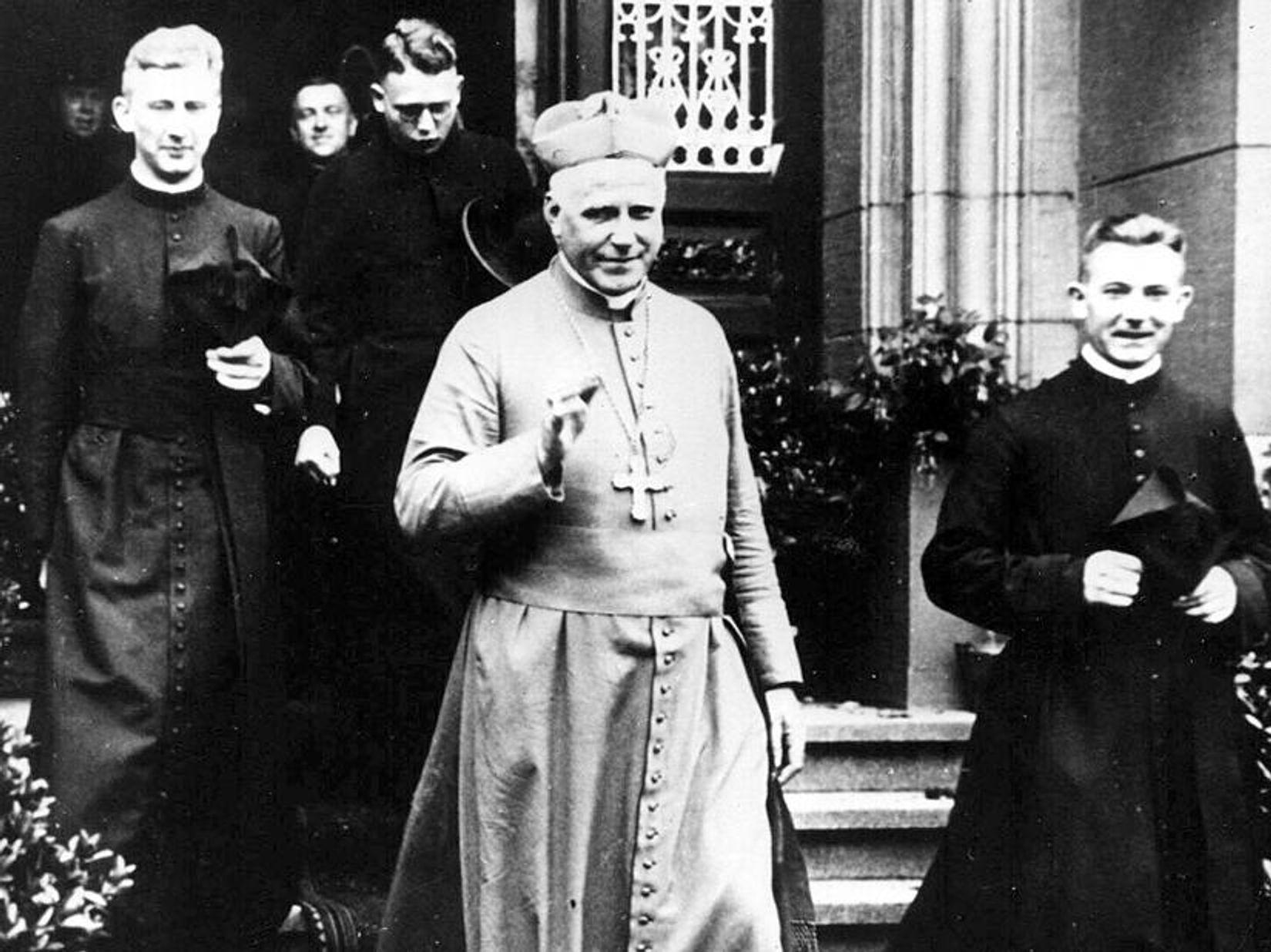
Clemens August von Galen
The churches fought a fierce war for exhaustion with the regime, receiving demonstrative support of millions of parishioners. Аплодисменты церковным лидерам всякий раз, когда они появлялись на публике, увеличение посещаемости таких мероприятий, как процессии в День Тела Христова, и переполненные церковные службы были внешними признаками борьбы особенно католической церкви против нацистского гнета.
Хотя церкви в конечном итоге не удалось защитить свои молодежные организации и школы, она добилась определенных успехов в мобилизации общественного мнения для изменения политики правительства. Британский историк Алан Буллок писал, что «среди самых смелых демонстраций оппозиции во время войны были проповеди, произнесенные католическим епископом Мюнстера и протестантским пастором, доктором Нимёллером», но, тем не менее, «ни католическая церковь, ни евангелическая церковь <...> как институты не сочли возможным занять позицию открытой оппозиции режиму».