
Translated material
The anniversary of the buch
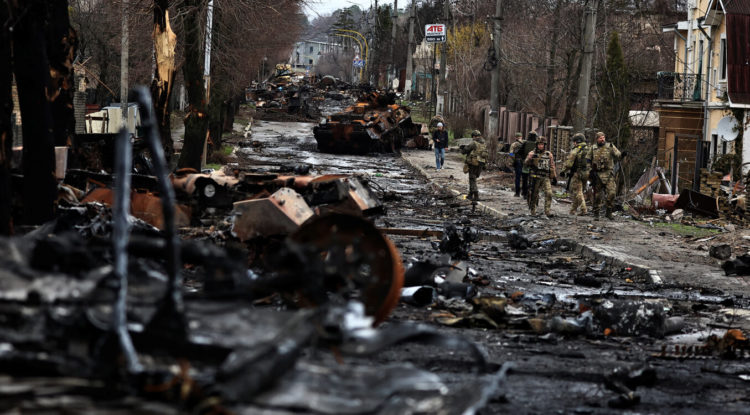
We talk about everything that is known about the war crimes of Russia in the Kyiv region 12 months later
A year ago, the Ukrainian army liberated Buch. Retreating, Russian soldiers left the bodies of murdered civilians and other evidence of war crimes that shocked the whole world. The next months, journalists and experts from around the world restored what happened in Buch during the occupation. "Cold" gathered everything that was known and unknown a year later.
In order not to miss the main materials of the "cold", subscribe to our Instagram and telegram .
Briefly recall what was in Bucha
Bucha is a small city in the Kyiv region about 20 kilometers from Kyiv. The first Russian military was noticed here on February 25 - on the second day of the war. Then the battles began in the city: Russian technology tried to enter Buch, Ukrainian artillery - to stop it, and she succeeded . On February 27, Russian troops once again tried to break into the city, but again unsuccessfully - the frames of the broken column of Russian armored vehicles on one of the central streets of the city were published in many publications.
A few days later, the buch was still captured. On March 5, large Russian forces entered the city from the West and founded the headquarters at the glass factory on Yablonskaya Street: this is on the outskirts of the city, near the Bucha River, which separates the city from Irpen. After that, the fighting in the city practically ceased. This is evidenced by the satellite map of FIRMS fires from NASA - from that day until the end of the month the system registered only 10 fires in the city. Less than in the neighboring Irpen, who was regularly under fire. For almost a month, the city was under occupation.
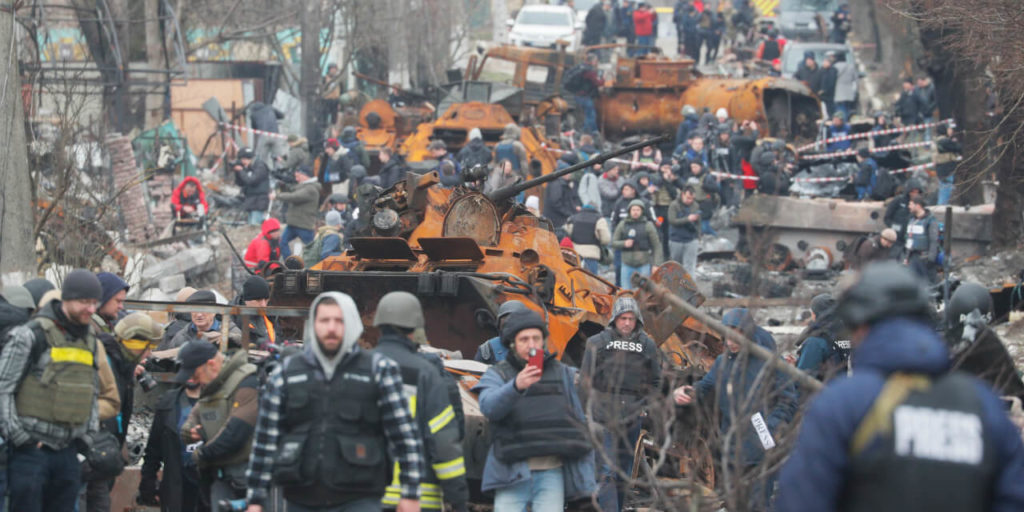
Russian troops retreated from Buchi only on March 31. In the Kremlin, the departure from the Kyiv region was called "a gesture of goodwill to create favorable conditions for negotiations." The next day, the Ukrainian military entered Buch and discovered on the streets of the city the frames of fired civilian cars and houses, apartments cleaned by the marauds, the places of executions and the body of the murdered civilians. The frames of the bodies lying on Yablonskaya Street (it began to be called only “dear death”) were published in the first lanes of international publications and shocked people around the world. Vladimir Zelensky called the incident genocide. The heads of European countries and representatives of the UN condemned mass killings.
Several hundred bodies were found in Buch: most in random burials throughout the city
After a de -Ukrainian, foreign investigators, journalists and representatives of human rights organizations arrived in Buch to help local authorities document the war crimes that occurred there. At first, they had to conduct reports on the found bodies by hand: the Internet and electricity in Buch began to disappear even before the occupation.
The bodies of people were found everywhere: in wells, on the streets, in the forests, remotely from the city and in mass graves.
In total, 461 dead were found in Buch. Of these, 73 bodies are exhumed from the largest mass grave at the Church of Andrei First-Called in the presence of European high-ranking officials Josep Boar, Ursula von der Lyain and Prime Minister of Ukraine Denis Shmygal. 40 buried were identified as civilians, traces of gunshot wounds were found on many bodies.
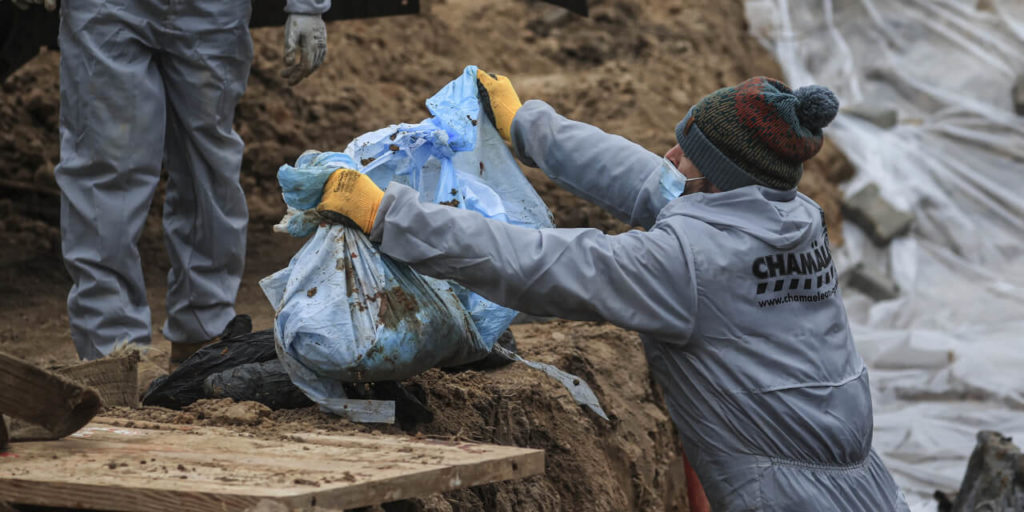
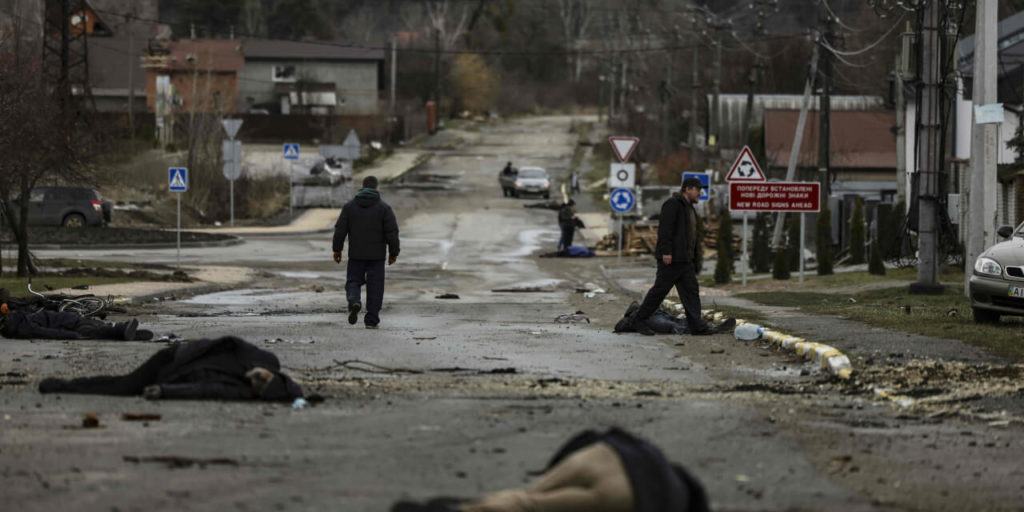
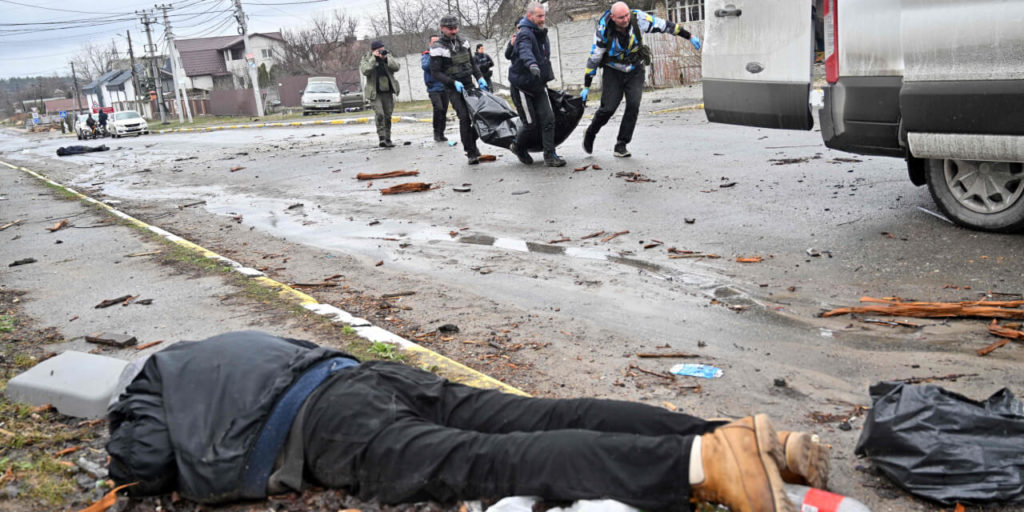
About 40 more bodies of civilians were found on Yablonskaya Street. The New York Times reporters talked with local residents and close victims, studied satellite pictures of the terrain, video from drones, posts on social networks, telephone messages and recordings from surveillance cameras. So they managed to identify 36 victims and restore the latest moments of their lives. Most of the dead - the inhabitants of Buchi and nearby villages - shot Russian soldiers when people tried to evacuate from the city.
Many dead were found in arbitrary burials in the courtyards of residential buildings, in apartments, on roads and in the salons of fired cars. In the basement of the second building of the Summer Children's Camp "Radio", where, according to the assumptions of the Ukrainian authorities, the Russian military were located, five male bodies were found . They were on their knees with their heads lowered and hands tied behind their backs.
Journalists established the names of the victims and told the stories of their families
The New York Times also managed to identify eight more men whose bodies with their hands were found in the courtyard of a four -story office building on Yablonskaya Street. Russian paratroopers used it as a base and a field hospital.
Before the occupation, eight dead voluntarily volunteered to carry a shift at a spontaneous checkpoint on Yablonskaya Street. Standing in body armor with a grenade and one gun on all, they inspected cars passing by. On March 3, the volunteers learned that the Russian unit was moving in their direction and hid near the checkpoint - in the house of a local resident who regularly treated their coffee and tea.
Soon they realized that the paths to the exit were cut off. “We are surrounded, they shoot from a large caliber, kill the locals. On the streets of the body, ”they wrote to friends in the morning of March 4 and called their wives to say that they could not get out.
A few hours later, conducting houses on Yablonskaya Street, Russian soldiers found them and, together with the owner of the house, brought them out into the street. On the record from the surveillance camera and on the video that a resident of the neighboring house shot, it is clear how the Russian military at the muzzle of machine guns lead men along Yablonskaya Street. The witness’s video breaks off when the military put prisoners to the ground.
According to the stories of residents of nearby houses, after which the military took prisoners to their base to the office building. From there, shooting was heard, and the prisoners no longer left the building. In the video from the drone dated the next day, the motionless bodies of men in the courtyard of the office building are vaguely visible. One of the dead is dressed in a bright blue sweatshirt, in which on the video on March 4 there was one of the volunteers.
One captive survived due to the fact that the bullet passed through without hitting the organs. He collapsed to the ground next to his comrades and lay motionless in the yard for another 15 minutes, pretending to be dead. When the soldiers left, he escaped and reached the territory under the control of Ukraine.
He later told reporters that one of his comrades handed over to Russian soldiers that volunteers are not just civilians, but participate in resistance. The scammer was released, and the rest decided to execute: one was killed in the parking lot at the entrance, the other inside the building, and four were taken to the yard.
The New York Times also at the disposal of the video from the drone, which shows how the cyclist rides along the street in Buch, gets off the bicycle and turns around with him around the corner, to Yablonskaya Street, where the Russian military is located. Russian armored vehicles shoot several times, and smoke rises above the place where the cyclist turned.
The daughters of Irina Filkina are sure that this video captures the murder of their mother, who was traveling through Buch home to the village of Mikhailovka-Rubzhovka. Before that, she spent a week in the basement of a shopping center on the outskirts of Kyiv, where she worked as a boiler room operator. The daughter of the daughter, who left to work as volunteers in Poland, learned about her death after the city’s de -captain. For several days they could not get through to her mother and subsequently recognized her from a photograph - a shot woman lying near a bicycle on Yablonskaya Street was the same manicure as that of Irina.
It was possible to confirm crimes using 3D models, as well as interceptions of phone calls
On April 4, The New York Times published satellite pictures of boots taken by Maxar Technologies in mid -March. The pictures record that in the period from March 9 to 11, when the city remained under the control of Russian forces, at least 11 dark objects the size of human bodies appeared on Yablonskaya Street in Buch, which since then have not changed the locations. In the video shot on April 2, when the city returned to the control of the Ukrainian army, the bodies of civilians lie in the same places as objects in satellite images taken at the end of March. Two more bodies - one of which lies next to the bicycle, the second - near the abandoned car - according to satellite pictures, appeared on Yablonskaya Street between March 20 and 21.
Associated Press journalists, PBS Frontline PBS STASS Authorities used Situ Research visual data recordings, intercepted conversations of Russian military and drones to recreate the Russian military in Bucca in the 3D operation in Buch. According to the model they created on Yablonskaya Street, the majority of war crimes were committed by Russian soldiers.
People who could cooperate with the Armed Forces of Ukraine were looking for the Russian military throughout the city. They were taken out of the houses, tortured and shot. In the video version of the investigation, journalists of the Associated Press also published records of telephone conversations of Russian troops with their relatives. They admitted that they killed civilians.
One soldier told his mother that the bodies of innocent people were lying on the streets and they were killed by “ours”. The second is that they shoot “all”, including women and children. Other soldiers asked to take their weapons from them, said that they would soon go crazy because they “exceeded so many civilians,” and admitted that they had an order “to fel up everyone, they are civilian, not civilian”.
Thanks to the records from surveillance cameras, journalists also managed to establish that the Russian military opened residential buildings, carried things, electronics and products, tormented the pets and used the property of the owners.
Russian soldiers committed sexualized violence. Dozens of cases are known
In early April 2022, the former authorized by the Verkhovna Rada for Human Rights Lyudmila Denisovastated that in only one building in Buch, Russian soldiers raped 25 women and girls, and said that they also raped an 11-year-old boy in the city.
At a press conference on April 14, journalists asked Denisova, which confirms the words about rape of 25 people in Buch. According to journalists, the local prosecutor's office confirmed the information to them only about three rape. Denisova replied that the injured women do not want to tell their stories yet, but they will be sure to convey them to the investigation.
At the end of May last year, Denisov was fired from the post of Ombudsman. The parliamentarians of the Verkhovna Rada brought her a vote of no confidence, including due to the fact that she provided unconfirmed data on sexualized violence by Russian troops, and, according to psychologists, journalists and human rights activists, was not considered ethics when she commented on sexualized crimes, turned the “traumatic theme and family tragedy” "Scandalous chronicle."
However, not only Denisov spoke about the sexualized crimes of Russian soldiers in the Kyiv region. Investigatorsfound condoms and women's linen at a glass factory where Russian soldiers were located, and considered them the evidence of possible rape.
Representatives of the Ukrainian police alsotold reporters that they found the bodies of dead women and children with traces of sexualized violence in several locations of the city. How many people have suffered from violence is not known exactly. In the December report of the UN, information is given about 86 cases of rape from February to October in the liberated Kiev and Kharkov regions.
The pathologist Vladislav Perovsky conducted the autopsy of the bodies found in Buch, Borodanka and Irpen. In an interview with The Guardian British publication, he said that he has reasons to believe that some killed women were raped before his death.
Journalists established the names of the soldiers who committed crimes in Buch, and called their relatives
The New York Times journalists established the names of more than 20 Russian paratroopers who were in Bucha during the occupation and could be involved in the murders of civilians. It was possible to establish their personalities thanks to the interception of phone calls: the military called from the mobile phones of the dead and robbed residents of Buchi.
The journalists of “important stories” found eight Pskov paratroopers by calls to Russia from the phone of the man who survived after the execution in the courtyard of the office building on Yablonskaya Street. From his room, the Russian military called home - parents and wives - on the same day when they killed the comrades of its owner (we talked about their execution in previous chapters). At least three of the eight paratroopers identified by journalists died in the next months of the war. Some of the relatives that the journalists contacted, confirmed that their sons and husbands were in Buch during the days of occupation.
Journalists also established the names and callsigns of some commanders who were nearby and probably authorized crimes. In the conversations of the soldiers who have at the disposal of NYT, the callsigns of Astra and the bottle are mentioned by the commanders of the battalion-tactical groups of the 234th regiment and the call sign “Uranus”, which is used by Artem Gorodilov, the commander of this regiment.
After the retreat of Russian troops from the Kyiv region, Gorodilov received the title of Colonel.
Based on the documents that the Russian military left behind, Reuters journalists found that during the occupation, in addition to the 234th regiment, the 76th airborne assault division from Pskov was in Buch, the fighters of the Vityaz Rosgvardi and at least three Chechen divisions .
It is also known that soldiers from the 5th Separate Guards Tatsinsky Tank Brigade from the Ulan-Ude, 56th Guards Airborne Regiment from the Volgograd Region, the 64th separate motorized rifle brigade from the Khabarovsk Territory could be involved in the occupation of Buchi and the murders. The former soldier of this unit Nikita Chibrin requested a political asylum in Spain in November and expressed his readiness to testify about the crimes of the Russian army in Buch.
In Russia, evidence of crimes was immediately called "fakes"
Russia denies the involvement of its troops in crimes.
Immediately after the publication of photographs and videos of bodies from Buchi, Russian propaganda began to call these evidence “fakes”. And she put forward several conflicting versions about what was happening.
According to one of them, the bodies on Yablonskaya Street appeared after the retreat of the Russian army from the city. The Russian Ministry of Defense stated that the Russian units left Buch on March 30, and thus four days passed before the appearance of videos and photos of the bodies on the network. According to the Ukrainian command, they finally free the city and its surroundings from the invaders only on April 1. The first video on which the bodies are visible appeared on the network in the evening of the same day. Also, the fact that the bodies were even earlier than March 30 subsequently showed satellite pictures that were already mentioned ..
The propagandists also insisted that the corpses on the streets of Buchi are fake . The message that the bodies allegedly move, move their hands and feet or even sit down, the authorship of the propaganda resource “War with Fakes” appeared even in the official telegram channel of the Ministry of Defense of the Russian Federation.
The Mediazona analyzed the video and dismantled the “movements” that the propagandists saw.
On one of the videos removed from the car, a drop falls on the windshield and overlaps the body, from this it seems that the body is moving. In another video, again shot by motorists, a rear -view mirror enters the frame. It seems that in his reflection you can see how the body of one of the dead slightly rises. However, this is an optical illusion due to aspericity, that is, the imperfection of the form, mirrors.
Propaganda channels call the publication of evidence from Buchi by the provocation of the Ukrainian authorities. However, by that time, independent journalists, photographers and videoographers of international publications had already worked on the spot: BBC, The New York Times, CNN, Reuters.
Materials about the murders of the civilian population in Buch were also published not only by Western publications, but also by the Qatari Al Jazeera and the Turkish news agency Anadolu .
The Russian Ministry of Defense also stated in its telegram channel that they caused “special concern” that the bodies in the photographs were “not stiffed, have no characteristic cadaveric spots, and in the wounds of unusual blood”. At the same time, the judicial pathologist, who worked at the massacres of massacres in Kosovo and Rwanda, told BBC that, according to the incident of several days, the cadaveric winding passes and noted that the appearance of people who died from gunshot wounds may differ depending on the weapons used and the distance from the victim was used. The blood, in his words, may not be visible in the photographs at all, since it can accumulate under the bodies or absorb into dense clothes.
Russians are planted after the publication of Bucha. For years
The scale of war crimes in Buch outraged not only the international public, but also Russians. Immediately after the publication of certificates of it, many Russian opinion leaders expressed .
April 4 - three days after the publication of the photo of those who died from Buchi - an unknown activist went out to a solitary, silent picket called “Buch - Moscow”. He portrayed the victim of war crimes of Russian troops in Buch: he tied his hands behind his back with a white rag and motionlessly lay down on the ground. He repeated this action four times - in the Alexander Garden, on Nikolskaya Street, on the old Arbat and on the bridge near the Cathedral of Christ the Savior.
The state responded with repression. In December 2022, politics Ilya Yashin, who spoke about the events in Buch in his stream,found guilty of the spread of “fakes” about the Russian army and sentenced to eight and a half years in the colony.
For coverage of events in Buch and other Ukrainian cities, criminal cases were instituted on the eight leading projects “Popular Politics”. And the publisher of the Mediazons Peter Verzilov and the media manager Ilya Krasilshchik in absentia was arrested in cases of “fakes” after the publication of Bucha in social networks. The author of the telegram channel "Protest Moscow State University" Dmitry Ivanov received eight and a half years of the colony, too, after the statements about Bucha.
For this year, those who shared other people's reports about Bucha were also subjected to criminal prosecution in Russia. For example, in the summer of 2022, archaeologist Yevgeny Kruglova was detained during an expedition in the Tyumen forest. A criminal case was opened against him for reputing a news report on military operations in the Kyiv region and Mariupol in his page in VKontakte. He was sentenced to eight months of correctional labor.