
Translated material
Battle for Bakhmut - Layout
January became the bloodiest for Wagner in the capture of Bakhmut, the analysis of “Layout” showed
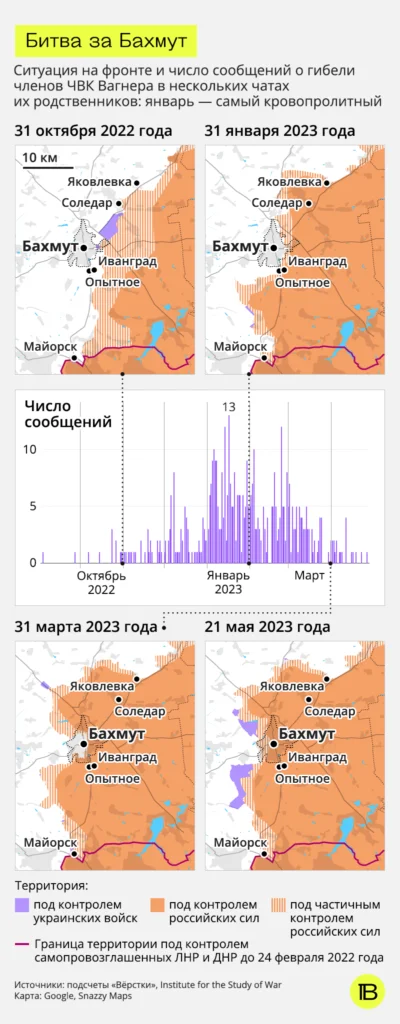
The so-called Battle of Bakhmut became the most protracted combat operation in the Russian invasion of Ukraine. “Verstka” analyzed the chats of relatives of PMC members who died in the Bakhmut area and its environs. In them, the Russians told when and for what reason their relative died. Analysis of these messages helped us collect an array of data on what dates Wagner PMC most often suffered losses. By comparing this information with reports from the Institute for the Study of War (ISW), we reconstructed the course of the battles for the city and found out which military operations were the bloodiest for the mercenary organization. “Verstka” managed to confirm the death of 502 PMC members; real losses could be many times higher.
The founder of the Wagner PMC, Yevgeny Prigozhin, reported that the capture of Bakhmut was supposed to last from October 2022 to April 2023. In fact, the mercenary organization joined the attack on the city since July last year, and battles for it continue to this day - including after Prigozhin’s reports about the capture of Bakhmut.
In order not to miss new texts from “Layout”, subscribe to our telegram channel
“I go to the grave every day and ask for forgiveness for not saving it”
“That’s all... What did these people do?! So many guys died on foreign soil. There is still someone left to withdraw from the PMC. And no one will ever return our relatives to us,” this is how one of the chats dedicated to the PMC members who died in Bakhmut was met with messages about the occupation of the city by the Russian army.
Chats of relatives of PMC fighters began appearing in instant messengers at the beginning of this year. They were organized either by the so-called curators of PMCs in Russian regions, or by the relatives of the group members themselves. By mid-May, the number of messages in them reached tens of thousands.
“My husband from Ukraine was never able to call or write, perhaps there was no connection. As a result, he died, and, unfortunately, I will never hear his voice again. - Natalya said in one of the chats, “This damned war destroys everything in its path, spares no one, it would be over sooner , how many more of our dear children must die for peace to come.”
The regional curator of the PMC informs relatives about the death of members of the group. In some cases, representatives of the organization themselves call relatives and say that their husband, son or brother died heroically. In others, relatives of group members independently search for information and call their curators. And some to this day do not know whether their loved ones, who stopped communicating weeks and months ago, are alive or dead.
What relatives write about the dead Wagnerites
Expand ↓As chat participants say, the problem is that the PMC does not take the bodies of the dead from the battlefield or does so months later. “My son was pulled out of there about a month after his death,” Tatyana told the “Verstka” correspondent. “Some are taken earlier, some later, some are still waiting for those who are silent and have not been in touch since the end of last year.”
Some chat participants say that they do not believe in the death of loved ones and continue to believe that they are alive even after the funeral .
“I’m not one of those who believe without reason,” one of the participants, who lost her husband, wrote in the chat. — He had stubble [at death] for at least a month, and he sent the [last] photo on December 19, he was clean-shaven. The stubble needs time to grow. Again, the salary for January was full. In short, [the day of death] doesn’t add up for me on January 1.”
“My mother and I don’t dream about him, no matter how much they ask him,” Evgenia said about her dead brother. “He came to another sister and cursed, saying, why did you bury me, I’m alive!” This is how you can let go after something like this... No way. From February to this day I have been looking for at least some information about him, in every video I look with my eyes, but they are all wearing masks. I didn't find it in the lists. But there is no point in calling [PMC curator] Sergei; according to the documents, he died. But we will always wait for him."
In order to make sure whether the deceased is really their loved one, some of the chat participants say that they open zinc coffins and conduct DNA tests . Earlier, the Dozhd TV channel reported that in some cases Russians received empty coffins from PMCs. In the chats studied by Vorstka, similar messages were also recorded.
“My brother died on February 12, was reported on May 4, and was brought in on May 11. We decided to open it,” Ksenia said in the chat. “In it [the coffin] there were a couple of bones and a piece of terribly burnt meat. We were simply horrified, before our eyes was the whole picture of how you can identify your loved one. We have done DNA, we are waiting for the result <…>. We have very high hopes that he is alive."
“They opened the coffin, there were bones covered with moss,” wrote Lyubov. — They wanted to do DNA, [but] due to circumstances they could not. Now I regret that we didn’t do it.”
In addition, chat participants discuss how they cope with the loss of loved ones, who is to blame for this, and together pray for the repose of their brothers, husbands and sons .
“[The husband] left the colony with the blessing and wishes of his mother, who watched Channel One,” said Natalya. — He wrote the will entirely for me, we have been together for almost 9 years, the official wife. Now my mother and relatives are trying to prove who I should give what part to. At the funeral, all the bones were washed for both me and him. I can’t come to my senses.”
“It’s a fucking war with presidents,” Ksenia, who lost her husband, described her emotions. “Why don’t they go to war with their bureaucrats, they can only rob people and send them to war.”
“When I was pregnant with my son, I was in the maternity hospital, and the neighbors were still waiting for the boys. And in general, at that time, girls were rarely born to us,” said Elena, who lost her son near Bakhmut. “I remember telling my mom on the phone: “It’s so strange that they all have boys.” She was so silent on the phone, then she said [that it was] bad. I also asked what was wrong with this. She says: “There will be war, so there is such a sign.”
“They buried him like a hero, with honors and fireworks, flags and all the business,” Marina wrote about her husband. “Now I go to the grave every day and ask for forgiveness for not saving me, not dissuading me .”
Officially, Wagner PMC stopped recruiting prisoners to participate in the war with Ukraine, but in practice, as Vorstka previously wrote , representatives of the group continued recruiting in individual colonies. At the same time , the organization launched an advertising campaign to recruit “free” volunteers . At first, announcements about this appeared on social networks and on billboards in Russian cities. Later, PMC representatives began to take to the streets and public places, offering passers-by service in their units. In some cases, joining PMCs was even advertised to high school students.
In recent weeks, the Institute for the Study of War (ISW) has mentioned in its reports that the Wagner PMC is increasing offensive attacks in the Bakhmut area. This section of the front remained one of the most intense until the last, and the battles there became the most protracted during the entire Russian invasion of Ukraine . Initially, as Yevgeny Prigozhin himself stated , it was planned that the capture of Bakhmut would end before April 8, 2023. At the same time, the main offensive operation on the city, according to him, began in October last year.
Senior military adviser to the British mission to the OSCE, Ian Stubbs, stated that from July 2022 to March 2023, about 30 thousand military personnel and members of the Wagner PMC were killed or injured in the Bakhmut direction.
“Verstka” studied all the messages that relatives of the deceased members of the Wagner PMC published in three thematic chats dedicated to the deceased members of the group in the Bakhmut direction. We took into account only those messages in which the authors indicated the date of death or provided supporting documents - a death certificate, an extract from the registry office, copies of posthumous award certificates and letters of gratitude indicating the place of death of their loved one.
Judging by the messages in these chats, the most massive deaths of PMC members began in October last year, with the start of the operation to occupy Bakhmut by the forces of the Wagner PMC. Chat participants practically did not report the death of loved ones in August and September.
We compared messages in chats about the deaths of PMC members with front-line ISW reports and described on which days Prigozhin’s PMC lost the most people and what happened on the battlefield on those dates.
In order not to miss new texts from “Layout”, subscribe to our telegram channel
October 2022
October last year began with attacks by the Russian group of troops on Bakhmut and along the entire line of contact. At the same time, Prigozhin, together with Ramzan Kadyrov, began to criticize the Ministry of Defense for decisions and actions at the front.
Judging by ISW reports, in early October, Wagner PMC could not break through the defense line in the direction of Bakhmut. But still, by the end of the first week of the month, the mercenaries advanced deeper into the area. This is also confirmed by the analysis of reports from relatives of PMC members about the death of their loved ones in this part of the front.
By mid-October, members of the group continued ground attacks near Soledar. During the same period, judging by the analysis of “Vestka”, a jump in the number of deaths of PMC members was recorded.
The largest number of reports of Wagner personnel losses in October occurred on the 24th and 27th of October, about 33% and 22% of the total number of reports in that month, respectively. By October 24, Ukrainian forces had recaptured a concrete plant on the eastern outskirts of Bakhmut, 2.5 kilometers from the city center, causing the Russian side to retreat. And on October 27, the Ukrainian Armed Forces repelled attacks from the Russian side in the areas around Bakhmut: Soledar, Ivangrad and Mayorsk. At the same time, reports of repelled attacks were received in previous days.
As ISW analysts noted , by this period Russian forces had likely become increasingly dependent on Wagner PMCs . This conclusion was made against the backdrop of reports that the group is recruiting soldiers to form crews for the Pantsir-S1 anti-aircraft missile systems, S-300 air defense systems, helicopters and attack aircraft, and electronic warfare specialists.
By the end of the month, ISW included in its summary a note from the FAN website (part of the Patriot holding, controlled by Prigozhin), which spoke of fierce fighting south of Bakhmut. On the same dates, jumps in the mortality rate of PMC personnel were recorded, the analysis of “Vestka” showed.
November 2022
According to Vorstka, in November, compared to October, the number of deaths of PMC members increased by more than 2.5 times. This trend continued over the next few months. At the beginning of the month, The Insider reported that more than 500 people had already died among the group’s personnel as a whole.
During this period, Russian troops continued to advance in the Bakhmut area: continued heavy fighting was reported, with attempts to blockade Bakhmut from the south and northeast and to break through the defense line. According to Ukrainian National Guard spokesman Nikolai Urshalovich, Russian forces continued to make suicidal attempts to storm Ukrainian positions around Bakhmut with “maniacal persistence,” conducting reconnaissance in force. As the analysis of “Vestka” showed, the number of deaths in the first two weeks of the month is evenly distributed on almost every day.
The first surge in the growth of deaths was recorded on November 14. On this and the previous days, judging by the ISW report , the Russian side intensified its offensive in the vicinity of Bakhmut and occupied Mayorsk, 20 kilometers south of the city. At the same time , each side intensified rocket and artillery attacks along the line of contact in this area . In addition, according to Ukrainian authorities, on the same day the Russian side used prohibited chemical weapons - several K-51 aerosol grenades.
At the same time, as the analysis of “Vertski” showed, in the second half of the month the number of deaths increased. This period accounted for more than 58% of all deaths that relatives of PMC members reported in open groups and chats.
The bloodiest day was November 19 - about 12.5% of all deaths. ISW then reported heavy losses on the front line in the Bakhmut direction, occupied by mercenaries of the Wagner PMC and the Russian Armed Forces.
Another surge in the number of deaths of members of the PMC “Verstka” was recorded on November 21. On this day, judging by the ISW report, Prigozhin’s structures attacked Kleshchievka, intending to cut the road southwest of Bakhmut, and launched an assault from Ivangrad, four kilometers south of Bakhmut. Soon, Prigozhin forbade members of the PMC to give interviews about what was happening in this sector of the front , and also stated that Wagner’s task in this area was not to take Bakhmut, but to weaken the Ukrainian forces.
In the last days of the month, the Wagner PMC again intensified its offensive in an attempt to encircle the city from the south and east. The “Layout” analysis also confirms that on these dates an increase in the mortality rate of PMC members was recorded.
December 2022
In December, “Verstka” again recorded an increase in mortality in the ranks of the group. This month, relatives of the victims left messages that their relative died as part of a PMC 2.5 times more often than in November.
Moreover, a large number of losses occurred on December 8 (13.1%). On this day, ISW cited in its report references to Russian military officers who claimed that Wagner PMC was at that moment defending the captured settlement of Yakovlevka.
The remaining deaths of group members were evenly distributed throughout the month.
In the second week of December, the group continued intense fighting in the Bakhmut area. With reference to an American military representative, ISW noted that “significant resources” are being allocated to maintain the pace of battles . Russian sources claimed that during the same period, Wagner PMCs approached the highway connecting Bakhmut and Soledar.
Vverstka, based on reports from relatives of deceased PMC members, recorded another jump in mortality from December 13 to 18, in the third week of the month. During this period, judging by front-line reports, the group broke through the defenses and captured the Bakhmut Artwinery champagne factory and the Siniat enterprise, and continued fierce battles in the Opytny area and the cleansing of Yakovlevka. In addition, on the same dates, judging by the reports , the Chechen special forces “Akhmat” joined the shelling of Ukrainian positions in Soledar, while the number of Wagner PMCs was probably simultaneously replenished with newly arrived recruits.
By the end of the third week, reports emerged that the group had developed a special tactic: protecting valuable leaders at the expense of the lives of prisoner recruits. By that time , Wagner PMC, as follows from the reports, had approached the eastern outskirts of the city . During the same period, reports appeared that Prigozhin had arrived at the front line near Bakhmut.
By the end of the month, the group began an offensive northeast of Bakhmut in the direction of Soledar. At the same time, fierce fighting continued in Opytny. During the same period, “Verstka” again recorded a jump in mortality among PMC members.
At the end of the year, according to the US National Security Council, the number of the group in Ukraine was 50 thousand people, of which 40 thousand were prisoners in Russian colonies. At the same time, within a month in the Bakhmut direction, according to the Council, about a thousand PMC members died.
January 2023
As follows from the analysis of “Layout”, January became the bloodiest month for Wagner PMC. The total number of deaths, judging by reports from relatives of deceased PMC members, was more than three times higher than the December figures, follows from the analysis of “Layout”.
Jumps in personnel mortality during this period were recorded every day. By the end of the first week of January, footage appeared online showing the corpses of members of the Wagner PMC lying near Bakhmut.
The second and third weeks were the bloodiest. This period accounted for about 54% of all deaths, according to reports from relatives of PMC members. During this period, the group fought to capture , hold and clear Soledar. ISW later confirmed that Wagner PMCs captured the city "on or about 12 January". In parallel with this, the battles for Bakhmut continued . Prigozhin tried to justify their ineffectiveness by supply problems, shifting the blame to the Ministry of Defense.
By the end of the third week of January, judging by ISW observations, the Ministry of Defense tried to distance itself from the Wagner PMC and began to identify the group in its reports as “assault troops volunteers,” although the department had not done this before.
“Putin is now distancing himself from a difficult-to-control mercenary group of mostly undisciplined prisoners who are commanded in the most brutal manner,” an ISW analysis said in late January.
During the same period, ISW again repeated the thesis that Prigozhin’s PMC is using convicts as cannon fodder , and also called it plausible that the group’s personnel had been reduced to 10 thousand armed prisoners.
At the same time, in the last days of the month it became known that the Russian army, along with the Wagner PMC, joined the active offensive in the Bakhmut direction: the assault units of the group were reinforced with soldiers.
By the end of January, Wagner PMC began having problems with the removal of “cargo 200” from Ukraine. In part, as Vorstka’s sources said , these problems were also related to Prigozhin’s regular conflicts with the Ministry of Defense.
February 2023
By February, the number of deaths of members of the Wagner PMC, judging by the reports of their loved ones, decreased by almost 35% compared to January. In general, judging by background reports, in the first two weeks of February, PMCs and the Ministry of Defense continued their tactical offensive on Bakhmut and attempts to encircle the city, seizing control of the adjacent roads and smaller settlements.
By the middle of the month, Prigozhin continued to insist that his group alone was fighting for Bakhmut and capturing new settlements in its vicinity. But soon after this, Prigozhin announced that the Russian military command had stopped supplying shells to his group . Against this background, according to him, the PMC’s losses have increased.
As the analysis of “Layout” showed, most often the deaths of mercenaries were recorded on February 4 and 24 (more than 18%). In the first case, citing Russian sources, ISW reported attempts by group members to encircle Bakhmut from the north and northeast. On the anniversary of the Russian invasion of Ukraine, ISW reported Russian advances in the eastern, southern and southwestern sectors of Bakhmut.
The next day, judging by the report , the PMC probably captured three villages and carried out assaults on several settlements near Bakhmut. The Ukrainian side also confirmed that mainly Wagner PMC forces are participating in the battles around the city.
At the end of the month, analysts recorded the advance of mercenaries in the northern part of the city, and the Ukrainian side reported that the group was increasingly using its best-trained assault units for an offensive in the area.
March 2023
In March, as an analysis of reports from relatives of Wagner PMC members shows, the death toll began to decline again: approximately 35% below the February level and 58% below January figures. About 73% of all reports of deaths of PMC members occurred in the first half of the month.
During this period, judging by ISW reports , Ukrainian troops began to prepare for retreat, destroying two important bridges in the Bakhmut area. Then the Wagner PMC moved closer to the center of Bakhmut, capturing the entire eastern part of the city. By March 8, according to ISW estimates, the Russian side occupied at least 50% of the settlement. At the same time, analysts at that time were confident that the complete capture of Bakhmut would completely exhaust all Russian units in this direction and stop the offensive . Thus, Vladimir Zelensky sent reinforcements to Bakhmut.
In the second week of the month, according to reports, the group entered the complex of the AZOM metalworking plant in the north-west and a few days later, as ISW reports, citing Russian sources, it captured the Vostokmash plant in the northern part of the complex and the village of Zalizyanskoye, 9 kilometers northwest of Bakhmut.
Moreover, after March 15, according to ISW, the offensive powers of the Wagner PMC and the Russian Armed Forces in the Bakhmut direction decreased briefly. By the end of the third week of March, the group had advanced to the Mariupol cemetery in the southwest of Bakhmut.
At the same time, the Ukrainian side noted that by the end of the month the Wagner PMC had not lost all offensive power and still had a numerical advantage on the front line. Also, according to the reports, regular battles and shootings continued in the city and its district. Their result was , among other things, the capture of the entire AZOM complex and the advance of PMCs to the city center . Nevertheless, the Ukrainian side noticed that the number of attacks on its positions continued to decline.
By the end of the month, according to the US Joint Chiefs of Staff, the Wagner PMC in Bakhmut numbered about six thousand professional military personnel and from 20 to 30 thousand recruits, mainly from among the convicts.
“The Wagner Group could lose thousands more members in the coming weeks as prisoners finish their six-month military contracts, and Wagner leadership appears to be allowing pre-pardoned convicts to return from the front lines to Russia for now,” the ISW report said.
April 2023
In April, judging by recorded reports, mortality in the ranks of the group continued to fall. However, it is worth noting that, according to chat participants, sometimes the time frame for reporting the death of a relative in war can take months. Thus, at the time of the analysis , some of the relatives of PMC members may not have known about the fate of their loved ones . Nevertheless, “Verstka” recorded the most reports of deaths in the first half of the month - more than 76%.
During this period, judging by the ISW report , Wagner PMC forces fought in the southern and northern parts of Bakhmut, moving towards the city center, and the mercenaries were flanked by Russian airborne troops.
By the middle of the month, the Wagner PMC captured almost two-thirds of the city’s territory. Prigozhin himself confirmed that the group waged fierce battles in this area. Both ISW analysts and Ukrainian military commanders reported significant personnel losses in the first half of April . At the same time, it became known that some of the mobilized were forced to sign contracts with Wagner PMC.
In the second half of the month, Wagner PMC increased the number of attacks and clashes. Soon, Wagner PMC lost some of its positions to the Ministry of Defense and volunteer detachments. By the end of the month, up to 85% of the city came under the control of the group, and Prigozhin, in turn, threatened to withdraw his PMC from Bakhmut in response to the so-called shell famine.
May
April was the last month that Vorstka was able to analyze. Single messages from chat participants about the death of their loved ones as part of PMCs in the Bakhmut direction in May do not allow us to compare these data with ISW reports. Nevertheless, May, judging solely by front-line reports, may also turn out to be extremely tense and bloody.
In the first half of the month, Prigozhin again spoke about a “shell famine” and several times threatened to withdraw his PMC from the Bakhmut direction, but in the end he continued his attack on the city . In addition, during the same period, he reported on the retreat of the Russian Armed Forces from the flanks and claimed that only his PMC was conducting military operations within the boundaries of Bakhmut, without the support of the regular army.
By the second half of May, ISW reported , citing Prigozhin, that the Ukrainian Armed Forces probably controlled only 1.46 square kilometers of territory in Bakhmut. On May 20, Prigozhin himself recorded a video in which he announced the capture of the city.
Vladimir Zelensky responded by saying that the Armed Forces of Ukraine still remain in the city and continue their defense. The commander of the ground forces of the Ukrainian Armed Forces, Alexander Syrsky, said that a small part of the city remains under the control of the Ukrainian army, but at the same time , the Ukrainian Armed Forces continue to advance along the flanks in the suburb of Bakhmut and are approaching “taking the city into a tactical encirclement.” On May 21, special operations forces of the Ukrainian Armed Forces published a video with Ukrainian military personnel, who are allegedly located in the city.
ISW also confirmed in its report that the city is mainly under the control of Wagner PMC mercenaries. At the same time, the report notes that the Ukrainian Armed Forces continue to counterattack from the flanks, which could lead to “a tactical encirclement of Wagner’s forces in Bakhmut.”
“There are discussions around Bakhmut - whether he is lost or not. The truth is that Russia suffered losses of about one hundred thousand people in Bakhmut. This is difficult to make up for. It doesn’t matter whether it’s occupied or not, it’s still a destroyed city ,” US President Joe Biden commented on the news.
Cover: Dmitry Osinnikov
Infographic: El
Regina Gimalova