
Translated material
Bad neighbor
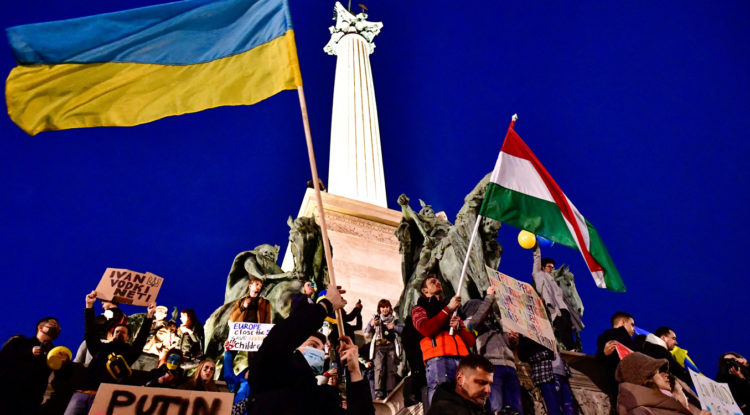
Orban demanded to include Ukraine in NATO and opposed Russia. Now Hungary is the main opponent of Kyiv in Europe. How did it happen?
Hungary is the only neighbor of Ukraine as part of the European Union, which refuses to supply it with weapons and other military assistance, opposes its rapprochement with the EU and NATO and advocates the weakening of sanctions against Russia. Because of this, the country is permanently on the tip of the diplomatic crisis- they declare a demarry and alternately Call the ambassadors. However, it was difficult to imagine the pro -Russian position of Hungary recently, and its leader Viktor Orban urged Ukraine to accept Ukraine in NATO. "Cold" tells the main thing about the complex relations of Hungary and Ukraine and their exacerbation against the background of the war.
In order not to miss the main materials of the "cold", subscribe to our Instagram and telegram .
A serious aggravation of Ukrainian-Hungarian relations began in 2017-2018: the rights of the Hungarian minority in Ukrainian Transcarpathia were the reason. The Russian invasion brought the confrontation to a new level: Budapest refused to tear off communications with Russia and help Ukraine with weapons and finances. The reason is the reason-the Prime Minister of Hungary Viktor Orban and his Party "Fides", which in Europe are considered the allies of the Kremlin. However, experts believe that, despite all the accusations of ties with Moscow, Orban supports more strong ties with the European Union and simply uses the war to extract his own political benefits.
Orban's evolution
Viktor Orban, who has been holding the post of Prime Minister of Hungary for 13 years and recently won the next parliamentary elections, remains the only comrade-in-arms of Putin in the EU. However, he was not always a supporter of Russia: at first he called to end the communist dictatorship, then he relerated his compatriots from re-falling under the influence of Moscow, criticized the decision of the then Hungarian government to approve the project of the Russian gas pipeline enveloping Ukraine, and called on NATO to include Ukraine and Georgia in the midst of the Russian-Georgian war.
However, everything changed after the global financial crisis of 2008 and Putin’s first personal meeting with Orban in November 2009. Then, once again, the prime minister of Hungary, Orban, flew to St. Petersburg to the Congress of United Russia and informally talked with the President of Russia in St. Petersburg. What was the Russian and Hungarian politicians then, it is reliably unknown , but from St. Petersburg Orban returned to the ally of Russia.
Having come to power in 2010, he began to develop economic ties with China and Russia , protecting their interests in the EU, and enrich themselves with joint projects. Over 13 years, the prime minister Viktor Orban significantly shook the system of checks and counterweights that limits his power within the country, ruined the institution of independent media and established himself as an authoritarian leader with conservative and nationalist beliefs. For his tough position in matters of gender policy, LGBTK+ communities and the immigration of Orban are often criticized by his partners from the EU, simultaneously expressing deep concern with a high level of corruption and weak democratic institutions. At the EU and the Eastern Partnership summit in 2015, the former head of the European Commission Jean-Claude Junker even jokingly called Orban a dictator and wilted him a slap in the face .
The last conflict with Ukraine was called a video with an appeal to stop military operations in Ukraine, which was recently spread by the Hungarian government. The words that “only the ceasefire can put an end to devastation and only peaceful negotiations can save life”, accompanied the frames of women and children, destroyed by the war of cities and the image of a map on which Crimea is not included in Ukraine. This outraged the representatives of the Ukrainian Foreign Ministry, who in response called on Hungary to stop supporting Russia's aggressive policy and participating in provocations.
"Friendship" and Patriarch Kirill
Although Hungary accepted at least 36 thousand Ukrainian refugees on its territory, and Orban himself reluctantly condemned the full -scale invasion of Russia, with the outbreak of war, he not only did not break the allied relations with Putin, but also began to directly oppose Ukraine. The Hungarian authorities refused to supply weapons to Ukraine, insisting that this could not contribute to the world, Hungary also banned the transit of weapons through its territory. This decision of the Foreign Minister Peter Siyyarto explained by his reluctance to turn Hungary into the next target of Russia, which, in his opinion, would inevitably happen if they allowed third countries to send equipment and weapons to Ukraine through their territory.
Expert on foreign policy and the author of the book “Tarnished Democracy, Viktor Orban and the Bluttle of Hungary”, Susanne, believes that Orbana is in vain considered a pro -Russian politician. “His position on Russia is a purely strategic rather than a personal position aimed at weakening the European support of Ukraine ... The expression of its selfish political style and willingness to take a risk in order to strengthen Hungary’s position in the international arena,” she says.
In addition, Hungary, as a member of NATO, refused to train the Armed Forces of Ukraine on its territory and opposed the creation of an alliance of the uniform zone over Ukraine. Budapest also threatened to prevent the adoption by the European Union at once by several packages of sanctions against Russia, but as a result, the parties found a decision - however, the European Union had to go to Budapest to make concessions several times. So, from the sixth package of sanctions, at the request of Hungary, the Druzhba pipeline was excluded , according to which it receives Russian oil, and Patriarch Kirill .
There is a version that Patriarch Orban did not stand out of personal sympathy, but from the desire to revive the long -existing project to create the Hungarian Orthodox Church, the embodiment of which, according to some assumptions , would allow him to suppress liberal voices in the Hungarian Catholic and Protestant churches and put pressure on the Orthodox churches that have their own structures in Hungary, especially the Serbian Patriarchate.
In November last year, Orban completely managed to resolve his problems with the European Commission with the help of blackmail. Then, with the help of threats to apply a veto, he froze a European program to provide Ukraine with financial assistance for 18 billion euros. These funds were necessary to Kiev to maintain the economy and restore infrastructure destroyed by Russian shelling. However, this required unanimous consent of all 27 EU members. Hungary eventually agreed to remove the veto and not to prevent the financing of Ukraine, but only after the European Union was obliged to resolve the issue of providing funding for Hungary itself.
Orban knocked out money from the European Commission against the backdrop of the fact that the EU himself was going to reduce the financing of Hungary from a total budget by 7.5 billion euros for non -compliance with the EU democratic standards. As a result of negotiations, the European Union agreed to reduce the volume of frozen subsidies from 7.5 billion euros to 6.3 billion and approved a plan according to which Hungary could get a grant from the EU in the amount of 5.8 billion euros for the restoration of the economy after the pandemic.
Political scientist and employee of the Catholic University Peter Pasmsany in Budapest Andrash Rats doubt that Orban’s rhetoricity about partnership with Russia lies anything besides the desire to “finish two cows at the same time”. A researcher at the US German Marshall, Daniel Khegetyush , believes that through such an anchor between Brussels and Moscow, Orban is trying to take the place of the representative of Russia in the European Union and hopes to maintain good relations with the Kremlin even after the end of the war.
He is also echoed by Andrash Perentoti, a political consultant who prepared the Hungarian opposition for the last parliamentary elections and advised them on foreign policy issues: “Orban is not a Putin puppet, Putin does not control him. But their interests often coincide. For him, relations with Russia are a pressure lever to the West. As for Putin, relations with Hungary are a way to influence the West. ” Preight is sure that Orban does not believe that his alliance with Putin can actually replace Hungary to Europe. But for Putin himself, the membership of Hungary in NATO and the EU is a particularly valuable asset that the Hungarian prime minister understands well.
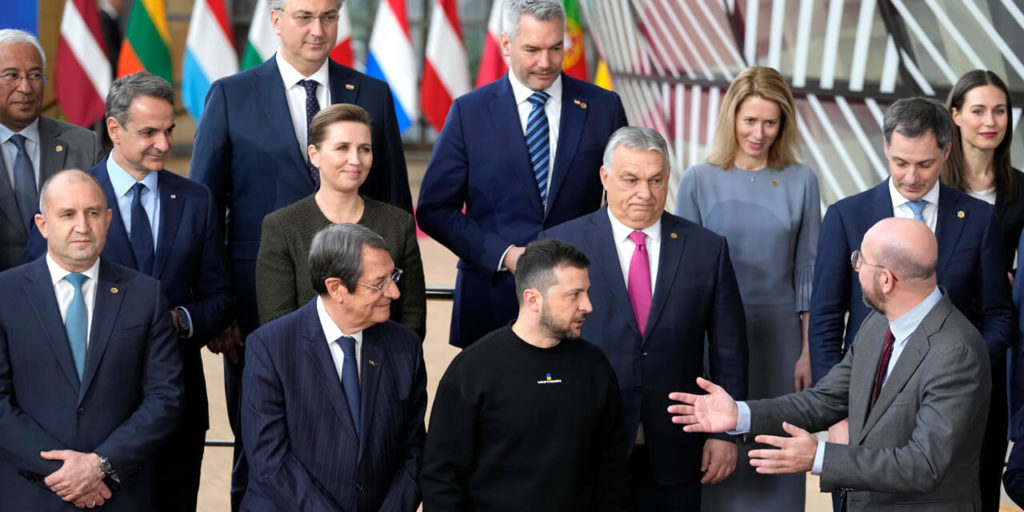
Now Hungary is again threatened to block the 11th package of sanctions and the allocation of another 500 million euro military assistance to Ukraine from the European Fund of the World, if Kiev does not exclude the Hungarian OTP Bank from the list of “International Sponsors of War”. Such a status was assigned to the Bank of the Ukrainian National Agency for the Prevention of Corruption for continuing to work in Russia and even provides preferential conditions for servicing loans for military personnel. Because of this, even the Council of the European Union for Foreign Affairs became interested in the bank’s activities. Hungarian Foreign Minister Peter Siyyarto considers such attention to OTP Bank unnecessary and does not agree with the assignment of such a title.
Against Europe and Ukraine
Some Ukrainian officials call the “sponsor of war” not only the Hungarian bank, but also the prime minister of Hungary, who not only conducts frankly pro-Russian policy, but often makes statements about the war that Kiev considers outrageous. So, Orban has repeatedly said that Ukraine could not win the war, and continues to insist that the only way to end the war is peaceful negotiations between Russia and the USA. In early June, he again resorted to this argument. On the air of the local radio, he stated that the war entered a very difficult phase, and called on his associates to make maximum efforts in order to reach the ceasefire before the Armed Forces of Ukraine began to lose three times more people than during defense. Advisor to the head of the presidential office, Mikhail Podolyak, in response, advised him to call his friend Putin if he "is really worried about the victims."
But Orban criticized not only Ukraine, but also the EU, saying that the supply of weapons to Ukraine and sanctions only extend the war, and even compared the EU project to expand the European Union and promote the uniform standards of Europe with the imperial ambitions of Napoleon and Hitler, which threaten the national states of Europe. In November 2022, he completely came to a football match between the national teams of Hungary and Greece in a scarf depicting a map of the Great Hungary - the territory occupied by Hungary until the end of the First World War, which included units of modern Ukraine and Romania. This provoked a scandal: the Hungarian ambassador in Kiev was summoned to the Foreign Ministry of Ukraine and demanded an excuse and refutation of the encroachment on the territorial integrity of the country.
Zelensky repeatedly called on Orban to stand on his side and even tried to convince him to visit Ukraine. However, Orban ignored his invitations, and for calls to expand sanctions on Russian coal, gas and oil refused. “Given that 85% of our gas and more than 60% of oil comes from Russia, the sanctions would mean that the Hungarian economy will slow down and then stop in seconds,” he explained his decision. The Hungarian prime minister also defiantly refused to applaud Zelensky at his meetings with the leaders of the European Union and, presumably, doubted the reliability of shots from Buchi when they began to appear on the Internet in April last year. The President of Ukraine then said that one of the European leaders demanded evidence that this is not a staging. According to the Ukrainian media, it was Orban.
Transcarpathian roots of the conflict
In 2018, the Hungarian government reported that Ukraine and NATO would not support Ukraine and NATO, if it does not go to their conditions in the issue of the rights of Ukrainian Hungarians. Ethnic Hungarians in Transcarpathia is the subject of a long -standing dispute between Ukraine and Hungary. The Transcarpathian region until 1920 was part of Hungary. Budapest maintained tight contact with them and until 2020 provided them with financial assistance. Nevertheless, over time, the Hungarian ethnic minority was significantly reduced: if in 2001 it was estimated at 150 thousand, then by 2023 it was reduced to 75–85 thousand.
A significant part left the country with the outbreak of war, some even earlier due to the reform of the educational system adopted in 2017, primarily oriented on Russian-speaking, also affected the Transcarpathian Hungarians. In accordance with the new laws in more than 100 Hungarian schools in Transcarpathia, training began to be carried out mainly in Ukrainian. Some Hungarian students were too difficult to study in Ukrainian, and their families left. Observing the outflow of the Hungarians from Transcarpathia, the Hungarian authorities called reforms discriminatory, and Tamash Menzer, Secretary of the Foreign Ministry of Hungary, even accused Ukraine of committing "atrocities" against the Transcarpathian Hungarians. He said these words shortly after the Ukrainian authorities removed Hungarian flags and signs from some municipal buildings in the Transcarpathian city of Mukachevo.
The transition of training in the Ukrainian language in Transcarpathia outlined the beginning of a protracted crisis in the relations of Hungary and Ukraine. The next problem moment in a series of conflicts was the incident with the issuance of Hungarian passports to Ukrainian citizens in Transcarpathia. In October 2018, the Ukrainian media published a video in which the Hungarian consulate employees in the Transcarpathian town of Beregovo issue Hungarian passports to Ukrainian citizens and advise them not to advertise the fact of their acquisition before Ukrainian government agencies. Despite the fact that there was no secret to anyone, that Ukrainians living in the border territories often receive second citizenship illegally, this video caused a scandal. The Minister of Foreign Affairs of Ukraine accused Hungarians of violating Ukrainian legislation and diplomatic etiquette. The representative of the Hungarian Foreign Ministry, in response, appropriated the authorship of the Ukrainian special services and accused them of surveillance. As a result, both sides expelled each other's consuls.
In 2017, after the protests of neighboring states, Ukraine sent a law on education for examination to the Venice Commission (an advisory body under the Council of Europe on Constitutional Law). Experts as part of the commission decided that the law really infringes on the rights of national minorities living in Ukraine, and in 2020 Ukraine finalized and changed it. Now the Hungarians, like other minorities speaking in the official languages of the EU, can study in the Hungarian language in elementary grades, and then gradually switch to bilingual education in high school.
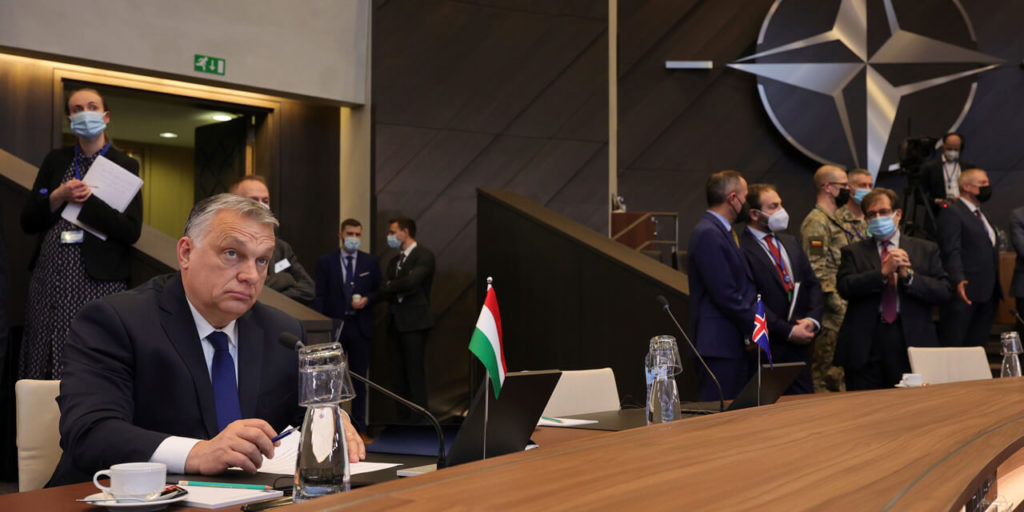
Photo: Olivier Matthys / Ap Photo / Scanpix
Despite the mitigation of laws in Ukraine, Budapest brought his edits to national education, releasing a geography textbook for high school in 2022, which states that in Ukraine there is a civil war to which Russia is not related.
Infinite tension
In April 2022, the ruling party “Fides - the Hungarian Civil Union” under the auspices of its permanent leader Orban won the fourth parliamentary elections in a row. This time with stunning results - 135 seats in parliament out of 199. In his election campaign, Orban appeared before voters in the image of the “defender of the world”, a man who wants to fence off Hungary from the war and its economic consequences, and was able to convince his electorate that the opposition would inevitably draw Hungary into the war against Russia.
“Some Hungarians do not share the anti -Ukrainian rhetoric of Orban and his party, but the majority was flattered by his promise to preserve the abstract world,” says Blanca Zoldi, editor -in -chief of the Hungarian publication Lakmusz, specializing in data verification. According to surveys , in March last year, only 64% of the Hungarians considered the war in Ukraine a consequence of Russian aggression. The rest accused the incident of the Ukrainians.
Zoldi is convinced that such results are facilitated by the silence of the theses of the opposition in the Hungarian media. A researcher at the US German Foundation Marshall Daniel Khegedyush, who believes that the level of Russian sympathy in Hungary has increased in recent years, is not so much due to Russian propaganda as thanks to the anti-Western agenda, which is promoted by the Hungarian state itself. According to his estimates, in the 2010s, about 15% of Hungarian citizens could sympathize with Russia. Today, this number has increased to 40-60%.
The next victory of Fides leaves Viktor Orban in power for another four years, which means that in the coming years, warming is not expected in the relations of Hungary and Ukraine. Министр иностранных дел Украины Дмитрий Кулеба уверен , что ни о каких изменениях в отношениях стран не может быть и речи, пока Венгрией управляет Орбан. Плохими новостями для Украины является и то, что в других европейских странах, таких как Словакия и Австрия, набирают популярность идеологически похожие на Орбана политики, которые открыто симпатизируют России и грозятся саботировать антироссийские санкции и снизить объем предоставляемой Украине военной помощи.