
Translated material
Ukraine claims a possible Russian attack on ZAES. The dispute of radioactive substances can be from 1 to 500 kilometers - Ozharovsky
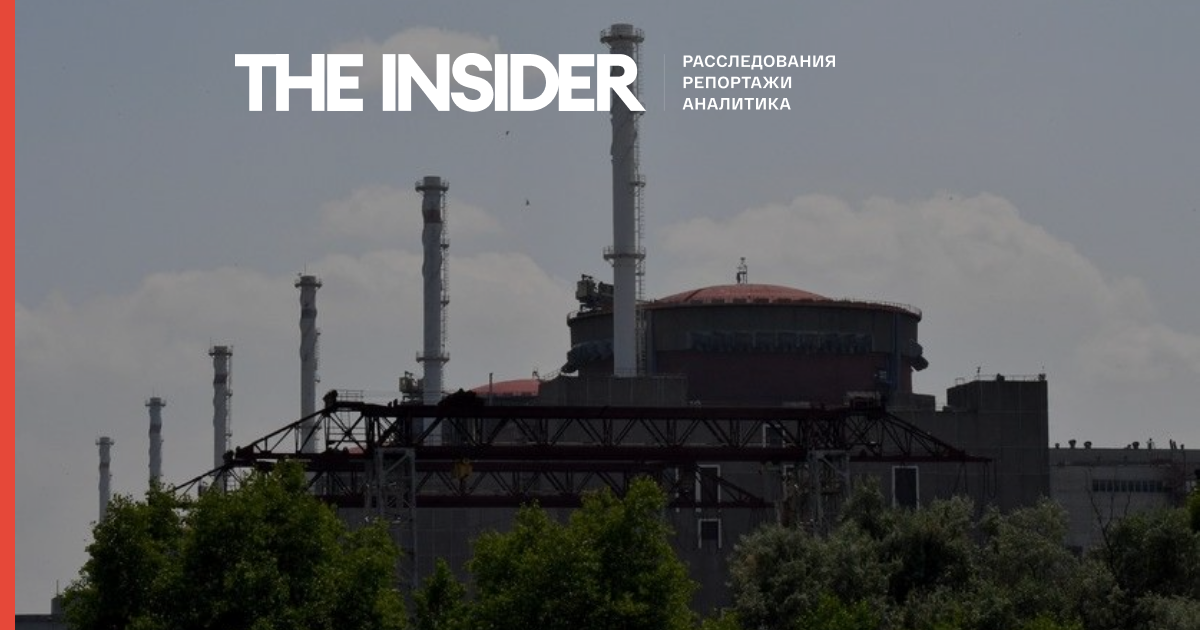

The fact that Russia can commit an attack at the Zaporizhzhya nuclear power plant was first made by the President of Ukraine Volodymyr Zelensky , and then, in an interview with the British publication The New Statement, the head of Ukrainian military intelligence, Kirill Budanov .
According to Budanov, the Russians placed explosives at the ZASS and may use the threat of undermining the station if the Armed Forces of Ukraine are successfully advanced on the battlefield.
On June 26, the head of the Russian Foreign Ministry, Sergei Lavrov, denied the existence of a plan to undermine the nuclear power plant, traditionally mentioning the Anglo -Saxons and wrote off everything on the “information war”.
The Ukrainian nuclear security expert Olga Koshaka said in an interview with DW that Russians could blow up Shandor-a damper that describes or produces water in the ZAES pond. Then the cooling system of power units will stop working, as a result of which reactors can explode after a while:
That week, when the Kakhovskaya hydroelectric power station was blown up, there was Sergey Kiriyenko personally, he examined this cooler pond. Now, despite the assurances of Russian invaders that the water level will not change in the pond, in fact, 2.5 million cubic meters are lost in 10 days. That is, the level decreased from 16.67. Pipelines, [space] around the spray pools are mined, mines inside the station. It is not necessary to lay the explosives under the reactor, it is enough to lower all the water from the pond, undermining Sandor, or blow up the pipelines that lead [water] to cool the reactor. I think that all this is done - both blackmail and threats - solely in order to stop the counter -cost of the Armed Forces in this region.
Jacker-nuclear person Andrei Ozharovsky told The Insider about how the Russian terrorist attack at the Zaporizhzhya nuclear power plant can be and what it will lead to:
What Russia can do on ZAS
Since I cannot even assume what Russia is doing there, I will tell you what abstract terrorists can do with a particular nuclear power plant. Even a stopped nuclear power plant is a nuclear and radiation dangerous object. Radio dangerous because a huge number of dangerous radioactive substances are accumulated there. They are partially in the reactor and partially - in the aging of the exposure of the designed nuclear fuel, which are next to each reactor (these are the so -called wet pools).
Specifically, at the Zaporizhzhya station there is a platform where there are metal -concrete containers for dry storage of the worked out nuclear fuel. Let me remind you that it was not exported from the territory of ZAEC, waste from the nuclear station is stored next to it. Plus, there are repositories of other atomic waste, and all this can be used to cause damage to the environment and health of people by spraying radioactive substances.
If the reactors are in the cold stop, then this is too complicated an object for releasing radiation. There is the first circuit, there is a reactor case - and these are thick -walled metal structures that are required to restrain the reaction inside.
How can an attempt to rise the reactor power in a hot stop end
In a state of hot stop, the reactor is much more dangerous. Now there are disputes about whether the fifth block has been transferred to cold stops or only gather. Recently, he was in a hot stop, that is, energy production did not go, but activity took place at a minimum controlled power level.
The most unpleasant scenario is an attempt to rise in the reactor power when temperature and pressure grow in it. In this state, in case of damage to the first contour of the protective membrane, conditions are created so that the accumulated radioactivity is “spilled” into the environment at a pressure in the first circuit about 16 megapascals and a temperature of about 300 degrees Celsius. During depressurization, water boils at atmospheric pressure, and this boiling radioactive mixture breaks into the environment.


Possible scenarios for the dispersal of radioactive substances under different weather conditions
The reactor power is raised by exposure to the regulatory organs on the block control panel. It takes tens of minutes or hours. Then the reactor goes into a hot state, and problems with overheating begin.
There are illustrations of accidents at the working nuclear power plant, which were made as part of the Flexrisk project Austrian scientists. In particular, they made pollution cards. It is worth noting that they did not simulate the consequences of a terrorist attack, but an explosion of the reactor due to internal problems, as at the Chernobyl nuclear power plant. But in general, these cards can be focused on understanding the consequences.
The initial scenario was taken with the old Soviet VVR-1000 reactors of the 1960s, after which it was studied how radioactive substances can fall on the soil, taking into account different weather conditions.
Maps are tied to Cesius, because Cesius-137 is one of the most significant radionuclides. After Chernobyl, the dosimetrists walked around the territory and recorded pollution, Austrian scientists tried to “reproduce” the consequences of the Chernobyl accident according to these data.
What is the scale of the possible tragedy.
It's hard to say. We do not know the type and script of the terrorist attack, but if it will be made on cold reactors, then the scatter will turn out to be small and will be a maximum of a couple of kilometers. Because if someone brings explosives there and blow up a reactor that is not under pressure, the temperature of which is not increased, then there will simply be a scatter of solids. The explosion will be scattered at certain distances and further by the wind and water will spread and washed off hundreds of meters (even, most likely, less than a kilometer).
Approximately the same applies to the storage of radioactive waste. Imagine the hit of shells in a heap, for example, ash - at what distance will it spread? It is for tens or hundreds of meters. The danger will be to find radioactive substances in the environment, which will be eroded further. But this is not the scenario that Austrian experts counted, modeling the consequences of accidents on pressure reactors.
If we talk about a hot reactor, then substances, according to Austrian maps, will scatter hundreds of kilometers. This will be so strong pollution that the current legislation may require resettlement of settlements. It is like Chernobyl, who flew to the Bryansk region in Russia and to the Mogilev region in Belarus. There is approximately the same reactor power. The consequences for agriculture will be felt at a distance of 500 kilometers or more.
The accident occurring on a working reactor can develop according to two scenarios. If weather conditions do not smear radioactivity, then everything falls close to the reactor, in a radius of hundreds of kilometers. If you smear it, then this is a smaller concentration in a larger territory.
So in the first case, we are talking about more pollution closer to the reactor, and in the second even evacuation may not be needed. However, with the development of the situation on the second option, agriculture can be killed both in the south of Ukraine and in the Kursk and Rostov regions of Russia. The Kursk region does not borders on the Zaporizhzhya region, but the story of Chernobyl and Mogilev may repeat, which also do not fit each other, but because of the rains in the Mogilev region there were heavy attacks. In an unobvious scenario, when the wind blows towards Moscow, substances can reach the Kaluga region.