
Translated material
Visual glue
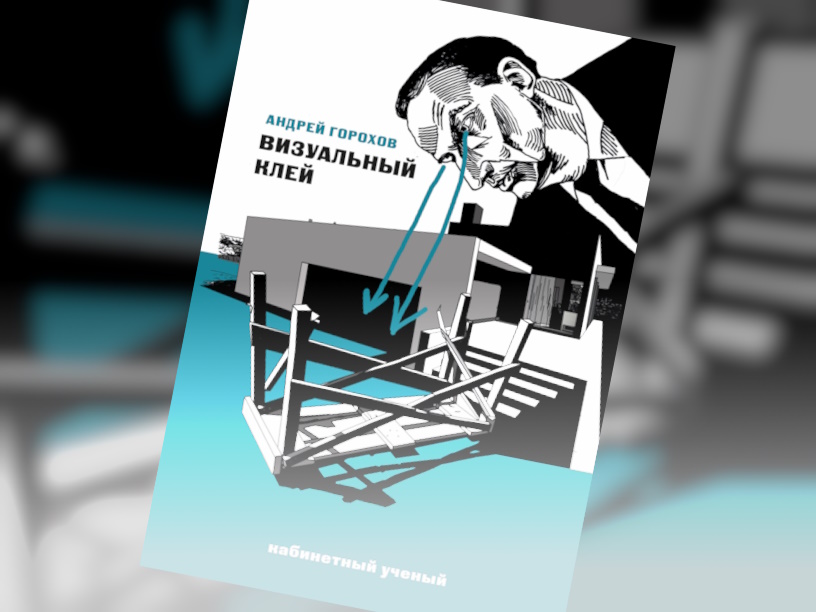
Polit.ru introduces readers with books included in the long list of applicants for the Enlightener Award of 2023. Twenty books of more than 130, put forward by various publishers, were selected into it. The short list of the Enlightener prize will be announced until the end of September.
The publishing house "Cabinet scientist" represents the book of Andrei Gorokhov "Visual Glue."
The book is devoted to the laws and principles of perception of not very complex pictures. It can be considered a treatise on shaping, design textbook or a preface to the drawing textbook.
We are talking about such fundamental concepts as form, structure, composition, balance, dynamics, hierarchical order, integrity. There is a picky exposure and demonstration, as this discourse is not able to seize what really happens in the world of pictures.
We offer to read one of the chapters of the book.
2. What is perception?
Why and how does a person see something and generally perceive (something hears or feels pain)? Seeing is to perceive with your eyes. Hear - perceive with ears. What is, I see what sounds, I hear. Why is there so much noise around this? What is the problem? And what does philosophy have to do with it?
Let's look around us. Here is a house, a real, real house, it is far away, but you can approach it and touch your hand, you can even dig its rough wall, you can go inside. So far, everything is really clear: there are existing objects around us.
2.1. Naive realism
A person simply sees such an object, well, of course, something understands and concludes something about him, say, he sees an apple and understands that this is a ripe fruit, and also that it is almost a ball, and also that it is an object. But this is all then, but for now a person sees a house or apple in front of his nose, that is, he sees reality as it is.
This is the position of naive realism (Naive Realism, Direct Realism): I see what exists in reality.
How does this work?
We need more words. The real object outside us is called American scientists “distal” (Distal Object).
The object is lit by sunlight, the rays are reflected from the front wall of the object and fall into the eye. A person sees his eyes, his eyes are a transparent ball that has a lens in front, and the cells that react to the light are located on the back wall. This bottom is called Retina. The distal object corresponds to the retinal image at the bottom of the eye or retinal projection. This is a flat picture on the back wall of the ball.
We have several problems.
The first problem.
Here I stand on the seashore and admire the setting sun. A path from bright sunlight runs towards the sea. You are standing a kilometer from me on the same shore, a path from bright sunlight also runs to you. Is this the same path? That is, the same distal object?
Hmm, there is no object. And the sea reflects the sun with its entire surface in all directions. In other words, the sea shines with the reflected light of the sun, it is brightly sprayed everywhere, at each point, it looks like a sea of molten metal. We see a narrow tenderloin from this radiance, because this is how the lens acts in our eye. The solar path is a bug, the reason for which is in the structure of our eye, you can call this bug artifact, draw a reflection scheme and calm down. It seems to us that each of us runs its own path, this is simply explained.
But the presence of artifacts is strange. There is a sea, there are waves, there is a shore, there is a sun, and there is no longer paths so perfectly inscribed in everything that is really existing?
Of course, this is not the only artifact, much more noticeable - a promising reduction in objects. In the physical world, the rails leaving us remain parallel and do not come closer, and we see them closer. A suspicion arises: what we see is not a very real world.
The second problem.
On Retin, the picture is flat. And the world around us is three -dimensional. He has a depth. The effect of depth is caused not only by the fact that we have two eyes. And not a promising reduction. The world is really three -dimensional, a ball can roll up for a tree, rinse into the depths, and through a projection on Retina, the world becomes two -dimensional, flattened. But we see it three -dimensional, we see that it is closer to us, which is further from us. It must be understood that the projection flattened on Retin is then somehow flattened, receives depth, unfolds deep into it.
But how is this adding?
There is a phenomenon when a flat picture looks like a two -layer (a black object breaks away from a white background) or even deep. The strangeness here is that spatial/depth was added by itself to a flat picture. Worse, a white ball was added here.
2.2. The dark side of the eye
What happens next?
Retin cells react to the light of different colors: red, green and blue. Some cells react to the edges of objects, that is, to the boundaries between, say, a dark and light zone, each time it is a small area of retinal projection.
They react - it means that the automatic pulse line is sent along the nerve towards the brain. The movement of the pulse along the long process of the neuron is the chemical process of transferring the charge between ions along the chain.
Even if there is no movement in the outside world, then the narrow area of acute vision jumps in different directions, because the retinal projection will fierce Retin. This leads to the fact that even a motionless panorama in front of our nose is generated by a stream of constantly changing impulses in the nerves coming to the brain from the eye. A motionless distal picture turns into a stream of signals in myriads of parallel neurons. The device of a separate neuron has been well studied, but the neuronal code is not deciphered, that is, it is not known exactly how the information is encoded, what the neurons transmit.
We are in a very interesting place - immediately behind the eye. The interest of this place is not only that it is dark, but mainly that there is no retinal projection, no pictures - no apples, houses, sun and sea.
I don’t know how to formulate this even more clearly: on the dark side of the eye from the real world surrounding us, there is nothing left, only a flurry of impulses in the myriads of neurons. The man has not seen anything yet, and the surrounding world is gone.
We still have the last step to the right - in the depths of the brain.
The signals from the eye nerves come to the area where they, relatively speaking, are “processing”, what exactly is happening to them there is unknown. But it is clear that there are some physical processes, they learned to notice electrical activity. I painted crosses there.
What is it? This is what the impulses coming from the eye were transformed into, that is, what apples and houses that are in the field of view of man turned into.
There are many names for these crosses: Mental Image, Percept, Representation, Sensum. In search of Russian terms, I decided to look into some book on philosophy in my native language, I remembered only “Materialism and empiriocriticism” of Lenin, not at all doubting that it was precisely this issue that should be discussed. And voila! Chapter 1, Part 1: Symbols of things, mental symbols, a complex of sensations, which has a shape, images or display of things, mental images.
Lenin does not agree with Ernst Mach that there are combinations of sensations. Lenin writes that a monstrous confusion has arisen, and he will now unravel this confusion. Great plan!
What, in fact, is the problem?
There are several problems.
Binding Problem problem : signals to the brain go in the form of streams, these streams diverge and process in distant areas of the brain, say, the color is processed the fastest, the contours of objects are processed a little longer, the more time is occupied by processing. Nevertheless, we see holistic painted moving objects, that is, several different crosses, far from each other, turn out to be one object.
The problem of consciousness (Hard Problem, Mind-Body Problem): the brain is a very complex, but nevertheless limited physical system in which chemical and physical processes, roughly speaking, chemistry and electricity.
And suddenly, for some reason, it turns out that something that begins to see, feel, experience pain, etc., is a living person on whose brain we look, appear inside the brain.
There is no more object in our world that would have such a property. This property is so strange that we can’t even say where this “consciousness” is actually located. When we look at the living brain, we do not see any consciousness, only the flashes of the waves of billions of lights. When we look at the world around us, that is, from the inside of our consciousness, we do not see the brain. All this has such an attitude to perception that even if our apple fell into the brain into a network of many electrochemical crosses, then how does it turn out that the apple becomes visible to someone who suddenly arises mysteriously?
2.3. RUSSELL
The sequence of steps from the sun to the house, further to the eye, further along the optic nerve in the brain to the crosses there is a causal chain of perception), it moves in one direction. This is the famous argument of Bernard Russell. There is no physical process that would endure our crosses out into the world around us. Crosses are locked in the head. But as a result of this process, we see an apple in front of us!
Here you need to take a few steps back. We had to admit that there are no pictures on the dark side of the eye. This is a physical fact, there is nothing to be done about it, you will not be able to drill. But you can ask if there is a picture on Retin?
Rays of light fall on Retina, what we perceive as light is electromagnetic radiation of different frequencies. I must say that we see only a small part of the spectrum of electromagnetic radiation. A huge number of higher frequencies: an ultraviolet is followed by x-ray radiation, and then a gamma radiation. We perceive the lower frequency of the same physical process as heat, these are infrared waves. Radio waves are even lower.
This trivial circumstances have two interesting consequences. Firstly, we see only a small part of the reflected rays, but for some reason we do not see any shortage. The surrounding world is continuous and full, it goes a continuous wall.
And secondly, if there is no eye into which electromagnetic radiation falls and causes a feeling of light, then there is no light, but there is only electromagnetic radiation. That is, relatively speaking, deep black night.
Similarly, we hear the sound when the waves of changing air pressure reach our eardrum. There are no sounds in the world outside our ears, sound arises in our head when we are conscious.
But if there is no light around us, if there is a black world around us, then our picture was incorrect from the very beginning! Outside our heads, the apple is not red, the light is not white.
Now we are returning to the argument of Russell: how did it happen that the image of an apple, existing in the form of an electrochemical process in the brain, suddenly turned out to be far in front of our nose?
A naive realist will say that the apple was from the very beginning in front of the nose, there is no problem. But we already understand that there is no light around us, there is no sound. There are no prospects there either. That is, the world surrounding us is far from the same as we see and hear it.
But are there any objects? Are there any forms of objects? I would like to say that yes, but the idea of the form (line, plane, ball, cylinder, prism) is the idea, the cross in our brain, the same as sound or light. But what corresponds to him in the surrounding black world is a big question.
If it seems to you that cubes and cylinders certainly exist, then you can remember something else, say, for strength or energy. Or here is the weather - does it exist? And literature? And the youth?
I do not want to discuss the problems of philosophy, which, as it is already understood, is a huge number, it is important for me to show that in this whole story there is grandiose incomprehensibility, incoherence, illogicality.
A naive realist carries out a short circuit: what is objectively in front of our nose (red apple) coincides with what a person perceives (crosses in the brain). It just turns out to be like that. Information about the structure of the three-dimensional world penetrates into the eye, penetrates into the eye nerve, somehow transforms in the brain with such a result that we see just what exists without any brain. Of course, there are several small oddities, say, optical illusions or hallucinations, they can be explored and discussed, but they do not make the weather.
2.4. Inadvertent realism
Incorrect realist (Indirect Realism, Representational Realism) is very impended.
He stares into the world around him and tries to guess: where is he sees around him - an objective, real, physical world, and where is that added by an eye and brain?
Added, it turns out, a lot of different things. This is not only color and depth. We see some objects as heavy, and some as lungs.
We see that many objects are symmetrical. Symmetry is not glued to the object, the tree itself is symmetrical, symmetry inside it, symmetry is the property of its structure. We see repeated elements: not just sticks of a fence or wood leaves, no, we see that this is a shift, duplication, propagation of the same object. We see that the letter “g” is like a snowflake, and a stooped man looks like a hill or wheel. If the cat is half hidden behind the sofa, we see how it continues there. We see not just a dangling flag, we see gusts and wind pressure.
We see that the crown of the tree is ready to take off, and the willow branches glide down, although the tree is motionless. We see the system of soldiers or a number of houses, although there are no gaps between them, and there is no system or row, generally speaking.
And each time Bernard Russell asks: how is it that your brain, locked in the skull, adds something to what is in front of you? How can the brain reach a distant object?
One can imagine that the brain stains the world, turning electromagnetic waves reflected by objects into their colors, but these colors are slyly distributed in three -dimensional space! When the system of soldiers or houses unfolds in front of us, we see their built -up and movement in three -dimensional space. That is, these are not flat staining glasses, but three -dimensional glasses?
2.5. Legar
Somewhere here it ends that one way or another is understandable and familiar. I wanted to show that the problem of perception exists and is global and fundamental.
But the story does not end there, there are guesses how to get out of this mess.
I tell in my own words what Stephen Legar wrote. He did not write this about it alone, but his course of thought seems to me clearly formulated and visual. And quite radical, so hold on to the wall.
Legar asks: where is the apple that we see in front of us? Its red color, its shape - all this is in our head, these are my crosses in the brain, it is an electrochemical process inside the brain.
But we see an apple in front of us. So we look inside our brain.
The world in front of us is the inside of our brain, a multi -colored three -dimensional dynamic (moving and transforming) model of the world, which is outside our skull.
And where are the limits of our skull?
If the visible world is closed in our skull, then above the sky we visited from the land, as well as behind the horizon, as well as below our feet, our skull is located. He is not topographically there, but topologically, if these words mean something to you.
But to what is beyond the borders of our skull - Legar calls it a monstrously huge and unusable world - we have no direct access. We either act inside the three -dimensional model, which we consider to be the world, or build other models, for example, as part of physics. Physics, chemistry and, say, molecular biology are trying to look at the real world bypassing what our eyes, tied to the brain, see themselves.
But what about my hands, my body, my head, which I can touch and see in the mirror? And this, like everything else, is a three -dimensional model. This is a model of my body. It is located in the center of the model of the world.
It is good if we know that we look deep into our brain and see not the outside world itself, but its three-dimensional model, representation, proxy, then we probably can somehow explore this?
Considerations in favor of the world-how-model are such (this is a laconic list, not a detailed presentation).
1) You can study the space visible to man, his geometry. He has a lot of non -trivial features. It forms a sphere with a cunning geometry, the farther from us, the more the space is compressed. It looks like a space distorted by a strong lens, the prospect in this space differs from linear. There is scientific literature on this topic, Legar discusses this and draws pictures in his book “The World in your head” (Stven Lehar “The World in Your Head”, 2002). Once again: what we see is seen through a very strong lens, if you turn your head right and right, the world will change in front of you, horizontal parallel lines will begin to move. To see means to see through the lens, without a lens it is impossible to see anything, it is impossible even to imagine how the world that is not missed through the lens looks.
This is known not only by those who are desperately trying to learn to draw from nature, but all the others: a comparison of a photograph with a landscape that you see in front of you is discouraged each time - in the photo the space turns out to be different, the items go further into the distance. There is also a lens in the camera lens, but what we see is very different from what the camera is obtained. In other words, the space that we see in front of ourselves can not be the space of the physical world, as it is by itself.
2) There are a lot of effects that a hundred years ago were called "gestalt effects." I mentioned a number of houses and a number of soldiers, in fact, there are many more such effects. We see that the apples are in the bowl, lie and crush. We hear not individual sounds, but melodies, the rumble of the orchestra, huge complexes of small elements. We see not just separate leaves, but the crowns of trees, we see not only individual trees, but the forest. Some incomprehensible power glues everything that we see, hear, feel, understand: letters glue in words, words are glued to the phrase, phrases are glued into books. A bouquet - flowers and leaves glued together into a single broom - is beautiful, and the Japanese ikebana is mysterious, some forms seem beautiful and perfect, they are so well tied and agreed in themselves. We see the movement not because something in the world is actually moving. There is no movement in the cinema, but there is a sequence of stop cadres, 25 frames per second are enough for us to see smooth movement, the effect of movement is a gestalt effect. There are so many such effects that I want to ask: what is not a gestalt effect? And it will not be easy to answer. It turns out that the whole world is glued with this gestalt-killer, however, physics and chemistry in the surrounding world do not find glue. Gestalt effects are what our brain adds to the world. Some visual gestalt effects will be discussed in this book. We are still inside the preface.
3) optical illusions are discouraged. And their origin is incomprehensible.
We stubbornly continue to see not what is: even if we know that the oblique line is straight, we see that it breaks. There are illusions regarding the color (Color Constance), there are illusions of size (Size Constance) and the illusions of the form (Shape Constance), there are a huge amount of literature on these topics, it is impossible to explain these illusions within the framework of naive realism, there are no explanations. It is curious that all the parameters of the visible world - the size, shape and color of objects - is the sphere of illusions.
4) If the cup on the kitchen table is inside the brain, then, hitting the head, can I break it? Yes, sure. There are many literature describing how people with brain injuries see the world. For example, the cessation of the functioning of a certain region (Lingual and Fusiform Gyri) leads to the fact that patients stop seeing color, the world becomes colorless. And if this region is stimulated by a magnet, then a person sees strange coloristic effects - circles or spots: in the center is white, green around, around red.
And if the V5 region is affected, then a person stops seeing the movement. The visible world turns out to be fundamentally motionless, after some point it changes in a new state with a jump in a new state: if a dog comes to you, then you see her frozen in the distance, then it is frozen in an unnatural pose near you.
5) the so -called “hallucinations” - distortions or changes in the perception of the world under the influence of a variety of chemistry - are another extensive theme. Changes-which are very many and which are very different-do not concern some incomprehensible “mental images” and “perceptes”, but are found in the very surrounding real world. The world becomes strange, some structures become visible in it (the forest turns into a Gothic cathedral, the number of symmetric patterns becomes not comprehensible to the mind), when exposed to other chemistry, it breaks up into fragments. In other words, hallucinogens allow you to see the deconstruction of the world model collected by the brain. Each time these transformations occur around you, they are three -dimensional. There are also many literature on this subject. Excellent introduction to this problem was written by Stephen Legar, this is a “great illusion” (“Grand Illusion”, 2010), this is the memoirs of a psychonaut, a kind of Castaneda’s book, only written by a sober, extremely observant and impressive researcher of visual perception. It reads easily and exciting. No mysticism, pure realism, however, is unnecessary.
Bertrand Russell formulated a radical view of things and frightened this wording: “When the doctor looks at the strange brain, he sees a fragment of his own brain, and not part of the brain that he examines” (“The Analysis of Matter”, 1927). If you wanted to read something radical, then this is it.
The meaning of this famous aphorism is that a person sees around him not at all surrounding the world, but his brain. A tree outside the window is your brain, a man goes along the road - this is your brain. It does not mean that the man is surrounded directly by chimeras and hallucinations, no, they are tied to the world around the world, but nevertheless they are the product of the brain activity. This applies to everything that a person feels, hears, thinks, understands, recalls. He is locked inside his brain. By the way, it is possible, therefore, the complex structures arising in various fields are similar to the nets, to rhizomes.
The problem of perception is now formulated as follows: how does it turn out that such a flexible, dynamic, three -dimensional model is built, how is the processing and binding of information, and binding in the form of a three -dimensional spatial configuration? It turns out to explain, in general, everything that we see around us, and not a few illusions and marginal oddities.
I will only pull the description of precisely some marginal oddities that I have to face when drawing simple pictures. Apparently, this is some kind of basic, not very complex level of what the brain does. It is not necessary to know and understand what I roughly outlined in this chapter, most people are naive realists, and do not experience any discomfort.
It is useful to read a legara or book with polemic so that the whole story is not remembered as a sluggish retelling of the film “Matrix”. Of course, the film "Matrix" showed the general public, which smells of indirect realism (Indirect Realism). Real Morpheus is Bernard Russell, and Neo is Stephen Legar. Joke.
Earlier, in the “Slow Reading” section, the following books were presented, included in the long list of the Enlightener Prize:
Mikhail Velizhev. Chaadaevsky business: ideology, rhetoric and state power in Nikolaev Russia. M.: New Literary Review, 2022.
Alexandra Goryashko. Wild bird and cultural person. Gaga is ordinary and reasonable: Fourteen centuries of relationships. SPb.: Printing house "LD Print", 2020.
Igor Lisov. Scouts of external planets: the journey of “pioneers” and “voyage” from the ground to Neptune and further. M.: Alpina Non-Fikshn, 2022.
Alexander Mozhaev. The Great Posad of Moscow. The true story of Kitay-Gorod. M.: Bombor, 2022.
Anton Nelikhov. Dinosaurs of Russia: past, present, future. M.: Alpina Non-Fikshn, 2022.
Natalia to Oshoyan. Romanian myths. From slices and pharaohs to mummy Paduria and Dracula. M.: Mann, Ivanov and Ferber, 2023.
Nadezhda Plungan. The birth of a Soviet woman. An employee, peasant woman, pilot, “former” and others in the art of 1917-1939. M.: Museum of Modern Art "Garage", 2022.
Sergey Samoilenko. Probabilities and troubles. Mathematics of everyday life. M.: Mann, Ivanov and Ferber, 2022.
Oleg Khlevnyuk. Empire corporation . Shadow economy and corruption in the Stalinist USSR. M.: New Literary Review, 2023.
Oleg Shumakov. The kingdom of Cambodia. The prolonged journey of the zoologist. M.: Fiton XXI, 2021.
Sergey Shumsky. Education of cars: a new story of the mind. M.: Alpina Non-Fikshn, 2021.
Tamara Eidelman. The right to life. The history of the death penalty. M.: Alpina Non-Fikshn, 2023.