
Translated material
Lord defense order
The Russian Orthodox Church intends to canonize Alexander Suvorov. And, apparently, not only him: saints are now looking for among military leaders - even with a controversial biography
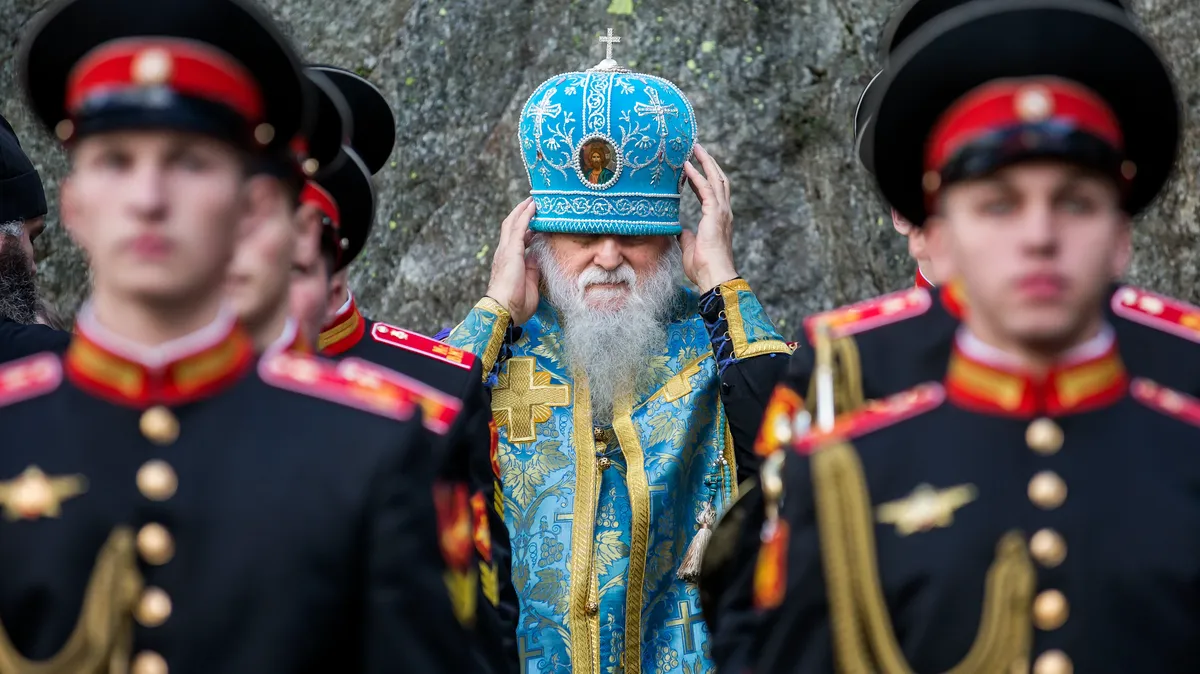
Russian soldiers and Archbishop Mikhail from Geneva are facing the monument to Russian General Alexander Suvorov, the Schalinenshlukht gorge near Andermatt, Central Switzerland, September 24, 2017 photo: EPA-EFE/Alexandra Wey
The Commission of the Russian Orthodox Church on the canonization of saints began preparing the glorification of the Holy and Righteous Warriors of Generalissimo Alexander Suvorov, a contradictory figure of Russian history of the 18th century. The corresponding order of the commission was given by the Synod, who met on August 24 in St. Petersburg, chaired by Patriarch Kirill (Gundyaev). In turn, the patriarch of the canonization of the Generalissimo was asked by the Minister of Defense of the Russian Federation Sergey Shoigu. Everything goes to the fact that Suvorov will not be the last generalissimo canonized by modern Russian Orthodox Church.
Procedure. Who and how canonize in the Russian Orthodox Church?
Historically, in the Orthodox Church, a clear regulatory procedure of canonization, that is, the official inclusion of a Christian in church shrines, did not form a clear regulatory procedure. In Byzantium or in Ancient Rus', the veneration of the saints arose quite spontaneously: sometimes even during the life of one or another ascetic (as in the case of the Monk Sergius of Radonezh), sometimes under the impression of the miracles committed on the grave of the saint, or from his posthumous phenomena. For the first time, a kind of canonization in the Russian Church took place at the Moscow Cathedral of 1547-1549, at the beginning of the reign of Ivan the Terrible. Not all historians agree that it was a canonization in the modern sense of the word . The initiator and head of those cathedrals, Metropolitan Macarius, went down in history as a great codifier: he defined the task of his main work, “great Cheynya-Mine”, he defined as a gathering under one cover of all life, “something in Rus'”.
However, so far no one still knows how many saints are revered in Orthodoxy. In the chants of the week of all saints, one can meet the statement that there are much more unknown to the world than known and famous, but at the same time each local Orthodox Church has its own lists of saints. Moreover,
Inside some local churches (in particular, Russian) there is a division into “local” and “general church” saints and a special procedure for the transfer of saints from one category to another.
This remotely resembles the Catholic difference between the “Beatification” (recognition of the ascetic Blessed) and the actual canonization.
After the breaks of canonization caused by the revolution and subsequent persecutions in the Russian Church resumed only in the 1960-1970s: first in the Russian foreign church (ROCZ), and then in the pro-Soviet Russian Orthodox Church. The apotheosis of the new canonization process was the glorification of the new martyrs and confessors of Russian who suffered from Soviet persecution: ROCZ committed it in 1981 (which then caused indignation in Moscow), and the Moscow Patriarchate-only in 2000. The stumbling block was the veneration of Nicholas II and his family members, who are still considered “just mentors”, while others were “redeemers”.
The first relatively free local cathedral of the Russian Orthodox Church in 1988 decided to streamline the procedure, and soon a special commission appeared, which the ROC defines the charter of the Russian Orthodox Church as "the coordinating scientific research body engaged in the preparation of materials for the canonization of the ascetics of faith." For more than 20 years, the commission was headed by Metropolitan Juvenal (Poyarkov), and in 2011 the Patriarch and Synod appointed Bishop Pankrati (Zherdeva) to this post by the Valaam Monastery. In addition to specialized church scientists and rectors of the main spiritual schools, the commission includes bishops from Ukraine, Baltic countries, Belarus, Moldova and Kazakhstan, representing the canonization interests of their countries. For example, the Ukrainian Church of the Moscow Patriarchate is represented by Metropolitan and Tauride John (Siopko). Several times a year, the commission gathers at meetings on Novokuznetskaya Street in Moscow, in the building of the St. Tikhonovsky Orthodox University. She considers materials about the canonization candidates received either “from below”, from the diocesan bishops, or “from above”, from the patriarch. No “folk initiatives” are provided.
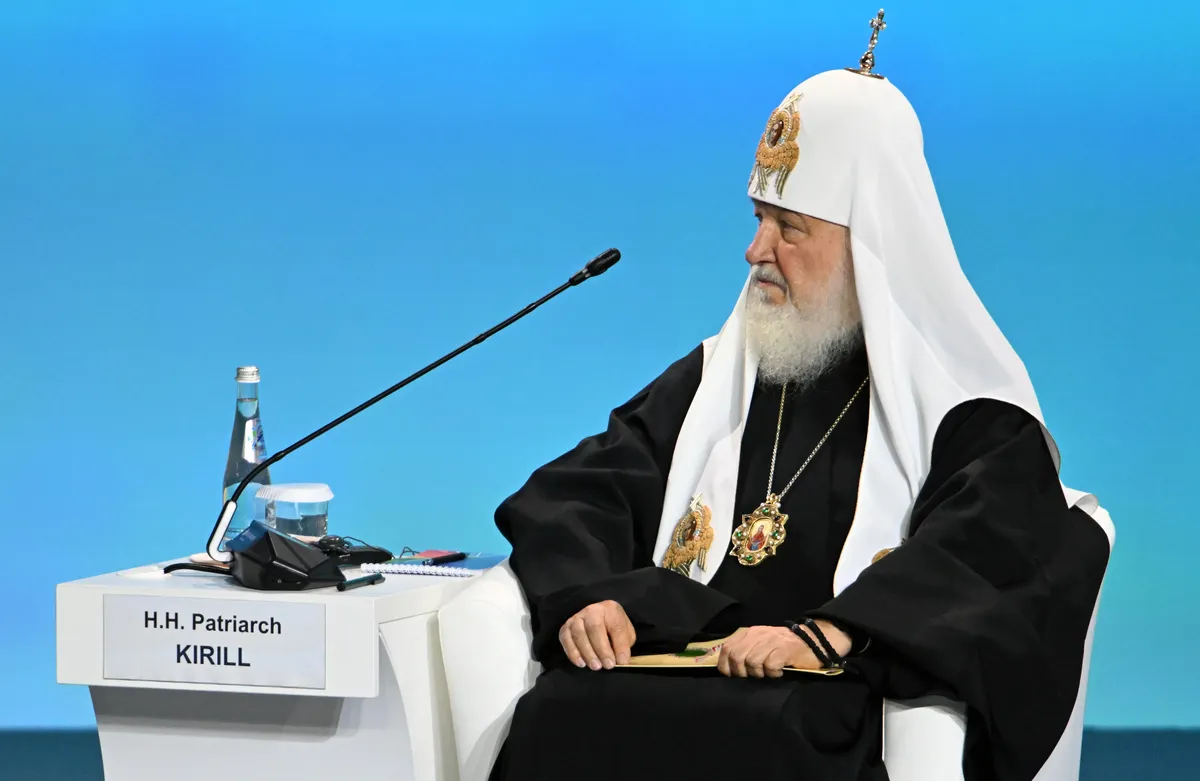
Materials are distributed between members of the commission, which are required to prepare reports on them for the next meeting. Consensus the commission makes motivated decisions about who is worthy of canonization and who is not, and sends them to the patriarch and the synod. Depending on the "category" of the saints, either the Synod or the Bishop Cathedral can finally canonize them. In the framework of his struggle with the remnants of church democracy, Patriarch Kirill deprived the right to canonize the highest representative body of the Russian Orthodox Church - the Local Council, which has not been gathered since 2009.
Patriarch Cyril believes that he himself has certain power over the saints, without any synods and cathedrals. Perhaps such an opinion inspired him with his own title - "Holy".
By ordinary protocol decree, the Patriarch "determines the saint NN to be the patron saint of troops NN." For example:
“In connection with the 75th anniversary of the Victory in the Great Patriotic War,” Cyril appointed the patron saint of the troops of the chemical, bacteriological and radiation protection of St. Andrei Bogolyubsky (XII century);
St. Alexander Nevsky was appointed patron of the marine corps;
Rev. Joseph Volotsky-troops of material and technical support;
martyr Theodore Stratilat - the Federal Bailiff Service;
Optina elders - GRU special forces;
St. the great martyr Barbara - strategic missile forces;
St. Prophet Elijah - Airborne Forces.
In the last two cases, the dates of industry holidays coincided with the days of memory of the corresponding saints.
Even in the patriarchate of Alexy II, Kirill pushed the canonization of Admiral Fyodor Ushakov, who had not occurred to anyone in the church in the face of the saints, after which his corpse was exhumed, divided into parts and sent to the divisions of the Russian Navy, which, of course, “St. Ushakov ”began to patronize heavenly.
Does Christ learn to prick directly in the stomach?
At the very beginning of the war, last spring, Sergey Shoigu turned to Bishop Pankrati with an appeal to urgently canonize Suvorov - after all, without prayers of the Russian Orthodox Church, Kiev or at least Kharkov could not take the ROC. The fact that Suvorov was still not canonized after a year and a half, speaks of the lack of enthusiasm on this issue even by the hierarchs. When Suvorov’s candidacy nominated the “Orthodox oligarch” Konstantin Malofeev in 2020, the Patriarchate of Savva (Tutunov) sorted to him: “One of the problems in the field of canonization is mythologization, when the heroization of a worthy person replaces the glorification in the saints ... genuine miracles are no longer reasoning people about a person, but God's testimony of him. With the hope, of course, that the fixed miracles are not from the series “Have you had cases? So they will "."
But “Svo” forced Bishop Savva to seriously rethink his religious ideas, and now he is a supporter of the canonization as a manifestation of “concern for Russian military personnel”. If you understand the meaning of the veneration of the saints, then the church institution should not be religious, it is purely agitprop, such as the auxiliary department in the management of the educational and political work of the RF Armed Forces. It is hardly Russian soldiers who die and losing limbs in the trenches near Donetsk or Zaporozhye, it is important to draw a portrait of Suvorov or without a halo.
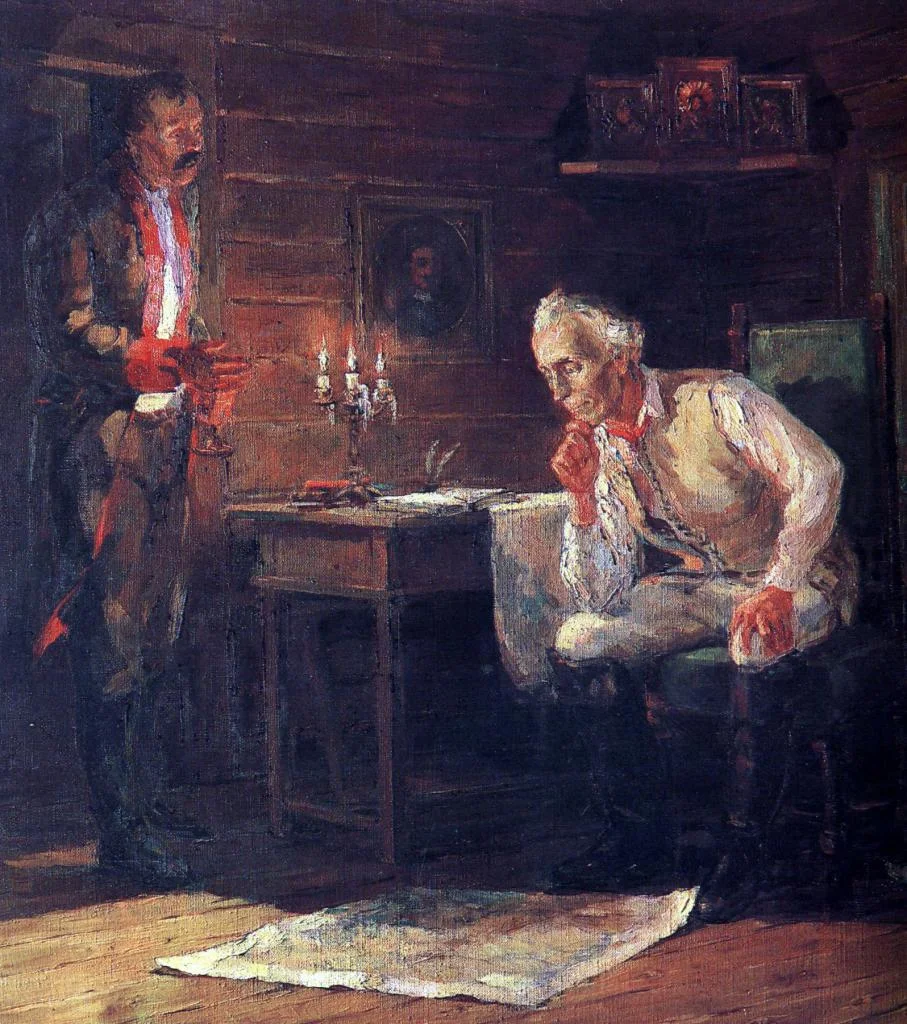
Suvorov’s literary heritage, which in the event of his canonization will become the “sacred tradition of the Church” (according to the Russian Orthodox Church), is represented by the famous book “The Science of Win”, which everyone knows, but no one read. The disgraced Moscow theologian Andrei Kuraev took on the work to make a squeeze from the "teachings" of the future saint. Here are the commandments that are replacing the gospel:
“The offensive is rage, horror. Determine the word "retirade." You must be able to beat, not scratch. ”
“Cold weapons - bayonets, sabers! To chase on the heels, exterminate to the last person. There is only blood! The enemy must be chopped directly in the stomach, and if which is not pinned with a bayonet, then his butt. ”
“Dying for ... Mother (Empress), for the most likely house (Romanovs)!”
Well, or a fragment from the "Life" written by the "saints" himself: "chopped everywhere. There were few prisoners, did not give mercy, and although there are several hundred of them, but most of the mortally wounded. ” This is actually a new religion, in which only elements of external ritualism remained from Christianity. Kuraev recalls: “A saint is when“ I don’t live, but Christ lives in me ”<Gal., 2:20>. If the words of the saint can be inserted into the Nagoric sermon of Christ, it means that this is he and this is his disciple. We try: “The Lord is the speech to His disciples: the enemy must be stabbed directly in the stomach, and if that with a bayonet he is not pinned, he is a butt of him.”
In the interval between the capture of Ishmael and the crossing through the Alps in 1794, the future “holy” brutally suppressed the uprising of Kostyushko, organized by the Polish gentry, disagreeing with the Russian occupation. Obviously, the Kremlin directorial historians see a direct parallel between this “victory” by Suvorov and their plans in Ukraine. By the way, the notorious “meat marches” undertaken during the current war also have their own parallel in Suvorov’s “Life” - this is the legendary “transition through the Alps”, where a third of the Russian army died and all artillery was lost.
Who is in line and when will we see a fresco with Putin?
Admiral Ushakov, Generalissimo Suvorov ... If we are talking about the revival of the Late Soviet Pantheon of Heroes under the Sample of the Church month, then General Peter Bagration, the brightest prince Mikhail Kutuzov, Admiral Pavel Nakhimov and, finally, Marshal, Georgy Zhukov, find herself in line for canonization. Indeed, in their honor, as in honor of Ushakov and Suvorov, streets, cities and educational institutions were called in the USSR. If the religion of Patriarch Kirill and Vladimir Putin is inseparable from nostalgia for the USSR, then it would be strange to stop at Suvorov.
Such a blind sacralization of Russian history (without any analysis-imperial or Soviet) inevitably leads tothe celebration of “Orthodox Stalinism”-a church-political myth of direct divine intervention in the Second World War through the “God-given leader” by Joseph Stalin. That is what the Russian Orthodox Church called him in her official documents of the 1940s-early 1950s.
While the church cult of Stalin is somewhat hidden, esoteric in nature - the leader’s icons are sold in church shops only “under the cover” of the blessed old man of Matrona, which the dictator allegedly visited in 1941. But the excuses of his atrocities sound from church amvons with might and main, and the ominous statues of the mustachioed monster are “consecrated” by the clergy of the Russian Orthodox Church. The special church status of Stalin gives the completeness of the entire design of the “civilian religion of the totalitarian type”, which is built by Patriarch Kirill and his team on the ruins of historical Russian Orthodoxy, bloodless and driven underground during the repressions of the 1920-1930s.
The priest John Burdin, persecuted for his anti -war position, is bitterly noted that his “Patriarch is ready to canonize any military leader who crossed himself at least once in his life. Do not remember who the cinema was shot about there in Soviet times? This is a list of future saints! ”