
Translated material
"I cried, thanks to Mitsky, you are my mother <3"
One of the main records of autumn is “The Land is Inhospitable and Sore We” Mitski. Leo Gankin tells how the fans saw in the singer not only the inspirer
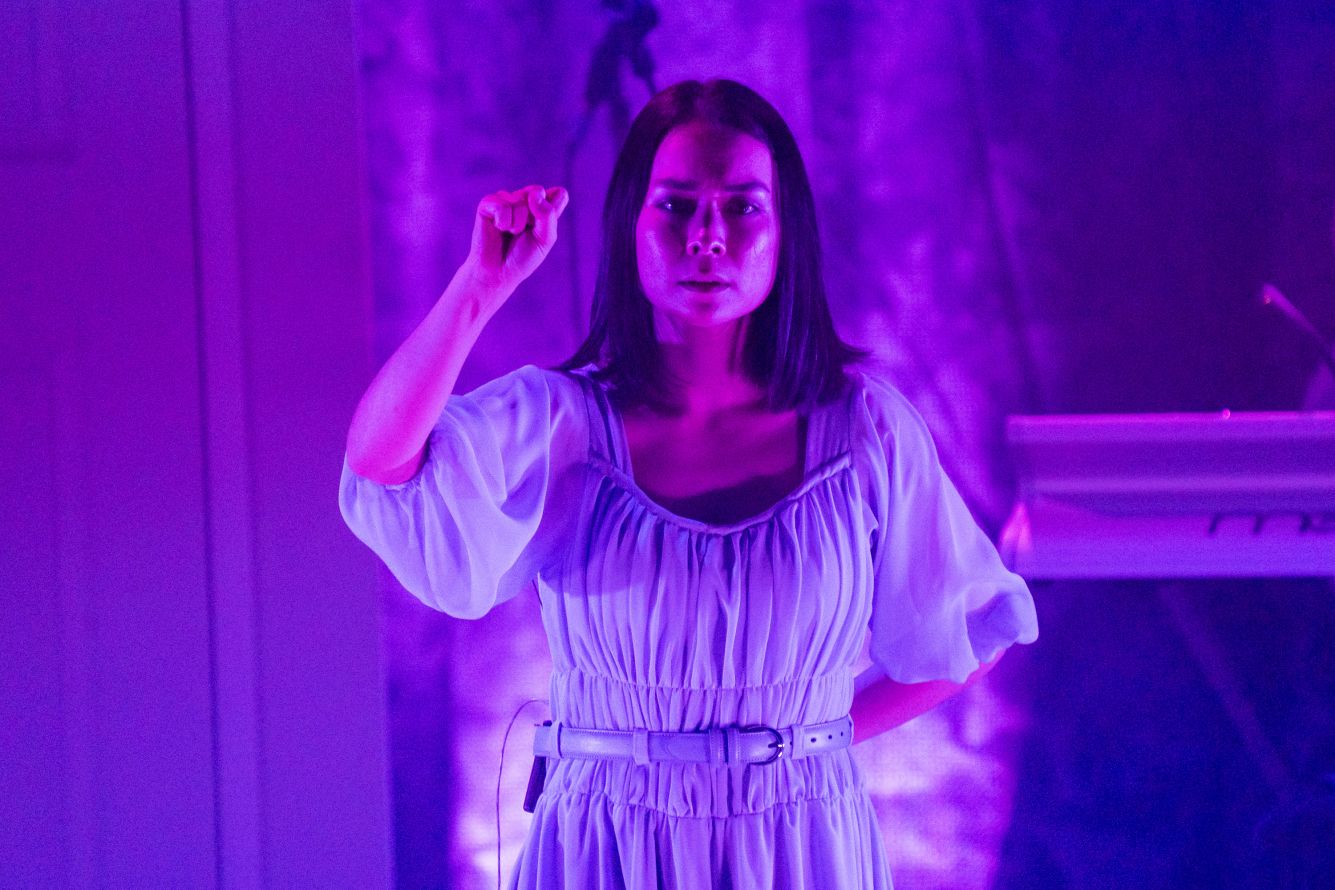
Miyavaki, a Japanese-American singer, who is adored both by critics and Tiktok users-on September 15 released her seventh album “The Land Is Inhospitable and Sore We”. On the one hand, he completely does not look like her previous work “Laurel Hell” - there is almost no synthesizer sound here. On the other hand, it accurately guesses the handwriting of the author, openly telling the audience about homelessness, abandonment and the desire to hide from this (sometimes at the bottom of a glass). Musical critic Lev Gankin talks about the new work of the singer, whom the listeners call the "mother."
Mitski enters the dark hall and sees a chair in front of him. After a couple of moments, it turns out that it is not alone here - the space resembles an abandoned furniture factory through which a hurricane swept. Around - dozens of chairs of various shapes and styles: straight and unpretentious, with elegantly rounded backs, on wolted legs, with tough seats and with soft, whole and broken, standing stands and overturned to one side. Mitska approaches the chairs and begins to pour them on top of each other. When a tall tower grows from them, she, refuting all the laws of physics, climbs to the top and peers from there into the distance. The last frame of the clip for the song “My Love Mine All Mine” , in which the described scene unfolds is a blurry, defocated palette of bright color spots. They guess a certain landscape, obviously colorful contrasted by the stingy, poorly illuminated interior of the hall with chairs - but what specifically Mitski saw from the top, we are unknown to us.
“My Love Mine All Mine” is an excerpt from the fresh, seventh album of the singer, “The Land Is Inhospitable and Sore We” (“Earth is inextricable, and we, too”). In it, Mitski is largely true to himself - at least does not depart from his eternal habit of not talking, leaving a lot behind the scenes (although about the recording of the singer on furniture items, one could write a separate article: the main character of her concerts in 2019, one of which I personally observed, was the dining table standing in the center of the stage, around which she arranged an exciting choreographic performance).
Like all her other notes, the new plate lasts a plus or minus for half an hour-the songs come to naught, it would seem, only starting a run; The shortest, “When Memories Snow” , barely an hour and a half. Toratically, this, apparently, is a breakup album-an echo of parting sounds in almost every composition: in “I Donʼt Like My Mind”, a lyrical heroine eats a Christmas pie intended for two, in “Hhen Memories Snow” tries to clear his world from the likely snowy memories, in “Iʼm Your. Man ” reflects on death and only in the final “ I love me after you ” seems to be reconciled with a new status. True, Mitska never revealed the details of his personal life-again, it remains only to guess what kind of relationship the next block of her compositions is dedicated.
The music itself corresponds to the introverted nature of Mitska: the song “Bug Like Angel” opens the plate in a dead loop of four major chords - and this is not at all a life -affirming major, but, on the contrary, a painful, reduced by an endless repetition to a monotonous, instructive background. It is probably here that this solution is additionally related to the immediate theme of the composition: “Bug Like Angel” is devoted to alcohol dependence and the hopeless square of the chords is a metaphor for a destructive habit, which is so difficult to get rid of.
However, the situation still does not look hopeless: the encouraging gospel-chor invades a grunge guitar battle without warning. And the bug, which stuck to the bottom of the glass (this is only one of many insects inhabiting the space of the album - later we will meet mosquitoes, crickets, cicadas and not only), in the title of the track is compared with the angel. When the drunkard, having lifted his head, overturn the last drops of the drink into her throat, the flattened dead insect against the backdrop of the sky begins to resemble an angel, the singer believes, again demonstrating her ability to see beauty in the most unlikely places and situations.
Apparently, it is this ability, among other things, attracts to the songs of Mitski numerous fans. From the side, the singer’s wide popularity, which The Guardian recognized a year ago, recognized the best young artist of the United States a year ago, at first it seems inexplicable: in the end, there are not even refinements in her songs! Their winding melodies develop according to their own laws, ignoring generally accepted craft rules. On the stage-at least, judging by the successful tour of 2019-Mitski is not too smiling and not too sociable: that musical and plastic performance with the table was inspired by the Japanese dance of Buto, with his slow shifts of poses and expressive facial expressions. The singer said that she felt awkward, trying to interact with the hall with traditional ways - therefore she tested a different, deliberately conditional, theatrical type of stage performance.
However, despite the emphasized restraint, the artist mentioned Scott Waker, Iggi Popa of the Berlin period and Arthur Russell, and the background dawn in the song “Star” from the new plate, according to her, owes a lot of the Terry-Monnoilist, in the context of the previous album “Laurel Hell ”. The non -construction nature of his notes, Mitska is a vasromelive star. Her tracks fall into the playlists of Barack Obama and in the radio broadcast of Elton John. Last year, she lit up in Oscar nominations with a song from the film “Everything is everywhere and at once”, and in this she warmed up Harry Stiles in the touring tour (I wonder if she showed him her article six years ago, which began with the words “Like all the handsome men, I preferred to look at the distance at Harry Stails” and ended with the phrase “I think that if Harry is that if Harry Stiles will ever read this text, then he will stick it ”?).
It is even more indicative that her compositions have more than two and a half million streams in Tiktok: under an excerpt from the Nobody song, service users - including famous influensers - shot short videos on how they run away from domestic problems or emerge from toxic relationships. In the specific world of this social network, the laconicism of the artist’s records, as well as the ambivalent nature of texts, allowing everyone to subtract their own content in them is exactly what is needed. Mitski discovered herself Queen Tiktok after she said goodbye to readers and left the social networks - her pages, with purely technical information about new releases and upcoming concerts, have been conducted by specially hired managers since 2019.
“I cried, thanks to the songs for the songs, you are my mother <3 <3”, ”the user or user with the nickname Chechnyann writes in the comments on the song“ My Love Mine All Mine ”in the comments on the song“ My Love Mine ”. The fans and fans of the singer really call her a mother - their love, bordering on obsession, sometimes knocks out of her rut: Mitska recalled how she cried, making her way to the exit through the crowd of fans at her own concert - everyone tired at least to touch her.
For the Zumers, the singer, according to the remark of the New York Times , he herself became "something like a meme, a vessel that [they] use to experience deep feelings or talk about deep feelings." “I am like a black hole into which people discard everything that they do not want to face their own lives: thirsty for love, anger, hatred,” Mitska said in a rare big interview in the anticipation of the release of the previous Laurel Hell album. All this seems to not rhyme with the strict image of the artist and the sound of her songs, deprived of an hint of emo-exaltation.
But perhaps the rhyme is simply worth looking for the wrong one. Mitski was born in a small town in the prefecture of MIE in the southeast of Japan and from an early age collided with bullying, as she was an American father and looked different than neighboring children. We know not so many details of her biography (sometimes this leads to the appearance of conspiracy theories-one of them claims that Mitsk's father was an agent of the CIA), but we know for certain that in his youth she constantly moved after his parents: for some time she lived in Turkey, some in Malaysia, she went to schools everywhere, but for obvious reasons, she did not fully develop strong Emotional ties with classmates.
Having settled in the USA, she thought that she had gained the house, but this land was inhospitable: Mitski here also very soon felt a stranger-now, on the contrary, because of the Asian appearance and the corresponding section of the eyes. The wandering harmony of her songs is as if a consequence of this particular existential loneliness, consonant with many of those who grew up in the global world, dotted with fiber lines, those whose address were not the house and not the street, but the virtual space. On the other hand, it also seems to be a cool melancholy inherent in her music: like a dancer Buto, the singer rewrites bitterness and the pain is not a scream, but a quiet, but symbolically saturated plastic sketch.
Mitski today in itself, she is suspicious of attempts to hang labels on her-to proclaim her, for example, by an activist of the struggle for the representation of women in the patriarchal world of Indie rock or an example to follow Americans of Asian origin. But the advantage that pursuing her also has the advantages: stylistically, in sound terms, it turns out to be somewhat liberating. The previous two albums of the singer, “Be the Cowboy” and “Laurel Hell”, gravitors to the electropop, in “The Land is Inhospitable and sore We” can hardly hear, and the sound palette shifts towards country music and nothing: all three plastics unemployed without a sophisticated They are identified as the work of one performer.
The choir mentioned above in the Bug Like Angel is only one of the many convincing appeals contained by the American tradition. Others-slide guitar, sprawling orchestrations, rustling brush on a small drum; Sometimes it’s hard to get rid of the feeling that we have Nancy Sinatra reincarnation before us. However, it was reincarnation, not the original: Nancy in the 1960s, of course, did not have access to the buzzing shoheaz guitars sounding in the songs “Buffalo Replaced” or “I Love Me After You” (although the Sinatra’s repertoire was reinforced, including in the similar sound-as in the similar sound-as well as Classics of Shugais, British SlowDive, in the cover version of her hit with Lee Hazlwood "Some Velvet Morning" ).
This remarkable stylistic flexibility is also a sign of time, also hello to a generation, which has a harmoniously adjacent record of different eras and sounds in playlists. Mitski can complain about his own fans as much as possible, about their excessively exalted expressions of feelings, that they see not a living person in it, but only a set of their own projections, even for the fact that they take concerts for a smartphone, instead of exchanging energy in real time (this complaint, a whole wave of disputes and discussions on a twitter one and a half years ago). Sometimes she can even threaten the early end of her career-from 2019 to the 2022th singer did not appear on stage. But despite this, she definitely spoke and continues to speak with her audience - including adolescents who call her mother - in the same language.
Lev Gankin