
Translated material
Orthodoxy, autocracy, anti -Semitism. How the authorities of the Russian Empire encouraged and justified Jewish pogroms
Orthodoxy, autocracy, anti -Semitism. How the authorities of the Russian Empire encouraged and justified Jewish pogroms
The Insider 11 Novmber 2023 “Pogrom” is one of the few words that European languages borrowed from Russian. In Russia itself, in recent decades, it would seem to have gone out of everyday life and was used only in connection with the past - but the events at the Makhachkala airport again made it relevant. Country and the Russian Empire existed at all times, and the history of Jewish pogroms has many bloody chapters. Almost always, official authorities were inactive, and in some cases even encouraged the pogroms to robberia and massacre.
Content
Ivan the Terrible, Peter I and Elizabeth
A wave of pogroms under Alexander III
Chisinau pogrom 1903
A wave of pogroms of 1905. Odessa pogrom
The triumph of injustice
Ivan the Terrible, Peter I and Elizabeth
Also, Ivan the Terrible refused to let the Jewish merchants into Moscow under the pretext that "dashing affairs, as our people and Christianity, were taken away from poisonous potions to our state." Tsar Alexei Mikhailovich drove Jews from cities under his leadership: “But there is no life in Mogilev and there is no life”, “Send out of Vilna to be sent to live outside the city.”
Peter I treated the Jews relatively loyally (once in 1708 in Mstislavl, he even personally stopped the pogrom, begun by his soldiers, and ordered to hang up 13 pogroms), but already under his widow the Supreme Privy Council issued a decree on the expulsion of Jews from the country of Jews: “The Jews of both the male and the female Paul <...> to send everyone out of the binding of Russia. From now on, they can’t let them into any images to Russia and to warn all places firmly. ” Elizaveta Petrovna adhered to a similar position.
However, until the second half of the 18th century, the problem of anti -Semitism in the country was not acute: simply because there were very few Jews. Everything changed after the division of the Commonwealth, when a huge number of Polish Jews suddenly turned out to be under Russian jurisdiction. They could no longer simply be “not allowed” into the country - they were its citizens. I had to urgently invent something, and the Russian authorities came up with a “line of constant Jewish settled”: the range, outside of which Jews (with the exception of “crosses” and some more categories, which changed at different times) was forbidden to live and work. The Pale of Settlement lasted from 1791 to 1917, although its borders changed - often along with the borders of the empire.
True, he owns the phrase: "I prefer to see Mohammedan and Gentiles in my country than Jews."
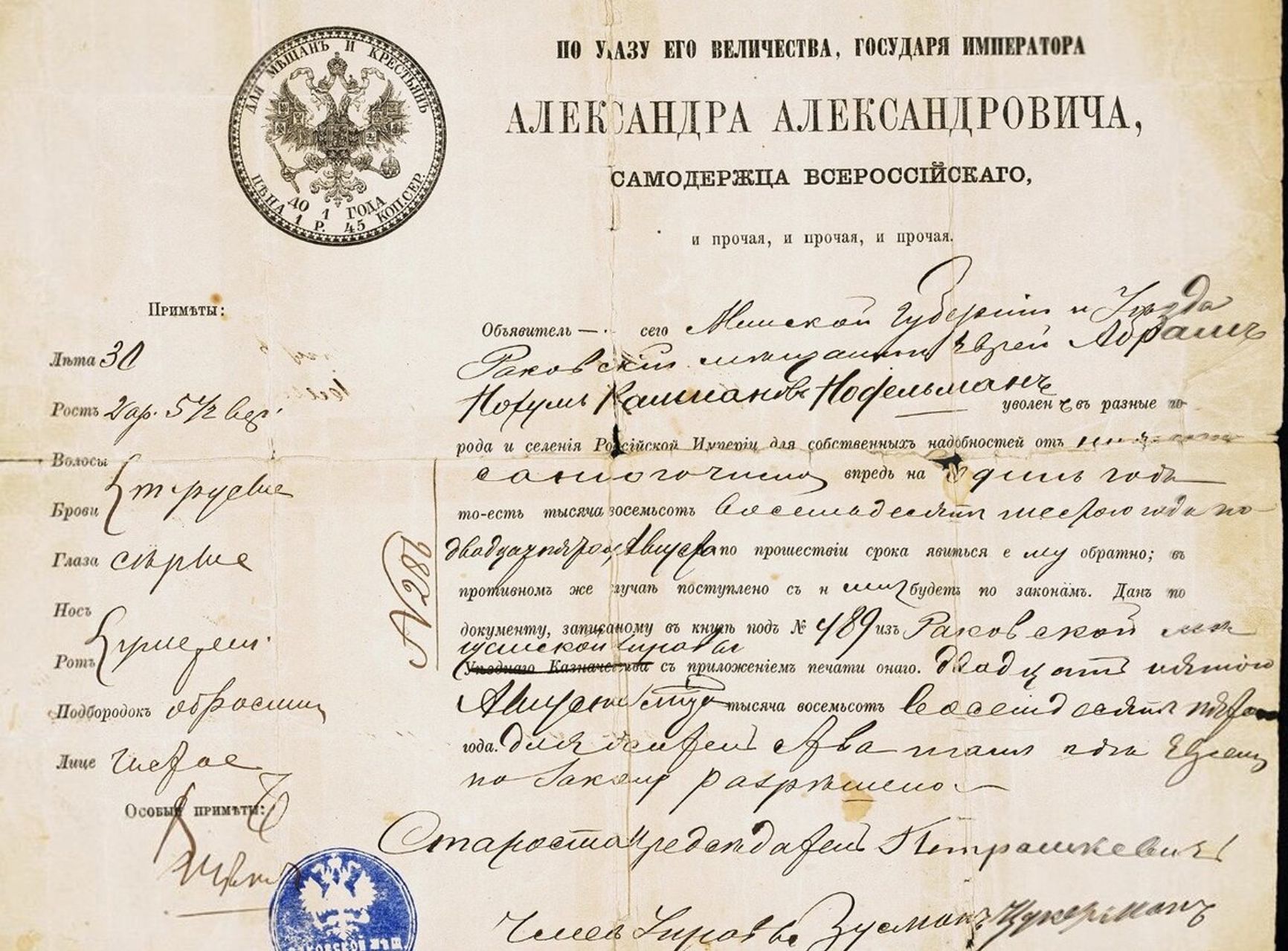
A temporary pass to the Jew to travel for the line of seduction to other areas of Russia for family affairs. The end of the XIX century
By 1825, the Russian Empire was in a completely new situation for itself: 1.6 million Jews now lived in it. As the demograph Pavel Polyan writes , it was almost half of world Jewry.
True, he owns the phrase: "I prefer to see Mohammedan and Gentiles in my country than Jews."
By 1825, 1.6 million Jews lived in the Russian Empire - almost half of world Jewry
Around the same time, in 1821, the first large Jewish pogrom - Odessa in the empire occurred . The initiators were the Odessa Greeks: they, who controlled bread trade in the region, did not like the increased role of Jewish merchants. A formal occasion was the murder of Greek Patriarch Gregory: the Turks brutally killed him in Constantinople, but the Greeks dismissed the rumors in Odessa that the Jews were to blame. The body of the patriarch was brought to Odessa, and on the day of the funeral, Jewish pogroms began at the same time in three parts of the city - but the non -Jewish population did not support them then. The instigators did not find the pogrom.
Another large pogrom occurred in Odessa in 1859; The organizers and participants were again the Greeks. The local authorities sent the police to suppress the pogrom, but, not wanting to quarrel with an influential Greek diaspora, tried to imagine what was happening as an ordinary fight.
The next Odessa pogrom, 1871, lasted three days; 863 houses and 552 shops were injured. This pogrom was already different from the previous ones: although the Greeks began it again, this time representatives of other nationalities joined them. The reaction of the authorities, which covered their eyes and reacted only to the fourth, is noteworthy for three days. “The local administration and society, gloating, admired the picture of destruction and encouraged rapists to robbing,” wrote historian Julius Hessen.
And yet it was only a background. In full force, the pogroms unfolded since 1881.
A wave of pogroms under Alexander III
Almost all Romanovs suffered to more or less anti -Semitism to a greater or lesser extent. Even the enlightened Alexander II, in which some liberalization of the position of the Jews occurred, could easily say something like: “The people are generally courteous, but is untidy to the extreme and similar to the Jews,” is about the Italians. But Alexander III did not even try to hide his anti -Semitism - not brilliantly educated, he sincerely believed in a bloody backlight and was a newcomer even in everyday life. Sergei Witte recalled how the emperor refused to give out loans to the Jewish bankers, because “in general, he does not see why to give out various loans to the Jews,” and sometimes he did not agree to cooperate with the Jews even to the detriment of his own interests.
True, he owns the phrase: "I prefer to see Mohammedan and Gentiles in my country than Jews."
Alexander III was a newcomer even in everyday life
This immediately affected politics: Alexander III not only canceled all the relief adopted by his father, but also tightened anti -Jewish laws as much as possible. “Temporary rules” , which forbade Jews to settle in rural areas, acquire real estate, rent lands outside the places and cities and trade on Sundays, not only deprived many Jewish families to livelihood, but also, according to the remark of the publicist Semyon Dubnov, opened the way to legal pogroms. And it was only a small part of the anti-Jewish laws adopted under Alexander III: the policy of the “peaceman king” was undead anti-Semitic. All this could not but affect public moods. No, the government most likely did not initiate pogroms, it simply made it clear by all its might: it can!
It is the feeling that the authorities, if they are not directly called for the pogroms, then at least silently encourage them, in many ways the cause of the pogroms of 1881–1884 became the cause of the wave of pogroms. The occasion for them was the murder of Alexander II: shortly after the attack, articles began to be released in many newspapers, one way or another accusing Jews of this murder.
The accusations were absurd: there was only one Jewess among the detained people - Gesia Gelfman - and she was not a conspiracy leader at all, but this did not interfere with the anti -Semitic press (they were indignant, in particular, by the fact that the pregnant Gelfman delayed the execution until the birth of the child). Some newspapers directly wrote about the upcoming performances against Jews on the eve of Easter. Given the level of censorship during the time of Alexander III, such attacks simply could not go into a seal without the silent approval of the censors - read, state power. And the audience of newspapers read this: printed - it means approved.
A wave of pogroms began on April 15 in Elisavetgrad (now-Kropyvnytsky)-with a small skirmish between Shinkar and a visitor because of a broken glass. A fight began in Shink; Soon the riots spread to the street. “The crowd with a whistle and scream rushed in pursuit of running Jews, breaking the glass along the way in the Jewish shops”; “Breaking the shops, throwing things and goods into the street and generally destroying all Jewish property that came to the arm,” eyewitnesses recalled .
The patrols tried to intervene, but rather sluggishly : firstly, there were no instructions from above, and secondly, due to "the accumulation of the mass of spectators from among educated and wealthy classes-ladies, women with infants and young children, against whom the officers were not dared to use power." The next day, the riots resumed with a vengeance: the shops were smashed, the Jews were beaten, the police and junkers tried to stop the pogroms, but could no longer cope. Only when regular troops entered the city, the pogroms in Elisavetgrad managed to stop. But late: the wave of pogroms was rapidly spreading through the surroundings. In total, the pogroms took place in more than one and a half hundred settlements.
Common to all these pogroms was that the participants were completely convinced: to smash. He stubbornly circulated the rumor that there was even a royal decree that the Jews are smashed; And the fact that this decree has not been published anywhere is the Jews prevented. And the pogroms themselves were not quite spontaneous: in almost every village where they flashed, provocateurs appeared the day before.
They convinced that “in other places of the Jews they beat, and this remains unpunished” that “the emperor does not like the Emperor of Jews” and the order to “shoot the Russian people” would not give the soldiers to the soldiers, that they “personally heard the police officer read the order of the sovereign, allowing the Jews, since the Russian people have no life,“ the emperor, leaving strangers, leaving for strangers, leaving for strangers. The edges ordered him to beat all Jews until his return. ” Listers were pasted everywhere, The anonymous authors of which not only called for “eradicating the hated Jewish tribe”, but also prudently indicated the dates of the upcoming pogroms.
True, he owns the phrase: "I prefer to see Mohammedan and Gentiles in my country than Jews."
Leaflets not only called for “eradicating the hated Jewish tribe”, but also prudently indicated the dates of the upcoming pogroms
There are different opinions about how planned the pogroms. The note submitted to the government by Baron Ginzburg indicated that most of the pogroms occurred in points along the railway, and they all took place one scenario: at first a rumor was launched that on such and such a pogrom; Then, on this day, the “gang of rags” came by rail, and, under the leadership of the instigators (who had lists with addresses of Jewish apartments and shops in advance), began a pogrom. The crowd necessarily attended agitators who read articles from the anti -Semitic press and assured that these were decrees that allowed the Jews.
The same note said that the authorities silently sympathized with the pogromers: despite the pre -well -known dates of pogroms, they never took preventive measures. This was sometimes confirmed by the representatives of the authorities themselves. Thus, General V. Novitsky, the direct witness of the Kiev pogrom of 1881, wrote that “Jews, of course, were obliged by this pogrom, the Kiev Governor-General Adjutant General A.R. Drentel, who, to the core, hated Jews, gave complete freedom of action for the unbridled crowds of “hooligans” and the Dnieper “tramps”, which smashed Jewish property, shops and shops, bazaars, even in his eyes and in the presence of troops, in the cash in the casualness of the riots to stop. The troops became only blind spectators of all the outrages, atrocities and robberies of Jewish property, were so demoralized that they even robbed Jewish property in the bazaars, an eyewitness to what I was. ”
True, he owns the phrase: "I prefer to see Mohammedan and Gentiles in my country than Jews."
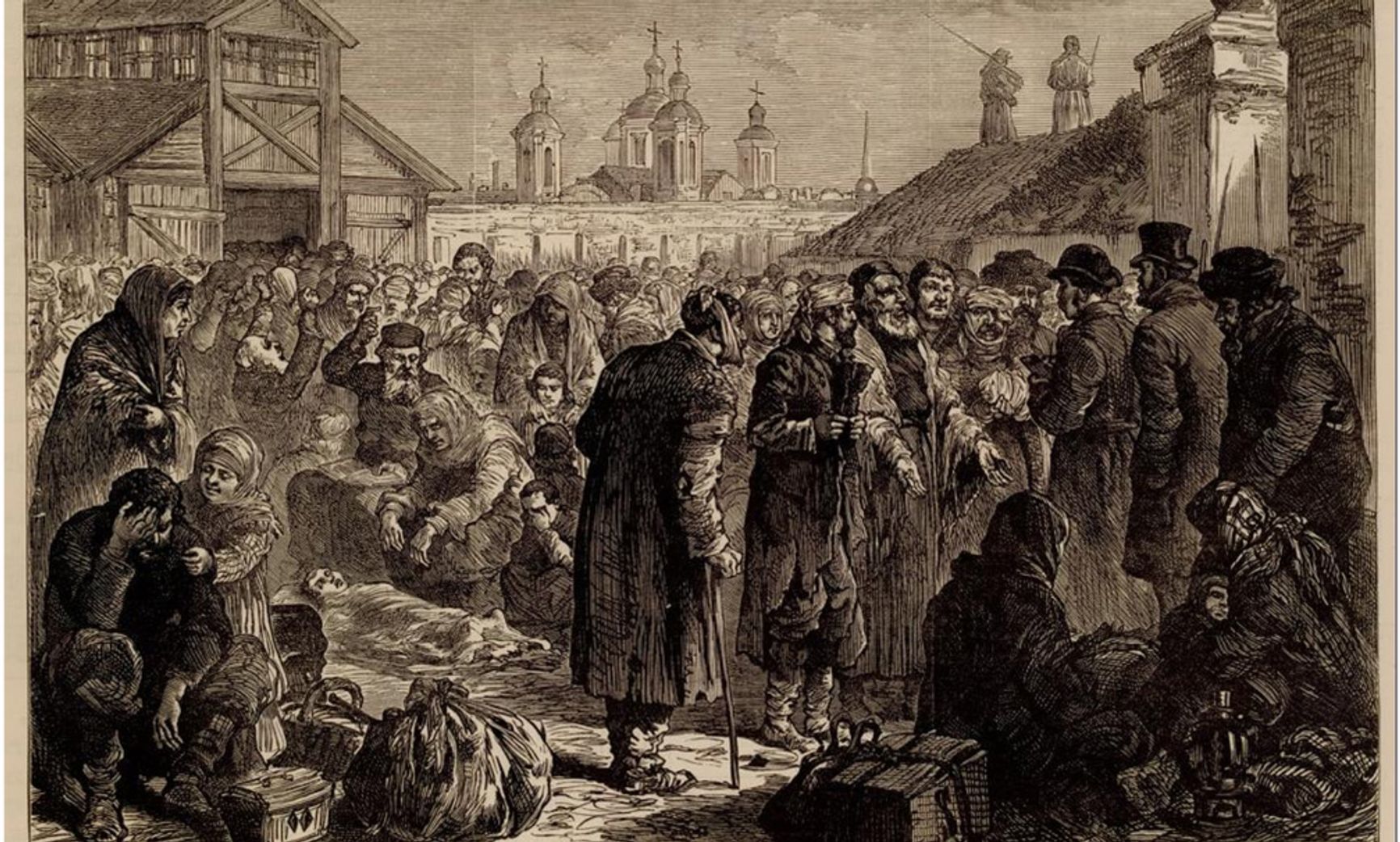
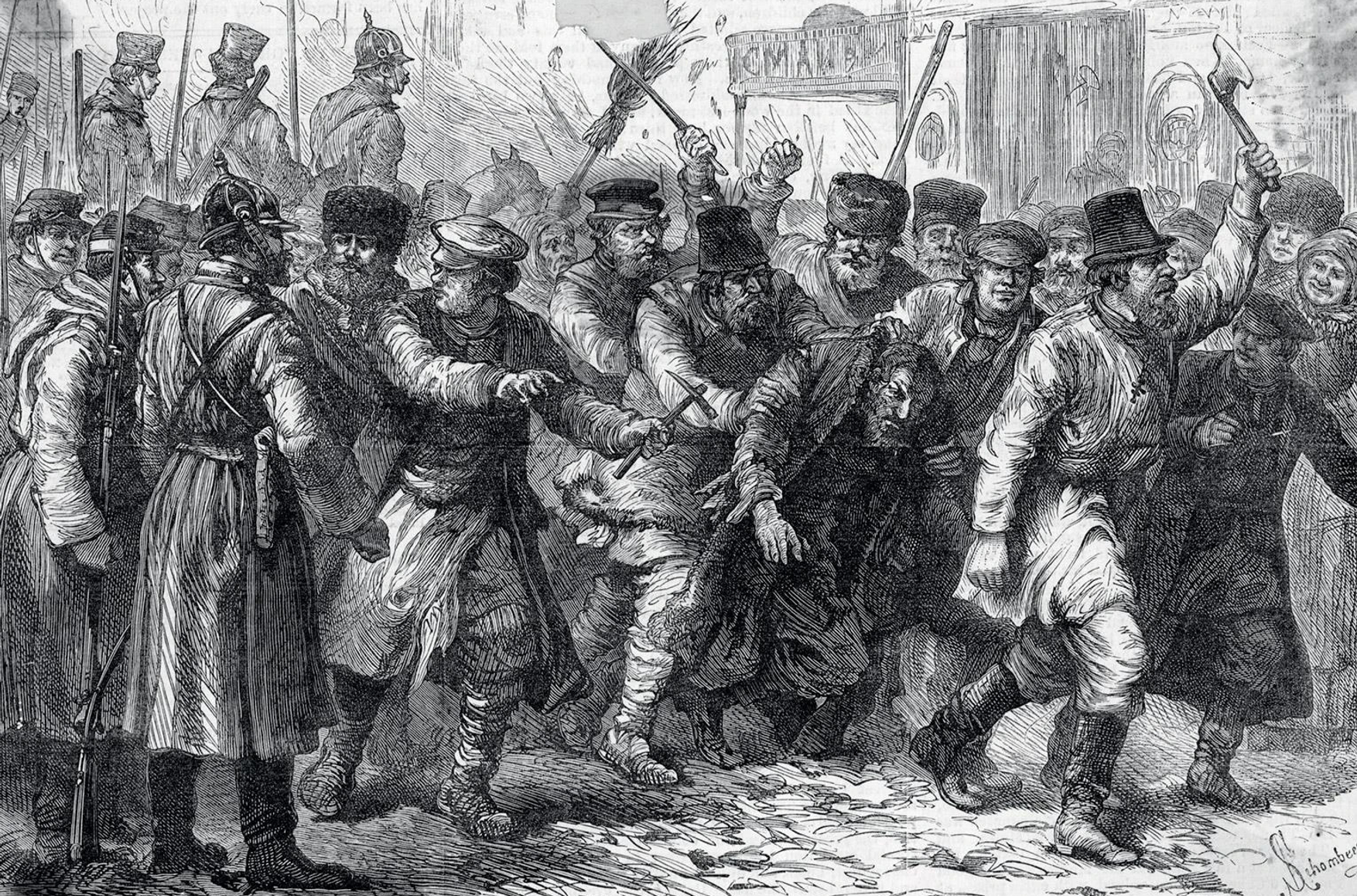
Pogroms of the 1880s
engraving, author Johann Schonberg
The same inaction, bordering on complicity, occurred during a pogrom in Balta in March 1882. This pogrom turned out to be one of the most cruel: 211 people were injured, 12 - killed, at least 20 cases of rape were noted, 976 houses and 278 shops were looted.
“Their (authorities) actions freely or involuntarily contributed to the growth of unrest,” writes historian Arkady Zelzer. - So, already on the first day of the pogrom, the troops did not let the Jews through the bridge on the Turkish side, which allowed the robbers to defeat the property of the Jews there; The authorities freed the crowds of 24 Christians arrested on the first day, while the detained Jews were arrested until arrival in the city of the governor. <...> The troops to some extent tried to restrain the riots; The local battalion, patrolling the city, cordoned off the crowd and kept it for almost an hour, <...> However, with the advent of the police chief, the military boss and the police officer, the chain opened, and the mob, accompanied by the peasants who arrived from the villages, attacked the alcohol warehouse, drunk and began to destroy and break everything in its path. <...> The police chief disappeared somewhere, and no one saw him all the time. The police and soldiers greatly contributed to the hooligans. The military chief Karpukhin patrolled throughout the day in the city, accompanied by soldiers, who, however, did not counteract the pogrom. ”
And during the subsequent “analysis of flights”, the Baltic authorities tried to convince the higher authorities that the riots organized ... of course, the Jews themselves.
Other representatives of the authorities, albeit not so literally, also blamed the Jews themselves in the pogroms: they brought, they say, the people. Among the most common explanations are the “economic dominance” of Jews, the “soldering” by them of Russian people, the “wrecking” commercial activity. Even the closeness and cohesion of Jewish communities (for the preservation of which the trait of sedentary and other anti -Semitic laws made a lot) were confused by them.
This wave of pogroms ceased in 1884, but caused the first major wave of emigration of Jews from the Russian Empire: about 2 million Jews left Russia in those years. The first Aliya was largely provoked by pogroms.
Chisinau pogrom 1903
With the advent of Nicholas II, the pogroms resumed. In the 1890s they flashed here and there. But truly bloody events unfolded already in the 20th century: on April 6–7, 1903 in Chisinau.
This pogrom turned out to be all the more shocking that Bessarabia at that time was considered an oasis of calm. But, unfortunately, the atmosphere in the country of pogroms favored the most favorable.
Firstly, the post of Minister of Internal Affairs and chief of the gendarmes in these years was occupied by Vyacheslav von Pleve-an undisguised anti-Semite. Many witnesses of events directly called him one of the main culprits and organizers of the Chisinau pogrom (Count Witte, including Count Witte). Almost no one has almost no doubt about the fact that he was the organizer today, but the fact that Pleve at least approved the pogroms. Former Minister of War Nicholas II, General Kuropatkin, wrote in his diary after a conversation with Pleve: "Like the sovereign, I heard from him that Jews should have learned that they were arrogant and in the revolutionary movement were going ahead."
An important reservation - "like from the sovereign." Nicholas II in anti -Semitism was not inferior to his father - and even exceeded him. Apparently, he sincerely believed in the “Protocols of the Zion sages”, he openly sympathized with the “Union of the Russian People”, which bloomed under its wing, and subsequently eagerly satisfied the petitions of pardoning pogrom. All this gave the latter confidence not just in impunity - but in the approval of the authorities.
True, he owns the phrase: "I prefer to see Mohammedan and Gentiles in my country than Jews."
Nicholas II sincerely believed in the "Protocols of the Zion sages" and openly sympathized with the "Union of the Russian People"
The newspaper Bessarabets began to prepare the soil for the Chisinau pogrom (it was published by the famous Black Highlight Pavel Krushevan - the one that in the same 1903 first published the Protocols of the Zion sages ). The day before the household murder of a 14-year-old teenager Mikhail Rybachenko (as the investigation soon found out, he was killed by a relative due to the inheritance) the newspaper turned into a brutal ritual murder. Day after day, journalists savored bloody details of torture (supposedly the killers sewed their eyes, ears and mouth) and explained that the Jews released blood to the child to prepare Matsu out of it. At the same time, the Jews recalled all the other “sins”.
The date of the upcoming pogrom was not a secret for anyone: public places were dotted with anti -Semitic leaflets, rumors bloomed around the city that the king issued a decree “beat the Jews for three days after Easter”, representatives of the Jewish community specially went to the provincial administration with a request for protection, and the Christian population prevented the crosses on their doors and exhibited in the windows and exhibited in the windows and exhibited in the windows. icons.
The pogrom began on April 6 (19) - on the first day of Orthodox Easter. At first, the pogroms simply threw stones at the windows of Jewish houses, then began to smash the benches. At first, it still did without human sacrifices - but, seeing the inaction of the authorities, the aggressors felt absolute impunity. Dr. Moses Slutsky, in those days the chief physician of the Jewish Hospital, who took the victims of the pogrom, said that the wounded and the dead arrived every minute: “I familiar with whom I often traveled, brought the seriously wounded to the hospital and left; Half an hour later they brought his corpse on his own exit. ”
«Лица убитых, — рассказывает доктор, — были до такой степени обезображены, что ближайшие родные — жены, дети покойников не сразу их узнавали: разбитые черепа, из которых вываливались мозги, размозженные лица, залитые кровью и облепленные пухом… Они часто узнавали покойников лишь по платью». Спасения от погромщиков не было нигде: они врывались в дома, избивали всех, кто попадался им на пути, отыскивали тех, кто спрятался, и догоняли тех, кто пытался бежать.
Ему же, правда, принадлежит фраза: «Я предпочитаю видеть в моей стране магометан и язычников, нежели евреев».
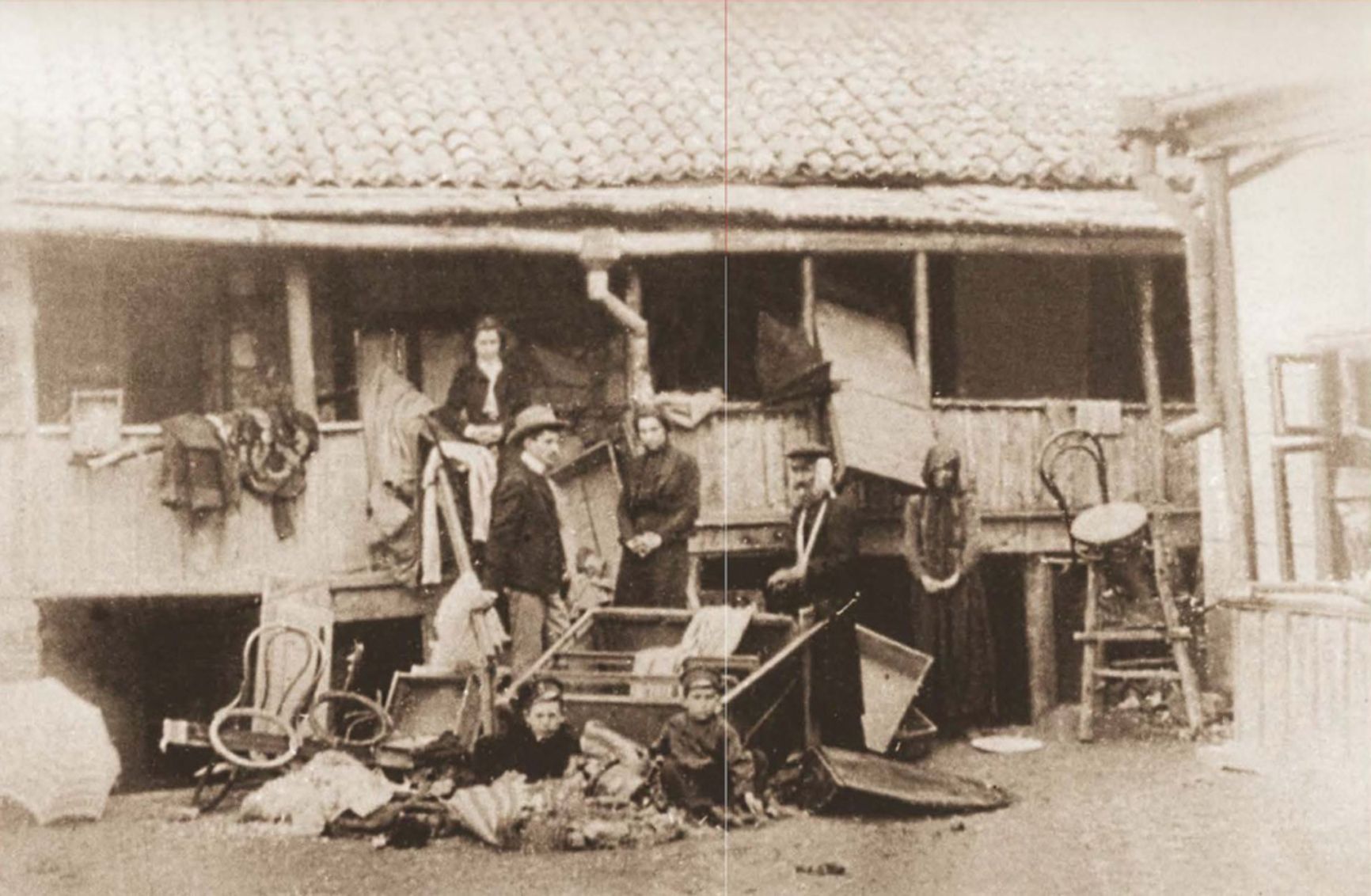
Кишинёв, после погрома
Слуцкий вспоминает, что одна семья успела спрятаться на крыше, но «громилы последовали за ними. Вскоре громилы их поймали и стали при хохоте стоявшей на земле толпы сбрасывать несчастных поодиночке с крыши» — почти все они погибли. Другая семья спряталась в сарае, но их нашли и там: сосед пырнул главу семьи ножом, а потом «громилы добили его дубинами на виду у жены и детей» (погромщики и их жертвы действительно зачастую были соседями, и до погрома между ними были вполне добрососедские, если не дружеские отношения). «Интересно, — замечает Слуцкий, — что около дома стоял на своем посту городовой и невдалеке стояли солдаты. Несмотря на отчаянные мольбы о защите, они оставались безучастными зрителями, отговариваясь тем, что не получили никакого ”приказа”». Зато, по свидетельству доктора, полиция иногда задерживала евреев, пытавшихся организовать отряды самообороны.
Только вечером второго дня местный гарнизон получил разрешение применить оружие против погромщиков. Солдатам раздали патроны. Примечательно, что они не понадобились. «В час или полтора во всём городе водворилось спокойствие. Для этого не нужно было ни кровопролития, ни выстрела. Нужна была только определенность», — писал Владимир Короленко в очерке о кишинёвском погроме.
Наконец-то были произведены аресты. И подсчитаны жертвы: 49 человек были убиты, 600 ранены, разрушено 1500 домов — более трети от всех домовладений Кишинёва. «Всюду деревья были обсыпаны пухом, как снегом. Зияли отверстия от вырванных дверей и окон. На улицах валялись обломки мебели, посуда, разорванная постель, платье, страницы из еврейских разорванных книг. <...> Разгромленные синагоги, где были разорваны и осквернены свитки Торы», — так, по воспоминаниям Слуцкого, выглядел город после погрома.
Ему же, правда, принадлежит фраза: «Я предпочитаю видеть в моей стране магометан и язычников, нежели евреев».
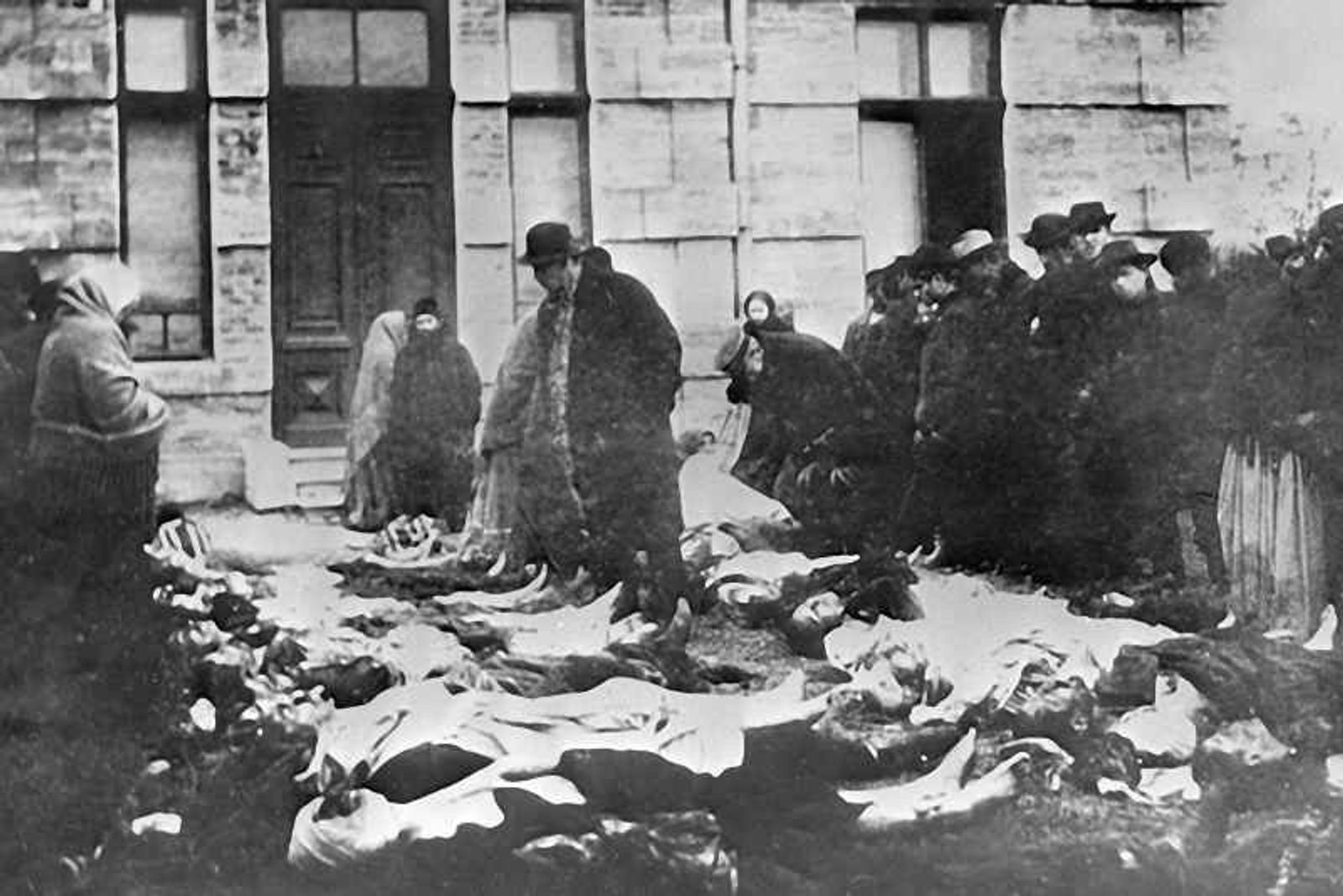
Волна погромов 1905 года. Одесский погром
В 1905 году погромы вспыхнули с новой силой. Причем власти в этот период стали, кажется, даже еще лояльнее к погромщикам. На это было сразу несколько причин. Во-первых, они считали именно евреев «подрывными элементами» (пропаганда тех лет изо всех сил стремилась поставить знак равенства между «евреем» и «революционером» — и позже это станет в каком-то смысле самосбывающимся пророчеством). Во-вторых, черносотенцы казались Николаю едва ли не главной опорой в смутные дни, поэтому он их искренне поддерживал. Да и вообще: пусть лучше недовольная беднота выместит агрессию на евреях, чем обратит ее против государства.
Погромы происходили по прежней схеме: им всегда предшествовали провокаторы, распускавшие слухи (например, о том, что какой-то еврей осквернил икону или стрелял в царский портрет). Полиция и войска зачастую бездействовали. Но к тому моменту во многих городах и местечках появились еврейские отряды самообороны — иногда им удавалось останавливать не привыкших к отпору погромщиков. Особенно если власти не мешали обороняться (но так бывало далеко не всегда).
Ему же, правда, принадлежит фраза: «Я предпочитаю видеть в моей стране магометан и язычников, нежели евреев».
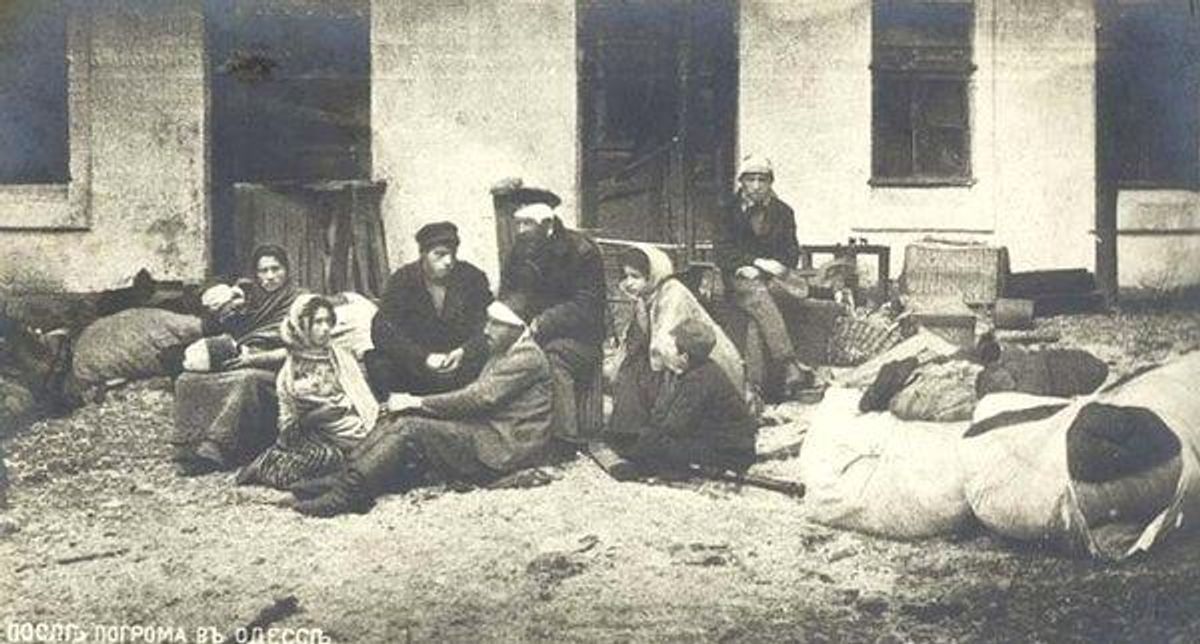
После Одесского погрома
Пик погромов пришелся на октябрь 1905 года: 690 погромов в 102 населенных пунктах, от 800 до 4000 (по оценкам разных историков) погибших. Самый кровавый произошел в Одессе 18–21 октября.
К моменту начала погрома обстановка в городе уже была нестабильной — достаточно было любой вспышки. И она случилась: возник конфликт между двумя демонстрациями, погиб ребенок, и в этом тут же обвинили евреев. В первый день отряды еврейской самообороны вполне успешно сдерживали беспорядки: они разоружили и задержали как минимум 200 погромщиков. К сожалению, тут вмешались местные власти: они вступились, но совсем не за евреев. Градоначальник Дмитрий Нейдгардт приказал убрать с улиц городовых (якобы опасаясь за их безопасность), а генерал-губернатор А. Каульбарс, согласно некоторым источникам, приказал войскам использовать для подавления еврейской самообороны все виды оружия. Погромщикам дали зеленый свет.
После этого погромы продолжались еще четыре дня — причем, по свидетельствам очевидцев, многие солдаты тоже к ним присоединились. Корреспондент газеты «Русское слово» телеграфировал из Одессы: «Беспорядки принимают грандиозные, угрожающие размеры, сопровождающиеся убийствами, поранениями, насилием, нападениями на мирных жителей и бесконечными грабежами. Громадные толпы хулиганов, усиленные жителями с окраин, отбросами, портовыми босяками, вооруженными ломами, дубинами и кольями с железными концами, двигаются по улицам группами, разрушая и грабя всё на пути».
Беспорядки перекинулись на пригороды. Евреев, которые пытались бежать, топили в море или убивали прямо в поездах. Полиция не вмешивалась; среди погромщиков с самого начала ходили слухи, что до 21 октября приказано их не трогать. И действительно: приказ войскам применить силу вышел только утром 22 октября, и беспорядки тут же прекратились.
В Одесском погроме погибло, по разным оценкам, от 500 до 1100 человек: места на кладбище не хватало, евреев хоронили в братских могилах. Еще 3000 человек были ранены. Десятки тысяч остались без крова.
Торжество несправедливости
За погромами следовали суды, но чаще всего они становились для жертв новым издевательством: «процессуальным погромом», по выражению адвокатов. С евреями обращались, как с преступниками. Присяжный поверенный и публицист Лев Куперник писал о «презумпции виновности» еврея: «Всякий человек считается порядочным, доколе противное не доказано; наоборот, всякий еврей считается подлецом, доколе противное не доказано».
Очень показателен в этом смысле судебный процесс после погрома в Гомеле в 1903 году. Там на одной скамье подсудимых с погромщиками оказались 36 евреев из отрядов самообороны. Очевидцы вспоминают, что суд был настроен предвзято и к евреям, и к их защитникам: в какой-то момент обстановка стала настолько возмутительной, что защитники евреев ушли с заседания, сложив с себя все полномочия. В итоге 23 из 36 евреев были осуждены, причем наказание им было назначено такое же, как и погромщикам. Обвинительный акт был прозрачным посланием от властей: обороняться от погромов евреям запрещено.
Ему же, правда, принадлежит фраза: «Я предпочитаю видеть в моей стране магометан и язычников, нежели евреев».
Обвинительный акт был прозрачным посланием от властей: обороняться от погромов евреям запрещено
Показательна и судьба одесского градоначальника Дмитрия Нейдгарда, виновного как минимум в преступном бездействии во время погромов 1905 года. Под давлением общественности его сначала сняли с поста, но потом он ушел на повышение — стал сенатором, был произведен в тайные советники, а в 1907 году Одесская дума присвоила ему звание почетного гражданина Одессы.
Сам Николай II и не скрывал, на чьей стороне его симпатии. «Народ возмутился наглостью и дерзостью революционеров и социалистов, а так как девять десятых из них — жиды, то вся злость обрушилась на тех — отсюда еврейские погромы», — писал он матери 27 октября 1905 года.
Мировая общественность резко осудила погромы в Российской империи. Президент США Теодор Рузвельт потребовал от Николая II изменить антисемитские законы (в первую очередь, о черте оседлости) — Николай отказался, хотя это означало потерю очень нужных ему иностранных займов. Помогать жертвам погромов финансово он тоже не спешил: это делали отечественные и западные еврейские организации.
Считается, что косвенно Кишинёвский и последующие погромы повлияли даже на исход русско-японской войны: американские банкиры еврейского происхождения финансово поддерживали японцев в знак протеста против политики России по отношению к евреям. Да и в дальнейшем антисемитизм Николая II и его окружения сослужил им плохую службу: еврейская молодежь, у которой при нынешнем режиме не было никаких шансов на нормальную жизнь, присоединилась к революционному движению.
Ему же, правда, принадлежит фраза: «Я предпочитаю видеть в моей стране магометан и язычников, нежели евреев».