
Translated material
Pirrova’s victory of the economy. She grew up on military doping
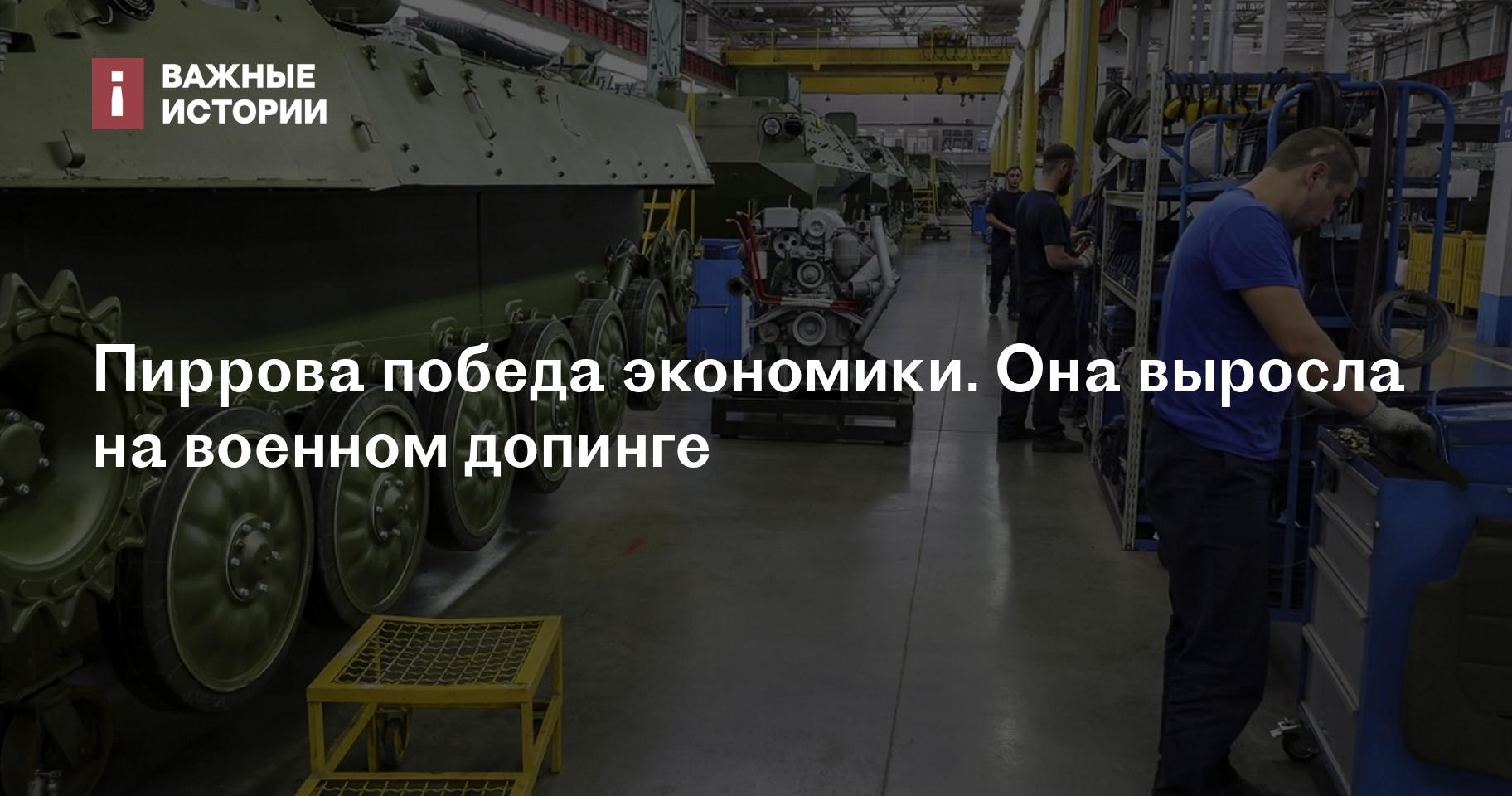
The economy of Russia contrary to all forecasts not only grew, but also played last year's decline. You might think, she’s nothing to her: neither sanctions, nor spending on war. This, of course, is not so, and the outgoing year began to clarify it.
Again a deuce
Killer orders a wreath for a friend's funeral.
- What to write on a ribbon?
- "Sorry, bro, the mistake came out."
Everything goes to the fact that, according to the results of the year, GDP will grow by at least 3%. President Vladimir Putin, Ministers of Finance, Anton Siluanov, and economic development, Maxim Reshetnikov, say that growth will be 3.5%, analysts surveyed by the Central Bank predict 3.1%. Last year, the decline was 2.1%, so this year there will be more GDP than in the pre-war 2021.
It seems that nothing foreshadowed such a success. After the start of the war, the experts were fulfilled by pessimism - both independent and official. All of them expected the collapse of GDP by 7-12%, but high oil prices, budget support and successful bypassing of sanctions helped to keep afloat. By the end of 2022, the economists decided that the severity of the crisis was exchanged for its duration: instead of a sharp decline and subsequent restoration, Russia will receive several years of lowering the economy by 1-2% per year. Everything had this: a shortage formed in the budget, the ruble began to fall, people were scared by mobilization and tried not to spend too much, plus the ceiling of prices for Russian oil began to operate in December, and its export decreased. In general, everything looked bad.
But the story of last year repeated: the experts again gave Mahu. The results exceeded expectations, and the economists revised forecasts over and over again.
Oil sanctions were not as terrible as it seemed at first. Of course, they created a number of problems and deprived the oil workers and the budget of part of the petrodollars, but the losses turned out to be much less expected (“important stories” told why it happened). And oil prices did not fail.
Experts overestimated the external threat, and one important internal factor was underestimated. At the end of the last - beginning of this year, the state injected huge money into the economy to fulfill the defense order. A powerful increase in expenses and budget deficits in December 2022 (more than 3 trillion rubles) and January-February of this year were associated with this.
Such a deficit was seriously scared by economists: it seemed that the situation was getting out of control. Oil and gas revenues of the budget almost doubled, and the expenses rose sharply. In the first four months of 2023, the government spent 11.2 trillion rubles - a quarter more than a year earlier. The Ministry of Finance explained that he wants to avoid the traditional December surge in expenses and this year advanced part of the expenses in advance. And in fact, by summer, expenses returned to normal. By that time, they learned to bypass the ceiling of prices, the economy began to grow, and the situation with the budget normalized. According to the results of 11 months, the deficit dropped below the trillion rubles, and in the May-Nobra, the surplus amounted to 2.6 trillion.
Everything is fine, beautiful marquise
Rabinovich had been waiting for the onset of Black Day for so long and prepared so well for him that he had already counted the days when he would come.
Giant injections allowed to increase military production and gradually dispersed the whole economy. The defense does not exist on its own: its enterprises have suppliers who also grow orders from military factories; Both people work on both who begin to earn more and increase their expenses. So budget money is gradually leaking into the rest of the economy. The gross profit of companies beats all records .
“It can be seen that [economic growth] was not just painted. Money from the budget is applied first to separate assigned enterprises. Then, in the income of citizens, consumer demand, in the purchase of products necessary for production, this is the next stream. All this is raising the economy, ”the economist Oleg Vyugin, the former first deputy chairman of the Central Bank and the deputy Minister of Finance, describes the growth mechanics. Lending and investment began to grow rapidly - their growth promises to become maximum in 12 years. Average salaries will grow almost like last year over the year (13% are expected against 14% in 2022), and the average inflation is noticeably lower (approximately 6 versus 13.8% in 2022). So the real (adjusted for inflation) salaries increase 6.6%.
The income of people began to grow, the shock from mobilization passed, and they began to spend more. After a year of savings, the Russians wanted to consume, the benefit was that: the supply of many goods was established, import in 2023 almost returned to the level of 2021. Car sales in 2023 will be about a third lower than in 2021, but grow quickly.
Too good - it's already bad
The nurse takes a thermometer from the patient.
- Horror! You have a temperature of 65 degrees!
- Do not worry, I just stirred tea with this thermometer.
You can add others to these achievements. For example, a decrease in poverty and unemployment (it is 2.9%at a historical minimum). So, the economy really survived?
In general - yes. Brilliant indicators are achieved due to the mobilization of a significant part of the resources available in the economy. Pour the economy with money - half the battle, it should still be able to master it. Not in the sense of sending money to the desired pocket, but to put it into business, to make something with their help. This requires equipment and people. And with both there are problems.
Record low unemployment is just a reflection of an acute personnel crisis (“important stories” talked about this). Personnel hunger is felt by 85% of enterprises. Mobilization, emigration and reduction of labor migrants have been superimposed on a demographic hole (a large generation leaves the labor market, and the small number comes to it). The country does not have enough workers, and different: ITishnikov, workers, drivers. Even the police and the Russian Guard complained about the shortage of personnel.
The enterprises of the military -industrial complex, which urgently needed workers, were forced to lure workers with high salaries. A private business, in order to keep employees or lure someone else, was also forced to increase salaries.
The same with equipment: loading production facilities at a historical maximum . The government is preparing to further increase the budget expenditures, but the matter is not only in money: the economy does not have enough resources to satisfy demand, economists call it overheating. He was well described by the Chairman of the Central Bank Elvira Nabiullina: “Imagine that the economy is a car. If you try to go faster than set by the design, and crush the gas with all our might, then the engine will sooner or later overheat, and we will not go far. It may be fast, but not for long. ”
The pumping of the economy in such a situation can lead primarily to price growth. Which, in fact, is happening.
The ROMIR Romir Index of Personal Consumer Prices for Products of everyday demand according to the data on real purchases in November was 24.2% higher than a year earlier. This is three times higher than official inflation. And approximately corresponds to the sensations of consumers.
Particularly accelerated inflation is felt by low -income Russians. Products are most expensive, and they occupy a large share in the consumption of such people. “The increase in prices for fruit and vegetable products, eggs, chicken, bread, which are the basis for the consumption of the poor population, is mainly accelerated relative to the average level,” experts noted by the authorities of the analytical center of the TSMAKP. The “consumer basket for the poor” compiled by them is more expensive than the main one. Real - with the adjustment for inflation - the amount of pensions in October decreased in annual terms, for the first time since May 2022.
Another reason for the acceleration of inflation was the fall of the ruble - and this is the second side effect of pumping the economy with money. The fall began at the end of last year, and this year accelerated sharply. Less petrodollars began to enter the country, and the demand for currency grew as the import is restored. And budget infusion in combination with a low key rate provided a sufficient amount of cheap rubles to buy currency.
Without frozen reserves, the Central Bank remained the only more or less effective way to support the ruble-increasing the key rate. But the Central Bank used ittoo late (although it is unlikely that this would fundamentally change the situation).
When the dollar reached 100 rubles, the authorities resorted to administrative measures, at first informal - they convinced the exporters to sell more currencies, and then formal: in October, Putin issued a decree obliging the 43 largest exporters to return foreign exchange earnings to Russia and sell the most. This returned the course to the area of 90 rubles/$, but it cannot further strengthen.
Now you can’t break what exactly stopped the devaluation, says Nabiullina. Again, several factors coincided-oil in the second half of the year went up, and imported imports (partly due to the fact that with such a course the roads became, partly began to affect the increase in the key rate, which made savings more profitable, and loans were less). And, of course, Putin’s decree played some role.
Rising prices and the fall of the ruble led to the explosive increase in lending. People rushed to buy equipment, cars, apartments - who could. Those who had savings tried to save them in this way, and those who did not have was to make a purchase, so far, is still possible. High rates did not scare them away. “People are afraid of inflation that their savings will depreciate, high inflation expectations make bets more acceptable,” Nabiullina explained . “If you dig, it turns out that people expect that either inflation will devalue all this, or that salaries will grow”, - Anton Tabakh noted by the chief economist of the expert RA.
The mortgage was especially “shot”, where state support programs operate. The rate of 8% for preferential mortgage for inflationary expectations of 12% is super -attractive, Nabiullina said.
With such a boom, loans were issued a variety of borrowers, including not the most reliable. The number of Russians with several loans is growing, some mortgage borrowers are likely to take a loan for the first fee (6%) or repair (up to 25%), the Central Bank is anxious . By December 1, the debt of Russians to banks amounted to 33.7 trillion rubles, and the total exceeded 35 trillion.
To whom war, to whom mother is dear
Paradox: baseballs are usually not on sale, because there is no demand for them. And baseball bit is often not, because everyone has already been bought.
The experts of the TsMAKP call this "crisis consumption." But it also became an important contribution to the economic growth of the outgoing year, the consumer sentiments of Russians are now at the 15-year maximum , because the main blow to them was inflicted last year.
In a similar way, many undoubted successes mask saving problems. For example, with an obvious boom in the military -industrial complex, industrial production has not been growing since May. So, in some sectors, a decline. “The Russian economy is now the economy of imbalances associated with sanctions and restructuring the economy,” says Oleg Itskhoki, professor of the University of California at Los Angeles. “And the growth of GDP, expected at the end of the year, hides these imbalances: collapse in some industries and rapid growth in others.”
The boom, of course, in everything related to the military-industrial complex and the replacement of what the Russians lost due to war (for example, domestic tourism). The decline is in the industries oriented to consumption, from where foreign companies went, as well as in the extraction of fossils - numerous sanctions (this is not only oil, but also coal) nevertheless affected, like the gas war with Europe. This year, data on oil and gas production are classified, but the experts of the TsMAKP regularly noted a small decrease in oil production (they can give a “qualitative assessment of the trend”).
The economy is divided into important and secondary directions. The priority is everything related to the war, the rest is how it will turn out. This is clearly visible by budget and investment. The expenses of the budget for healthcare, economics and transfers to the regions have not changed much, and taking into account inflation, it has become less. The investment boom upon closer examination is focused on several directions: the expansion of the military -industrial complex and infrastructure for the supply of goods along new routes, as well as the replacement of lost imports. In the investment boom, “investment activity began to decline (with accuracy to defense production),” the Central Department Store notes, and “the main blow came on private investments in fixed assets - the most valuable element of demand”.
A similar situation in imports. In dollars, it almost recovered to the pre -war level: $ 274 billion in 11 months against $ 304 for the entire 2021 years. But inflation is raging in the world, and the purchasing power of dollars 2023 and 2021 differs by about 10%, and for Russia, taking into account new realities (sanctions risks and complication of delivery), the rise in price is even stronger. So in physical terms, imports are probably in a tangible minus (unless a mass replacement of goods occurred with cheaper ones). And as an investment, this is primarily the maintenance of the military -industrial complex and the replacement of the lost. The imports of cars, according to Avtostat, grew up almost four times, the import of cigarettes doubled ... This is an adjustment of the economy, says Itskhoki.
Most of the import is now coming from China. In the conditions of sanctions, he became the main support of Russia: he is now No. 1 both in imports, and in export, and in the routes of goods delivery, and Yuan became the main foreign currency for Russia. Another imbalance: over the year, Russia's economic dependence on China has critically grew (“important stories” talked about this here).
Another manifestation of economy stratification is a reaction to a sharp increase in the key rate (as the Central Bank fights inflation). Following her, loans began to rise in price, and this is a sensitive blow to business. But not for everything. In Russia, programs for supporting different industries and projects are multiplying. One of the popular methods is the preferential rate on loans that the state subsidizes (the budget compensates to banks the difference between the interest rate and market rates assigned in the program). Those who got into the program do not matter how much a loan costs, and the rest have to overpay even more: the Central Bank, in order to achieve the desired effect for the whole economy, has to increase the rate even more. In fact, part of the business pays "for himself and for that guy." “The two -digit rate will completely freeze civic activities, more precisely, which does not receive payments from the budget,” says Vyugin.
Hold on balance
In the menu of an expensive restaurant "Cutlets from the hazel grouse." The visitor asks the waiter:
- How many hazel grouse does it take?
- Well, we add other meat, such as horses.
- In what proportions?
- In equal terms.
-?!?!
- 1 hazel grouse - 1 horse.
“The average temperature in the hospital” is good, but the imbalances are multiplying. The authorities are increasingly having to intervene in order to maintain balance in manual mode, although it is often violated by his actions.
Take a preferential mortgage. She was launched into a covid crisis to support the builders, and never turned off. As a result, the bubble is inflated in the real estate market: the gap in the price between new buildings and the secondary market has grown from 10 to 42%, and the budget spends hundreds of billions of billions on bids. Pyaterochki clients subsidize the customers of the ABC of Taste, describes these programs by Bloomberg Economics economist in Russia and the CIS Alexander Isakov. He means that they pay VAT during purchases, but less secured (Pyaterochki clients) cannot take a mortgage, even the preferential one - it turns out that the poor pay tax to support more wealthy ones.
Or the fuel crisis (“important stories”told how it turned out). The budget wanted to save on compensation to the oil industry and provoked a jump in gas and diesel prices. To stop prices, I had to prohibit fuel exports for 1.5 months.
A sharp restructuring of the economy does not pass without excesses, and manual control is becoming more and more. It is necessary to stop prices somewhere somewhere, then bypass new restrictions, then replenish the budget. Taxes try not to increase, but if additional money appears in the economy somewhere in the economy, the Ministry of Finance demands to share.
This year, business owners had to share: nationalization began in Russia. Formally, this is the introduction of external management by the Federal Property Management Agency, but, in fact, it is an asset of assets in favor of the state (“important stories” talked about this). The beginning of the redistribution of property even more strongly shakes the economic structure.
Do not return back
- What is this? Money?
- Do not touch, it's to the wind.
The most equilibrium in the economy violates its transfer to military rails. The intervention of the state in the economy and its role is growing in it, but it was the market economy that helped first avoid disaster, and now - to rebuild and bypass sanctions.
In addition, military spending and the entire VPK have the ability to change in one direction - they only grow. And even if the war ends, their appetites will not decrease. The “Everything for the Front” approach-and the minister of finance Siluanov described the budget of the 2024th-lays a short-action mine under the economy. The weight of the army, the military -industrial complex and security forces in the economy will continue to grow like a cancer tumor, gradually devouring healthy cells. In the long run, the war is destructive for the Russian economy, says Izkhoki.
This destruction can last long. The market Russian economy, as we have seen, is still in a good form, although the situation is gradually deteriorating. And this gradual fading will continue until the war sucks all the juices from it.