
Translated material
The Russian authorities discovered new "extremists" - these are supporters of Sergei Furgal
Those who protest against the arrest of the governor are in danger? Do I need to delete all the posts of “I/we Furgal” from social networks? We answer the most alarming questions
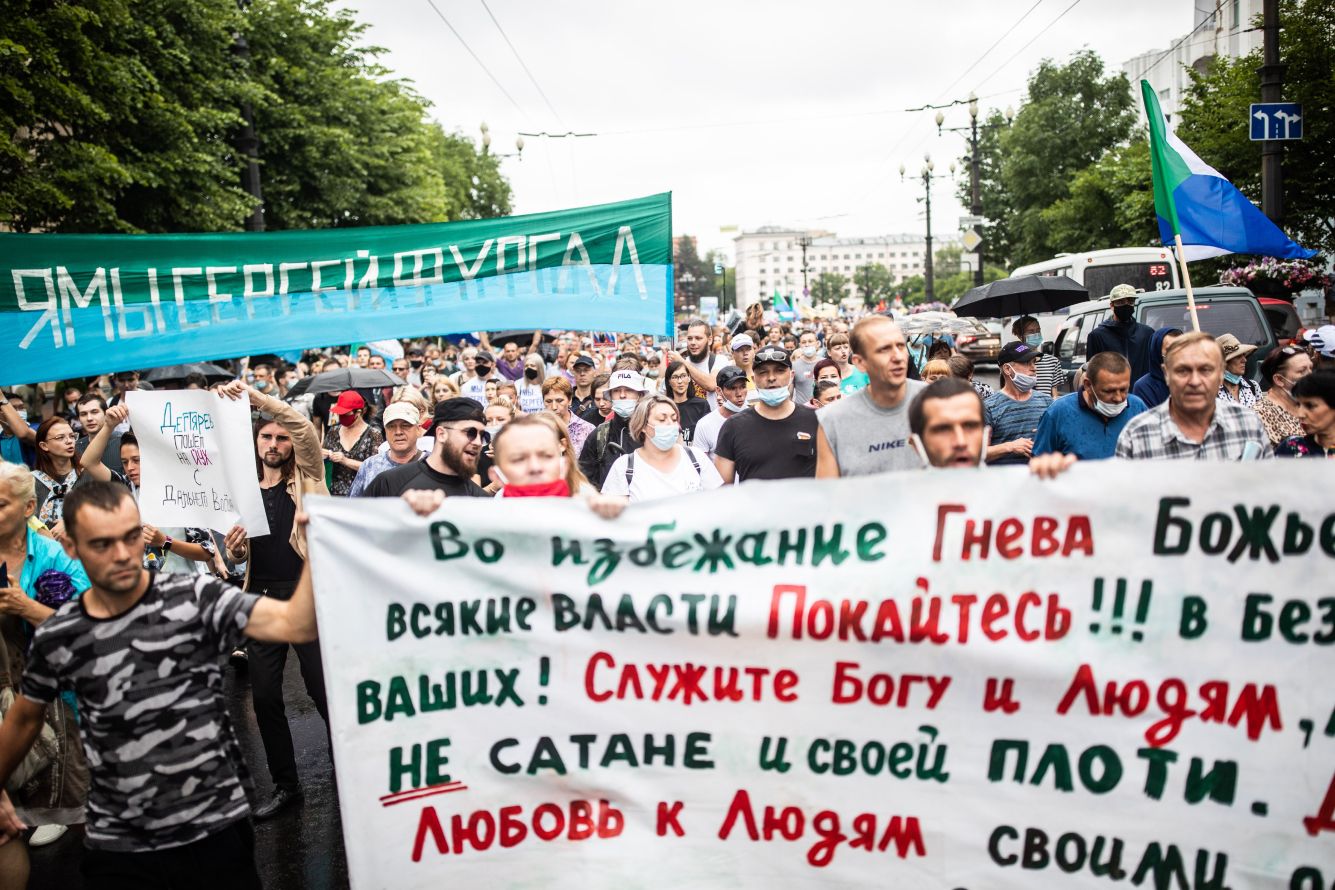
The movement “I/we Sergey Furgal” can declare extremist and ban on Russia. On February 22, the corresponding claim of the prosecutor of the Khabarovsk Territory will be considered by the Khabarovsk Regional Court-the Human Rights Project “OTD-Info” drew attention to this. Medusa answers the most alarming questions related to a new extremist business. First of all, about who can threaten a court decision and how to protect yourself if you supported the former Khabarovsk governor during street shares or on social networks.
Movement "I/We Sergey Furgal" generally exists?
Apparently, not - like the "international public movement of LGBT."
“I/we are Sergey Furgal” - perhaps the most popular slogan protesters against the detention of the then governor of the Khabarovsk Territory Sergey Furgal. In 2020, he was accused of involvement in registered murders, and in February 2023 he was sentenced to 22 years in a maximum security colony. The detention provoked massive multi -month protests in the region: the protesters were sure that the persecution of one of the few governors who did not represent United Russia were politically motivated.
Medusa could not be found in open sources of references to any group of activists who would call their association “I/we Sergey Furgal”. As the case of the “international public movement of LGBT” shows, this will not prevent the court from admitting that the movement “I/we Sergey Furgal” exists.
How does this work?
The LGBT movement, for example, also did not have a legal entity, a single structure, leader or coordinator, individual or collective membership. Nevertheless, the Supreme Court recognized a decentralized set of different unregistered LGBTK-organizational and activists by the Unified International Public Movement. This became possible thanks to the determination of the social movement (another format in this case would not fit):
The social movement is one of the organizational and legal forms of public associations and is consisting of participants and a mass public association that pursues social, political and other socially useful goals supported by participants in the social movement.
Evidence that the “LGBT movement” really exists, “ follows from the documents submitted by the Ministry of Justice of Russia and established by the materials of the case,” says the Supreme Court. These materials were never published - we do not know what arguments the Ministry of Justice brought into them.
Who will the authorities be able to declare a “participant” or “organizer” of a new extremist movement?
We do not know this - it will be more understandable only after the appearance of judicial practice. In the case of the “LGBT movement”, it is not there either: so far the Russians have been punished only for the “demonstration of extremist symbolism” - that is, the rainbow flag. But if we evaluate the judicial practice associated with the Aue movement , also declared extremist, we can conclude that any person who is in support of Sergei Furgal is under threat - both publicly and in private conversations.
What is this practice?
- On August 7, 2023, the Khabarovsk railway district court sentenced a 41-year-old prisoner serving a sentence in the regional correctional colony No. 3, to the four years in a maximum security colony under part 282.2 of the Criminal Code. According to investigators, the convicted person, being in a correctional institution, "promoted the ideology of AUE among other prisoners."
- On August 10, 2023, the SC SK in the Irkutsk region reported on the initiation of a criminal case under part 2 of Article 282.2 of the Criminal Code against the 36-year-old prisoner. According to investigators, while in the regional pre-trial detention center-5 from April to July 2023, he "promoted the activity of the forbidden AUE movement and explained its ideology."
- On August 7, 2023, the criminal case was initiated under part 2 of Article 282.2 of the Criminal Code was informed by the Investigative Committee of the SK in the Republic of Bashkortostan. The suspect in the pre-trial detention center “conducted propaganda conversations among prisoners”, made and distributed materials with Aue's symbols, “thereby promoting criminal and extremist ideology among other investigatively Arested ones.”
And if a person spoke out in support of the vuru to a court decision?
There are still risks - but it is difficult to evaluate them.
The notes to Article 282.2 of the Criminal Code of the Russian Federation (the organization of the activities of an extremist organization) says that a person who has first committed a “crime”, but voluntarily ceased to participate in the activities of an “extremist” organization, is exempted from criminal liability if his actions do not contain a different corpus delicti. There are similar reservations in an article on financing an extremist organization.
Ordinary participants in the extremist community who have voluntarily emerging from it are also exempted from criminal liability.
At the same time, in law enforcement practice there are cases that do not allow us to say that there is no danger at all - for example, the case of Lilia Chanysheva. For four years, Chanysheva headed the headquarters of Navalny in Ufa, but by the time of detention and arrest in November 2021, it was no longer related to the structures of the politician. At the same time, the Kirovsky District Court of Ufa sentenced Navalny’s ally to seven and a half years in prison. She was found guilty of “calls for extremism”, “creating an extremist community” using an official position and “creating an organization that violates the rights of citizens”.
When asked about whether the LGBTK activists should be afraid of the example of Chanysheva, a lawyer with whom Medusa talked , answered this way:
We do not know, they pursue Chanyshev for what she did before the decision to recognize the structures of Navalny's extremist structures, or for what she did after (since it was about the extremist community - then, probably, after). No one interferes with the use of similar logic to LGBT activists.
The same can be said of the supporters of Sergei Furgal. At the same time, according to the lawyer Valeria Vetoshkina, Chanyshev was convicted precisely for the actions that the politician performed even before the prohibition of Navalny's structures.
Do you need to delete posts in support of a van on the Internet?
Yes, if you are in Russia or plan to return to the country - be sure. We must immediately make a reservation: we do not know what symbolism will be considered associated with an extremist organization. However, even if the court decision indicates a specific list of such symbols, this will not give guarantees that for other posts in support of Furgal you will not be pursued.
For example, after the publication of the decision of the Supreme Court on the prohibition of the “LGBT movement”, we know that exactly refers to “extremist” symbolism - this is a variation of a six -color flag with additions . And what else can relate - we do not know, the lawyer Valery Vetoshkina explained to Medusa:
From the point of view of the law, the symbolism of an extremist organization is a symbolism, the description of which is contained in constituent documents. In practice, we have already seen many times how, by a demonstration of extremist symbols, they mean a demonstration of attributes indirectly related to “extremist” movements (an example is the symbolism of “smart voting”). I think that here practice can go along a similar path.
If you are in Russia and want to protect yourself - we recommend that you remove any posts in support of Sergei Furgal from social networks, even if they do not have the phrase “I/we”.
Publications on the Internet are the so -called consumption of offense. The statute of limitations in this case is considered not from the moment of publication, but from the moment when law enforcement agencies say that they discovered the post (regardless of when they found it in reality).
This means that for a picture on Facebook with the inscription "I /we Furgal" it will be quite possible to lose freedom. For the first such “violation”, administrative responsibility threatens under Article 20.3 of the Code of Administrative Offenses , the maximum punishment is an arrest for 15 days. For repeated “propaganda” or “public demonstration” during the year, they can be brought to criminal liability under Article 282.4 of the Criminal Code of the Russian Federation , the maximum punishment is imprisonment for four years.
At the same time, they are unlikely to be able to attract a person as a “participant” of the community for the old post in social networks and immediately start a criminal case on him-even if the police consider the record “promoting” something, as in examples with AUE. The fact is that in the case of “participation”, the act should begin after the decision of the Supreme Court comes into force. However, we do not know whether the investigation can calculate the “participation” post in support of the van, laid out after the recognition of the “movement” of extremist. Probably, for this, the investigation will need other signs of a crime - but it is difficult to judge this without any practice.
It seems that the authorities are increasingly announcing “extremists” different groups of the population. Now any opposition activity can be outlawed?
So far, these are still spot repressions, but this trend is really obvious - and it is very alarming.
For example, in the case of LGBT’s movement, the Supreme Court decided that manifestations of extremism are also a statement of a negative attitude to decisions of the authorities and “protest actions of a mass character”. The lawyer of the human rights organization Ksenia Mikhailova then told Medusa that this decision of the Supreme Court is not only about the LGBTK community-it is about how to qualify disagreement with the actions of the authorities in Russia. According to Mikhailova, it criminalizes not only LGBTK-activism, but also any opposition activity-which confirms the current lawsuit.
Valeria Vetoshkinka noted that the case with the “LGBT movement” is not the first such situation:
This is not the first time it has been slipping in decisions - for example, when the “lawyer street” was declared a foreign agent, she was accused of criticizing state authorities. This is the same. Do you criticize state authorities? Extremist or foreign Agent. And when the Law Sofia Foundation was announced to the undesirable organization, having connected its activities with the Agora human rights group, the Prosecutor General’s Office wrote that human rights activists “are emphasizing the coverage and replication of the facts of allegedly infringing on the rights and freedoms of citizens in Russia” and “on the provision of legal assistance to opposition with a pronounced anti -Russian position, including supporters of recognized extremist organizations. " That is, they were also “charged” by criticism of the current government and the provision of human rights assistance.
In addition, in the decision on Navalny’s headquarters there was also a logic that protest promotions are an inappropriate form of realizing the right to change power, you need to go to the polls. That is, the authorities go further, and not only steal the elections and prohibit protests, but also criminalize the organization of free elections and peaceful protests.
Peter Sapozhnikov