
Translated material
Putin said that the vast majority of Russians supported the war. This is true?
As independent studies show, the core of "supporters of their" melts. We publish the material of the project Re: Russia
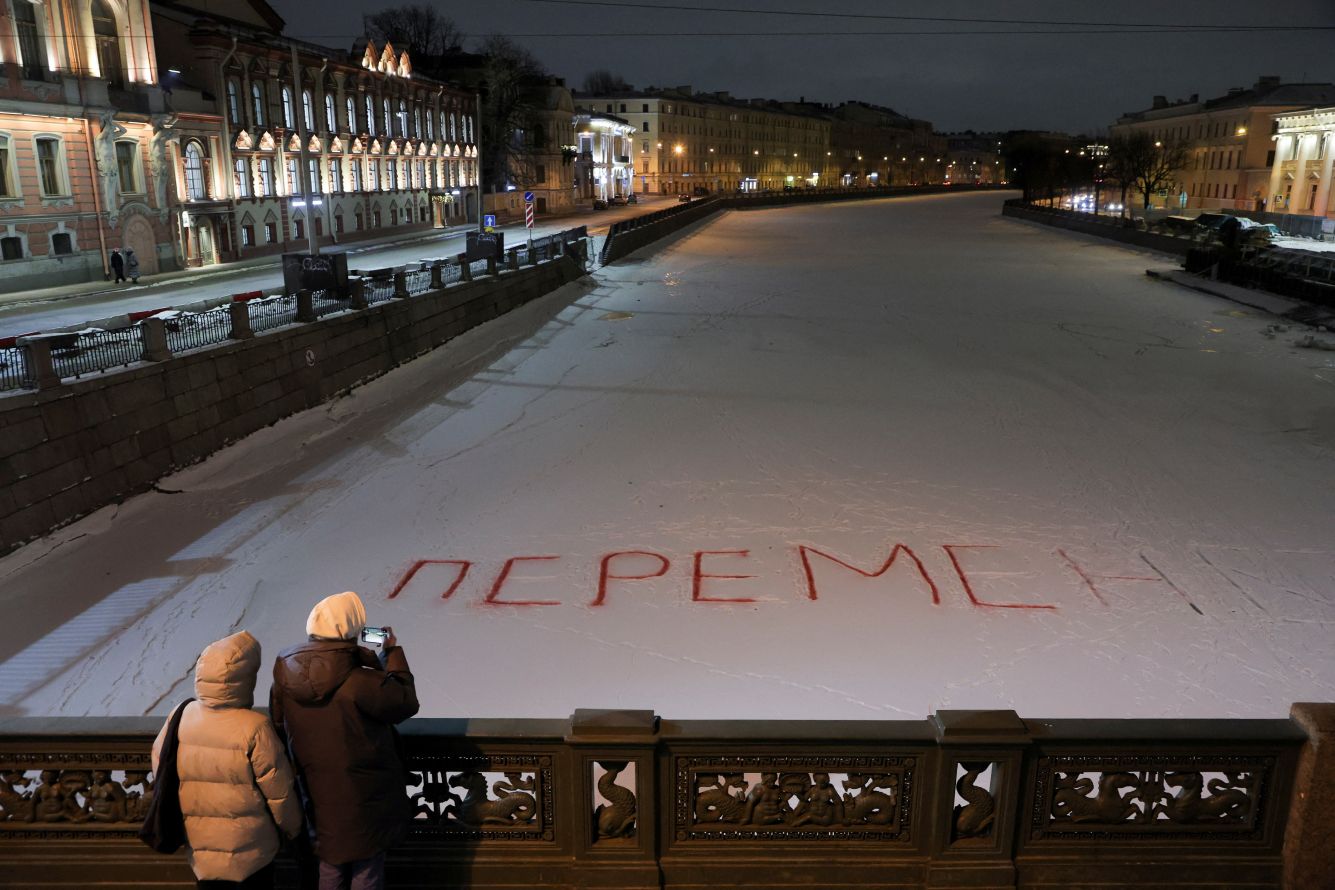
On February 29, Putin said that the “vast majority of the Russian people” supported the war with Ukraine. Independent studies of sociologists, however, indicate that during the second year of military operations in public opinion polls, a slight reduction in the share of respondents who declared support of their own and a significant reduction in the nucleus of supporters of the war was a worshiped segment of society could observe. As a result, this core was reduced by one and a half times and became the proportionate share of those who generally adhere to anti -war views. The zone of the blurry and alienated attitude of Russians to the war has also expanded, noted in the material for the RE project Re: Russia EXTREMESCAN Founder Elena Koneva and RE director: Russia Kirill Rogov. With the resolution of Re: Russia, we publish this article with minor changes.
Supporters, opponents and deviators
After the first year of the war, we tried to summarize some observations of the dynamics of public opinion on the material of polls of the Chronicle and ExtremeScan projects. The main conclusion was then the paradoxical, at first glance, the thesis that in these mass polls we see not one, but two majority at once.
In general, in these polls, thanks to the presence of two tips that are offered from the very beginning to the respondent (the answer options “I find it difficult to answer” and “I do not want to answer”) and allow him to evade the expression of a certain opinion, we see two large and one small groups.
- The first is those who are on the direct question "Do you support the actions of Russian troops in Ukraine?" answers in the affirmative. They form most of the "declarative support" of war. In the spring of 2022, at the beginning of the war, their share was 63%, then decreased and for the most part of 2023 (since April 2023, four measurements) was an average of 53%.
- The second group - those who stated that they did not support the war: their share (according to the measurements of the Chronicle and Extremeescan) for almost all two years of the war amounted to 10%.
- In addition to them, however, there is another large group - a group of “slopes”, that is, those who found it difficult or refused to answer. In the spring of 2022, there were 28%of these, and for most of 2023 - 36%. At the same time, the group of “difficult” grew by only 1 percentage point, and the group of “refusing” - by 7.
It is important to note here that support for the war in today's Russia is a strict normative position (normative requirement), the absence of which can bring social pressure and persecution on a person. Therefore, evasion of her statement in the survey for the most part looks like a significant gesture, and in any case, the refusal of the answer looks significant. If in the usual (non -sensitive) question, the answer is “difficult to answer” is simply evading “choice”, then here it becomes evading confirming the loyalty of the normative position, supported by an effective repressive apparatus. In this sense, it should be considered quite meaningful the fact that at the beginning of 2023 40% of respondents (“slope” plus open opponents of the war), and at the end of the year, 48% did not express the loyalty of the normative position of the approval of the war.
In general, according to the Chronicle and Extremeescan polls, four periods can be distinguished in the dynamics of attitude to war in the context of a direct question about its support.
- The highest declarative support figures were observed in the spring - at the beginning of the summer of 2022.
- Then, for several months, its decrease to minimums in September (after the announcement of “partial mobilization”) took place with the simultaneous increase in the “sloppy” share.
- In the winter of 2022/23, a new rise was observed.
- It was replaced by a new decline since the spring of 2023, when the support level fluctuated in the range of 51–55%.
These trends are distinguishable in the polls of the Levada Center. The peculiarity of the latter is, firstly, the implementation of them by Face-to-Face (Polsters arrives at home) and, secondly, that the respondent offers a scale of possible answers: “I definitely support”, “rather support”, “rather not support” and “I definitely do not support”. Such tactics (often and quite legally used in polls) pushes respondents to give a meaningful answer. As a result of aggregated support figures (“definitely support” + “rather support”), the “Levada Center” is higher-they fluctuate in the range of 70–81% with an average value of 75% and practically do not detect dynamics.
However, if you look at the support levels, we will see a picture close to the results of the Chronicle and Extremescan. The proportion of certain supporting military operations was reduced compared to the first six months of the war by 6 p. The share of those who do not support firmly remained unchanged - about 10%.
It is also important to emphasize that for two years, the majority of declarative support of the war hesitated in a very significant range (51–66%), while the share of open opponents of military operations remained unchanged. This is a rather rare situation for polls when reducing the support of one position is not converted into an increase in support of its alternative, indicating some special “blocking” circumstances, in this case, apparently, on the pressure of the climate of opinions and the repressive environment.
Why are two majority?
Two additional questions asked respondents in the Chronicle and ExtremeScan surveys concerned support for support
- Putin’s hypothetical decision to withdraw troops, even despite the fact that the goals of the military operation have not been achieved;
- Directions of budget funds for military needs in priority.
The answer to the first question demonstrates whether the purpose of the war is really significant for the respondent and is it acceptable for him to return to the starting point (“before the war”). The response to the second is that these goals look enough to “tighten the belts”, having limited other budget expenditures. At the same time, the formulations of both questions are not so sensitive - state officialdom does not require the only correct answer to them - and therefore leave space for the safe expression of their opinion.
The combination of three questions allows you to carry out more subtle segmentation and highlight the wide and narrow nuclei of supporters of the war. At the beginning of 2023, a wide core amounted to 39% - these are those who not only declaratively supported the “military operation”, but were also not ready to support the decision to withdraw troops before achieving its goals. The narrow nucleus of support - the turbotarists who declarely support the war who do not agree with the termination of it until it achieved its goals and are ready to “tighten the belts for the sake of victory,” included 22% of the respondents.
The fact that out of an average of about 55% of respondents expressing declarative support of the war, only about 39% do not support the decision to withdraw troops, means that about a third of those who have joined the normative majority of declarative support would probably not have done this if the “climate of opinions” was more favorable for this. This allowed us to argue that in addition to most declarative support of the war, there is also the majority of “non -resistance to war” - those who either evade the normative gesture of support, or, expressing declarative support, at the same time does not share wire views.
The situation when two majority are found in society, only at first glance seems paradoxical. In fact, the direct question about the support of the “military operation”, which sociologists constantly ask respondents, like other extreme sensitive (polarizing) questions, in a particular political context changes its actual content. In the same way, for example, when respondents in Russia are asked about the approval of Vladimir Putin’s activities, in conditions of widespread belief that the vast majority of Russians support him, this question is essentially as follows: “Do you approve President Putin just as the vast majority of Russians are approved (as it is well known), or belongs to the minority that does not approve it for some reason?” As a result, the respondent answers not so much to the question of his attitude to Putin, but to the question about his relations with the “imaginary majority” of Russians and in his response should declare either his opposition (opposition) to him.
The question of supporting the “military operation” in a specific repressive-propaganda context of today's Russia also has a specific sound for the respondent. The answer “support” is strictly normative, and the answer “I do not support” is openly confrontational in relation to the regime. That is, answering this question, the respondent primarily decides whether he is ready to define himself as a confrontation with the regime and in opposition to him - as well as the “imaginary majority” of Russians supporting the war. 10% of respondents, claiming that they do not support a “special military operation”, are those who admit that they are in a state of confrontation with the regime and the “imaginary majority” (even if it does not imply public actions).
Thus, in the distribution of answers to three concerning the war, we are dealing with three main groups:
- those who are aware of themselves in confrontation with the regime and the “imaginary majority”;
- those who really support the war;
- Those who are not ready for confrontation with the regime even at the level of personal positioning, and therefore are forced to look for for themselves niches of declarative support or avoiding an answer.
The last group is another majority - the majority of “non -resistance”, the contours of which appear in the shade of most declarative support.
Gradient support/defective warfare
The results of qualitative sociological studies , obtained on the basis of deep interviews, indicate that the support/defending of the war in Russian society is not a set of segments structured around articulated positions, but rather a continuum of argumentation and narratives located between two poles: convinced support of the war and its incontinuation. To a certain extent, quantitative studies based on mass surveys confirm these conclusions. And the most significant changes in relation to the war during this year did not take place in the distribution of answers to the direct question about the support of WO, but just in answers to additional questions about the war.
In the second half of 2022, as can be seen on the schedule above, the question of the immediate withdrawal of troops, by decision of Putin, put the respondents in a dead end, and the groups of claiming support for this decision, disagreement with him and those who were difficult to answer were approximately equal. At the beginning of 2023, the share of this decision supported at the same time, but even more-the share of it does not support. Such a simultaneous growth of two groups with opposite views is a sign of polarization of society. At the same time, those who did not support the withdrawal of troops last winter were more than those who supported. Then, the share of non-supporting the decision on the withdrawal of troops was reduced twice-in the spring and autumn of 2023. As a result, the share of this group compressed almost a third - from 47 to 33%. At the same time, the share of the supporting remained stable - 40%, and the share of the difficult and refusing to respond (from 13 to 28%) grew.
In other words, the support of the idea of withdrawing troops (without achieving the goals) still causes difficulty in a significant part of the respondents, but the share of real supporters of the continuation of the operation was reduced quite dynamically. The process of partial demobilization of solid supporters of the war also proved to be the distribution of answers to the second additional question about budget expenditures: in February 2023, their priority direction for military needs supported 37%, in October 2023-26%.
Accordingly, the narrow and wide nuclei of support for war has changed significantly. The narrow core in the February survey of 2023 was 22% of respondents, and in October - 12%. The wide core (supporting the war and not supporting the hypothetical withdrawal of troops) was 39% in February 2023 and decreased to 27% at the end of the year. At the other end of the spectrum, in addition to open opponents of the military operation (claiming that they do not support the war, in response to a direct question), those who do not express the declarative support of the war and at the same time support the withdrawal of troops, as well as the priority direction of budget expenses for non -military targets. This group is close in views on the opponents of the war. Avoiding the declarative opposition of themselves to the regime, they do not support wire politicians and do not consider the purpose of the war quite important.
In addition, there is also a group of those who do not express the support of the military operation and supports the withdrawal of troops without achieving the targets of war - these are the "nestrons" of the war. They are not ready to identify themselves as an opposition, to confront with the regime, but at the same time they would like to have no war or it ends faster. They are not necessarily “secret liberals”, most of them are quite loyal to “Putinism”, but “Putinism without war”. Finally, there is a group of declarative support of their, but at the same time supporting the withdrawal of troops and do not support the priorities of military expenditure of the budget - this is a group of purely declarative support of the war.
Thus, we can build a kind of spectrum of attitude to war in the form as it is represented in these mass surveys. And accordingly, to see how this spectrum has changed between polls of the beginning and end of 2023.
As can be seen on the schedule above, the wire part of the sample (turbo systems and supporters of war) has significantly decreased, the share of anti -tuned ones has not changed in size (20–25%), and the average zone of blurry, fuzzy or hidden attitude to war expanded from 41 to 54%.
How and why the attitude to the war in Russian society in 2023 changed
On the schedule above, it is clearly noticeable that it was the beginning of 2023 that became a kind of peak of mobilization of supporters of war and polarization in society - a group of supporting the decision to withdraw troops and a group of non -supporting such a scenario grew at the same time. And it looks quite logical in the context of concomitant events.
After the autumn retreat of the Russian troops from the Kharkov region and from under Kherson, the “smell of defeat” greatly excited the Russian public and settled in it a feeling of dangerous uncertainty. Moreover, these emotions were supported by quite specific changes in the information landscape. Evgeny Prigozhin with his frantic curses addressed to Shoigu and Gerasimov, allegedly not giving him shells, and Prigozhin brought to the federal media science of Trib Bloggers radiorated the atmosphere “Homeland in danger” (it is interesting that the wire discourse was supported in this option with a powerful counter -elite message).
This led to both the growth of declarative support of hostilities after its decrease in the autumn of 2022, and to the expansion of the militaristic support nucleus. And vice versa, by the end of 2023, the failure of the Ukrainian counterattack, the idle exhaust of the coup, the disappearance of Prigiron and the fall of the significance of the wire -packed bloggers, which were under pressure from the Kremlin censorship, reduced the degree of mobilization. The wire -up stirment lost the soil and recharge, the war was routine, moved to the periphery and to the zone of what was called “double -minded” - formal loyalty in the absence of any conviction in late Soviet times.
Rightly speaking of the routinization of war, experts, however, miss an important aspect: the routinization is associated with the compression of a group of supporters of war.
It is worth noting that even an increase in the share of families in which someone participated or participates in military operations (24% of respondents stated in the latest measurements), does not significantly change the profile of the attitude to the war: 58% in this group in this group in the average sample 52%. Thus, among close direct participants in the war, we are not observing either increased criticality in its regard, nor increased solidarity with its goals. In general, we are observing a double phenomenon: on the one hand, the indifference of society towards the losses of war (which reaches UNDERSTANDEDS INTENTIONALY), on the other hand, the lack of increased involvement and sympathy for its goals even among those whose loved ones risk their lives and health at the front.
The signs of public demobilization we noted echoes with the phenomenon considered in the article by Vladimir Zvonovsky and Alexander Khodykin and, possibly, give a hint to his understanding. Despite the fact that the share of the support of the “military operation” in 2023 was reduced slightly, the share of those who say that in his environment most people supported the war were much more noticeable - and vice versa, the share of those who say that opponents and supporters of the “military operation” have equal shares - 50 by 50. As you can see, the proportion of a wide wire -wire nucleus (39%) at the beginning of the beginning 2023 by one and a half times exceeded the share of those who adhered more to the skeptical regarding the war of views (25%). However, in the second half of the year, the size of these nuclei became almost equal. A group of convinced supporters of the war decreased by almost one and a half times, while the uncleaned or declarative supporters, most likely, have less incentives to speak about the war. For the Russian layman, the result of this could be that the “audibility” of the wire position in his environment has significantly decreased.
In the previous publication, we described several phases of changes in attitude to military operations and stopped in the phase of “immersion in the war”, the society’s awareness of its duration and insuriality, which came for last winter. In 2023, the main trend was the routinization or crowding out of the war. An important part of this phenomenon, as mentioned above, is the reduction in the share of real supporters of the war and a decrease in the “audibility” of a wire position in society, a kind of demobilization of society in the spring - the afternoon of 2023.
At the same time, the fact that, with a sharp reduction in the share of real supporters of the war, the share of its opponents did not grow in a narrow or wide definition, apparently indicates the effectiveness of authoritarian institutions: the costs of confrontation with the regime in the representation of the respondents look high, and the costs of war are quite low. A certain decrease in declarative support in 2023 was observed in most age groups, but in all it led not to growth of the group with an open anti -war position, but to an increase in the share of the “slope”. As a result, in the youngest ages (18–34), their share reaches 50-60% with the “normative” position of support for war 30–35%. It is characteristic that it is youth, where even declarative support of the war is the destiny of the minority, today is the main goal of the propaganda pressure of the authorities.
Thus, for two years of the war, we are observing two periods of mobilization and two periods of demobilization of public opinion in relation to war. The first demobilization in July - September 2022 was probably associated with the awareness of the protracted nature of the war and its significant costs. At the same time, the second, “Prigozhinsky” period of mobilization last winter (“Homeland in danger”) put as a result of a wire coalition on the brink of acute internal conflict (criticism of wire bloggers, Prigozhin rebellion).
It is difficult to say whether the trend described by us here is the second demobilization (from spring to the end of 2023) stable and irreversible. The reduction in the share of opponents of the decision to withdraw troops during this period, of course, indicates a growing request for the end of the war. At the same time, not only the share of open opponents of the war did not grow, but also the share of the emerging ending by the decision of Putin. In the EXTREMESCAN survey in September 2023, the life of Russians will improve or worsen, if Russia was now withdrawing troops from Ukraine, 12% said that it would improve, 34% will not change and 37% - which will worsen. Among those who stated the support of the war, answering a direct question, the last answer was given 50%. This indicates that the scenario of the withdrawal of troops looks like obscure, potentially conflict and alarming for respondents. And this circumstance, along with the fear of repression, also prevents the consolidation of anti -war sentiments.
Elena Koneva and Kirill Rogov