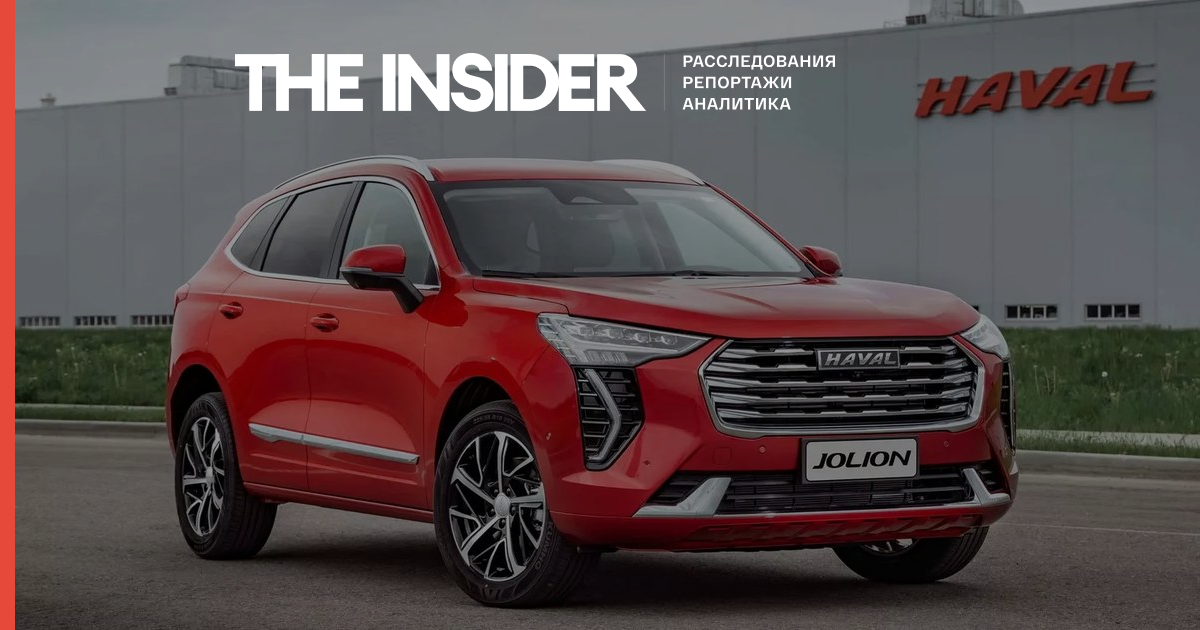
The Chinese HAVAL car manufacturer, according to the head of the external relations of his Russian structure Ivan Dushkin, is going to open the engines factory in the Tula region. Dushkin says that the company will produce 100 thousand engines per year, which will provide them with 90% of this brand’s cars in the Russian market.
Chinesist Alexei Chigadaev, in an interview with The Insider, found the opening of factories a logical stage in the expansion of Chinese companies on the Russian market:
“According to the General Customs Directorate of the PRC and Eurostat for 2021 and 2023, we see two multidirectional trends: the supply of cars from the EU has collapsed 11 times - from $ 3.63 billion in 2021 to $ 0.32 billion in 2023. At the same time, deliveries from the PRC have increased by 11 times - from $ 1.52 billion in 2021 to $ 11.66 billion in 2023.
The departure of European companies from Russia was voluntary, but since the area of engineering, in general, did not fall into the sanctions packages of the EU and the USA, the once competitive market for automakers actually passed under the control of Chinese companies.
How was the European market of automakers to the Russian market useful? These are workplaces, tax deductions, investments, participation in the supply chain and additional value and, most importantly, the possibility of borrowing technologies.
China intercepted this niche. Today, Russia is already operating in the production of household appliances of Chinese brands, and the production of cars even before the full -scale military invasion of Russia in Ukraine tried to establish several regions at once, the Tver region was the flagship. But, undoubtedly, competition was interfered, including from European brands.
Now the market is non -alternative in terms of the country of origin - the buyer is not faced with a choice: buy a European brand, Japanese or Chinese. There are only Chinese. However, the fact is that there are a lot of Chinese automakers - and if in 2021–2023 they supplied exclusively ready -made cars, now the one who can establish high -quality service and low price will now receive the advantage (which can be achieved due to the localization of production in Russia).
The degree of localization of production, the level of investment and the number of jobs that will appear as a result of Chinese penetration into the market - the issue is quite complicated. This will depend on the possibilities of the state lobbying of each of the governors of the Russian regions and the market logic of the Chinese. Is this a long game - and then you can consider these investments as justified, including for the subsequent sale of cars in the CIS market, or just a way to break the jackpot in the next few years, while the Russian market is isolated from other automakers. ”
Chinesist Leonid Kovacich recalls that Chinese automakers had previously opened production in Russia, invested in assembly enterprises:
“Somewhere it was just a screwdriver assembly, somewhere-an assembly with a slightly deeper localization. In any case, it is important to understand that the Russian market for China is extremely important and very promising in the context of the fact that Chinese auto producers have no more competition with the departure from the Russian market of all other automobile manufacturers - European, American, Japanese, South Korean.
Accordingly, localizing production, Chinese companies make their products even more competitive in the Russian market. This allows you to reduce prices, including by reducing customs duties and other fees. Thus, Chinese manufacturers will be able to expand their niches, conquering their buyer both in the premium segment, in the electric vehicle segment, and in the segment of budget machines, which is now still occupied by AvtoVAZ. In principle, there is a great economic meaning in this.
The problems of investment on the part of Chinese companies, in principle, in the Russian economy and production, of course, exist, and geopolitical and economic uncertainty and sanctioned pressure from Western companies are playing a role here - this complicates any transactions, and conducting any cross -border payments - in other words, transaction costs and risks in investing in the Russian economy sharply increase.
But on the other hand, China and Russia are still quite important trading partners for each other. We will not forget that last year the trade turnover between the two countries exceeded $ 200 billion. And in principle, China and the Russian Federation grew trade with the Russian Federation, while, for example, with its key markets and trading partners - with the United States, the trade union showed completely not such a convincing dynamics.
Therefore, it can be said that in general, the trade relations of Russia and China, they will develop, this is just the very prognostic content of bilateral relations that both states are satisfied. Another question is that of course there are risks, but for China everything is currently developing in his favor.
If we push away from the topic of the automobile market, then yes, the boycott of the Russian market by the Western and some eastern automakers led to the fact that if earlier the share of the Chinese automotive industry on the Russian market did not exceed 3-4%, now, literally in 2 years, this share has grown almost to 20–25%. This allowed China to increase its presence and, accordingly, sales, which, of course, any business cannot but rejoice. ”
The Chinese auto industry intends to seize the budget segment of the Russian market, which occupies AvtoVAZ - Kitaists • The Insider • RIMA — Russian Independent Media Archive