
Translated material
What awaits Russia after the election?
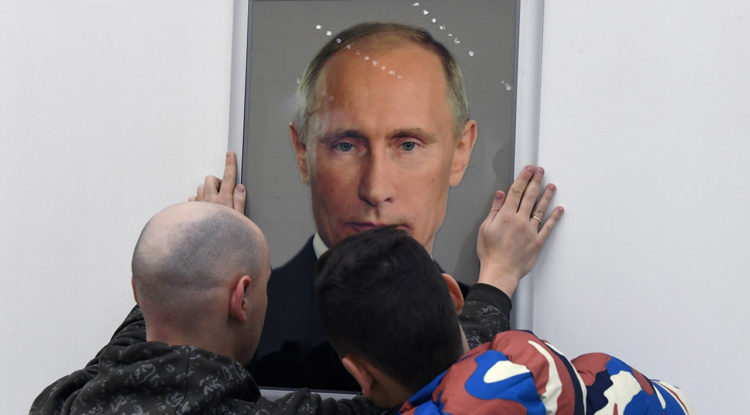
We tell what decisions will probably make Putin after re -election
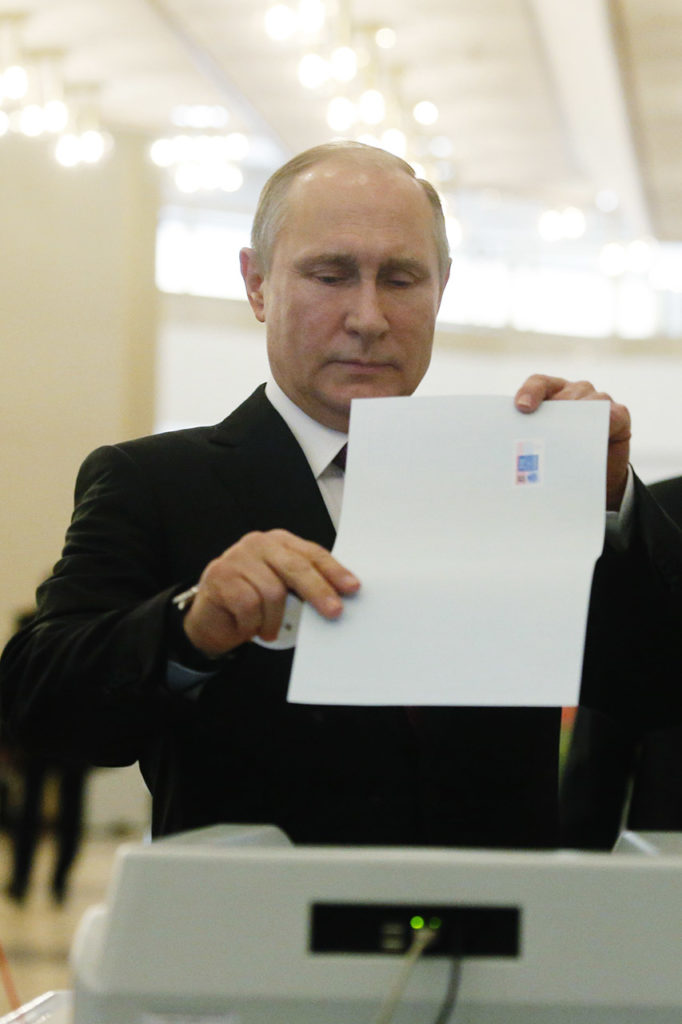
March 15 in Russia began voting in the presidential election. Their result is considered predetermined, intrigues are minimal. For example, can the Putin administration provide him with overcoming a bar of 80% of the vote? Who of the three Kharitonov-Sslutsky Davankov and with what result will take the second place? A much more relevant question for Russians - what will happen in the country after the re -election of Putin? In order to answer this question, the “cold” turned to the “post -breed” experience of other authoritarian regimes and remembered how Putin acted after the elections in 2000, 2004, 2012 and 2018.
In order not to miss the main materials of the "cold", subscribe to our Instagram and telegram .
Morning after voting in autocracy
The main fear associated with Russia after March 17 is a possible strengthening of repression. Its logic is transparent: before the election, the regime tries not to disturb citizens once again, so as not to provoke a protest vote , but after all the ballots are considered, the repressive machine will be launched at full power.
If we talk about authoritarian regimes in general, then statistical studies confirm these conclusions only partly. On the one hand, within six months before the elections in autocracies, there really is a slight decrease in the total number of repressions in comparison with periods outside the electoral cycles. On the other hand, on the eve of the elections, the authorities, on the contrary, increase pressure on political activists so that they do not prevent them from achieving the desired result.
That is, in the period before the day of voting, ordinary voters can feel even more calm than usual, but active participants in opposition movements are at risk.
However, an even more interesting conclusion is that the level of repressions observed immediately after the election does not differ significantly from that which is characteristic of authoritarian regimes outside the electoral period.
This may inspire hope, but do not forget: right now, Russia is unlikely to represent an authoritarian regime typical of the modern world. The country is in a state of intensive armed conflict, the authorities moved to the murders of opposition leaders and the open persecution of disagreements. Even hints of the appearance of an alternative (in the person of Duntsova or Nadezhdin ) are not allowed. In general, political science research makes it possible to identify dependencies and trends, but not to formulate universal laws applicable to each case.
Another frequent companion of authoritarian elections is “political budget cycles”. So scientists call the tendency of politicians who have already controlled power to increase budget expenditures in the pre -election period. Modern authoritarian regimes survive not only with the help of suggestion to voters of fear, but also the purchase of their loyalty. If citizens receive additional benefits from the dictator shortly before going to polling stations, the chance to achieve their voluntary favor will become much higher.
For example, it is known that during the reign of Hosni Mubarak in Egypt, budget reserves were exhausted in the year of the elections, inflation increased, and even jumped up the level of calories per capita. To make the “right” for the mode is always easier for a full stomach.
This is a typical model of behavior for Vladimir Putin. Only in February 2024 he instructed to increase labor wages for doctors , as well as employees of the education system. After the elections, the Russian authorities, as a rule, become much more stingy for promises and additional payments. How exactly this happens - we will describe further.
Moreover, the question arises of how to cope with the obligations already taken over. The plans voiced by Vladimir Putin in a recent message to the Federal Assembly are equivalent to the amount of 7.5 to 17 trillion rubles. Apparently, the government expects to attract additional funds by raising taxes .
Sources of “important stories” report that income tax with income from one to five million rubles per year can be increased from 13 to 15%, and citizens with incomes above five million a year may begin to pay 20%. Of course, the tax reform is due not only to the desire to increase social expenses, but also to an ever -more inflated military budget.
Finally, after the election of Russian officials, permutation probably await. At the same time, do not count on the appearance of a large number of new faces. Over the past 24 years, Vladimir Putin most often preferred not “dark horses”, but to well -known managers and politicians.
For example, in 2016, Vyacheslav Volodin migrated from the chair of the first deputy head of the presidential administration to the post of Speaker of the State Duma; Moscow mayor Sergei Sobyanin managed to work in the same presidential administration and government; Prime Minister Mikhail Mishustin previously led the Federal Tax Service. Therefore, after March 17, officials who have already become familiar with Russians are likely to maintain a high position in the power system, perhaps simply changing one office to another.
The meaning of this endless rotation of the elites is often explained by Putin’s reluctance to allow his associates to bit too much to one place, spreading with strong ties and influence. And the absence of large -scale permutations before the elections is most likely due to the desire not to break the stably working control system at a decisive moment for the regime.
In addition, for the whole class of Russian elites, first of all - governors, the elections are a kind of test for “professional suitability”. Numerous studies show that the preservation of the heads of Russian regions of their posts directly depends on the ability to ensure the necessary electoral result for Vladimir Putin or “United Russia”.
2000: Putin against regions and oligarchs
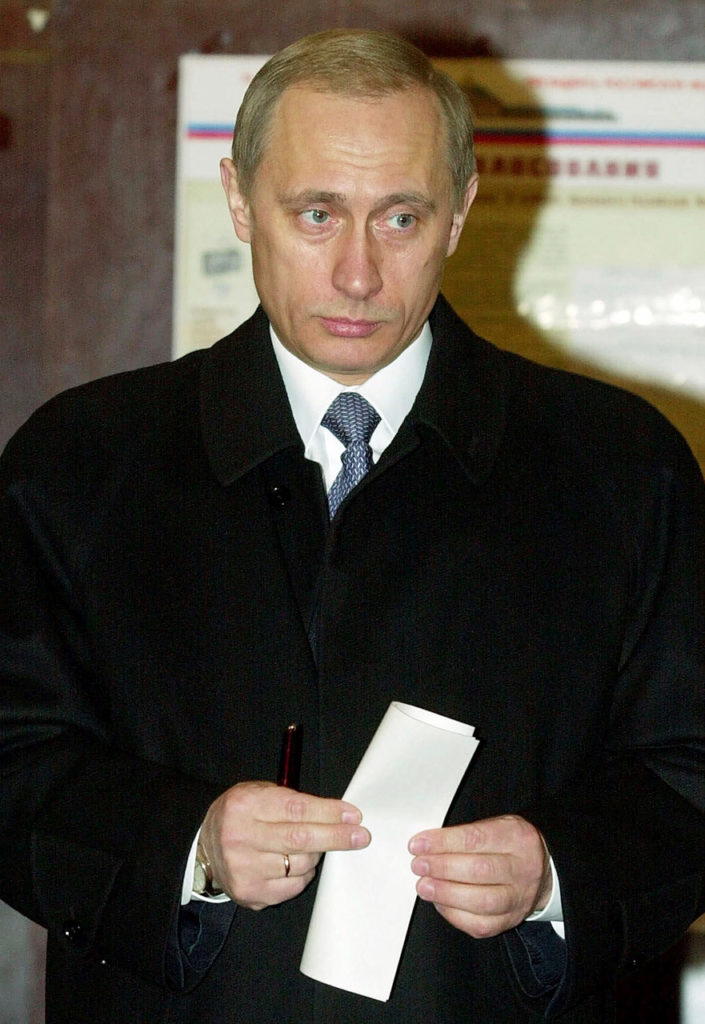
The Russian post -grade future can also be understood with the help of its past. Vladimir Putin intends to get to the post of head of state for the fifth time. Each of the previous presidential terms began with the struggle of a freshly elected leader with people or phenomena that could potentially threaten his power.
The young (he was not even 50 years old), the ex-director of the FSB Vladimir Putin quickly gained popularity as prime minister. The image of an energetic official contrasted sharply with a seriously ill and incoherently speaking to the public Boris Yeltsin. He was added by the tough position of the prime minister in the Second Chechen War: it was then, in September 1999, Putin promised to "wet the terrorists in the toilet." In March 2000, Putin won his first presidential elections with almost 53% of the vote; The closest pursuer, the leader of the Communist Party Gennady Zyuganov, scored only 29%.
Despite popularity, at the beginning of the first period Vladimir Putin did not have a monopoly on power. By the end of the reign of Boris Yeltsin, the leading role in Russian politics was played by oligarchs - entrepreneurs who managed to fabulously enrich themselves during the transition to the market system of the economy. In the second half of the 1990s, the media even used the term “Semibankirshchina” to describe the Russian regime, hinting that real power is in the hands of such influential businessmen such as Boris Berezovsky or Mikhail Khodorkovsky , and not the presidential administration or parliament.
Not even three months have passed since the election completion, when the media Media Magnant Vladimir Gusinsky was arrested on charges of fraud, and then released on a recognition. Soon he was forced to sell his media group to Gazprom and leave Russia. So the state has gained control over the most valuable asset of Gusinsky - NTV, which previously openly criticized the new president.
The next victim of the regime was Boris Berezovsky, with a rich man of the country in 1997 according to Forbes. Having learned that the Prosecutor General’s Office is preparing to re -charge him in the case of theft of funds from Aeroflot, Berezovsky decided not to return to the country from a foreign trip. Later, he will have to sell Roman Abramovich his shares in Sibneft, Rusale and ORT (Channel One).
The new rules of the game were finally voiced by Vladimir Putin at the so -called “barbecue meeting” in 2001: the country's president invited large businessmen to his dacha for barbecue, where he allegedly asked them not to go into politics, in return, promising to get rid of problems with law enforcement agencies.
Not everyone was heeded by the president: in 2003, Mikhail Khodorkovsky, the richest man of the country, openlyannounced his intention to finance the opposition political parties, as well as take a more active participation in the political life of the country. In October, Khodorkovsky was arrested on charges of theft and tax evasion. He spent more than 10 years in the colonies.
People with money were not the only problem for Putin. In addition to them, in Russia there were a large number of politicians who had control over real processes “on Earth”. Mainly - heads of Russian regions. In 1998, they united in the electoral block “Fatherland - all of Russia” (OVR). Such influential politicians as the mayor of Moscow Luzhkov, the governor of St. Petersburg Vladimir Yakovlev and Tatarstan President Mintimer Shaimiev joined him.
Evgeny Primakov, a prominent politician of the Soviet era, was elected one of the chairmen of the association. Media prophesied OVR to win in the 1999 parliamentary elections, and Primakov - the presidential post. This was not destined to come true. OVR took only third place in the elections, losing the Communist Party and the recently created Kremlin party "Unity".
The winners of the elections shared almost all parliamentary positions among themselves, leaving OVR out of work. Primakov abandoned the idea of participating in the elections, and a significant part of the deputies of the association began to support Vladimir Putin, still acting as the president. The oily point was set in 2001, when the “unity” absorbed the OVR, forming the United Russia party well recognized by the Russians.
In the spring and summer of 2000, Vladimir Putin struck several beats on the independence of regional leaders. Firstly, the entire territory of Russia was divided into seven federal districts, in each of which a representative of the president was appointed, in fact-looking after the actions of local politicians. Secondly, the law was abolished, according to which the heads of Russian regions directly represented their territory in the upper house of the Russian parliament. Reform significantly reduced their lobbying capabilities at the federal level.
The problems of oligarchs and governors did not cause compassion for most Russians. The country was rapidly rich at the expense of oil boom and successful economic reforms, and those who made the condition of businessmen or omnipotent “regional barons” in the 1990s could not be suspected of crystal honesty. Nevertheless, it was during the first period that Vladimir Putin managed to radically reduce the influence of those who had the ability to challenge his status.
2004: Putin against institutes
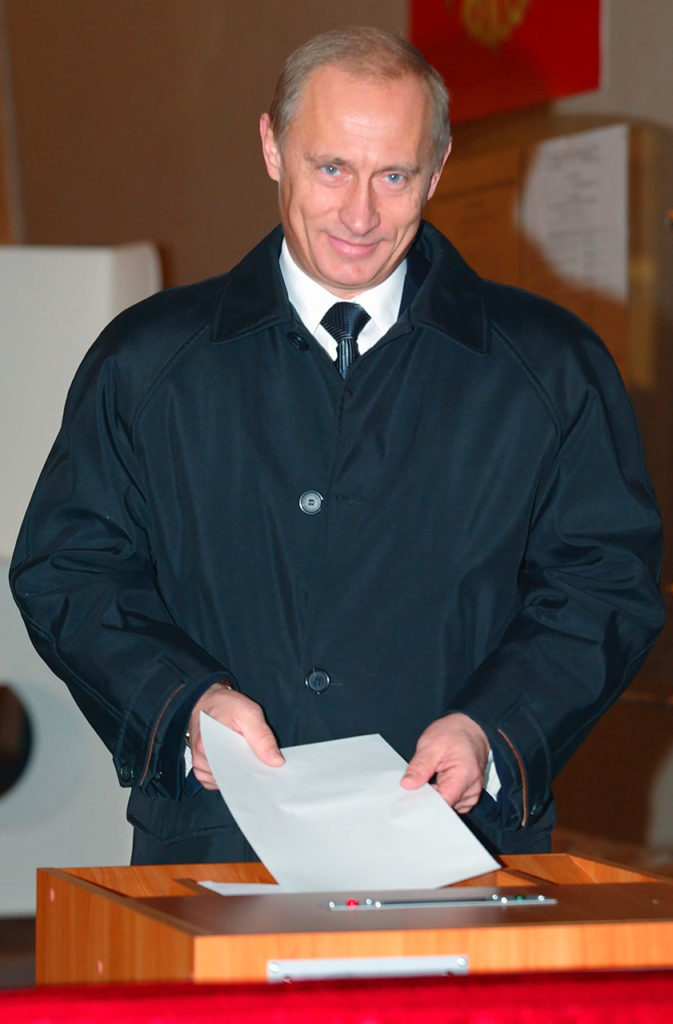
So, influential opponents either became your partners in the United Russia party, or are in prison or London. Of course, you manage to win the presidential election without significant obstacles: in 2004, Vladimir Putin received more than 71% of the vote. Your next logical step can be the destruction of those rules that create the very opportunity for the emergence of new strong players in the Russian policy.
Less than six months after Putin’s election for a new term, the terrorists captured hostages at Beslan school No. 1. More than 300 people died. Hiding behind security considerations, Vladimir Putin canceled direct elections of the heads of the constituent entities of the Russian Federation: now the governors were to appoint regional parliaments at the suggestion of the president. This minimized the probability of the emergence of the head of the region, which has folk support in Russia.
In addition to the unbuttoned governors, Putin inherited from Boris Yeltsin an annoying misunderstanding in the form of not fully controlled parliament. To solve this problem, in 2004 the Russian authorities significantly complicated the rules for registering political parties. For example, now the party could participate in the legal basis only if there were more than 50 thousand people in its ranks (previously the requirement was limited to 10 thousand). At the same time, party members should have been relatively evenly dispersed to different regional departments.
Another important innovation was the abolition of the elections of State Duma deputies in single -mandate districts. Prior to this, Russian voters could separately vote for a political party and separately - for a particular policy that was nominated either from the party or independently; Now they had to choose only between the parties, which later distributed places in the parliament between their representatives. Moreover, in order to hold at least one deputy to the parliament, the party had to gain at least 7% of the vote (before that - 5%).
It is easy to guess that the final result of the reform was the dramatic decrease in the variety of the Russian parliament. If, after the 2003 elections, among the deputies of the State Duma, representatives of the Present, Yabloko, the Union of Right Forces, the Agrarian Party, many self -nominates and even a member of the Great Russia -Eurasian Union could be discovered, then in 2007 only four political forces were able to form their fractions in parliament: United Russia, the Communist Party, the LDPR and the LDPR and the LDPR and the LDPR and the LDPR and the LDPR and the LDPR and the LDPR and the LDPR and the LDPR and the LDPR. "Fair Russia." Each of the “parliamentary opposition” of parties has become more and more dependent on the Kremlin. So Vladimir Putin got rid of potential threats not only in the regional, but also of the federal parliamentary policy.
Around then, Vladimir Putin, another important transformation takes place: he begins to seriously suspect that the threat of his power can proceed not only from the inside of the country, but also from the outside. Now it seems fantastic, but 20 years ago it could be called a "pro -Western" politician. The second country after Belarus, which Putin visited after the official entry of the President, became the UK.
On September 11, 2001, Putin was one of the first world leaders who called the US President and expressed condolences in connection with terrorist attacks. Back in 2005, a large-scale Summit of Russia-European Union was held in Moscow, during which roadmaps were approved for the formation of “common spaces of cooperation”.
Nevertheless, already during the second presidential term in Putin’s public speeches, notes hostile to the west appeared . Probably, a series of democratic revolutions that swept through the countries of the post -Soviet space played an important role in this.
In 2003, after trying to falsify parliamentary elections from the post of President of Georgia, Eduard Shevarnadze was shifted ; The authorities passed into the hands of the young reformer Mikhail Saakashvili. In 2005, the authoritarian president of Kyrgyzstan Askar Akayev was overthrown . But the most painful for Putin was probably the orange revolution in Ukraine.
The Kremlin openly supported the pro -Russian candidate for president Viktor Yanukovych: Putin regularly met with him, the landing of Moscow political technologists landed in Kiev, Ukraine received a huge discount on gas. During the second round of voting, mass falsifications were identified, indignant Ukrainians went to the Maidan, the Supreme Court sided with the protesters. The victory in the third round was won by the opponent of Yanukovych Viktor Yushchenko.
In the book “ All the Kremlin’s army ”, Mikhail Zygar suggests that these events, as well as a discussion of the entry of Ukraine and Georgia into NATO, forced Vladimir Putin to believe that the West not only was behind democratic revolutions, but would also like to realize the same scenario in Russia.
In 2008, the president moved to the post of prime minister: the Constitution forbade the same person to be in the highest post for more than two in a row . However, neither the basic law of the country, nor the political system itself, rebuilt in accordance with Putin's interests for eight years, could no longer prevent him from returning to power in 2012. Even more seriously for an even longer period.
2012: Putin against Russians and the "collective West"
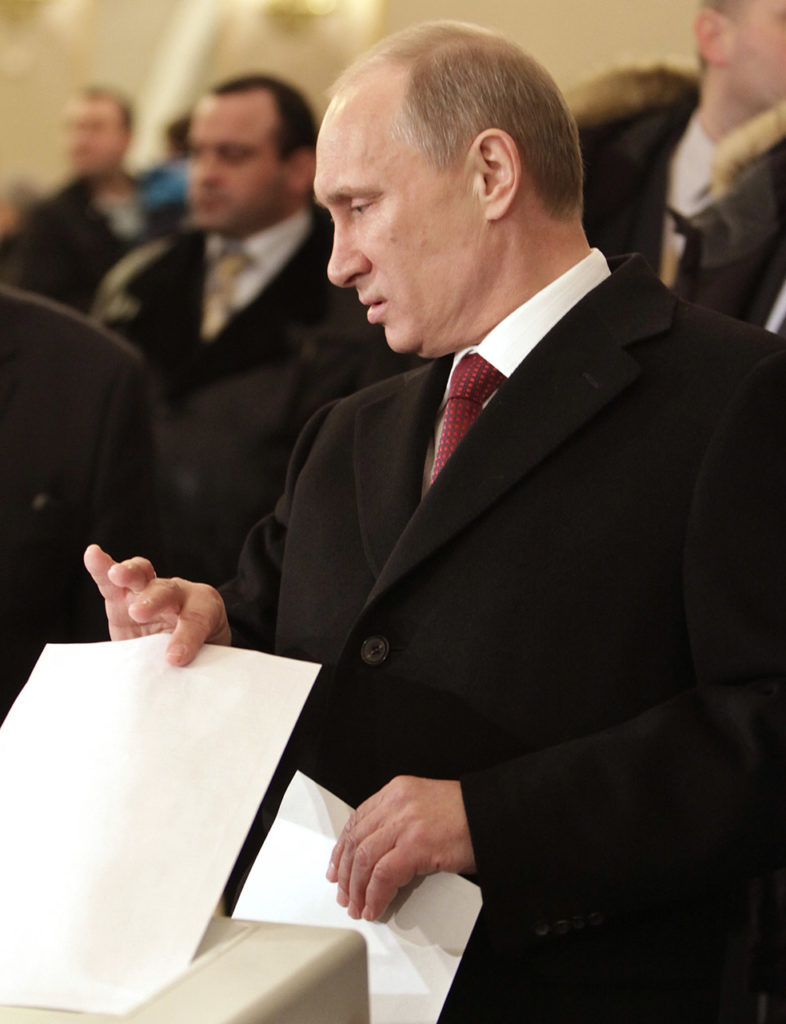
During the presidential term, Dmitry Medvedev, the worst fears of Vladimir Putin became a reality: in 2011, United Russia did not most honestly won the parliamentary elections, and the largest protests in modern Russian history began in Moscow. Putin, of course, did not miss the opportunity to blame the whole of the United States.
After returning to the Kremlin in 2012 (with a result of 63.6%), Vladimir Putin declared war on the Russians who dared to question the legitimacy of the regime. In May 2012, criminal cases were instituted on the fact of mass riots and violence against representatives of law enforcement agencies. Later, the matter will be called “swamp”, 35 people will receive charges. В июне власти ужесточили закон о митингах, увеличив штрафы за «нарушение порядка проведения митинга» и запретив выходить на них в масках.
В июле был принят первый закон об «иностранных агентах», который осложнил работу организаций, получающих иностранное финансирование. Параллельно были заложены основы государственной цензуры в интернете: в России появился реестр запрещенных сайтов, а чиновники получили возможность блокировать сайты без решения суда.
Это было только началом: в 2013 году в России приняли закон , позволивший блокировать сайты за «призывы к массовым беспорядкам»; в 2014 году Уголовный кодекс дополнили статьей, которая позволила сажать на пять лет активистов за «неоднократное нарушение правил проведения митинга»; в 2016 году был принят «Пакет Яровой», обязавший, к примеру, операторов связи хранить данные пользователей, а интернет-сервисы — делиться конфиденциальной информацией своих клиентов по просьбе ФСБ. Началось прямое устранение оппозиционеров: в 2015 году у стен кремля убили Бориса Немцова, в том же году впервые попытались отравить Владимира Кара-Мурзу-младшего.
На фоне протестов Путин начал все чаще говорить о патриотизме и обеспокоился хрупкостью российских «духовных скреп». По-видимому, скрепы должны были быть зацементированы с помощью, например, принятого в 2013 году закона о запрете «пропаганды ЛГБТ». Но самый простой путь к пробуждению в россиянах нужной властям разновидности патриотизма и заодно любви к президенту был обнаружен во внешней политике.
В 2013 году Украина протестовала против отказа президента Виктора Януковича от подписания соглашения об ассоциации с Евросоюзом. В результате попыток подавления уличных акций погибло более 100 человек. В феврале 2014 года Верховная рада отрешила Януковича от власти, бывший президент экстренно эвакуировался в Россию.
Тогда же началась переброска российских войск в Крым: военные без опознавательных знаков появились у правительственных учреждений республики. Вскоре на полуострове был проведен референдум, по результатам которого Россия присоединила Крым к своей территории. Немного позже, весной 2014 года, в Донбассе началась война между вооруженными силами Украины и формированиями самопровозглашенных ДНР и ЛНР при активном участии российской армии.
Крым стал настоящим подарком для Владимира Путина: в 2000-е годы основой его легитимности был стабильный экономический рост, а когда этот ресурс оказался исчерпан, власти сумели найти ему замену в виде чувства гордости за геополитическое «величие» страны. Подавляющее большинство россиян поддержало аннексию, рейтинг президента достиг рекордных значений. «Крымский консенсус», как его окрестили в СМИ, был размыт только к 2018 году, когда власти провели непопулярную пенсионную реформу.
Так Владимир Путин угодил в порочный круг взаимозависимости между внутренней и внешней политикой, а также собственными представлениями о реальности. С одной стороны, действия России в Украине и последующее обострение отношений с западными странами кажутся ему абсолютно оправданным: в президентской картине мира Евромайдан представляется не чем иным, как государственным переворотом, организованным при участии ЦРУ. С другой, в 2014 году он обнаружил, что внешняя агрессия оборачивается значительным ростом рейтинга.
В условиях, когда многих россиян перестала удивлять относительная безопасность на улицах и доступность базовых материальных благ, эта перспектива оказалась слишком соблазнительной. По-видимому, на что-то похожее Владимир Путин рассчитывал и в 2022 году.
Конечно, третий срок Путина не состоял только из мрачных событий. Некоторые решения можно трактовать как вполне «оттепельные»: допуск Алексея Навального до выборов мэра Москвы в 2013 году; освобождение Михаила Ходорковского; возврат прямых выборов губернаторов и некоторые другие реформы . Однако каждое из этих решений тоже может объясняться желанием укрепить авторитарную власть.
Ходорковский был отпущен для улучшения (отмывания) международной репутации перед Олимпиадой в Сочи; допуск Навального должен был продемонстрировать способность режима уверенно побеждать оппозицию даже в умеренно честной борьбе (вышло так себе ). Прямое избрание глав регионов, повышающее легитимность власти на местах, вернули вместе с муниципальным фильтром: чтобы выдвинуться на губернаторских выборах, кандидат должен собрать определенное число подписей депутатов муниципальных советов, которые почти повсеместно контролируются «Единой Россией».
С 2014 по 2018 год Владимир Путин нанес множество болезненных ударов по гражданскому обществу. Несмотря на это, сотни тысяч россиян находили в себе смелость выходить на улицы: на антивоенные протесты в 2014 году, на марш памяти Немцова в 2015 году, на акции против коррупции в 2017 и 2018 годах. В 2019 году люди в ыступали против недопуска независимых кандидатов на выборы, пытались защитить Алексея Навального в 2021 году и Украину в 2022 -м. Но с каждым разом делать это становилось все сложнее и опаснее.
2018: Путин против всех
Четвертый срок Владимира Путина представляет собой наглядную иллюстрацию того, что может сделать политик, планомерно уничтоживший все существовавшие сдержки и противовесы для своей власти. Непопулярное решение, которое будет принято в штыки одной из самых лояльных частей электората? Получайте пенсионную реформу . Арест излишне самостоятельного губернатора? У нас таких нет, но можем посадить пользующегося настоящей, а не воображаемой популярностью Фургала .
Надругательство над остатками демократических норм в Конституции? Пожалуй, стоит организовать референдум прямо в разгар смертельной эпидемии. Самый масштабный вооруженный конфликт в Европе со времен Второй мировой войны и изоляция страны от доброй половины мира? Get and sign. Отравление , заключение в тюрьму и смерть самого популярного лидера оппозиции? Of course.
Парадокс этой ситуации состоит в том, что, воюя со всем миром, Владимир Путин рано или поздно начнет бороться с самим собой. Возможно, это происходит уже сегодня. Вооруженные наемники не могут пойти маршем на столицу страны, где все находится под полным контролем. Вне зависимости от того, чем закончатся текущие выборы, 2024 год почти наверняка станет знаковой точкой в эпохе «Путин против Путина».