Almost 90% of Russian regions in 2023 did not comply with the May decrees on salaries of public sector employees
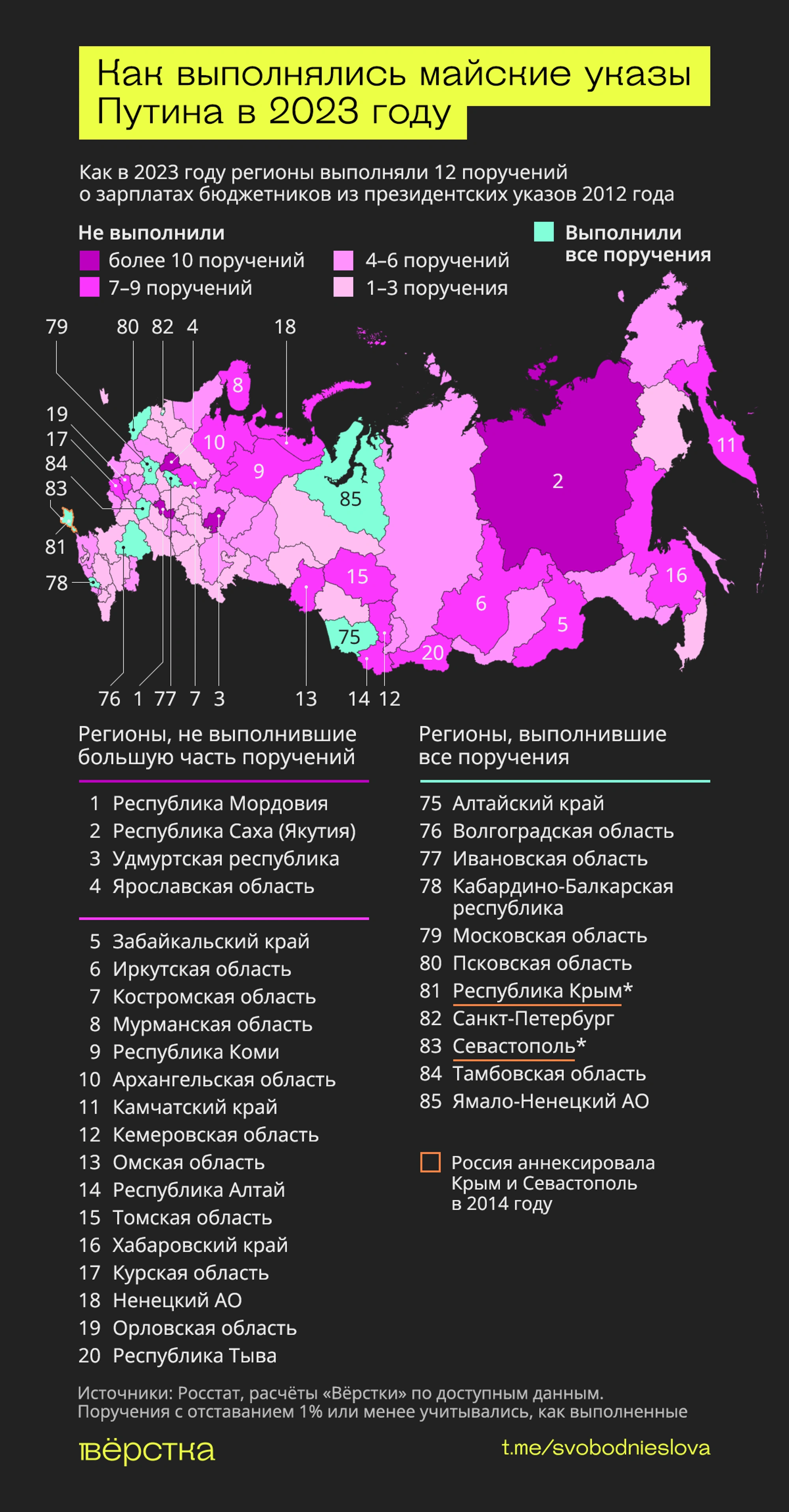
The Russian authorities cannot provide the salaries of doctors and teachers announced at the beginning of the last decade. On May 7, Vladimir Putin’s fifth term in power will begin. Exactly 12 years ago, at the beginning of his third term, he promised to raise the salaries of teachers, doctors, social workers and other public sector employees. This became the main “May Decree” of 2012, which was planned to be implemented by 2018. But even by 2023, only 11 regions can boast of meeting all parameters. The rest now have until December 2024 - but debt overload and local budget deficits do not guarantee positive results.
In order not to miss new texts from “Layout”, subscribe to ourtelegram channel
In October 2023, Putin instructed the Cabinet of Ministers and the regions to meet salary targets by the end of the year. Later, during the annual report of the Cabinet of Ministers in the State Duma, head of government Mikhail Mishustin said that wages in the public sector are “in the area of constant attention,” and 190 billion rubles were allocated for it last year. Putin, in his message to the Federal Assembly, indicated that decrees on state employees must be implemented by December 21, 2024.
How Russian regions carried out instructions on public sector salaries from Putin’s May decrees
What salaries should doctors and teachers have in accordance with the “May Decrees”?
For each category of public sector employees appearing in the decrees, certain amounts are established. Thus, school teachers, orphanages and boarding schools, teachers of colleges and technical schools, nursing and junior medical staff, as well as employees of cultural institutions and social workers should receive the average salary in the region.
This means that a paramedic, for example, from Dagestan should have received no less than 28,931 rubles last year. On average, the salary of local specialists was 31,499 rubles per month. But there is a gradation by type of ownership: employees of federal medical centers earned 30,679 rubles, regional ones - 31,561 rubles. If the institution is on the balance sheet of the municipality, like most hospitals and clinics, then wages in the republic are much lower - 20,072 rubles. A similar situation has developed in Kabardino-Balkaria and North Ossetia.
The salary of nursing staff in the Krasnodar Territory in 2023 was 45,010 rubles, with the regional average being 43,184 rubles. But even here there is inequality between those who work in hospitals of federal (53,001 rubles), regional (44,661) and municipal (24,233) significance.
Uneven distribution of income is also observed in education. A school teacher, for example, from Mordovia in 2023 earned 31,888 rubles. If he works in a republican institution, the salary was 34,719 rubles, if a municipal school - 31,714 rubles, there is no information about the federal level. Moreover, each of them had to receive at least 36,560 rubles per month. In Moscow, such work is paid much higher: 111,744 rubles, with the average wage in the city being 99,029 rubles. By type of ownership, the difference in income is distributed as follows: 117,804 rubles for a teacher from a federal institution, 111,624 from a regional institution, and 115,860 from a municipal institution.
Social workers from the Pskov region received 36,091 rubles last year, a figure that lags behind the average salary in the region by only 2 rubles. There is information only about social centers on the subject’s balance sheet, so it is impossible to judge differentiation. Rosstat provided the same set of data for the Trans-Baikal Territory. Local social workers in 2023 earned 41,535 rubles per month against a target of 55,199 rubles.
According to the May decrees, the work of kindergarten teachers and additional education teachers is prescribed to be paid at the same level as work in the field of general education. In the Stavropol Territory it is 36,967 rubles, but the salary of local teachers lags behind the bar. Last year they received 33,034 rubles per month. There is no information for federal institutions, but regional (35,417 rubles) and municipal (32,940) pay differently. In Chechnya, such specialists are entitled to at least 26,128 rubles. They earn an average of 25,481 rubles, but the gap between types of ownership is colossal: 43,610 at the federal level, 25,300 at the republican level and 25,288 at the municipal level.
University teachers, researchers and doctors are entitled to two average regional salaries. True, if a doctor’s salary in Adygea is 77,033 rubles, and in Ingushetia - 53,739 rubles, then in the Tyumen region - 114,568 rubles, and in St. Petersburg - 157,974 rubles.
“Injustice was inherent in the May decrees from the very beginning. It lies in the fact that the bar is the average salary in the region, and not in the country. That is, for meeting the same federal standards in government institutions, people receive completely different money,” an economist at one of the leading universities in Russia, a specialist in the field of economics of education, who wished to remain anonymous, emphasized in a conversation with Vorstka.
As a result, specialists from poor regions tend to move to places where salaries are higher, or even go to private institutions, the expert clarified.
In Russia as a whole, salary goals were achieved only for doctors (113,602 rubles), university teachers (124,946) and scientific workers (147,007) and cultural workers (57,767). The largest gap in wages is for junior medical staff (47,583) and social workers (47,534) - 16.8% and 16.9%, respectively. The average salary in the country is 57,210 rubles. This is the average monthly salary of Russians in organizations, individual entrepreneurs and individuals. The methodology for calculating it differs from the nominal average salary in the economy as a whole, which in 2023 amounted to 73,709 rubles.
In order not to miss new texts from “Layout”, subscribe to ourtelegram channel
How many instructions from the May decrees have the regions fulfilled?
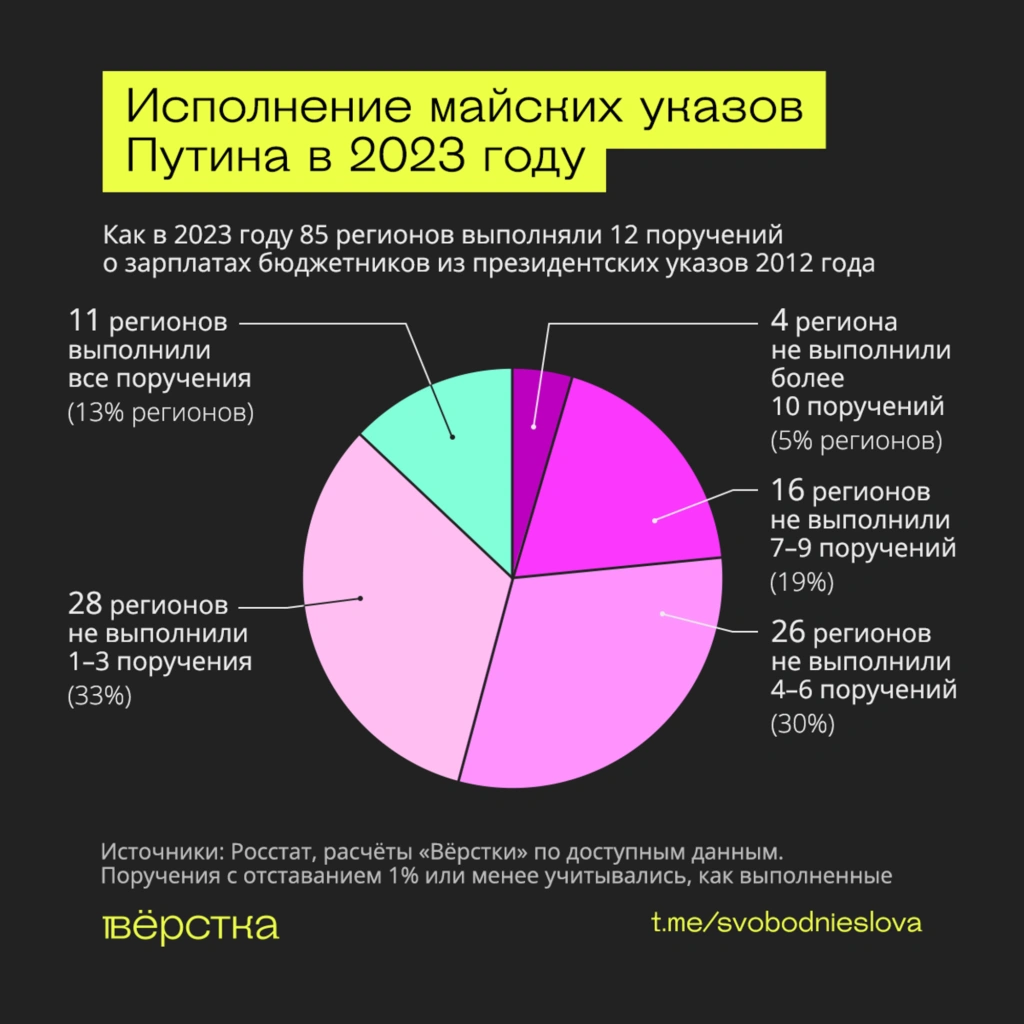
At the end of 2023, “Vorstka” calculated based on Rosstat data, only 11 regions of the country fully implemented wage decrees, which is 13% of all subjects. This material, as well as official statistics, will not take into account the “LPR”, “DPR” annexed by Russia, and parts of the Kherson and Zaporozhye regions.
How many instructions from Putin’s May decrees have Russian regions fulfilled?
A third of regions (30%) failed to achieve four to six target indicators. Slightly more (33%) - from one to three. Another 19% of regions fell short of seven to nine targets, and finally, 5% of regions failed more than ten tasks. The last group includes the republics of Sakha (Yakutia), Mordovia, Udmurtia and the Yaroslavl region.
The worst situation is with the salaries of junior nurses, housekeepers and nurses. 64 regions failed to increase their salaries to average levels in 2023. Moreover, in eight of them the gap with the target indicator exceeds 20% - these are the Kursk, Murmansk, Nizhny Novgorod and Magadan regions, the Republic of Karelia Komi and Tatarstan, as well as the Trans-Baikal Territory.
The best indicators are among university teachers; in this category, only nine regions did not achieve the salary targets set in the May decrees - they receive little in the Bryansk, Kostroma, Oryol, Yaroslavl, Murmansk and Astrakhan regions, the republics of Karelia, Sakha (Yakutia) and Udmurtia. True, there is a lot of closed data in this group; there is no information about the situation in 12 regions.
It is important to emphasize that even when it comes to fulfilling all 12 instructions, the amounts that state employees receive are most often far from the Russian average. For example, in the Ivanovo region, which can boast of achieving all goals, school teachers receive 33,980 rubles, doctors - 62,689 rubles, university teachers - 65,134 rubles, and nurses - 31,373 rubles.
The average accrued salary in the country in 2023 was 73,709 rubles. Even if we compare it with the wages of the same 12 categories of public sector employees throughout Russia, that is, aggregate data for all regions, it is higher only for those who are entitled to double the average indicators - doctors, university teachers and researchers. For the rest, it does not even reach 60 thousand rubles.
Why can’t the salaries of public sector employees be brought in accordance with the “May decrees”?
The most important reason why the salaries of teachers, educators “and other public sector employees” cannot be “stretched” to the level determined by the May decrees is the “total” debt load and deficit of regional and municipal budgets, according to an expert in the economics of education.
“Regions are forced to direct even part of the incentive payments to pay for non-teaching workers. Many schools, with the setting of targets, began to cheat and hire part-time teachers or even less. For example, a geography teacher in a small school - if there are one or two classes in parallel, only a third of the rate or about half is recruited. And the organization has no obligations to such employees regarding the level of salaries,” the expert explained.
An additional payment of five thousand rubles a month for class management from the federal budget was supposed to improve the situation. But until 2023, this amount was not increased or indexed; as a result, it was “eaten up” by inflation, the publication’s interlocutor added. From this year it is 10 thousand rubles, but not for everyone, but only for teachers from settlements where less than 100 thousand people live.
Healthcare expert Nikolai Kryuchkov explains the low salaries of medical workers with a short phrase: “Today this task is not a priority, the state prefers to spend on other goals, we know what goals.” In addition, he believes, the PR fact plays an important role - when you buy new equipment for a hospital, you can call journalists and talk about it, but an increase in wages “can’t really be presented to society.” In addition, in order to comply with the May decrees, many hospitals began to split rates and fire some staff.
“The life of a doctor in the region, and in general, the life of a public sector employee, is, frankly speaking, a semi-poor life. How do we determine the average standard of living? A person must have housing, be able to buy a car on credit, go on vacation at least once a year - not to a neighboring village, but even if not to some expensive resort, but abroad, eat well, buy clothes not when the old ones are worn out. If we are talking about a single person, then perhaps he will still be able to maintain this level, but if he has a family, people whom he supports, then, of course, not,” said Kryuchkov. The regions do not have the funds to increase salaries, and the federal authorities today have “different tasks,” he added.
But for the regions themselves, public sector employees’ salaries have not become a priority for 12 years, notes a macroeconomics specialist who wished to remain anonymous. “The achievement of the May decrees is not strictly administered, that is, there is no connection between their implementation and the approval or re-approval of the heads of the subjects,” he explained.
Economic geographer Natalya Zubarevich sees “nothing surprising” in the fact that wage targets in the public sector have remained unfulfilled. For the pre-war years, the May decrees could still have been a tool for equalizing income, but today “the demand for fulfilling salary orders has dried up.”
“In addition, wages in the economy are growing at a breakneck pace, and the public sector is not keeping pace with the commercial sector,” she clarified. Nominal (before taxes) wages in Russia in 2023 increased by 14.1%. At the same time, the salaries of “May” state employees in 2024 were indexed by only 9.8%, Zubarevich clarified. To equalize these amounts, indexation must exceed the real increase in prices. Previously, the research company ROMIR estimated personal inflation for 2023 at 19.3%.
Putin himself said that the regions do not comply with the May decrees. At a meeting with members of the government at the end of 2022, he said that only 10 regions met the targets for public sector salaries: “And even then, not 100%, but with a 5% deviation.” A year earlier, the academic club "1 July" - an informal association of members of the Russian Academy of Sciences - said that optimistic reports on the implementation of instructions were based on manipulation. Governors, meanwhile, continue to report progress. For example, on May 1, the media of the Vologda region, citing the press service of the local head Georgy Filimonov, reported that the subject had fulfilled all obligations for state employees. In fact, over the past year, the salaries of scientific workers here were not brought to the required level, as follows from Rosstat data.
Let us remind you that earlier “Layout” talked about how Russia achieves development goals by changing calculation methods and drawing statistics, as well as how Russians got used to war and how long it will last.