To finance increased budget expenditures, the state will have to increase taxes
On May 23, Finance Minister Anton Siluanov, speaking in the State Duma, announced a “reasonable progression” in which the change in personal income tax “should not affect the vast majority of citizens, the change in tax rates.” He also said that families with two or more children with low incomes will receive a tax deduction.
In order not to miss new texts from “Layout”, subscribe to ourtelegram channel
In addition, the head of the Ministry of Finance supports the exemption from innovations of war participants in Ukraine. “Our fighters, those who are participating in a special military operation today, need our support. If we can do this through tax proposals, this will definitely be done,” he said, responding to a corresponding proposal from Speaker of Parliament Vyacheslav Volodin.
For the first time, Vladimir Putin announced that the tax system in the country would change during his address to the Federal Assembly at the end of February 2024. “We need to consider a more equitable distribution of the tax burden towards those with higher corporate and personal incomes. And on the contrary, it is necessary to reduce the tax burden on families, including through deductions,” he said then.
Later, in an interview with RIA Novosti, Putin confirmed that we are talking about a progressive tax, clarifying that “I wouldn’t want to go into it” and “we need to work on it.” “Verstka” figured out what the new income tax scale could be.
What is personal income tax and what is it like now?
Personal income tax is a tax on the income of individuals. Now in Russia there is a predominantly flat scale - people with incomes up to 5 million rubles pay 13%, this money goes to regional and municipal budgets. An additional 2%, which is collected from citizens with excess income (more than 5 million rubles per year), goes to the federal budget, and then is transferred to the “Circle of Good” fund, which cares for children with serious illnesses.
Russia already had a progressive personal income tax scale. In 1991, Boris Yeltsin, who then headed the country, signed a law that established a minimum tax of 12% for incomes up to 42,000 rubles, and a maximum of 60% for amounts over 420,000 rubles. The system changed several times, and in 2001 it took on the familiar “flat” form with a rate of 13%.
The flat NFDL scale “was never perceived as a permanent measure, even by its original authors-reformers of the early 2000s,” a specialist in Russian macroeconomics, who wished to remain anonymous, emphasized in a conversation with Vorstka.
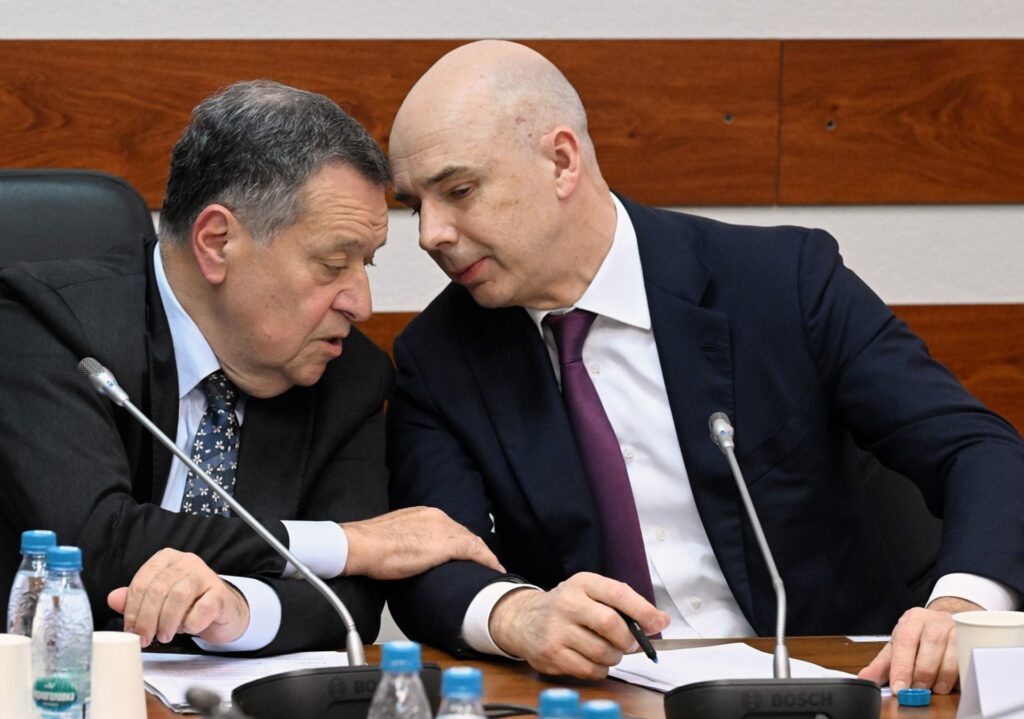
Chairman of the State Duma Committee on Budget and Taxes Andrei Makarov (left) and Minister of Finance of the Russian Federation Anton Siluanov (right) during a meeting of the Expert Council on Tax Legislation under the State Duma Committee in Moscow on May 20, 2024. Photo: Profimedia.
“It was supposed to help whitewash, to become a test period in conditions when the government did not have the ability to administer more complex taxation schemes,” he noted.
What will the new personal income tax look like?
Today, the Russian authorities are still discussing the progressive scale. There are different opinions on this matter. For example, the head of the Duma Committee on the Financial Market, Anatoly Aksakov, believes that citizens with an income of 1 million rubles per year (83,300 rubles per month) should pay 15% personal income tax, and if a person receives 5 million in 12 months (416,700), the rate in his interpretation will increase to 20%. Deputy Chairman of the Parliamentary Committee on Economic Policy Artyom Kiryanov said that for annual incomes above 7 million (583,300) a 16% tax must be paid, and if they are more than 10 million (833,300) - 17%.
Will a progressive personal income tax help replenish the budget?
According to calculations by the ACRA rating agency, additional revenues from tax reform could bring up to 2.5 percentage points of GDP to the budget. At the same time, experts believe that changes in personal income tax may become an incentive to switch to gray salaries.
“In general, the parameters of tax reform will be determined by the need to finance additional expenses. If before 2022 the “normal” level of budget system expenditures was 34–35% of GDP, now it is more likely 37–38% of GDP,” explained an economist at one of the largest Russian banks in an interview with Vorstka.
Some of this additional need has already been provided by changes in the fiscal rule. “The tax reform is designed to ‘fill’ the remaining needs,” the expert clarified.
What is a budget rule?
Expand ↓
Since 2017, a rule has been in effect - if the price of Urals oil on world markets was above $40 per barrel, foreign currency was purchased for the difference in price (this level is called the cut-off price). The purchased currency went to the National Welfare Fund (NWF). If the price of oil fell below, then the currency was sold in the amount of up to 2% of savings per year and, using the proceeds, the budget deficit was covered and the Pension Fund (PFR) was co-financed. In 2022, the budget rule was frozen, and in January 2023 it was resumed with new parameters: the base price rose to $60 per barrel.
The parameters of the tax reform will be adjusted in such a way that, together with the already occurring increase in the cut-off price in the budget rule, additional expenses will be provided at approximately 3% of GDP, the publication’s interlocutor said.
“This will allow us to maintain adherence to the fiscal rule and achieve a zero structural budget balance,” he added.
Before the transition to a flat scale, the maximum marginal rate was 35% - both the government and the Ministry of Finance will most likely use it as the upper limit, in turn, says a specialist in Russian macroeconomics.
“Of the criteria that the Ministry of Finance will focus on, we know only one - the progression should affect a relatively small share of payers. This means that the progressive scale should start from 2 – 2.5 million with a rate of 15% and end with a rate of 25 – 30% for incomes over 30 – 50 million per year,” the interlocutor argues.
According to his estimates, the progression of personal income tax “will generate about 0.5% of GDP in additional income, that is, “about a trillion in 2025 money.”
The introduction of the PFDL progression, according to the economist, is a necessary measure for the government. It is necessary “due to the gradual exhaustion of the possibilities for taxing natural rent.” Around 2020, the tax limit for the oil and gas industry was almost reached, and because of this, the load on other mining industries was increased. Now the authorities can only increase the burden on the income of individuals.
“From the government’s point of view, this is a simpler source of taxes, because large enterprises have associations that can more actively resist attempts to increase the tax burden,” the expert concluded.
How much “progressive” personal income tax does the state receive?
In 2023, due to the “progressive” 2% tax paid by people with incomes of more than 5 million rubles a year, the federal budget received 159.5 billion rubles with total personal income tax collections of 6.5 trillion rubles.
By the end of 2024, the state expects to receive 176 billion rubles from this 2% in excess income.