
Translated material
The turn is prohibited. Why secondary sanctions still work

Despite the common opinion that sanctions against Russia were ineffective due to re-export through Asia, statistics show not such a rainbow picture for the Kremlin. Under the secondary sanctions of the United States, 500 companies have already fallen, mainly from countries such as China, the UAE and Turkey, which affects trade. The import of goods from Turkey for six months fell by almost 30%, about 80% of the payments in the yuan returned . While Asian politicians assure the Kremlin in friendship and partnership, private business is increasingly choosing not to risk it. The sanctions do not lead to the international isolation of Russia, but significantly complicate the purchases of investment equipment and all goods that can be suspected of dual -purpose, and this leads to the degradation of its economy.
Content
An unexpected turn
Deliveries have begun decrease
Golobrota goods
Payments will not pass
An unexpected turn
In early July, a rather unusual event occurred in the world of sea cargo. It happened to the Chinese ship Wei Xiao Tian Shi. This is a 240-meter carrier of heavy goods, built in 2019. Most of the vessel is occupied by a flat platform on which you can place very bulky structures, for example, supports for sea winds of 100-150 m high.
And at the end of March, the Wei Xiao Tian Shi leaves the Chinese port located on the island about 120 km south of Shanghai. On board - two modules for the natural gas liquefaction plant made by a Chinese company from the Wison group. They look like blocks of almost cubic shape, with a height of about a 25-storey house.
A ship with a giant cargo goes to Murmansk, where it should arrive in late May. There, on the assembly platform in the village of Belokamenka, the modules had to go into the hands of the Russian Novatek company, to become part of the third line of the Arctic LNG 2 plant and go already collected two more polar seas to the eastern coast of the OBU lips, to the Gydan Peninsula, to the Salmanovskoye deposit.
These are companies:
Bomesc Offshore Engineering,
Penglai Jutal Offshore Engineering,
Wison Offshore Engineering Module Development,
Qingdao McDermott Wuchuan Module Development,
Cosco (Qidong) Offshore Company.
Countries from which imports grew in the first quarter: India, Malaysia and Thailand.
Trading balance is the difference between export and import. It is a surplus if the export exceeds the import, and is shortage when, on the contrary.
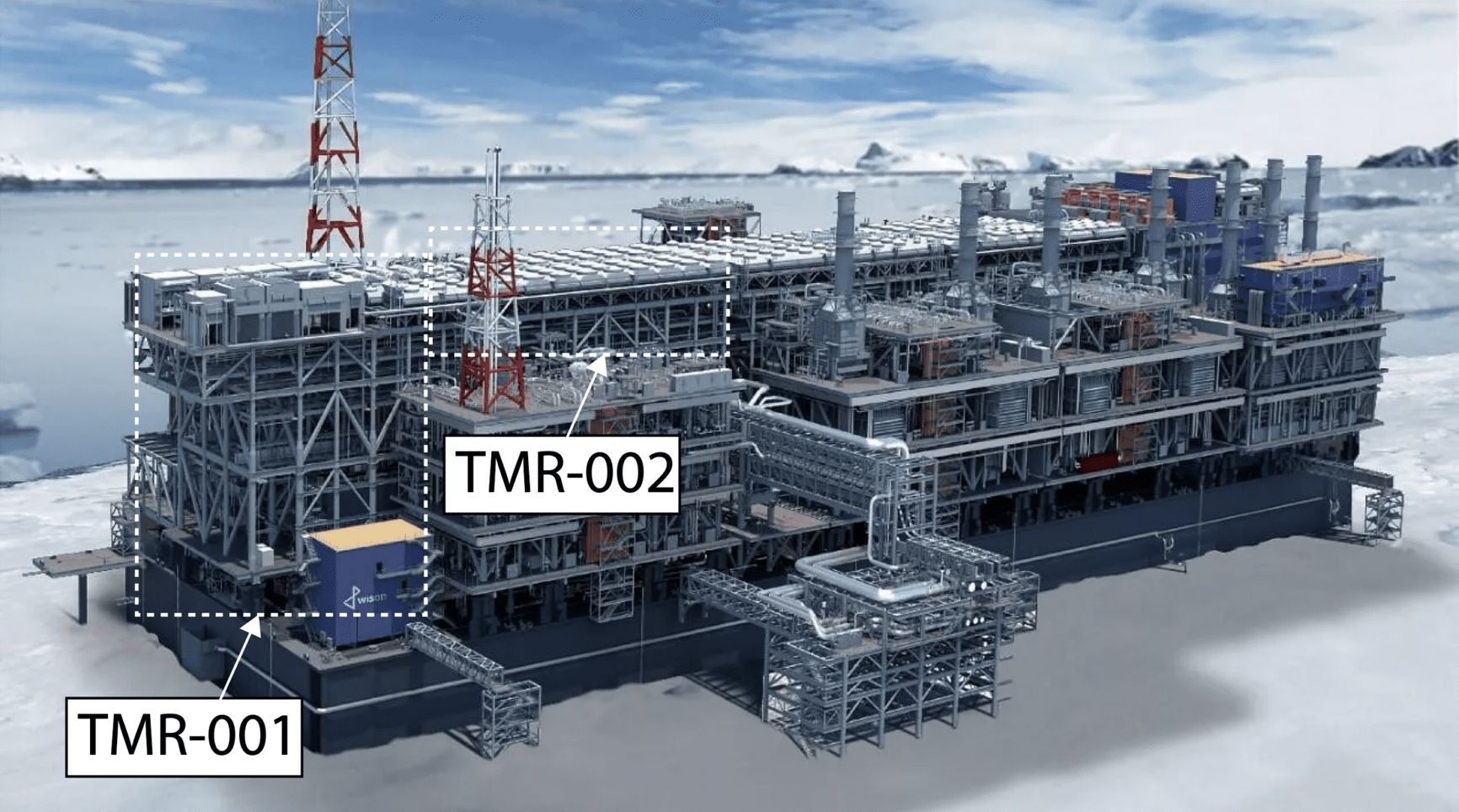
The second line of the Arctic LNG 2 plant, a sketch of the contractor, the Chinese engineering company Wison. The modules transported to the Wei Xiao Tian Shi are allocated. The collected line should turn on only 14 modules
Wison
Having passed the three oceans and rounding Africa, the ship reached the Atlantic waters adjacent to northwest Europe. And then began to loop and circle. May passed, passed June. There were only a few days of the journey to Murmansk. However, in the end, the modules did not reach there. On May 1, 2024, the US Department of Finance included in the sanctions lists of Singapore and Hong Kong shipowners, whose vessels previously drove modules for the second line of Arctic LNG 2 to Russia. Nevertheless, on May 10, Wei Xiao Tian Shi continued its journey to Murmansk. On June 13, a message appeared that the Chinese manufacturer of other Arctic LNG 2 modules Penglai Jutal Offshore Engineering Heavy Industries was subjected to sanctions.
Novatek found in China only five suppliers of modules for a megaproject on the Gydan Peninsula. Together, they set up two dozen modules for the first and second Arctic LNG lines. For this, under the secondary sanctions of the United States on June 12, one of them was already falling - Chinese Penglai Jutal. Wison leaders decided not to tempt fate and announced the immediate and complete exit from all projects with Russian participation. Therefore, on July 8, it became known for sure that the modules, immersed on the Wei Xiao Tian Shi, turn around and go back to China, and those who are waiting for loading to Russia will not go at all. And even the production site itself, where they gathered, will be sold.
Ship services shows that the Wei Xiao Tian Shi has already been decent from Murmansk and goes along the Atlantic shores of Africa back to the cape of good hope.
These are companies:
Bomesc Offshore Engineering,
Penglai Jutal Offshore Engineering,
Wison Offshore Engineering Module Development,
Qingdao McDermott Wuchuan Module Development,
Cosco (Qidong) Offshore Company.
Countries from which imports grew in the first quarter: India, Malaysia and Thailand.
Trading balance is the difference between export and import. It is a surplus if the export exceeds the import, and is shortage when, on the contrary.
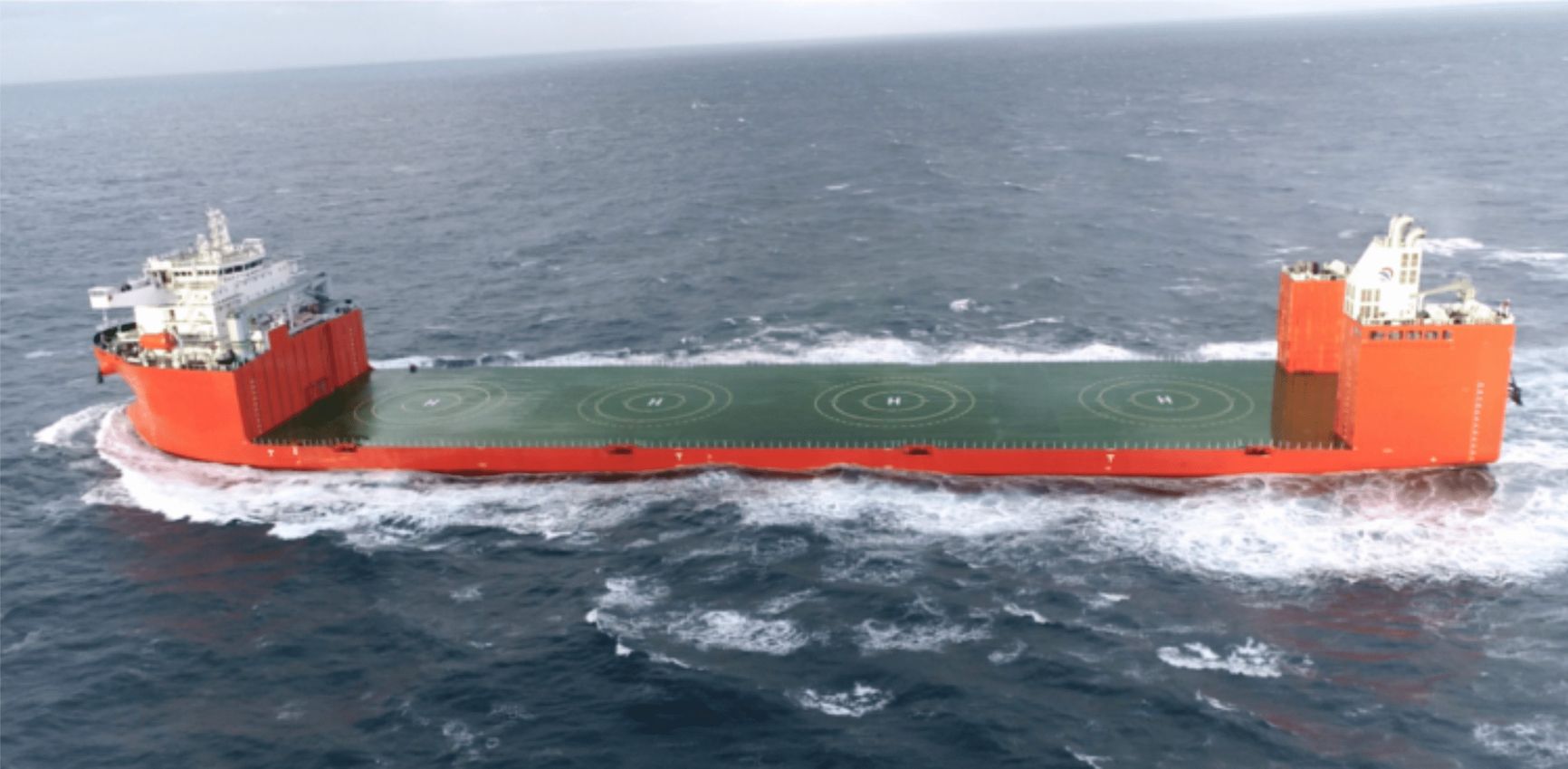
Wei Xiao Tian Shi ship without cargo
Jiangsu Fanzhou Shipping Company
This U -turn is a characteristic and symbolic example of how Asian suppliers behave, faced with the threat of US secondary sanctions. Despite all the optimistic statements of politicians, mainly Russian, about a reliable partnership, companies prefer not to take risks.
These are companies:
Bomesc Offshore Engineering,
Penglai Jutal Offshore Engineering,
Wison Offshore Engineering Module Development,
Qingdao McDermott Wuchuan Module Development,
Cosco (Qidong) Offshore Company.
Countries from which imports grew in the first quarter: India, Malaysia and Thailand.
Trading balance is the difference between export and import. It is a surplus if the export exceeds the import, and is shortage when, on the contrary.
Faced with the threat of US secondary sanctions, Asian companies prefer not to risk
The inconspicuous meetings of the leaders of the PRC and India with Vladimir Putin, after his inauguration, also show the cooling of relations. Can in such conditions Asian partners become a reliable support for the Russian economy, and suppliers are replaced by European ones?
Deliveries have begun decrease
The import of Russia in 2023 was even more than in 2022, judging by the total price of imported goods. He approached the level of the pre -war 2021. Import from Europe fell from $ 89 billion to $ 78 billion, and imports from Asia grew from $ 145 billion to $ 187 billion. It would seem, if this goes on, then Russia will really be able to receive all the necessary imports from the east.
However, in 2024 everything changed. For five months, foreign goods were brought into Russia at $ 108 billion, which is 8.5% less than a year earlier. At the same time, import from Asia was also reduced (by 4%). If the trend continues, then Asian goods will not be able to completely replace European products. This is true for all groups of goods and for specific countries separately.
Russian imports from China for the first quarter of 2024 are approximately the same as for the first quarter of 2023 - about $ 24 billion. But supplies began to decline in May - by 2% by May 2023. Import from Turkey fell by 28% in the six months, according to Turkstat. Amazingly, in January-March, Türkiye put the goods in Russia for a smaller amount than Germany, which returned to second place among the sources of Russian imports.
These are companies:
Bomesc Offshore Engineering,
Penglai Jutal Offshore Engineering,
Wison Offshore Engineering Module Development,
Qingdao McDermott Wuchuan Module Development,
Cosco (Qidong) Offshore Company.
Countries from which imports grew in the first quarter: India, Malaysia and Thailand.
Trading balance is the difference between export and import. It is a surplus if the export exceeds the import, and is shortage when, on the contrary.
In January -March, Türkiye put goods in Russia for a smaller amount than Germany
And Turkish deliveries to Russia are reduced even a little faster than German. In total, imports of three main partner countries in the first quarter of 2023 amounted to $ 29.9 billion, and this year-28.4 billion, which is 5% less.
It turns out that the import of the PRC has stopped growing, from the “unfriendly” South Korea, Japan, Hong Kong, Taiwan (as well as from neutral Indonesia), he decreases, and the rest of the countries , although they increase deliveries, are not able to make up for the departure of the “pro -American Asians”.
Golobrota goods
Why is import important? Because export, if simplified, is needed by the economy only then to buy imported goods. If the state only exports, and in return does not receive anything, it is likened to the characters of Stanislav Lem, who were fed by free food on their planet a huge vile monster and were sure that this is an “export” that was very beneficial for them.
Import in military and semi -war conditions is especially important, when control over physical resources is needed, and the benefits of owning international financial assets are becoming somewhat conditional. A country with a trading balance surplus credits its partners who have a deficit with it. This is what Russia does in relation to China, Turkey, Brazil, and especially to India.
These are companies:
Bomesc Offshore Engineering,
Penglai Jutal Offshore Engineering,
Wison Offshore Engineering Module Development,
Qingdao McDermott Wuchuan Module Development,
Cosco (Qidong) Offshore Company.
Countries from which imports grew in the first quarter: India, Malaysia and Thailand.
Trading balance is the difference between export and import. It is a surplus if the export exceeds the import, and is shortage when, on the contrary.
Russia sends 17 times more goods to India than it receives in return. With her, Russia has the largest surplus of trade. But Indian Rupe is not a freely convertible currency, but to purchase Indian goods on rupees and sell them outside India, as a rule, is unprofitable. Therefore, Russian oil suppliers are accumulating not very useful supplies in rupees in Indian banks. This problem was not resolved during the visit of the Indian Prime Minister Narendra Modi to Moscow.
These are companies:
Bomesc Offshore Engineering,
Penglai Jutal Offshore Engineering,
Wison Offshore Engineering Module Development,
Qingdao McDermott Wuchuan Module Development,
Cosco (Qidong) Offshore Company.
Countries from which imports grew in the first quarter: India, Malaysia and Thailand.
Trading balance is the difference between export and import. It is a surplus if the export exceeds the import, and is shortage when, on the contrary.
Russia sends 17 times more goods to India than it receives in return
Russia takes out 10 times more to Brazil than it receives from it, to Turkey - about 5 times more, even despite the bypass of sanctions and “gray” imports.
With China, the trade is relatively balanced. But here the problem is unilateral dependence. For Russia, China is a number one partner, it gives about half of Russian imports. And for China, the main source of imports is Taiwan, in the second place of the United States, in the Third South Korea, in the fourth Japan, in the fifth of Australia and only in the sixth Russia, whose share in Chinese imports is 5%.
Payments will not pass
Exacerbate the problem of complexity in making payments. The US Treasury warned Indian banks about the inadmissibility of business management with the Russian Military-Industrial Base. At the same time, the definition of the Russian military-industrial base was expanded in June, so now it includes the banking sector represented by Sberus and VTB. Foreign banks that will make payments with them are facing loss of access to correspondent accounts in the United States, that is, to the use of non -cash dollars.
For China, this is even more important than for India. About 80% of the Yuanvial payments from Russia to China do not pass and return back, so you have to use intermediaries for Russian-Chinese calculations. Sometimes these are banks of Central Asian countries, but they also fear secondary Western sanctions and reject about 30% of payments from Russia. The schemes are becoming more complex, slow and expensive.
As The Insider recently found out , the Taiwanese Giant Force was obligated to bypass the sanctions to put an indispensable device for testing the missile corps, but a scheme with the participation of the Chinese factory of the Taiwanese company, the Malaysian transport company and the Kyrgyz bank did not work due to vigilant banks, including Chinese. Fearing sanctions for the export of dual -use goods, they stopped the chain.
It seems that the Asian partners of Russia are increasingly aware of the need to choose with whom to maintain official economic relations - with the West or with Putin and his allies. And they choose the West. This is unlikely to lead to the same breakdown of the connections that Russia and the United States and its allies occurred. However, there will be no growth in trade and investment either, but there will be stagnation or decline. Slow, but comprehensive degradation - this is what awaits the Russian economy in connection with this. Purchases will gradually contract and become more and more “gray”.
The Russian authorities, faced with sanctions, partially realized that imports and international economic cooperation were good even when transactions are made in the shadow sector, without complying with regulatory requirements, accurate reporting and paying taxes under the law. The bills are approved by which cryptocurrencies can be used in cross -border calculations under foreign trade agreements. This means that operations are becoming less transparent both for the Russian authorities and for those who impose sanctions.
But administrative pressure on business has decreased in this regard. Principal solutions in this area will be quite difficult to roll back. Probably, one can hope that the consequences of this forced deregulation will survive both the war and the regime.
These are companies:
Bomesc Offshore Engineering,
Penglai Jutal Offshore Engineering,
Wison Offshore Engineering Module Development,
Qingdao McDermott Wuchuan Module Development,
Cosco (Qidong) Offshore Company.
Countries from which imports grew in the first quarter: India, Malaysia and Thailand.
Trading balance is the difference between export and import. It is a surplus if the export exceeds the import, and is shortage when, on the contrary.
Articles on the topic
Growth is not like people. Why the Russian economy is growing, and the well -being of Russians is declining
Ships-ghosts. Vladimir Milov about why Putin's shadow fleet is not terrible and what to do with it
Abibas returns. Russia is again captured by low -quality goods and counterfeit
We really need your help
Subscribe to regular donations