
Translated material
Autumn censorship marathon
After the summer holidays, the RKN in one fell swoop declared five book sites, five books and four articles harmful. For what?
The first day of September turned out to be hot not only in terms of degrees Celsius. The Prosecutor General's Office and the RKN, apparently having returned from their summer vacations, returned with renewed vigor to book bans. Moreover, this time the complaints against books and scribes turned out to be not only “requests” to remove books and articles from sales and sites, but also bans in the full sense of the word: five sites were included in the register of prohibited information at a time:
Freedom Letters
Babook.org
Goodreads
Ruslania
Book Amaro
A little earlier, Roskomnadzor added Sergei Davydov’s novel “Springfield,” sold on the Freedom Letters website, to the same register. And then he bombarded the publishing house and the Babook book project with letters demanding that four more books be withdrawn from sale:
The long-suffering “Mouse” by Ivan Filippov* (RKN had already tearfully begged to be removed a month ago);
“Not the Last Words” - a collection of speeches by political prisoners in court;
“Suriname” by Oleg Radzinsky;
“Wildness” is a collection of reports from Novaya Gazeta Europe** about how Russia lives after February 2022.
But even this was not the end of RKN’s vigorous post-vacation energy: according to Boris Akunin*, they demanded that four more articles be removed from the Babook website:
poll-voting about the worst ruler;
"Pique vest";
“Yoke with rattles and whip”;
February letter from Ilya Yashin*.
In general, the first autumn weekend turned out to be eventful. But the most interesting thing was not even the post-vacation energy with which the RKN and prosecutors rushed to make up for lost summer days without book bans, but how they explained these bans.
The main explanation was, of course, the standard formulation: “for everything traditional against everything non-traditional.”
Thus, “Springfield” was included in the prohibited register because “it contains prohibited information that promotes non-traditional sexual relationships and (or) preferences, pedophilia, and gender reassignment.”
“Mouse” and “Not the Last Words”, according to RKN, contain:
“False reports of acts of terrorism or other unreliable socially significant information disseminated under the guise of reliable reports, which creates a threat of harm to the life and (or) health of citizens, property, a threat of mass disruption of public order and (or) public safety, or a threat of interfering with the functioning of or termination of the functioning of life support facilities, transport or social infrastructure, credit institutions, energy, industrial or communications facilities.”
Readers are familiar with this formulation from the July RKN hunt for “The Mouse” - and even then everyone was surprised how science fiction can be disseminated under the guise of reliable information and what relation life support facilities, credit organizations and energy facilities have to Filippov’s novel.
But new letters from the RKN made people even more surprised—and not the readers, but the authors themselves: in the novel “Suriname,” which was far from a fishing theme, the Prosecutor General’s Office read information that could be used “for illegal fishing.”
The author of the novel, Oleg Radzinsky, decided to enter into an epistolary dialogue with Roskomnadzor and on the website of the same Babook he repented: he announced that after a long search in the text of the novel for at least some hints about fishing, Sergei Parkhomenko* still found a scene of illegal fishing - which there really is in the text and which is really illegal. It looks like this:
“There were a lot of fish in the river... but he [Oscar Kassovsky’s main character] didn’t have a spoon or hooks. Once he tried to throw a tallit into the river like a net, but the fish did not want to swim inside the strange rag with tassels.”
And it’s true: there’s no point in fishing with a Jewish prayer shawl, the author humbly admitted his sins.
In the end, the RKN press service posted an open explanation for its behavior, which sounded like this:
“The above book platforms contain works containing fake news about the Northern Military District, LGBT*** propaganda, information aimed at destabilizing the political situation in the Russian Federation, as well as discrediting the actions of government bodies of the Russian Federation and the Armed Forces of the Russian Federation. The authors of many of these books and publications are foreign agents, and their works are not labeled: the services did not provide the legally required warning about the author’s status. Some of the founders of these book services are Russians who left the Russian Federation; some of the resources are owned by foreign companies.”
Is it worth clarifying that not a single one of the books and articles—even “The Mouse”—was removed from the sites. In response to this, both Freedom Letters and Babook again stopped opening for users from Russia - again, because after the July war for Sorokin’s “Heritage ” they were already blocked, then quietly unblocked because the AST publishing house, which was suing him, did not provide the necessary documents on time , and now they blocked it back.
The series about the war of the tandem Freedom Letters and Babook with the RKN is all the more interesting to follow because this is one of those rare wars that is not only waged bloodlessly, but also brings obvious benefits - according to the laws of authoritarian marketing, they rush to read prohibited books greedily, making every “ junk” book trend. True, adding literature to the register of prohibited information - in contrast to simple letters of chain with requests to remove books from virtual and physical shelves - has its own legal subtleties. According to OVD-Info lawyer* Eva Levenberg, they are as follows:
“Russian legislation strictly limits the dissemination of information declared prohibited. Reading such materials is not punishable, but their distribution entails serious responsibility, that is, responsibility comes for the “click”. The concept of “distribution” varies depending on the rule of law and can be a criminalized act even if there is a secretive method of conveying prohibited information to other persons.
Officially prohibited is information aimed at promoting war, inciting hatred, promoting drugs and other actions that threaten public safety. For such offenses, various types of liability are provided - from administrative fines to criminal penalties. For example, fines for promoting narcotic drugs can reach a million rubles, and for disseminating false information about the Russian Armed Forces, penalties of up to 15 years in prison are provided.
Thus, any act of transmitting prohibited information to others, including posting on the Internet, may be considered a violation of the law with corresponding legal consequences.”
At the same time, it is quite obvious that there is still no clear answer to the main existential question of the Russian reader of the last two and a half years (“Is it possible to read this book on the subway?”). All that remains is to enthusiastically follow the development of the fascinating game between tamizdat and RKN - and carefully read which “messages of freedom” turned out to be undesirable in Russia this time.
Who was banned
If the media reading audience has already heard about the publishing house Freedom Letters, Boris Akunin’s Babook project, the world’s largest book site Goodreads, the novels “Springfield” and “Mouse,” most of them may not know about the rest of the “figures.” Filling in the gaps:
Sites included in the register of prohibited information:
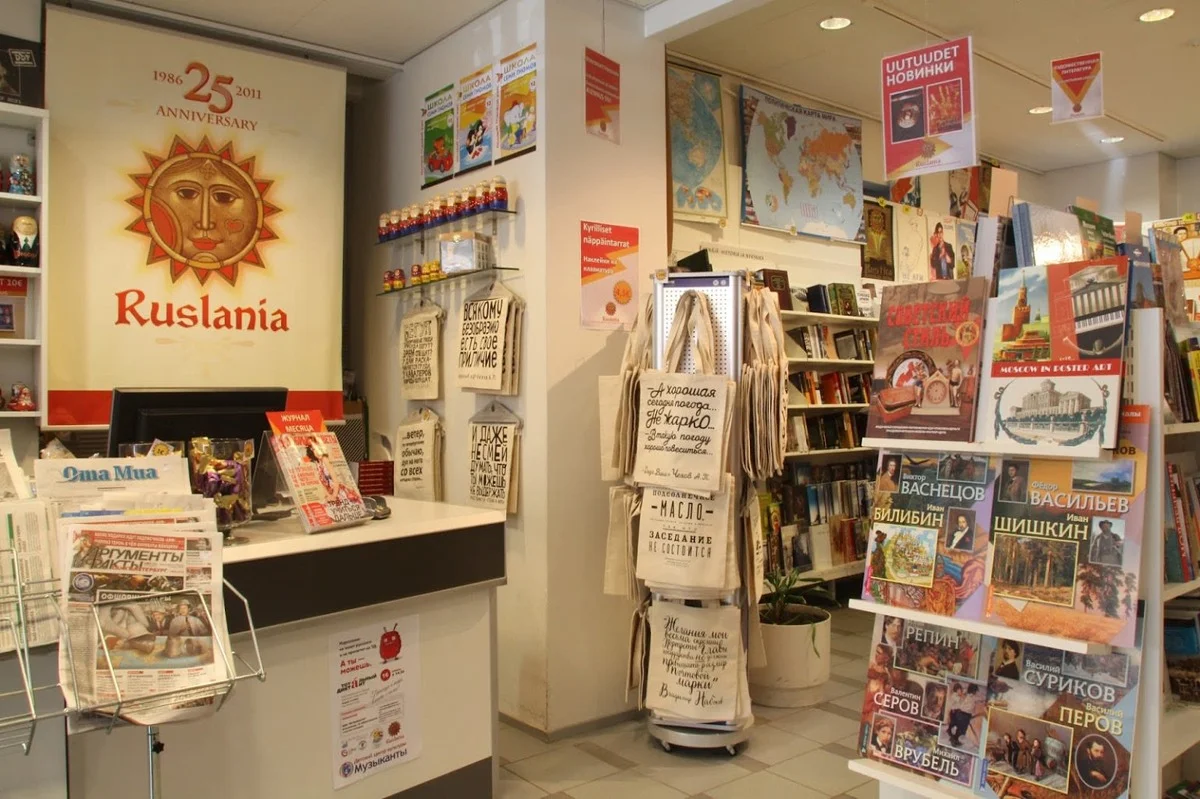
Ruslania
This is the website of the bookstore of the same name, located in Helsinki, a store specializing in Russian-language literature (as well as music and souvenirs). In guidebooks, such places are usually called “corners of national culture” in Europe: everything there is aimed at making a foreigner feel like he is in the center of Moscow or St. Petersburg. In the blessed year of 2012, when the store turned 25 years old, it was visited by Russian Ambassador Alexander Rumyantsev, who was full of delight and compliments:
“In my life I had the opportunity to visit, travel around the world, and in every city I went to Russian book stores. But what I saw in Helsinki, I have never seen anywhere. True, times have changed, but nevertheless: this selection of literature, this opportunity to order any printed publication, any film that is published in Russian, is the thread that connects people living or working here with Russian culture. And this store simply became a carrier of Russian culture in the broad sense of the word, without reference to nationality.”
Then times really changed. The owner of the store, Andreas Agopov, whose father is from Lugansk, said in an interview with Yle in April 2022 that the store faced a wave of hate after the start of the SVO: the store was accused of selling Putin propaganda. Nevertheless, Ruslania fundamentally separated Russian culture from the politics of the “Russian world” and continued to trade in classics and contemporaries.
True, even until February “Ruslania” did not have an easy life: the trauma of the Russian-Finnish war made itself felt, and in one of his interviews Agopov said that some hatred of Russian culture was still felt. But he looked at it with optimism: “Two generations have already passed, now the third will pass - and there will be no hatred left.”
Book Amaro
This is also a virtual analogue of an existing physical bookstore. It is located in Umbria, and it was opened by a Russian emigrant who left Russia after 2022. As stated on the now banned website, the creation of the bookstore was for her an attempt to put her life back together and to try to give support to those Russians who also had to leave the country and now pick it up piece by piece - or piece by piece. The interesting thing is that the store approached these rather abstract and idealistic goals practically: when creating book selections, the team recommends soundtracks, a place for reading, food and drinks, and even weather conditions in which the book is best read. That is, the text goes beyond the pages and begins to resonate with life around, creating an atmosphere and truly reassembling reality.
Books
"Not the last words"
A collection of speeches by political prisoners - the very words that are usually called the last. To the delight of those who open this book, for many of those who were given the floor by the compilers of the collection, it actually turned out to be not the last: among the authors there are many who have been free for a long time (like Mikhail Khodorkovsky *, for example) or who continued to speak thanks to a recent exchange (Oleg Orlov*, Vladimir Kara-Murza*, Sasha Skochilenko). But the central one, of course, is the speech of the one for whom the words before his arrest really were the last, whose photo became the cover, who did not live to be able to speak freely again, and to whose memory the entire collection is dedicated. There are several of these speeches by Navalny in the collection, and in the very, very last one, dated July 20, 2023, he explained why he continued to do his job to the end. The explanation turned out to be simple: “I love Russia.” And then the question somehow naturally arises: are these words taken by the RKN for extremism?
"Wilderness"
And this is a collection of a different genre - albeit also documentary. This is a collection of reports from Novaya Gazeta Europe** journalists talking about how Russia lives after February 2022. These texts, by definition, cannot be published now where they were written.
Babook site articles
Poll-voting about the worst ruler
Boris Akunin - both as an author, and as a blogger, and as the creator of the Babook book club - is distinguished by his interactivity. Rarely does his book or idea reach the publisher without him first consulting with his audience, allowing them to speak out, weigh the pros and cons, and vote. In general, all the sites under his jurisdiction are built on exactly the same principles of freedom and democracy that he has been calling for for years. The poll about the worst ruler is also one of these democratic referendums: the writer was interested in understanding how people’s dislike is distributed if the calculations are done without the opinion of VTsIOM. We will not clarify the result of the vote - this is already clear from the editorial office of the angry Roskomnadzor.
"Pike-vest"
In this post, the writer discusses what the logic of the winner of the previous poll might be—and what it might not be. It is no longer possible to quote this post. At the same time, there have already been a huge number of assumptions about “what the father of the fatherland thinks”, and Akunin, and all of today’s liberal intelligentsia - the stranger is the fact that the RKN was especially dissatisfied with this particular post. Maybe Grigory Shalvovich simply turned out to be very close to the truth.
"Yoke with Rattles and Whip"
A completely illogical ban: a page from the writer’s “Calendar”. In this post, Akunin discusses why elections were needed in the Soviet Union. In the conditions of the Candidate’s proud loneliness, it would be much easier for everyone to simply make him a lifelong candidate and not waste his and others’ time on the election procedure. But no - the elections are underway, and 99.9% - well, or 80% with a discount on modernity - obediently vote for the same candidate who is modestly trampling Olympus. Akunin gives his own version of the answer to the question: “Why is this necessary?” — having written ten volumes of “History of the Russian State,” he comes to the conclusion that this is a matter of ritual. Judging by the reaction of RKN, he was right here too.
Letter from Ilya Yashin*, February 20, 2024
The last complaint of the RKN today is again not about fiction, but about a document of the era: Yashin’s reaction to the death of Navalny. Then this letter circulated widely on social networks - but it especially irritated the authorities, apparently in the context of Akunin’s website. It ends in unison with the words from Navalny’s last word:
“As long as my heart beats in my chest,” wrote Ilya, “I will fight tyranny. As long as I live, I will fear no evil. As long as I breathe, I will be with my people.”
Probably, this is now also considered extremism.