
Original Material
“Not being able to perform in Russia is a tragedy”: Rock musician Boris Grebenshchikov on life after 2022
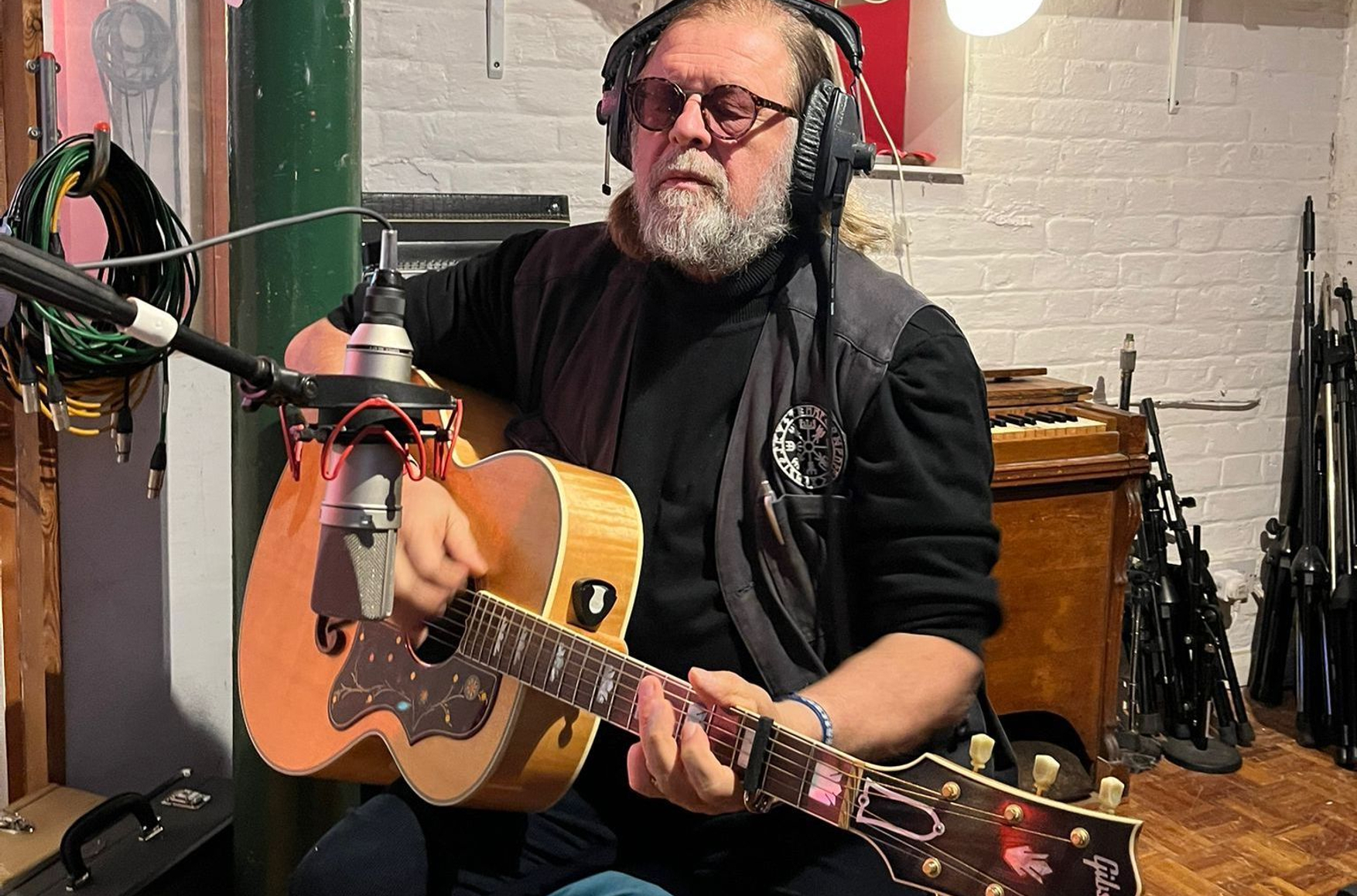
This past September, Russian rock musician and Soviet underground icon Boris Grebenshchikov survived a heart attack that saw him hospitalized in critical condition. He has recovered, much to his fans' relief, and has resumed his tour, which includes a set at the INOY festival at London's Wembley Stadium on Dec. 19, 2024, where he will share the stage with other Russian independent performers: Bi-2, Monetochka, Noize MC, Kasta, and Pornofilmy. Music critic Lev Gankin has spoken with Grebenshchikov on behalf of The Insider to find out more about the festival, his old and new records, and the pointlessness of drawing the line between those who left Russia and those who stayed.
Grebenshchikov put his band, Aquarium, on hold after the beginning of Russia's full-scale invasion of Ukraine, but he still actively tours with his musicians under the signboard “BG+” — and they are even putting out new albums. In the fall of 2022, they completed “The House of All Saints.” On Jun. 30, 2023, the Russian Ministry of Justice labeled Grebenshchikov a “foreign agent,” a move that in no way affected the musician's prolificacy or signature style. His latest creation, “Square Root Sun,” first saw the light of day only a couple of months ago.
For the last couple of years, you've been performing mostly for people who also know English — even though your songs are in Russian. You can't perform in Russia, where you have quite an extensive fan base...
Which makes me very sad.
Do you miss Russia a lot?
'Missing' is not the right word. It's a tragedy. I feel as though I'd left my family behind. I do what I can — after all, this isn't the first time. When we started out in the 1970s, we weren't allowed to perform either. The only way of reaching any audience was to sit in front of a tape recorder, record what you did, and share the result with everyone you could think of. This is exactly what we are doing today.
Do you feel somewhat isolated from Russian reality? A gap between you, your London life, and those who stayed in Russia — a gap that's growing wider?
I understand what you mean. Of course, the experience of living outside Russia is drastically different from that of staying. Mostly because of what everyone in the Soviet Union knew since birth: you cannot call a spade a spade — otherwise, a black police van will come for you, and that was it. “Words for kitchens and words for the street,” the underground nature of the truth — these were the natural conditions of life. They never changed for me, not even when we were at the height of glory.
The current events vividly confirm that nothing at all has ever changed there. People thought they were in for something entirely new. But as you read [19th-century authors] Saltykov-Shchedrin, Dostoevsky, or Leskov, you can see that nothing ever changes.
As you read Saltykov-Shchedrin, Dostoevsky, or Leskov, you can see that nothing ever changes in Russia
And as a result, people are forced to treat one another the way they do. Those born in Russia are destined to experience this way of life. It's like a computer game: you have a level to complete, and depending on how well you play, your further path may differ. Once the level is passed, life takes you to another place, to explore the world further. This is the essence of emigration: welcome to the next stage in your life, where you gain new knowledge.
But it's not always a matter of choice.
Indeed. A lot of wonderful people cannot or will not leave. So they stay. The fact that I can't visit them the way I have for 40 years saddens me greatly. We are trying to maintain the closest possible contact, looking for ways to play an online gig with a Q&A session on Zoom. From what I see online, a lot of people there [in Russia] still listen to our music, just like they did before. Similarly, people who never liked us or listened to us still don't — and it's their rightful choice.
I was happy to learn you'd resumed your tour after being released from the French hospital.
Yes, we're in for an incredible adventure. We have seven gigs planned for December. No flying, though: doctors have recommended staying off planes for a while. We'll see how it goes.
There's also the INOY Festival at London's Wembley Stadium, set to feature other Russian antiwar performers, many of whom, like yourself, have been labeled “foreign agents” at home. Were you involved in the creation of the festival?
God forbid. Moreover, I think I need to unburden my conscience and say it out loud: I believe that any attempts to split people who belong to the Russian culture into two camps and pit them against each other is not even a sin — it's a crime. It's bad enough that so many people in Russia are seething with anger and slinging mud in all directions. If mud begins to fly outside Russia as well, there is no benefit to it.
Any attempts to split people who belong to the Russian culture into two camps and pit them against each other is not even a sin — it's a crime
Nationality is not a place of residence; it's a gene code and an appurtenance to a culture created by a specific community. A Georgian living in Russia is no more capable of becoming an ethnic Russian than an ethnic Russian of becoming Georgian by going to that country. Being for or against the war is not about nationality; it's about conviction. Hostility is a trait of ignorance. If a man is convinced that his pack has the right to break universal human laws, this speaks of his likeness to a beast, not his nationality. Meanwhile, being able to solve a problem without resorting to violence is a quality of developed human beings.
Are you talking about attempts to draw the divide between those who left and those who stayed? Between the so-called emigre scene and the inner Russian scene?
I believe that dividing people into two camps is a great mistake. We all speak the same language. We were all raised with the same worldview. It's high time we stopped trampling on each other as a means of asserting ourselves.
But this is exactly what any festival does: it brings people together. Those who come up on stage do not only speak for themselves, addressing a niche audience. They unite their voices with people they apparently see as kindred spirits.
As a wise man once said, “When you see a crowd, step aside.” We only speak for ourselves. What was important for me about Aquarium was that in a gray, not very friendly Soviet reality, our songs were saying, ‘look, you can live a different kind of life. You can be different.’
Can you see any common traits between the Soviet era and today? There was the underground rock of the 1980s, which brought together vastly different performers — but there was something they had in common, something that made them allies and sometimes friends.
You know, this mysterious “something”...
We could probably find a word for it.
We could, yes. It was respect for each other and a trivial sense of dignity. No one makes you bow to the world, but you shouldn't expect the world to bow to you. We never engaged in either. All we did was remind people that they can be free on the inside: no one can take Homer, Tolkien, Marina Tsvetaeva, The Beatles, or Debussy from you. If you live in a global cultural context, you are already free.
Looking at the INOY lineup, some may say, here you go — these are also musicians who possess a sense of dignity and inner freedom. BG, Monetochka, Noize MC...
I am sure they are all wonderful people and it will be my great pleasure to shake their hands. There is one thing I can't figure out: why does the festival poster feature some kind of cockroach in a top hat and with a black eye? Is that how the organizers see INOY [the Russian word for “different”] — or is it an act of ideological sabotage? (smiles ironically) What on earth happened to good taste?
Anyway, Dionysius the Areopagite was right to say that tastes differ. Those who will come to listen to us had nothing to do with it.
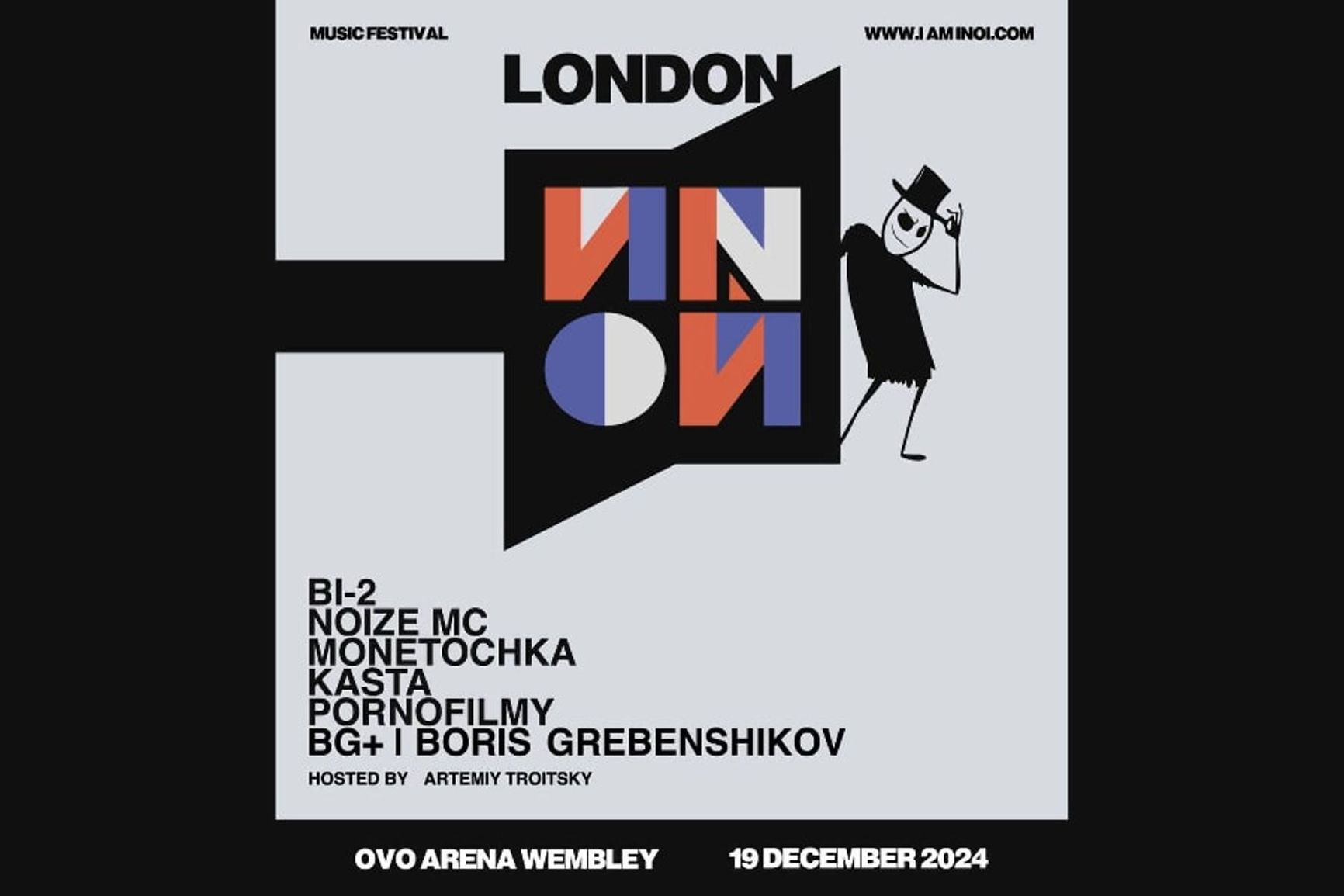
The poster of the ИNОЙ (INOY) festival
Before the interview, you warned that you were busy at the studio. What are you working on? A new EP like the ones released in the last two years?
Yes, another EP. There are records we made with Seryozha [Sergey] Kuryokhin in 1991 at the request of his manager — eight songs in English. Subsequently, those tracks mysteriously ended up erased by employees of the Melodia label.
Hang on, is it the same era as his “Detsky Albom” [“Children's Album”]?
Correct. “Detsky Albom” partially consisted of those songs, reimagined by Seryozha [Kuryokhin] without my input. He was absolutely in his right to do so — and I'm glad he did — but I have a different vision of these songs, and they hold a different meaning for me. I have the discarded versions of two of the songs on tape. Thanks to AI, we can now extract individual instruments from them and improve the sound quality.
In addition to those two songs, there is one that I never completed in 1990, and another two songs from 1999, recorded for Mad Now Disease, a band that was conceived with Dave Stewart but never came to be. In 1998, he offered me to start a band but soon received a call from Annie Lennox, who said they should relaunch Eurythmics.
I openly told him that in my opinion, Eurythmics was way more important than any of our ideas. But the songs are still there. I haven't thought about them in a while, but stumbling across them recently, I realized that the five songs put together make for a very convincing cycle, even though they are in English. This cycle fits perfectly into my current reality. So we gathered at the studio to dust them off. I haven't got the slightest idea what will come out of it. But I feel I must see this though, even if not a single person hears these songs.
When you wrote songs in English in the late 1980s and early 1990s, did you have to break any habits? Or, to put it more mildly, make a special kind of effort?
I don't see any benefit in breaking. Broken people aren't good for anything. Quite the contrary. What I wrote in English, I could never write in Russian. This was what I liked about “Radio Silence”: this album was an opportunity to express my feelings differently, using different terms and different words — a different kind of myth. After all, there's a certain difference between [Alexander Pushkin's] “The Tale of the Fisherman and the Fish” and “The Hobbit.”
Still, Kuryokhin's manager must have had a different agenda when he asked you and Sergey to make an English-language record. Market potential and all that...
You're probably right. But market potential is not my concern: I was interested in trying it for reasons of my own. I had the fantastic privilege of knowing English since childhood. And while it wasn't easy to start writing songs in English for “Radio Silence” in the late 1980s, I wrote songs in English back in the late 1960s for the school band I was in. I have to tell you that mastering two languages — two different methods of communication — is a huge blessing.
The cover of your latest album, “Square Root Sun,” sports a man with a ball of fire for a head. Many noticed at once that the string section for “Angel” had been orchestrated by Tony Visconti. Have you known each other long?
You could say we've known each other for a long time, but we still haven't had the chance to meet in person. We've spoken on the phone and exchanged messages. We wanted to meet up in London, but when he got there, I was at the hospital in Nice. I hope to finally see him early next year.
In my social media feed, many wrote, “Wow! Tony Visconti himself! Incredible!” Some felt differently: “What's the deal with Visconti anyway, why the obsession?” Boris Grebenshchikov does not need validation through collaborations, as outstanding as his collaborators may be. How important is this alliance to you? Is it that he's not just a solid professional but someone who worked on “Ziggy Stardust” and “Heroes” yesterday, figuratively speaking, and is working on “Angel” today?
Out of Tony’s works, early T.Rex albums hold the biggest importance to me. In the mid-1970s they largely shaped who I am as a person and songwriter. Tony is one of the two people who taught me how the string section can sound in a song — he and George Martin. “Angel” found its true sound for me when we added our strings. All of a sudden, the song got a new life. But then Tony presented his version, and I heard the magic that affected me so much in the 1970s — and the flow of time was restored.
How would you describe this magic? Are there words for it?
It's as though music were playing in the forest at night — all by itself.
“Angel” is over 30 years old, but it was never recorded until now. Why not?
I wish I could explain it to you, but I can't. It suddenly resurfaced from Lethe and said: my time has come. I'm happy that I never recorded it in all this time, because whenever I listen to what we have come up with, my hairs stand on end every time the guitar joins in. With a method unknown to science, we achieved what I'd wanted from the very start but never knew how to do.
And it somehow resonates with the times we live in: “Show me happy people, and I will show you death.” As I listened to “Square Root Sun,” I got the impression of a very distinctive, dynamic arc: from darkness to light, from “Angel” and “Plokhaya Pesnya” [“Bad Song”] to “Phoenix” with its “Let's get rowdy, let's sing songs,” and “Pyat Utra” [“Five in the Morning”] with its light melancholy.
I'm happy that the album elicits such a response. I never took the time to think about it, but it may have been my subconscious intention. Normally, as you arrange songs in order, you try several options and realize what would never work and what is the right order.
How did you come up with South African musicians for “Phoenix”? Everyone was surprised about Tony Visconti, but I was more surprised with the choir, percussion, and the wind section from Cape Town.
I made a note to myself about South Africa a long time ago. As usual, everything worked out miraculously. For a few years, we've been working with a remarkable gentleman named Chris Kimsey. He has a fascinating gift for a Westerner: he can make your voice heard on the record. As a rule, vocals don't get a lot of attention here; what matters is the grand total. But Chris works his magic and makes sure my voice is heard — and conveys what I want to convey. So I had this idea for a specific rhythm in this song. I approached Chris, who made a call and found a guy in South Africa, whom we called immediately.
By word of mouth, you mean. Your guy makes a call, and then his guy makes another call...
Isn't that how the world works? In any case, what you can hear in “Phoenix” is probably one-tenth of what we recorded together. We must have tried all of the instruments available in Cape Town to find the best match for the song. And we only left those that make the song vivid and tangible.
What about “Pyat Utra” [“Five in the Morning”]? In your Aerostat broadcast, you introduced it simply as “the last song.” And indeed, it is the last one in the album. But somehow your words felt more meaningful. As if you had meant more than its position in the tracklist.
In fact, it is the real title — “Poslednyaya Pesnya” [“The Last Song”]. To avoid any fuss, it's been called “Five in the Morning.” But to me, it's still “The Last Song.” Because I've got nothing to say beyond it. And I don't know what happens after.
Oh.
And everything that's been happening to me since confirms that it is exactly what I called it — the last one. I've somewhat changed. I see life differently; I see myself differently, and I see music differently as well — the same goes for making music. Even my singing has changed. And I'm not complaining. What I wanted to do with my life is done. Everything I'm doing now and what might come after is already a bonus.
What I wanted to do with my life is done. Everything I'm doing now and what might come after is already a bonus
When did that shift to a different perception of reality occur?
When my heart stopped on a plane, and I was technically declared dead but then was miraculously brought back.
I'm sorry if that may sound unethical but I've given a lot of thought to something that wasn't common in popular music before but occasionally happens now and floors me every time: songs and albums explicitly conceived by their authors as a goodbye. David Bowie, whom we mentioned earlier, and his “Blackstar.” Leonard Cohen's “You Want It Darker.” When the musician consciously tells us and himself that this is it, full stop. I was wondering if you...
No, I'm no good at goodbyes. I'm not sure about new songs — that's up to God — but we're about to finish the five songs I was telling you about (the EP will most likely be titled “Pictures of You”), and I already know what we'll be doing next, because I have a few unrecorded blues tracks.
Oh!
And since I've been making friends with so many fascinating people, I have the chance to record them the way they deserve.
Wonderful. That is, we can finish our interview with something other than thoughts of death. Again, apologies for raising that topic.
You don't need to apologize. Death is a key notion. Castaneda always said that death is the best counselor and always stands behind one's left shoulder. It should always be the starting point, as it provides boundaries. Meanwhile, his best buddy, Laozi, noted that an artist has too many colors, and a poet has too many words. If you don't set boundaries for yourself, you'll end up being superfluous. Once you realize that the boundaries are there, that everything has an end, you can set...
A deadline.
A deadline, yes. In its most literal sense. But we still prefer it to be the other way around — a lifeline.