
Translated material
Vaccine for an emigrant
The premiere of the play “Healing” took place in Estonia: how did the production turn out with Chulpan Khamatova and Yulia Aug about the intrigues around the charitable foundation
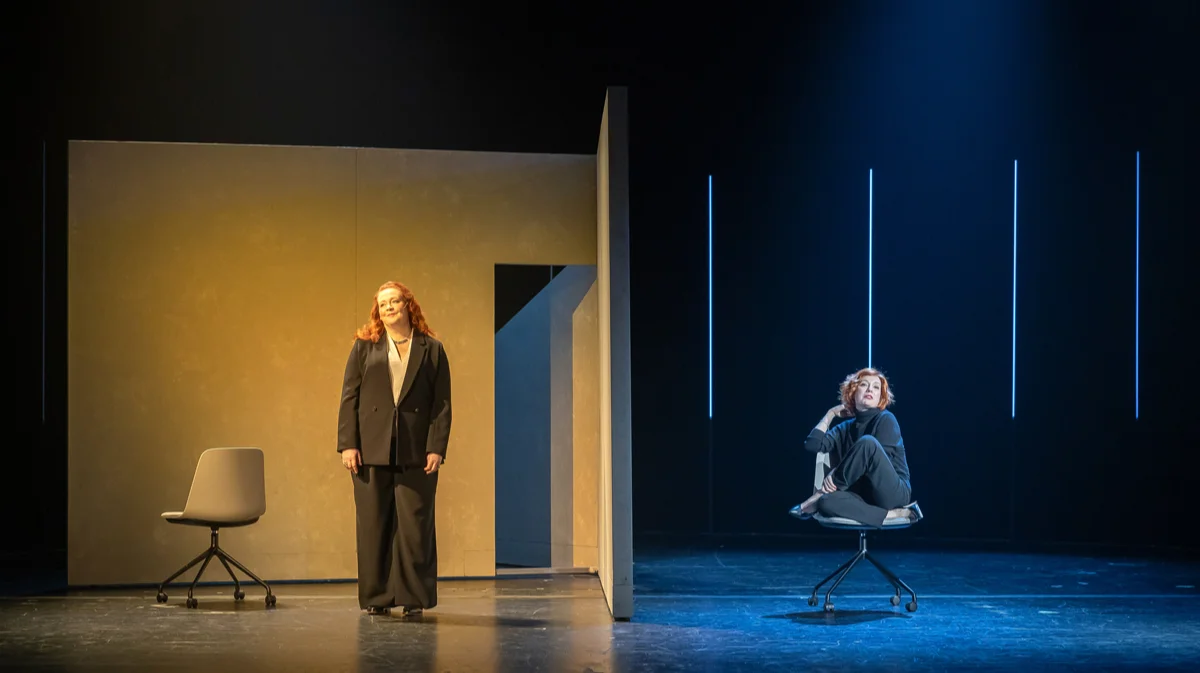
Photo: Siim Vahur
The general producer of the theater project Vaba Lava (Estonian “Free Stage”) Märt Meos is a master at coming up with all kinds of collaborations. Without them, his brainchild, completely deprived of government funding, despite the importance of the mission, would have closed long ago. They no longer have premises in Tallinn: only the black box in Narva remained, where rehearsals for “Healing” took place, a commercial collaboration in which Meos united three countries along the Baltic Sea.
In Estonia, the word “commercial” does not carry that despicable trail that bearers of Russian culture by default have in mind. It simply means “self-supporting” or “expensive.” Tickets are really not cheap. Therefore, the play was rehearsed in Narva and shown to “their” audience there as a pre-premiere run-through, but the premiere on December 3 and 4 was played at the Russian Theater in more solvent Tallinn. On December 9, the production arrives in Riga, followed by London.
“Healing” is entertainment for the wealthy viewer, invented specifically for two very famous actresses who ended up in two neighboring countries.

Once upon a time, such states were called limitrophes - bordering on something large and not very peaceful. No matter how infuriating this may be for the Baltic countries, which have gone far into Europe compared to other colonies of the USSR, their position is now as precarious as it was during the period between the world wars. Finland, despite having the longest border with Russia, feels more confident, and this is reflected in the play by Durnenkov, who now lives there .
The action takes place in conventional Europe, and the play is about the Healing charity foundation, which was founded in exile by Philip Cohen, a native of the USSR, who spent his entire life searching for a cure for a fatal disease with a complex name. He dies of brain cancer, and his daughter Anna (Julia Aug) becomes the head of the foundation. Born into prosperity and studied at the best universities, she has retained her father's language, but she is not very good at managing things. And then there’s this journalist Sonya (Chulpan Khamatova), who is investigating fraud in the management of the fund.
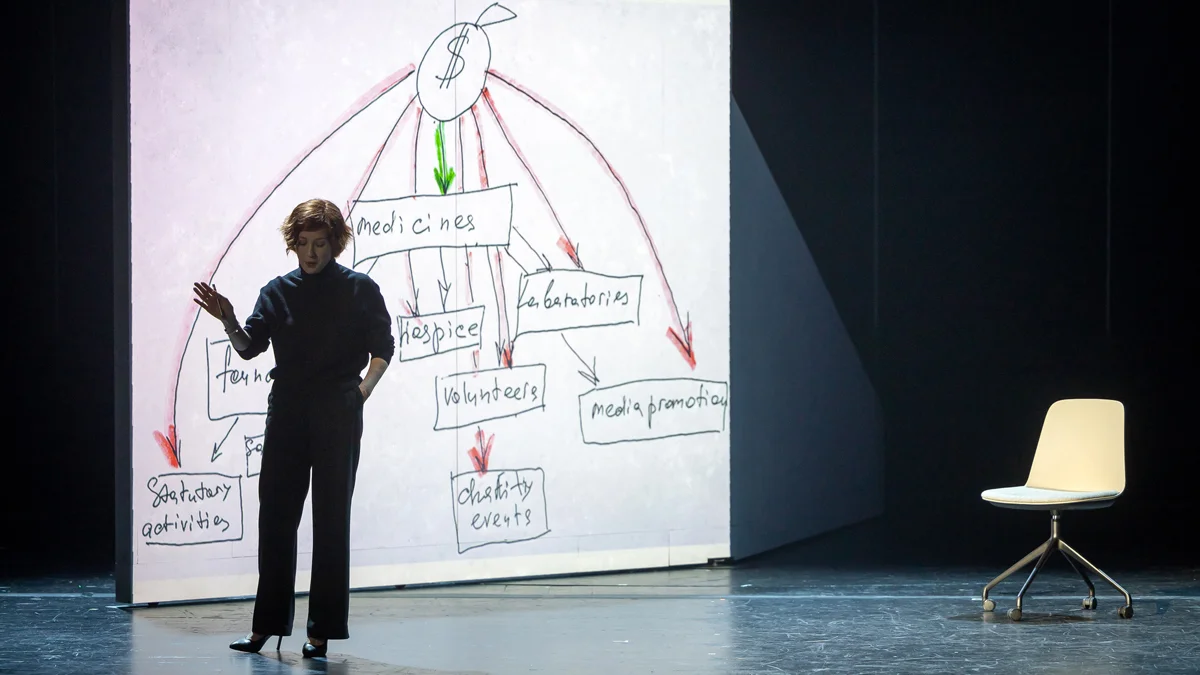
It would be tempting to see this distribution of roles as a play on real biographies. Chulpan Khamatova is known for her charitable activities - everyone knows about the “Give Life” foundation, founded in 2006. Yulia Aug also worked as a trustee for the Zhivoy and AdVita foundations. However, superficial parallels lead in the wrong direction. In the end, Durnenkov is an outstanding playwright, who still would not limit himself to such a simple “temptation”.
In an interview that Julia Aug gave to the author of this text shortly before the premiere, it was said that people often do not live their own lives. They deceive themselves with habits, traditions and a sense of duty, following the expectations of others. What they really need, they may never know, rolling to death on rails that they did not lay. This hidden, unrecognized tragedy characterizes people who are not equal to themselves and are accustomed to pretending to be someone else. People with an exorbitant “super-ego”, that is, proud of their ability to be “good” - first for those close to them, and then for everyone else.

The heroine Aug is just such a person. And what helps her understand this is the trouble in the shell of another person. This man is filled with a thirst for revenge: this is not just some corrosive journalist - there are skeletons chattering their teeth in the family closet. This turn immediately emphasizes the Russian origin of the characters, despite the neutrality of their names. Their lives are determined by family values, which do not allow them to develop.
Therefore, real life begins only when they have the strength to send these values to hell.
This is where the benefit of the country in which Durnenkov found himself manifested itself - not in the nervous Baltic, but also not somewhere in Germany, rich in Russians.
Technically, the performance is made in an emphatically artless manner, although its scenography requires a turntable, that is, the correct theatrical machinery. Elmars Senkovs, who worked for a year as the artistic director of the Latvian National Theater and staged a lot at the Mikhail Chekhov Theater in Riga, in Liepaja and Valmiera, provided the actresses with a benefit performance. Their main roles also include secondary characters. Khamatova is especially active in transforming herself - either into a demonic lawyer (a caricatured scoundrel), or into an equally grotesque billionaire - the main trustee of the fund.
Senkovs has already worked with the Free Stage: his hilarious production “Two Garages” is still sometimes performed in Narva, where there are two actors from Latvia and two from Estonia on stage. In “Healing,” the principle of the Baltic neighborhood is preserved, but with emigrants the matter is complicated by their irrevocable background, which cannot be ignored. Moreover, it is here that it is both a resource and a subject of comprehension. Until recently they shone in Russian projects and are now spat upon by the propaganda there from head to toe, the actresses of “Healing” play themselves here in the sense that they are looking for an answer to a question common to all: what to do, where to go...
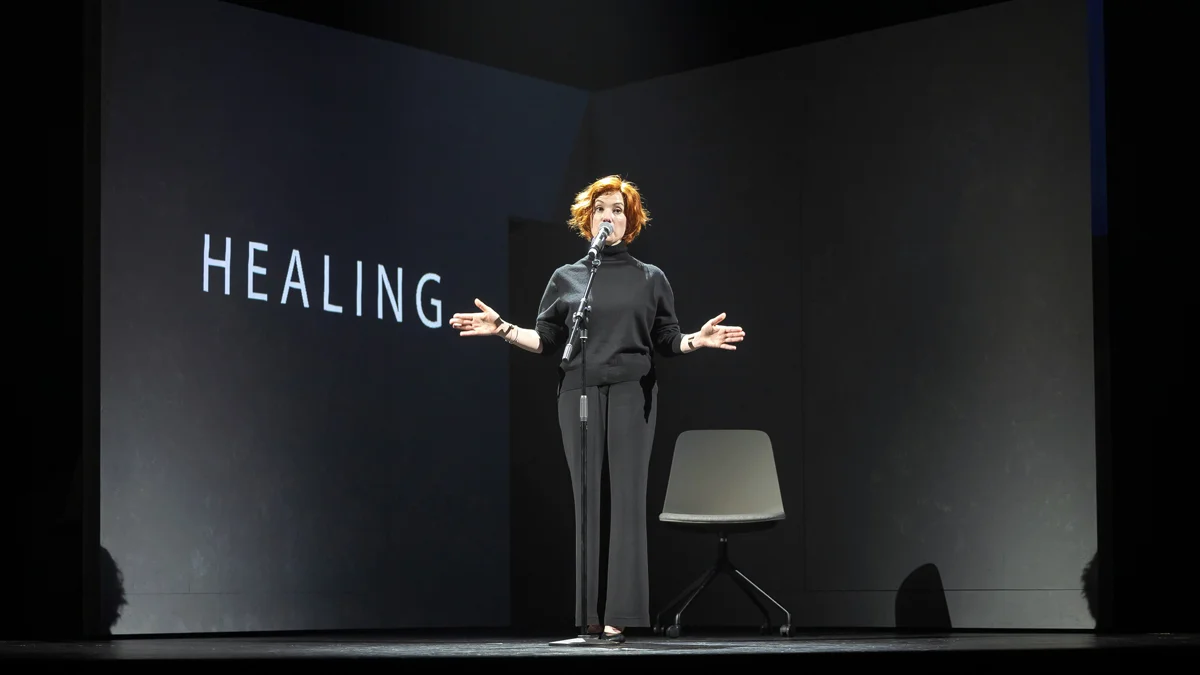
“Healing” is an allegory of the new wave of Russian emigration, which, like none of the previous ones, left prepared. These people were not thrown into the void by the revolution and were not deprived of citizenship for their dissident exploits. Such, of course, do occur - like greetings from the Cold War era. But mainly these are people who were simply able to leave. They had documents, a supply of money, and most often, knowledge of languages and a set of skills that could be sold, and even without being strictly tied to the host country. It is these people who are often called upon to be aware of their privileges. And from all sides.
These are no longer those foreign Russians who preserved the archaic language and honored the Orthodox rite, carefully taken to the Rue Daru. They are already completely Western in appearance and touch; all that remains is to heal from passions based on family ties and finally become free people. The stage conflict clearly invites the viewer to become bolder.
To finally step over the outdated identity that the homeland, persistently directed to the past, is so desperately grasping at.
However, the example of Chulpan Khamatova clearly shows that you can leave Sovremennik and Theater of Nations at the call of your soul, but they leave you with difficulty. The actress can truly do anything, she is an absolute pro. And so much so that there is a lot of ringing metal in her voice and movements. Like hitting a gasoline can - a sharp and immediately melting sound. And nothing responds, except that “it’s boring to live in this world, gentlemen!” - melancholy and that’s all.
In this situation, Aug, with her strengths and weaknesses, looks much more alive, and this is not only the effect of her role. She may not be able to do something and is not afraid that they will see it. Human evolution is evident in the design of her role and in her own image. It's fascinating to see this interaction between closed and open structures on stage. The second is less advanced and very poorly protected, which ensures a response. But the first one probably shouldn’t, it’s not about that.
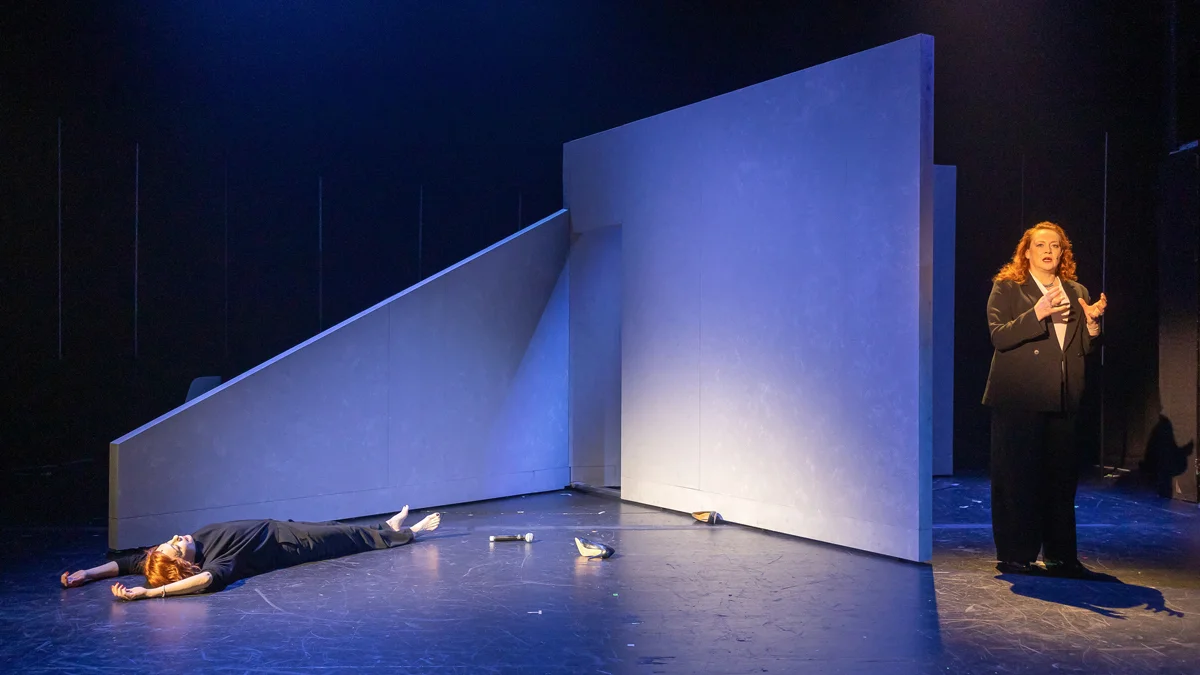
...The thunder of applause died down at a signal from Chulpan Khamatova - she immediately called the founder of a volunteer project helping Ukrainian children onto the stage and addressed the public with a request for its support. This is such a job, such are its features. There is a possibility that the effect will be more significant in London - the productivity of emigrant labor is higher there.