
Translated material
Good news 2024: “Vorstka” shares good memories
Especially for “Layout” Shulman, Moniava, Vilenskaya, Kashin, Goralik, Kazantseva and others share good memories
“Verstka” asked scientists, writers, doctors, activists, musicians and other people our audience follows and loves to share at least one good news or good memory for 2024. Many admitted that this was not an easy task and answered: “Yes, we are alive and thank God,” or “Nothing good comes to mind right away.”
However, we have collected 10 life-affirming (or almost) stories - from Lida Moniava, Asya Kazantseva, Anna Vilenskaya, Oleg Kashin, Sergey Ievkov, Linor Goralik, Andrey Kuraev, Fyodor Katasonov and Grigory Sverdlin.
In order not to miss new texts from “Layout”, subscribe to our telegram channel
Grigory Sverdlin
head of the Nochlezhka charity organization and head of the “Walk through the Forest” project, which, after the start of mobilization, helps Russian men evade conscription, leave the country and find refuge
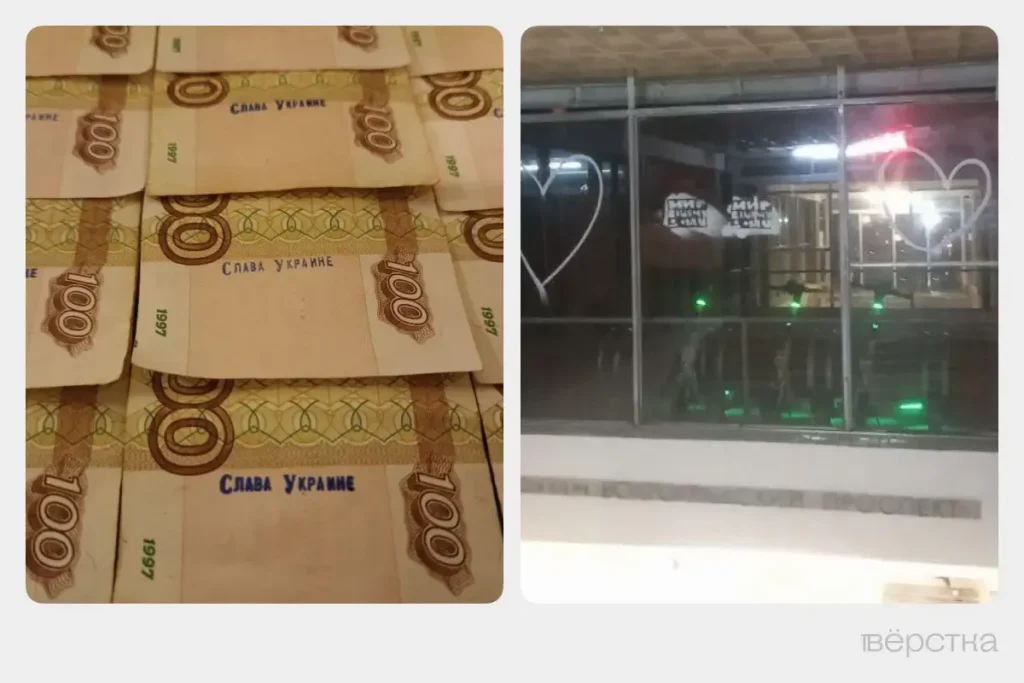
In 2024, 2,921 people from Russia sent us photos and videos of anti-war actions - people put up anti-war stickers, put “no war” stamps on banknotes, and even posted “ Go through the forest ” QR codes in a military unit. I want to say a huge thank you to these brave and strong people.
Anna Vilenskaya
musicologist, composer
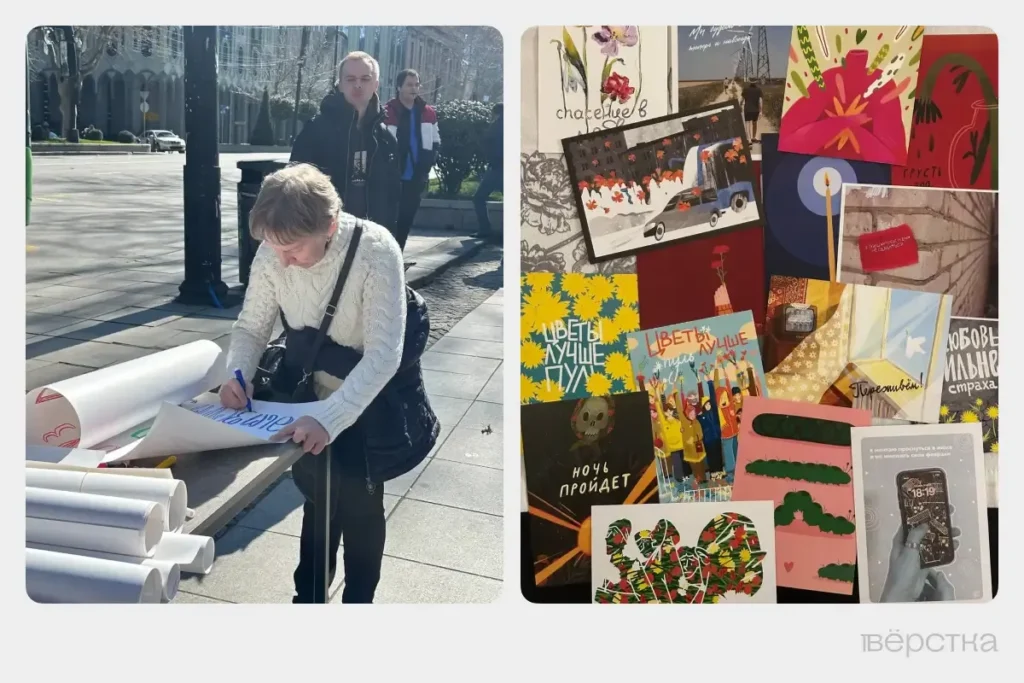
On March 17, a rally took place in Tbilisi. All over the world, people stood in lines at the “ noon against Putin ”, and we did not have a Russian embassy, so those who did not go to vote in neighboring Yerevan gathered for a solidarity rally. I brought a pack of postcards with an anti-war theme to the rally and put them on the table where people were making posters for themselves, so that everyone could take a beautiful, supportive postcard. At some point, an elderly woman approached the table and grabbed the entire stack. I tensed up. I think, why does she need so much?
I ran up to the table and asked the woman not to take all the cards. We started talking. It turned out that this was a woman named Olya. She has been corresponding with political prisoners throughout Russia for many years, and she began to do this long before the war. Olya saw the postcards and immediately wanted to send them to political prisoners. She and I exchanged contact information and agreed that I would definitely print another batch for her. Soon I left Georgia, and my friend Anton brought postcards to Olya after I left. I still remember Olya with a kind word and am glad that I have such loving, consistent, wonderful fellow citizens like her.
Right while I was typing this message, Olya congratulated me on the New Year. I think this is a sign that I chose the right inspiring story!
Asya Kazantseva
science journalist
With good news, it's a bit sad these days! But, for example, I liked the investigation that anthropologist Alexandra Arkhipova and linguist Daniil Skorinkin released recently. They became interested in the personality of Anna Korobkova, who endlessly wrote denunciations of anti-war Russians, collected 74 of her texts, carried out a stylometric analysis of them (that is, looked at which words and grammatical structures were especially characteristic of them), and formed a hypothesis about the real personality of the author, which, as it turned out, fits well with other data, from biographical details to the model used camera
The key clue for the researchers was the vanity of the author, who himself wrote an article on Wikipedia about his subpersonality, was unable to resist numerous interviews and public statements both under his real name and under a pseudonym, and generally left many traces.
Thus, this case illustrates that there is a correlation between moral qualities and mental abilities ! Academic researchers, by the way, are quite seriously considering this hypothesis and finding confirmation for it (one, two, three). Developed abstract thinking goes hand in hand with theory of mind and the ability to imagine the complexity of the world. And if someone is stupid, then the world for him is black and white, simple and understandable, subordinate to selfish interests.
Oleg Kashin
publicist
I’m not sure that this event has any social significance - this is my story. In the spring in Paris, for the first time in my life, I met my long-term co-host of streams, Mikhail Svetov. We have been discussing the events of the week on air for four years now, he is in Brazil, I am in England. And it seems, what's the difference? A conversation is a conversation, and the Covid remote environment has taught everyone that you can talk to a square on the screen.
And all the more surprising for me was the effect of this sharp, literally shock return to normality, when you are talking not with this little square, but with a living person . Some reflexes awaken, but they appear to be lost. When any relationship - with like-minded people, with opponents, with enemies, with friends - in any case takes into account the context of everyday life. From having your children baptized to, so to speak, “punching them in the face.” Ordinary, normal life means that you can quarrel with someone, but then you meet every day at work and leave the entrance together.
And the Internet reconfigures relationships in a different way: a small quarrel that would otherwise go unnoticed offline - and you press a button, and the person essentially disappears. Now, in conditions of emigration, when the former old Moscow is scattered across different capitals - and not only the capital - all over the world, a person really disappears with the press of a button, and you treat yourself like someone who plays a continuous and, in fact, sad computer game.
And this rare, one-time and almost shock return to normality shook me up and reminded me that everyone is living people and we must not forget about it.
This sounds naive and, perhaps, childish, but it seems to me that most of the problems and conflicts that we are seeing now are due precisely to the fact that too many people have turned into accounts for each other. I don’t know how appropriate this intonation of a New Year’s toast is, but I suggest you always remember: we are living people.
Ekaterina Shulman
political scientist
I remembered an inspiring event, or rather, a series of events: the Vesuvius Challenge project and the deciphering of burnt papyri from Herculaneum (note: an ancient library that archaeologists found in the 18th century during excavations of a villa destroyed by the eruption of Vesuvius) using human and artificial intelligence.
It all started with the word “purple,” which the researchers were able to read, and then they read parts of the treatise of the philosopher Philodemus. Now we know more about the history of the academy and the supposed location of Plato's grave!
And in September in Egypt, unknown passages from the tragedy (or tragedies) of Euripides were deciphered .
In general, there is a feeling that thanks to new technologies and some kind of revival in this area of science that I don’t fully understand, we are rising to a new level in our knowledge of antiquity. It was as if there had been a long plateau when we were exploring the known, and now there was a new breakthrough.
Of course, I am sharing only my amateur feelings. But when I read about the success of Vesuvius, my first thought was: “The end of the world is being postponed.” If people are capable of this, civilization will still survive.
Lida Moniava
founder of the House with a Lighthouse foundation, which helps seriously ill children and young adults
Five years ago, the “House with a Lighthouse” acquired an apartment in which children from Moscow boarding schools with serious illnesses began to live. They are already over 18 years old, and if we had not taken them to the apartment, they would have ended up in a penal institution, which means prison and quick death. The boys and I always have chaperones, so they can do a lot of things: they constantly go to museums and concerts, study at school, and this year they even went to the seaside. I don't get as much done as they do .
And this year we opened another apartment. She was left as a legacy to the “House with a Lighthouse” by school mathematics teacher Ninel Moiseevna Mishuris. Young adult hospice patients settled there who found themselves in a difficult life situation: there was no one to care for them. They could go to a boarding school, and we took them to an apartment. And I am very happy. Because they went to the Volga in the summer, and then to St. Petersburg, and are already planning where else to go. They go to clubs and concerts, learn to plan their budget and earn money, travel around Moscow by metro and buses, invite guests and celebrate holidays with friends - in general, they do everything that all young guys do.
Sergey Ievkov
Head of the Charity Hospital in St. Petersburg
The main event of the year is that our Charity Clinic is fully operational. Since January, we have received 1,240 patients - homeless, refugees, people without documents or citizenship. And our monthly flow now is 550 – 600 people.
Here's just one story. Andrei is 37, he was hit by a train and miraculously survived - he woke up in the hospital after several operations. To save the man, doctors had to amputate his right leg.
Andrey does not have Russian citizenship, so he cannot register for disability and receive a free prosthesis. There is also no money to pay for production in a workshop (about 400 thousand rubles).
After being discharged from the hospital, Andrei could no longer work at a construction site and pay rent, so he ended up in a homeless shelter. In January, Andrei attended his first appointment at the Charity Clinic. And... we decided to try to make a prosthesis for the patient ourselves so that he could start walking again. Medical technician and Hospital volunteer Kristina Tseveleva got down to business.
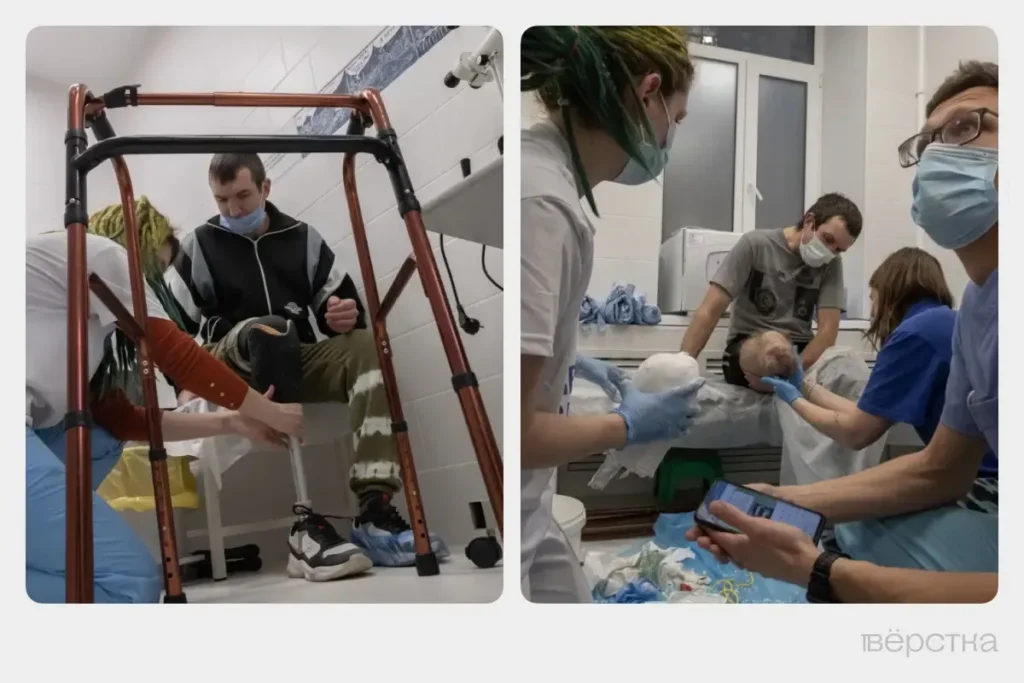
The components were found on Avito - thanks to the help of the Kinonia club, we bought a metal shin, an artificial foot and connecting devices for 15 thousand rubles . Now Andrey walks on a prosthesis and works.
Linor Goralik
writer, comic book artist
Trying to answer the “Layout” question, I realized that all my options boil down to the overall picture: my main joy this year was to see over and over again how many people - those who work in civil and anti-war initiatives, in NGOs, in volunteer helping projects, in independent media - do not give up in the midst of darkness . And first of all, this concerns, of course, the ROAR team.
This causes me admiration, it inspires me, it gives me the strength to somehow continue to work. Thank you all very much. And may next year be at least a little easier. Is that possible?
In order not to miss new texts from “Layout”, subscribe to our telegram channel
Andrey Kuraev
protodeacon
The changes in my life were:
- On the last Friday of last year, I was honored with the title of foreign agent.
- In the spring, Ecumenical Patriarch Bartholomew accepted my appeal and reinstated me and assigned me to his Lithuanian Exarchate.
- Once I managed to fly to Tbilisi, where my grandchildren were brought from Russia for a date for a couple of days .
- My two-volume book “The Mythology of Russian Wars” was published by Boris Akunin’s publishing house.
- In Moscow there were new “protocols” and courts in connection with my incorrect behavior.
But my most important wish for 2024 did not come true. Russia continues to drink the cup of grief and shame.
The other day, Prague neighbors invited me to a family holiday. I had a couple of firecrackers on hand for the holiday. I tried to give them to a 14 year old. He asked:
- Does it explode?
- Yes.
- Then don't. The war is on.
The family is Ukrainian, Transcarpathian. Not refugees. For a long time in the Czech Republic. Their village was not bombed. But the national memory of the war exists even in a child.
(“Vorstka” previously spoke with Andrey Kuraev about spirituality in Putin’s Russia)
Fedor Katasonov
pediatrician, writer
It is quite difficult to highlight good news on the public agenda, except for the obvious - the return of prisoners from captivity: Russian, Hamas, Syrian. All the good news I have this year concerns my private life. However, against the background of the fact that people around the world are becoming stupid or going crazy, the main hope that appeared in 2024 is artificial intelligence.
Already, AI solves many problems better than humans, rediscovers physical laws using completely different constants, and designs engineering objects that are more efficient than anything that a person can think of. In my native medicine, AI is used both in an applied sense (for example, stabilizing and smoothing the ride in an electric chair for people with movement disorders) and in a fundamental sense.
Power chairs are sometimes the only way for a person with mobility impairments to gain mobility. However, direct control during sudden movements, which are often characteristic of such people, leads to jerking and instability. AI built into such chairs becomes a layer between a person and technology, recognizing and even guessing human movements and controlling the chair smoothly and reliably, without “garbage” jerks and stops. Actually, this year I rode on such a chair at a conference in Bruges - this is space .
Soon, AI will search for new effective molecules for drugs, process and interpret clinical trial data (and develop their design), and improve the efficiency of healthcare systems in general. The year 2024 made it clear that all this is already a reality.
Artificial intelligence is the main hope in a world where natural intelligence is in short supply.
Cover: Dmitry Osinnikov
You can support “Layout” from any country in the world - it is still safe and very important. We really need your support now. How to help us →