
Translated material
Zolotoy billion. In the Russian economy, the battle for a declining resource is flared up
Nominally, Russian billionaires were never as rich as in 2025 - at least, judging by their combined state. However, with the adjustment to inflation, their condition is significantly lower than before the war, and dramatically less than in 2008. Moreover, although the number of dollar billionaires in Russia has grown to a new maximum, the average size of their conditions in real terms has significantly fell. In real terms, income of ordinary Russians also fall. Reducing resources in the economy enhances competition for them. The war and sanctions led to a very uneven enrichment of groups within the Russian elite, and this is only the beginning of a large redistribution.
Content
How the billionaires suffered
How the rest of the Russians suffered
Who suffered more
How the billionaires suffered
Russian billionaires have never been so rich as in 2025, the Forbes flavor showed . The magazine estimated their total fortune at $ 625.5 billion - this is a record. The former maximum of 2021 is $ 606 billion. Then, in a short-term lull between the pandemia and the war, the total assets of Russians from the Forbes list first surpassed the level of 2008-$ 531.7 billion. When the eyes of Russian billionaires looked at the eyes, after 12 years of stagnation in 2009–2020 there was a short rise in 2021, and then three more of three more The years of stagnation from 2022 to 2024 and now a new revival.
However, these numbers measure wealth in nominal dollars, and the dollar has greatly depreciated over the years. Over 17 years, the consumer price index in the United States has grown 1.5 times, and about half of this growth has occurred for the last four years. If you measure in 2008 dollars, it turns out that the Russian oligarchs are poor: in February 2021, their real fortune was $ 489 billion, and for February 2025 - only $ 416 billion. This is only 78% of what was in the inaccessible 2008.
Fast Moving Consumer Goods, wide consumption products that make up the range of supermarkets - food, cosmetics, household chemicals, hygiene products.
It was the sale of assets in claims of the General Prosecutor's Office: Rolfa (35 billion rubles) and chemical companies Volzhsky Orgsintez, Metaphrax Kemikikals and the Bor Mining Company (38 billion rubles) that gave more than half of this amount.
If you measure in 2008 dollars, it turns out that Russian oligarchs are poor
If you look closely at the dynamics of billion states, it turns out that in 2022 a third of Russian billionaires completely ceased to be such: the Forbes list was short from 123 to 88 people. However, then the states began to grow again, and by 2025 the billionaires became 146. The combined wealth of these people since 2023 grew in nominal and real terms.
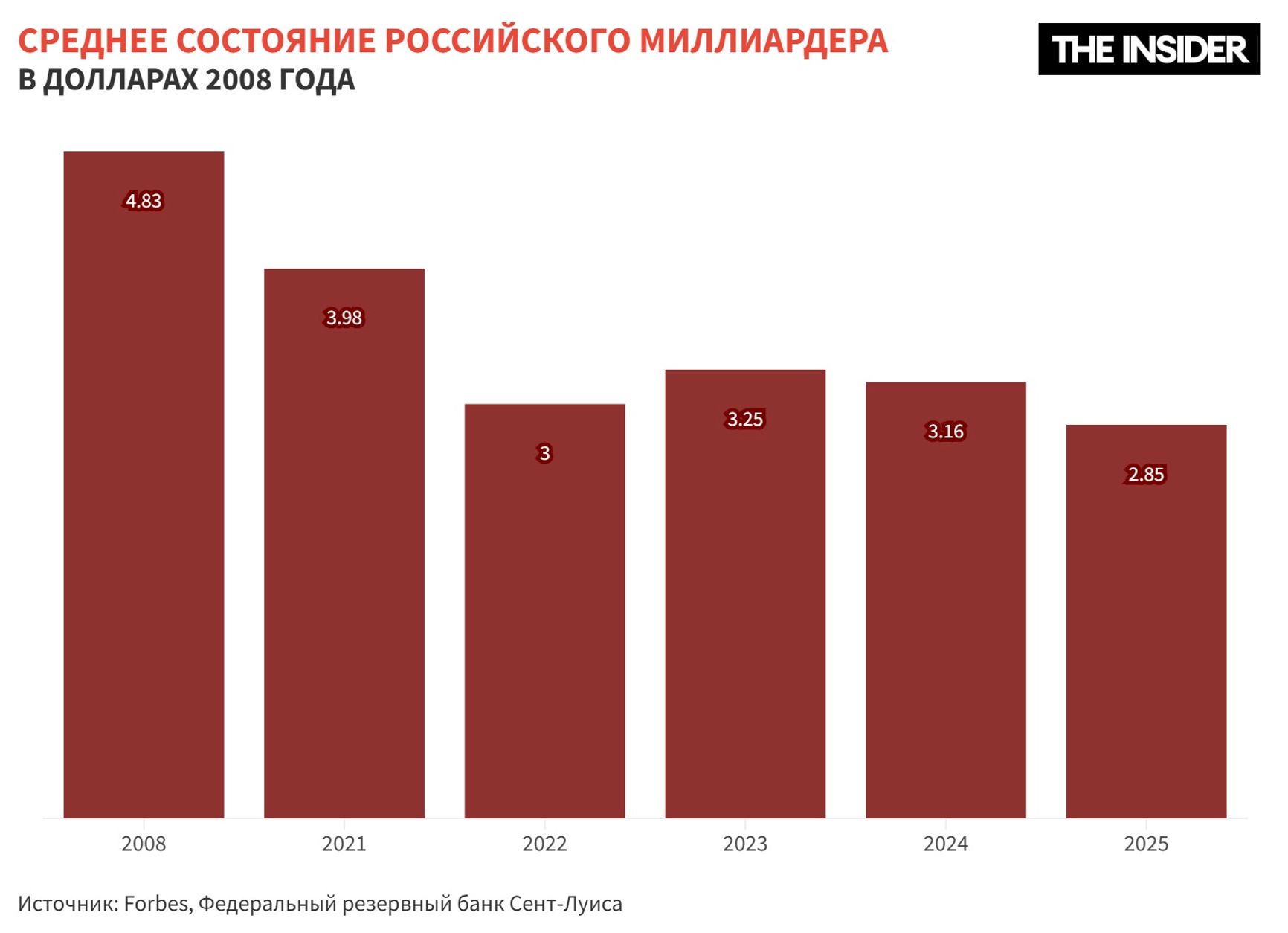
But the attitude of the real aggregate wealth to the number of people in the list, that is, the average state of the Russian billionaire, fell. In 2008, the average state of the Russian person involved in the list was $ 4.83 billion, $ 3.98 billion in 2021, and in 2025-only $ 2.85 billion. Today, real assets of the average billionaire from Russia make up 72% of what it had before the war, and 59% of the 2008 level.
Fast Moving Consumer Goods, wide consumption products that make up the range of supermarkets - food, cosmetics, household chemicals, hygiene products.
It was the sale of assets in claims of the General Prosecutor's Office: Rolfa (35 billion rubles) and chemical companies Volzhsky Orgsintez, Metaphrax Kemikikals and the Bor Mining Company (38 billion rubles) that gave more than half of this amount.
The billionaire-the Seredioned Servica is now nominally richer than three years ago: then Forbes estimated his fortune at $ 4 billion, and now at $ 4.3 billion. Examples of such "middle peasants" can serve:
- Former member of the Board of Directors of Alfa-Bank Peter Aven ($ 4.7 billion, 33th place);
- Founder Wildberries Tatyana Kim ($ 4.6 billion, 34th place);
- co -owner of the retail holding "Mercury Retail" Igor Kesaev ($ 4.5 billion, 35th place);
- The founder of the Kismet Capital Group, which owns Avito, Ivan Tavrin ($ 4.4 billion, 36th place, the calculation was carried out before the sale of 50%);
- Co -owner of EN+ Group, including Rusala, Oleg Deripaska ($ 4.1 billion, 37th place);
- Owning shares in the manufacturers of Arbidol and Pentallgin, Yegor Kulkov ($ 4.1 billion, 38th place).
In the Global Forbes rating, they take places between the 760th and 900th.
Of these, Tatyana Kim’s things developed the worst of all. The founder of Wildberries is now three times poorer than before the war. In 2022, its fortune decreased by more than six times, from $ 13 billion to $ 2.1 billion, in 2023 it increased four times, and then almost doubled. So the initial shock appeared, then the adaptation to new conditions, and then the losses from the growing military burden.
Fast Moving Consumer Goods, wide consumption products that make up the range of supermarkets - food, cosmetics, household chemicals, hygiene products.
It was the sale of assets in claims of the General Prosecutor's Office: Rolfa (35 billion rubles) and chemical companies Volzhsky Orgsintez, Metaphrax Kemikikals and the Bor Mining Company (38 billion rubles) that gave more than half of this amount.
The founder of Wildberries is now three times poorer than before the war
It is significant that the Wildberries revolutions continue to grow rapidly during the war years: in 2024, sales are more than 2021 more than 2021 and became larger than the X5 Retail. According to Forbes, Kim remains the richest woman in Russia and continues to live in the Moscow Region. There were no international sanctions against her, except Polish.
Peter Aven remained more or less at his own, retaining, according to Forbes, 89% of what he had in 2021. Aven and Russian companies in which he is a major shareholder are under international sanctions, while he himself lives in Latvia, which is part of NATO. Obviously, long -standing ties with Putin still help the former minister.
Oleg Deripaska is now even 8% richer than before the war. For him, this is hardly successful, because in 2008 Deripaska was the richest in Russia and number 9 in the world Forbes - he could not get closer to those peaks. In 2022, he lost half the fortune, but then every year he became richer, and in 2025 his capital already surpassed the pre -war level.
The billionaire fell under American sanctions as a Putin’s “wallet” back in 2018, after the start of the 2022 invasion of European countries, he underwent sanctions and even confiscation of property. At the same time, he repeatedly condemned the Russian invasion of Ukraine and probably lost his luxurious real estate in Sochi because of this.
Fast Moving Consumer Goods, wide consumption products that make up the range of supermarkets - food, cosmetics, household chemicals, hygiene products.
It was the sale of assets in claims of the General Prosecutor's Office: Rolfa (35 billion rubles) and chemical companies Volzhsky Orgsintez, Metaphrax Kemikikals and the Bor Mining Company (38 billion rubles) that gave more than half of this amount.
Oleg Deripaska is now even 8% richer than before the war
The condition of Igor Kesaev, who owned the trade in cigarettes and the production of machine guns, grew faster faster. In 2022, his wealth decreased from $ 4 billion to $ 2.6 billion, but already in 2023 the pre -war level surpassed, then reached $ 5.5 billion, and in the last year, although it decreased, but still 13% more than in 2021. However, these are estimates in nominal dollars, and taking into account the depreciation of the American currency, it must be admitted that both Deripaska and Kesaev (which is also under international sanctions and lives in Moscow) from the war is still impoverished.
Those who were in a pure plus are Yegor Kulkov, a co -owner of pharmaceutical companies, including Geneum, one of the manufacturers of the satellite V vaccine. According to Forbes, Kulkov now lives in Switzerland, while his more public and richer partner Viktor Kharitonin remains in Moscow. Until 2022, Kulkov did not fall into the Forbes list at all, and for 2022–2024 managed to double the condition. Although over the past year it has not become richer.
Finally, the most of this six during the years of the war, Ivan Tavrin succeeded, in the past, the top manager of the Mobile operator MegaFon, a large investor in Avito and Headhunter. Tavrin burst into the list of billionaires in 2024, and for the publication of the rating-2025 he became more richer. In April, it became known that he sold 50% Avito Rosselkhozbank. In 2023, Bloomberg called Tavrin the main beneficiary of the war. Now that he transferred 50% of the Avito structure bought in 2022 under the control of the Rosselkhozbank, the assessment may change. In 2022, Rosselkhozbank acted as a company when buying a company from the South African Naspers holding.
How the rest of the Russians suffered
The income of most Russians grew during the war, official statistics testify. 65% of households won, lost only 26%, and 9% remained with their own, the Central Bank’s study showed in 2022–2024. It was a survey of the population, mediator income of those who answered - about 30 thousand rubles per person in the family.
At the same time, nominally income grew in all groups of the population. But not in the same proportion: the poorest - the most poor - the most, by 33% (this is 10% of those who answered with the lowest income, which grew from 9 thousand rubles to 12 thousand rubles per person). The smallest increase in middle groups is 25–26%.
Fast Moving Consumer Goods, wide consumption products that make up the range of supermarkets - food, cosmetics, household chemicals, hygiene products.
It was the sale of assets in claims of the General Prosecutor's Office: Rolfa (35 billion rubles) and chemical companies Volzhsky Orgsintez, Metaphrax Kemikikals and the Bor Mining Company (38 billion rubles) that gave more than half of this amount.
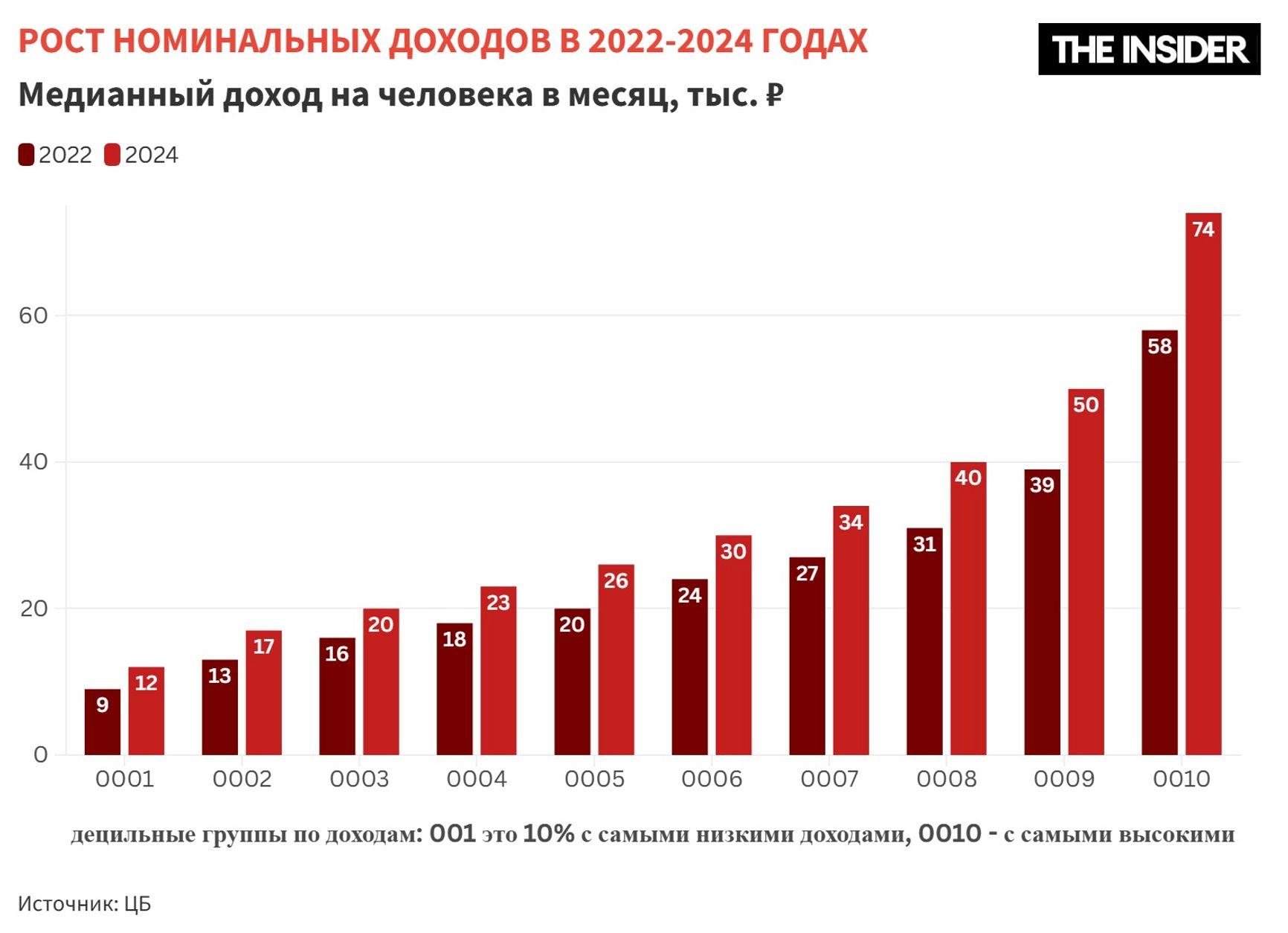
However, if we assume that the actual inflation is higher than Rosstat shows, and rely on the assessments of the Romir center, it turns out that everything has lost in real income. Romir publishes the so -called FMCG default, which shows that in 2022 consumer prices rose by 31.5%, in 2023 - another 20.8%, and in total in two years - by 59%. Those households, which before the war had an income of 9 thousand rubles per person and which the war allegedly blessed, raising their income up to 12 thousand, in the rubles of the beginning of 2022 now only 7.5 thousand per person receive. And even if you adjust these figures, given that, in addition to consumer goods, households are also paid by services that did not value so fast, the picture will still be far from optimistic.
Who suffered more
Contrary to the stereotype that many are earned in the war in Russia, in reality, with the exception of a very narrow group, it is unprofitable for most economic players. While many foreigners could not withdraw capital, Russian oligarchs and ruble billionaires were faced with completely unusual obstacles: it was difficult not only to get out of Russia, but also to legalize abroad. In addition, a large -scale redistribution of assets has occurred. Over the past two years, 411 companies with assets of 2.6 trillion rubles have been nationalized in Russia. Some companies have found new owners who can be considered the beneficiaries of war. But so far there are fewer than the victims: the income from privatization amounted to 132 billion rubles .
Fast Moving Consumer Goods, wide consumption products that make up the range of supermarkets - food, cosmetics, household chemicals, hygiene products.
It was the sale of assets in claims of the General Prosecutor's Office: Rolfa (35 billion rubles) and chemical companies Volzhsky Orgsintez, Metaphrax Kemikikals and the Bor Mining Company (38 billion rubles) that gave more than half of this amount.
Contrary to the stereotype, most economic players are unprofitable
The economy did not become mobilization-compulsory, but remained mainly market. The budget policy remained relatively conservative. Accordingly, there was no large inflationary pressure from the hole in the budget: prices are rising about the same pace as in the early Putin years, when inflation usually amounted to 10-15%.
At the same time, the population lost a preferential mortgage, and a decrease in the rate of construction threatens to make housing even less affordable. The commissioning of housing in apartment buildings for 2024 was 12% less than in 2023, and for the first quarter of 2025 - 17% less than in the same period of 2024. The rapid growth of real salaries slows down, judging by Rosstat, and the consumption of the population has passed to stagnation.
Thus, war, sanctions and response regulation led to significant losses and serious challenges for various layers of Russian society. If for the majority of the population the main strokes fell on a decrease in the growth of real incomes and living standards due to inflation, as well as the inaccessibility of a number of foreign goods and services, then representatives of business elites are faced with large-scale property losses as a result of nationalization, as well as significant restrictions in the usual possibilities of managing capital abroad.
At the same time, for part of the same elite, the redistribution of assets, on the contrary, has become a source of unprecedented enrichment. The consequences of the war are manifested not as uniform impoverishment or enrichment, but as a transformation and redistribution inside the economic landscape, aggravating social stratification through specific mechanisms of loss and acquisitions for each social group. In the future, experts warn, polarization will intensify between those who have acquired in the war, and those who could not do this.
Fast Moving Consumer Goods, wide consumption products that make up the range of supermarkets - food, cosmetics, household chemicals, hygiene products.
It was the sale of assets in claims of the General Prosecutor's Office: Rolfa (35 billion rubles) and chemical companies Volzhsky Orgsintez, Metaphrax Kemikikals and the Bor Mining Company (38 billion rubles) that gave more than half of this amount.
Articles on the topic
War with the poor. In Russia, a social gap is increasing: the poor are poor, the over -and -income billionaires are growing
VS tanks banks. Russia threatens the banking crisis
Pre -crisis mood. Four branches of the Russian economy that collapse the first from high rates and a reduction in demand
Not in favor of the poor. Poverty in Rosstat is increasingly different from real numbers
We really need your help
Subscribe to regular donations