“Intra -party disagreements prevented the stupor from getting a chancellor the first time. The Sopartians showed him a yellow card " - political scientist
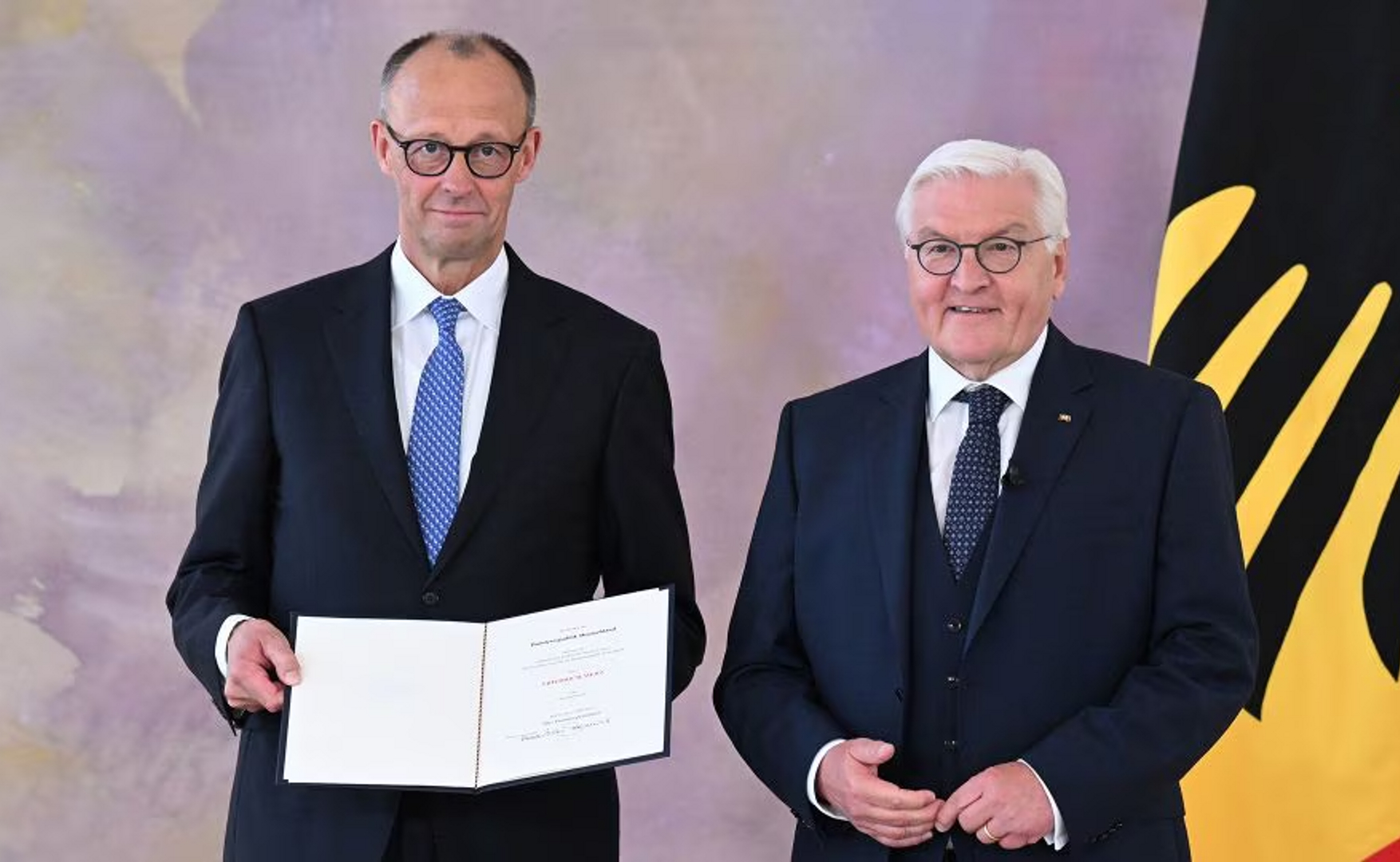
Friedrich Mertz and President of Germany Frank-Walter Steinmeier. Photo: ard
Frederick Mertz, the leader of the Christian Democratic Union, which is part of the CDS/CSS, was elected to the post of chancellor of Germany, but only in the second round. In the first round, he did not gain the necessary minimum in 316 votes of the deputies of the Bundestag - only 310 votes were cast for it (and 307 against).
The case of Friedrich Merets is the first when Chancellor was not able to elect in the first round, since 1949, when the main law (the constitution) was adopted in Germany and the first chancellor was elected in the history of modern Germany. In September of the same year, he became Conrad Adenauer, chairman of the Christian Democratic Union (CDU). The current chancellor is already the tenth in the post -war history of Germany and the sixth of the HDS/CSS bloc.
The cause of the hitch during the election of the chancellor may be intra -party friction, but the split inside the party is still far away, according to political scientist Dmitry Stratievsky, political scientist and director of the Berlin Center for the Study of Eastern Europe .
“Germany and German parliamentary democracy are considered one of the most stable in Europe. Many previously even called Germany’s policy boring and uninteresting due to the fact that there are no crises. When Angel Merkel was in power of 16 years < from 2005 to 2021 - approx. The Insider >, everything was quiet and calm. Now over the past six months, two major crisis events have occurred - the collapse of the coalition and extraordinary elections, which in Germany is extremely rare; And the non -removal of the candidate for the Chancellors in the first round, which has never been to Germany. ”
As Stratievsky draws attention, the Merets has a difficult path in politics from a number of failures. From 1989 to 1994, he was a member of the European Parliament, and then for 15 years (1994-2009) as a deputy of the Bundestag. In the struggle for leadership in the party, he lost to an angel Merkel, after which he left politics for a long time: until 2021, Mertz worked as a lawyer.
“It was extremely difficult for him to return to politics. He only became the chairman of the party for the third time, but in the Inter -Party struggle he won two competitors in turn, at which the Angel Merkel was betting after leaving politics. And the stroke really managed to clean the intra -party field in the CDU party. He became an unconditional leader, and everyone supported him. Against this background, he could feel too calm and relaxed, to believe in his full control over the party and in the fact that on the way of his election the tenth chancellor of the Federal Republic of Germany is no longer worth anything. ”
The Party of the New Chancellor-the HDS/CSS block-formed the ruling coalition in the Bundestag along with the Social Democratic Party of Germany (SDPG): the day before, their representatives signed the corresponding agreement. Together they have 328 seats in parliament, which gives, although insignificant, but most: there are 630 deputies in the Bundestag.
Who and why could not support the chancellor
Social Democrats have already disowned from the "betrayal" of the Mercke. The current party of the party Lars Klingbail said that all deputies from the SDPG supported the Mercke. Although Klingbail added that he could not say for sure due to the secret of the vote, his words were confirmed by the representative of the left wing of the party Ralph Stegner. “We have no alternative, otherwise the country will plunge into chaos,” he added.
The Opposition could appear in the ranks of the CDU/CSS. So, for example, The Guardian notes that the “debt brake” reform , adopted to increase defense spending, was extremely unpopular both inside the party and in the ranks of the Social Democrats. You can read more about it in the material of The Insider by the link .
In January of this year, Mertz, being the leader of the CDU/CSS faction in the Bundestag, initiated a vote to tighten migration policy . She was supported almost in full force of the CDU/CSS, a free democratic party (SVDP) and the ultra -right "alternative to Germany." The fractions of the SDPG, the "green" and the left then in full force voted against it. For attracting support for the ultra -right Party of ADG, the future chancellor then criticized , including from the former Chancellor of Germany, Angel Merkel.
Its supporters, occupying a more centrist position, could strike a stroke in the form of missing six votes in the first round. At the same time, representatives of the right-conservative wing of the CDU could be dissatisfied with the coalition with the levocentric Social Democrats, because of which they could also deprive the stroke of support.
In addition, inside the CDU/CSS, they noteda sharp and sometimes unnecessarily tough style of the man’s leadership , which also met discontent.
Dmitry Stratievsky, in a conversation with The Insider, is more inclined to the fact that the new chancellor was originally not supported in the ranks of the HDS/CSS:
“Mertz decided that he was controlling his party, and made some tactical mistakes. Most likely, this is due to the distribution of portfolios. In all major German parties like Christian democrats, social democrats, “green”, or smaller parties like liberals and left, there are several large party currents, and their interests should always be taken into account both in the formation of the government and the distribution of seats of ministers and secretaries, and in the formation of lists in the next election. I assume that the interests of any one faction within Christian democrats were not taken into account. Thus, they showed a yellow card . ”
In a conversation with The Insider , a political scientist, a member of the free Democratic Party Anastasia Vishnevskaya-Mann, partly agreed with this point of view:
“Representatives of any of the three categories of his opponents could vote against Merets. The first of them are members of the SDPG, simply organically not tolerates, who, as they say, have aesthetic disagreement with him. The second is the so -called “Merkelians”, supporters of Merkel inside the CDU, more left, dissatisfied with joint vote on migration issues with ADG. The third category is the turbine conservatives in his own party, dissatisfied with the CDS not very profitable for the CDU, in their opinion, by a coalition agreement with the SDPG and considering it a betrayal of conservative values. And they all understood that in the end, Mertz would still become a chancellor. To vote against or not to appear at the meeting in this case is a way to express his “f” and weaken the Mercke to the public, to show that he does not enjoy unconditional support, that he is forced to ask for something to offer these deputies.
In addition, it was extremely important for not only to choose, but to choose exactly on May 6, since his trips to Paris and Warsaw are already planned for the 7th, very significant visits to two main supporters of Germany, and on the eve of the 80th anniversary of European’s liberation from fascism. Therefore, the stroke had to hold a second round on the same day, and to do this change the meeting protocol, for which two -thirds of the votes of the deputies are needed. The ruling coalition has no vote. And as a result, Mertz violated his party’s internal attitude to the ban on cooperation with the “left” and went to bow to them. Since they did not want to hang out in the Bundestag on Friday on Friday, they were happy to depict defenders of democracy and go to meet him. ”
"Forced to be nervous"
According to the expert, deputies who initially did not give their votes, they wanted to “get him to be nervous”: according to German law, if the chancellor cannot be elected the first time, a second round is announced, during which the voters can change the decision.
As Stratievsky notes, although the current situation can hardly be called a split, rather only intra -party contradictions, an unprecedented situation can affect the rating and the political prospects of the Mercia in the future:
“What to expect now? Actually, now everything is more or less clear. Merza has already planned international visits in the status of the chancellor. He will take the oath in the Bundestag, receive powers and the work of the new government will begin. The sediment, as they say, will remain . Mertz today went down in history as the only candidate for chancellors who did not receive the majority in the Bundestag in the first round of voting. This is not to be removed from the story, and this will remain with Mern forever. And he will be happy to remind him of political opponents, or even his opponents within his own party. ”
“Intra -party disagreements prevented the stupor from getting a chancellor the first time. The Sopartians showed him a yellow card " - political scientist • The Insider • RIMA — Russian Independent Media Archive