Denis Beznosov, from the shortlist for the Dar literary award, was accused of involvement in the “re-education” of Ukrainian children. The awards didn't know anything about it. • The Insider • RIMA — Russian Independent Media Archive
Denis Beznosov, from the shortlist for the Dar literary award, was accused of involvement in the “re-education” of Ukrainian children. The awards didn't know anything about it.
Poet Galina Rymbu accused the Dar literary prize, created to support Russian-speaking authors, of being indirectly connected with “genocide and the abduction of Ukrainian children.” The reason for such accusations was that the shortlist for the prize included a novel by Denis Beznosov, who, according to Rymbu, was involved in programs of indoctrination and “re-education” of Ukrainian children taken from the occupied territories. The founder of "Dar" Mikhail Shishkin expressed regret that the jury did not receive information about Beznosov earlier.
The essence of the claims
Galina Rymbu, in a post on her Facebook page, points out that Denis Beznosov, who subsequently emigrated from Russia, until November 2022 served as deputy director at the Russian State Children's Library (RGDL). This organization, as the poetess writes, held “cultural events” for Ukrainian children as part of the “First Book” program.
“The RGDB received huge sums for these programs from the first year of the invasion and mass deportations of children. And my acquaintances, human rights activists, say that it is simply unrealistic to create such programs in the Russian Federation without the participation of law enforcement agencies. In March 2022, the RGDL organized so-called bibliomobiles - mobile stations on wheels with Russian writers, teachers, psychologists, propagandists and simply fascists who traveled to “re-education camps” for kidnapped Ukrainian children and distributed propaganda materials and narratives aimed at forced Russification and the destruction of their identity.”
In addition, Rymbu writes, the RGDL organized a training program for librarians in the occupied territories of Ukraine. According to the poetess, Beznosov, being the deputy director of the Russian State Children's Library, could not help but be involved in all of the above.
“I am not a legal specialist and I don’t know whether Beznosov’s actions can be formally classified as complicity in war crimes and crimes against humanity at the ICC level. We are not the ICC, but we can talk about such things publicly, draw the attention of international organizations and those investigating the abductions and practices of “re-education” of Ukrainian children to them.”
Rymbu believes that the “Dar” award is responsible for Beznosov, since it contributes to his fame.
“Events related to the promotion of this book were regularly advertised on social networks by the awards. The book received and continues to receive a lot of attention in Russian and emigrant literary media. This means that the prize itself, its organizers and jury members, and the media associated with it, are involved in increasing the visibility of this author, his texts and other literary work, and his views.”
Work at the Russian State Children's Library
According to information from Beznosov’s Linkedin page, he worked at the Russian State Children’s Library from 2012 to November 2022. Beznosov mentions that he “managed all processes in the library,” having 80 people under his command.
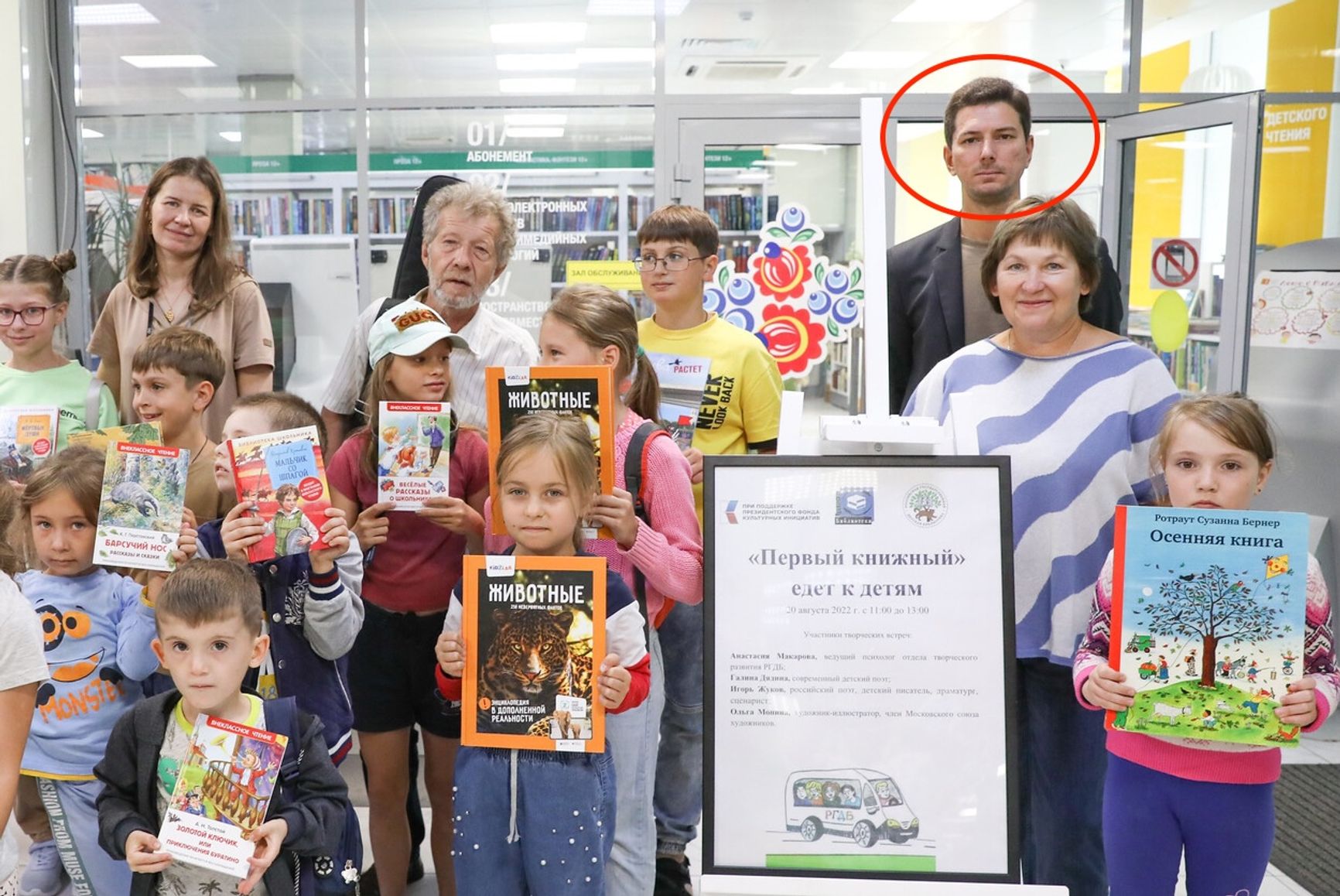
On the RGDL website you can find descriptions of dozens of events that took place as part of the “First Book” program, including with the participation of children from the occupied territories. Denis Beznosov personally attended at least one such meeting: in August 2022, it was reported about a “creative trip of writers and artists” to the Vladimir region, “to a temporary accommodation center for children and teenagers evacuated from the LPR and DPR”; Beznosov can be seen in photographs from this event.
Rymbu calls temporary accommodation centers where deported Ukrainian children were taken “re-education camps.” They were placed in sanatoriums, children's camps, etc.
In March 2023, the International Criminal Court (ICC) issued an arrest warrant for Vladimir Putin and children's ombudsman Maria Lvova-Belova. They are suspected of organizing mass abductions of Ukrainian children and taking them to Russia.
Denis Beznosov at a meeting with Ukrainian children
Photo: press service of the Russian State Children's Library
The meeting included “interactive literary and educational sessions based on the achievements of Russia’s rich cultural heritage.”
In general, as follows from the description on the RGDL website, within the framework of the project, “a creative landing of modern children’s and teenage writers, illustrators, teachers, psychologists, specialists in introducing children to reading and librarians conducts interactive literary classes, master classes, psychological trainings in temporary accommodation centers for displaced persons located in the Moscow, Kaluga, Vladimir and Tula regions. Using the example of the best works of domestic children’s literature and illustration, creative meetings popularize culture and assist in social adaptation to new living conditions.”
"Presumption of innocence"
The chairman of the Dar Prize jury, writer Mikhail Shishkin responded to Galina Rymbu’s accusations on Facebook.
“The Literary Prize is not the Investigative Committee; it acts based on the presumption of innocence. The list of finalist authors was posted on the website for several months, and the award was widely announced. We would appreciate receiving this information in advance, rather than after the first award season has already ended. It goes without saying that if the accusations brought by Galina Rymbu against Denis Beznosov receive official confirmation, we will take all measures in our power. People associated with the genocide of the Ukrainian people cannot have a place next to our award.”
In response to a request from The Insider, Shishkin said that the award had received “a huge wave of support from all sides,” but refused further comments, noting that he was expecting new attacks and considered it necessary to wait to “answer everything at once.” According to Shishkin, he received words of support, including from Maria Galina, a writer who became a winner of the Gift, but refused the award.
Beznosov himself has not yet given public comments in connection with Rymbu’s speech. The Insider reached out to the writer with questions, but has not yet received a response.
"Gift"
The objective of the prize, as follows from the description on its website, is to “support and promote authors writing in Russian, regardless of their place of residence and citizenship. <...> The Prize strives to create a new culture where literature in Russian takes its rightful place in the world, being responsible to humanity, and not to dictatorships.”
The Gift Award was founded in 2024 and was supposed to be presented for the first time in 2025, but the matter turned into a scandal. In May, the winner was announced, it was Maria Galina, a native of Russia, now living in Ukraine, with the book “NEAR THE WAR. Odessa. February 2022 - fierce 2023.” However, she refused to accept the award, explaining her position in a statement:
“I don’t think that, being in a country under fire from Russian missiles that are killing civilians, I, even in this form, can support the language and culture, which formally became (and remains) one of the reasons for the attack on Ukraine - under the pretext of defending it. <...> Unfortunately, Russian aggression against Ukraine, which I consider my homeland, has forced me to make a choice; it is not an easy choice for me, but it is mine. The fact that the Russian language and culture suffered such a terrible defeat is probably all of us to blame, and we are all paying for it - each in our own way.”
Shishkin wrote in his statement that he “accepts Galina’s decision,” noting, however, that the writer herself “submitted her book to the competition.”
“I have no doubt that her book, which has now become famous thanks to its victory in our competition, will be published in translation and will find a wide readership. And in this sense, the task set for the “Dar” Prize was completed - we were able to attract the attention of both Russian-speaking readers and Western publishers to this text.”
Laureates of the “Gift” are entitled to funds for the translation of works into foreign languages. The grants that Galina refused will be given to next year's winners.
Rymbu calls temporary accommodation centers where deported Ukrainian children were taken “re-education camps.” They were placed in sanatoriums, children's camps, etc.
In March 2023, the International Criminal Court (ICC) issued an arrest warrant for Vladimir Putin and children's ombudsman Maria Lvova-Belova. They are suspected of organizing mass abductions of Ukrainian children and taking them to Russia.