
Translated material
Front -free Front: What does the Korean version of the end of the war teach
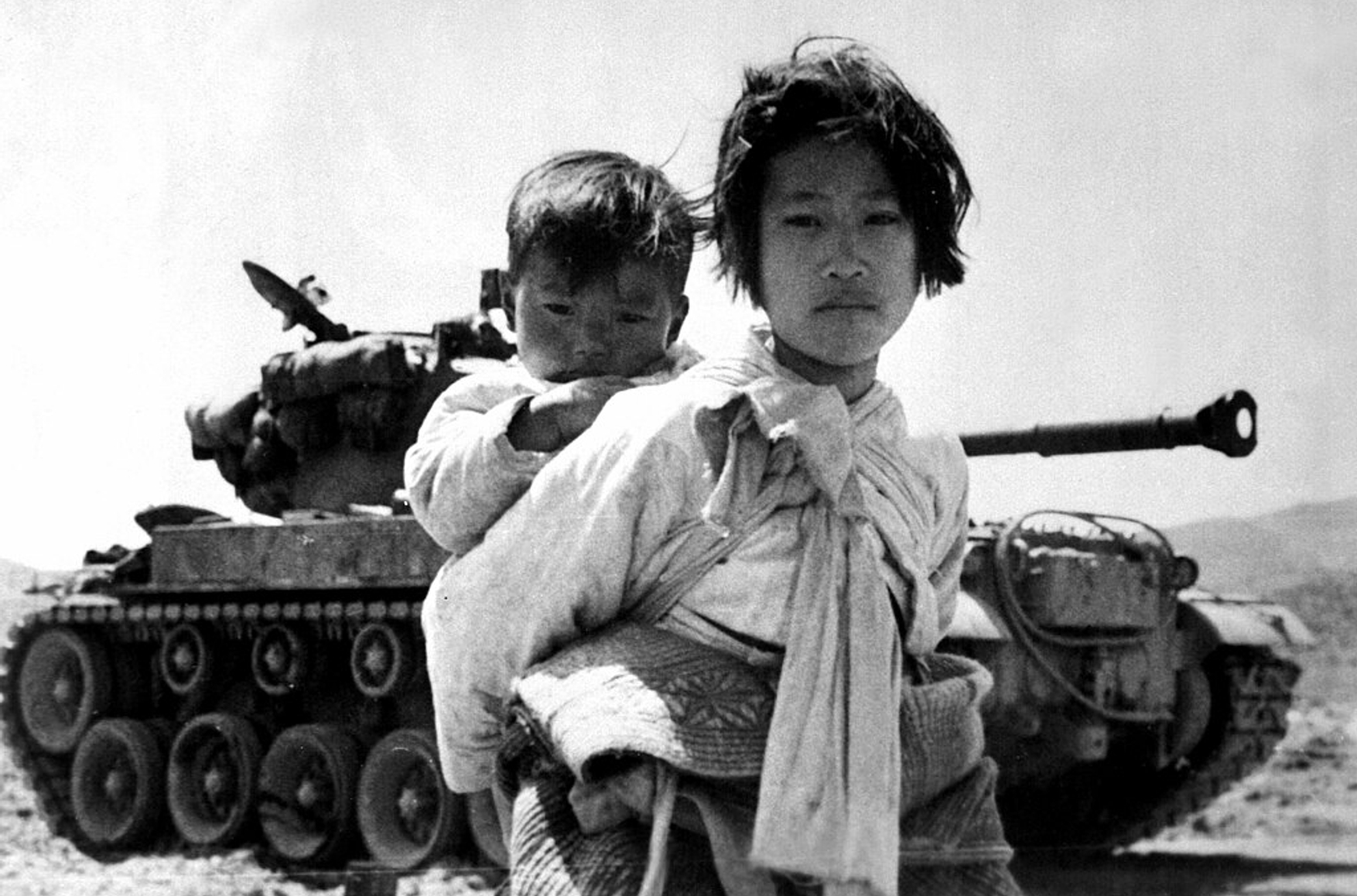
Korean refuge girl wanders with her brother on her back past the stuck M-46 tank in Hanju, Korea
History by Konstantin Gayvoronsky 13 June 2025When discussing options for completing the Ukrainian war, a truce is often recalled between two Korea, which was concluded without the end of the war on the current front line. In 1953, the agreement between the two warring parties did not seem obvious: the South Korean president Lee insisted on the complete liberation of territories north of the 38th parallel, and the decisive role was played by the unwillingness of the Americans to continue hostilities. US President Dwight Eisenhower made a promise to end the war one of the main ones during the election campaign. At the same time, the calculations of the American generals showed that it would be difficult to break through the defense of the North Koreans, and the continuation of the conflict could lead to further escalation up to the third world. But whether the fundamental position in the end led to the conclusion of the Seoul strategic agreement with the United States and reliably defended the country for many years.
Content
Light at the end of the tunnel
Elephant in the negotiation room
To the will, everyone to the will!
Special Supervisor flies to Korea
Alternative in the form of the third world
Light at the end of the tunnel
The Korean war entered the positional dead end exactly a year after its beginning. By the summer of 1951, the front line twice rolled through the entire peninsula-first to the far south, then north to the border river Yala-and finally froze on the original 38th parallel. And then neither the UN troops, 80% of the Americans, nor a million Chinese "volunteers" who came to the rescue of the North Koreans, could move each other from their place.
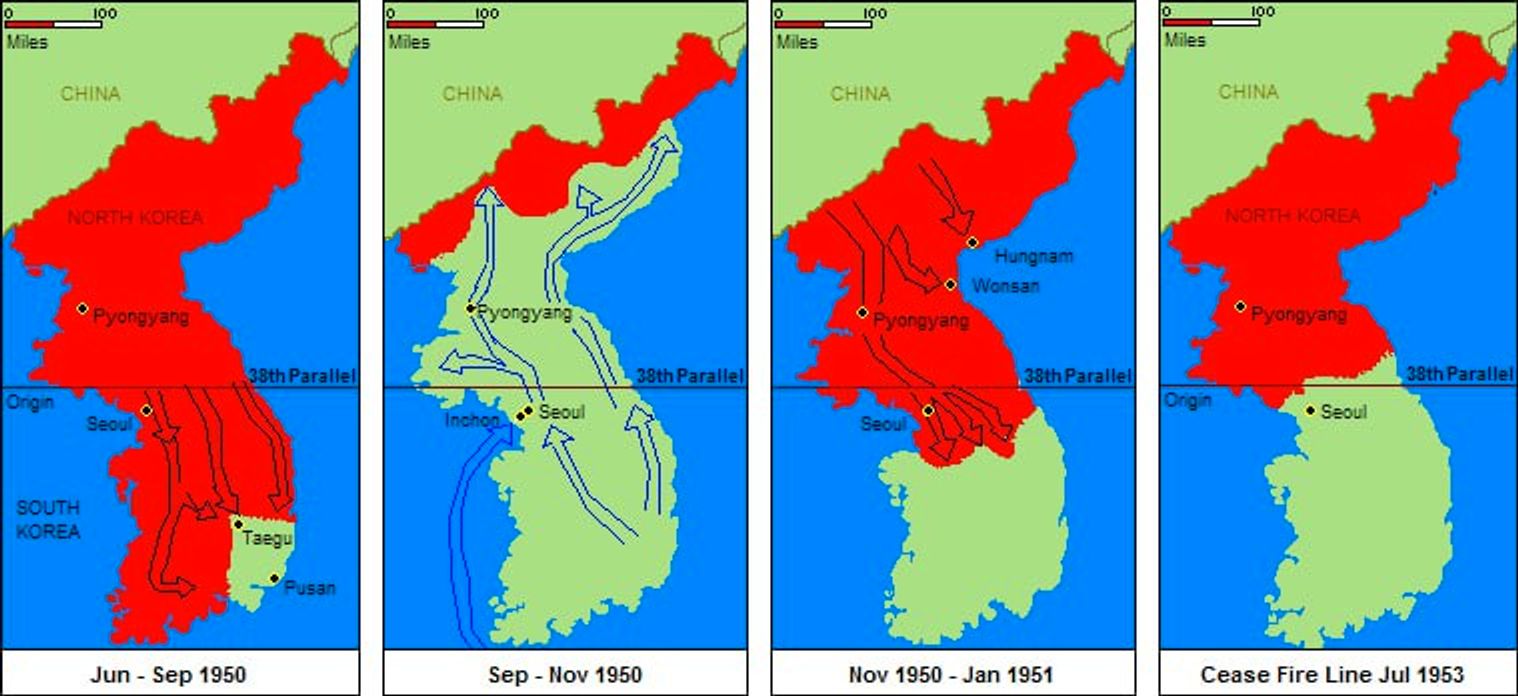
So the front line moved during the Korean War
The year 1952 ended - the year of the presidential election. Soldiers' coffins continued to deliver to America daily, no lumen was observed at the end of the military tunnel, and more and more Americans wondered: how much would it continue? What are we doing in Korea at all? What ideals we defend, if the authoritarian manners of the South Korean president Lee Lee Son Mana became a lady in the tongue, and even the extremely restrained The Christian Science Monitor called his “worthy totalitarian police state”.
Therefore, when on October 24, 1952, at a rally in Detroit, a candidate of US President from the Republican Party, Dwight Eisenhower, promised that his first and main task would be the “speedy and honorary end of the war” - the whole country heard him. And the phrase “I will go to Korea to find out how to serve the American people in the name of peace” entered the American textbooks of political science: it is believed that she brought him at least 2-3 million additional votes. “To many Americans, she promised exactly what they hoped for: the figure under her nose to people who advocated the vengeful expansion of hostilities into the territory of China,” writes historian Alexander Bevin.
Eisenhower's phrase “I will go to Korea to find out how to serve the American people in the name of peace” entered the textbooks of political science
Eisenhauer, already being elected president, really went to Korea, was convinced of the place of the continuation of the war on the spot, but ... for peaceful negotiations, as well as for the dance, two are needed - both should be interested in as a result. This condition was not observed until March 1953.
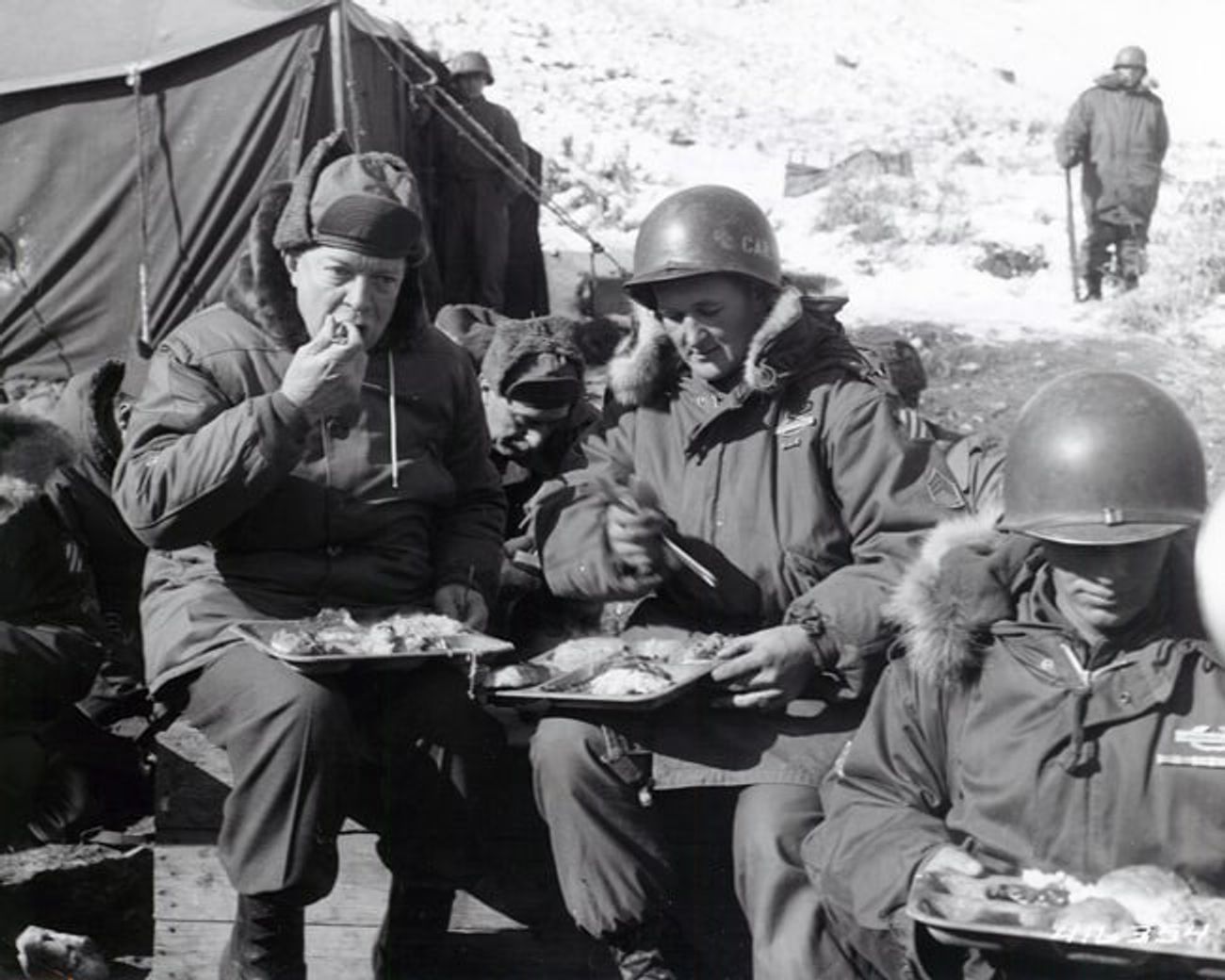
The elected US President Dwight Eisenhower (left) has lunch with American soldiers in Korea. December 1952
Formally, negotiations about the armistice between the Sino-Korean and American-Korean delegations were conducted in the town of Phanmunje since July 1951. Some pedant calculated that during this time 18 million words were said at the meetings, and the matter did not move from a dead point. Because the real operator of the Korean war from the North was Joseph Stalin, and he was more than arranged by its continuation: while the Americans spent their resources on the distant Asian peninsula, he could slowly prepare his army for the third world in Europe.
This continued until Stalin’s death on March 5, 1953, after which his successors gave Beijing an unambiguous signal about the change of political course. The head of the PRC Mao Zedong was just waiting for this: almost a third of the Chinese budget went to Korea, leaning led to mass hunger in the northern provinces, and if his will, Mao would have concluded a truce last year. On April 26, delegations of the warring parties once again met in Phanmunzhon, and this time the matter went much more lively.
The front line by that time almost perfectly coincided with the 38th parallel. Therefore, the parties quickly agreed to turn the line of combat contact into delimiting. The question of the exchange of prisoners of war was much more difficult.
South Korean camps contained 132,474 North Korets and Chinese. In the Chinese camps there were 11,559 captured soldiers of the UN troops, not counting about 65,000 South Koreans, who, as the Communists claimed, were “re -ian” and entered the communist armies. Mao insisted on the exchange on the principle of “all for all”, referring to the 1949 Geneva Convention, which stated that “prisoners of war should be repatriated without delay after the cessation of hostilities”. The Americans did not agree; In 1945-47 They returned 1.5 million Soviet citizens to Stalin without taking into account their opinions and decided not to repeat this bitter experience. A fugitive survey in the camps showed that only 70,000 prisoners from the north wished to voluntarily return to their homeland; The Chinese massively asked to send them to Taiwan.
Americans in 1945-47. returned 1.5 million Soviet citizens to Stalin without taking into account their opinion and did not want to repeat this bitter experience
It was not just a matter of principle. In Washington, it was believed that after the creation of a precedent of political asylum for prisoners of war, communist armies would “be much less reliable, and their governments would be more careful to use them for aggressive purposes.” If the soldiers are sure that they will not be given at the end of the war, then they will give up much more likely - it was especially true for the armies of Soviet satellites in Eastern Europe.
Mao, of course, was far from enthusiastic about the prospect of giving his mortal enemy Chan Kaisha on Taiwan thousands of Chinese prisoners, but even less he was smiling at the continuation of the war in the conditions of growing debt for the supply of Soviet weapons - he had already reached $ 2 billion, and Moscow was not going to write off it. As a result, the Chinese abandoned the principle of “all for all”, and further negotiations came down to the same questions about the representatives of which countries will enter the repatriation commission, how the access of the Chinese delegates to non -returnees will be ensured, how long they will be allowed to persuade, etc.
Elephant in the negotiation room
In the building where these negotiations were conducted, there was an elephant, which for the time being tried not to notice - whether the son of Man with a truce in any form was a categorical disagreement. Even in the summer of 1951, when the parties only began to probe each other's positions in Phanmunzhon, Lee said that an agreement that did not provide for the unification of Korea into one state would not have legal force. “If we agree to something less than the integrity of this country, we will betray the trust of those who in the struggle for freedom to all that are expensive-and we will not do this,” he proclaimed.
So in words, speaking for peace, Li son Many put forward the conditions obviously unacceptable for counterparties, somehow withdrawal from the country of Chinese troops, the disarmament of the North Korean army, etc. When he found out that negotiations, finally stepped on real soil, he recalled his representative from Phanmunmunzhon, and the US South Korea’s ambassador Ellis Briggsu promised that he would withdraw the South Korean army from the UN command (and actually American) and continue the war independently.
In words, speaking for the world, Lee Son Man put forward the conditions obviously unacceptable for counterparties
“Perhaps we made a mistake by relying on the aid of democracy,” Lee announced. “Sorry, but I cannot assure President Eisenhower in his cooperation in the current circumstances.”
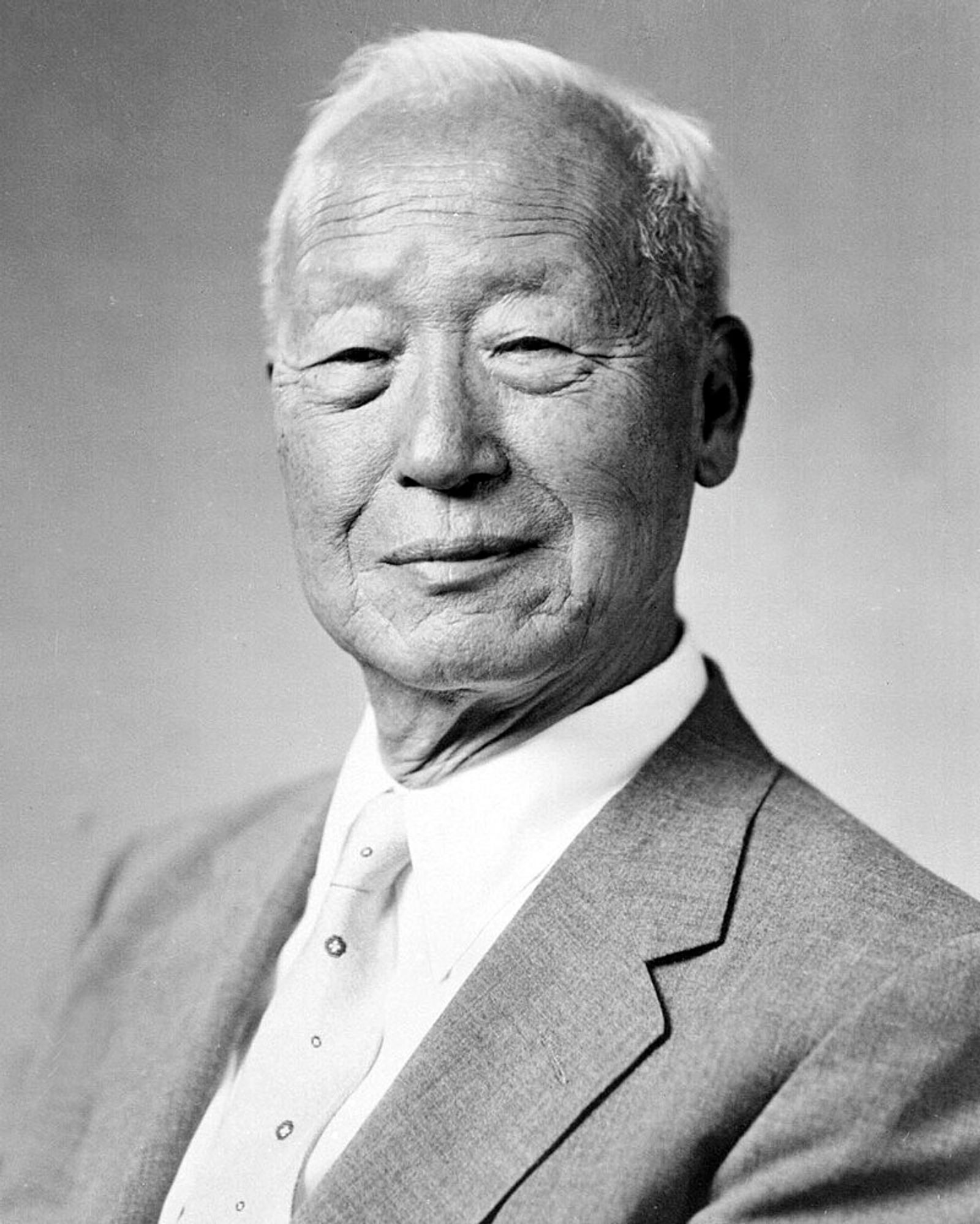
Lee son man
On May 30, the son of Man wrote to Eisenhower a letter in which he bitterly complained that the truce on the basis of the current front line would become a “death sentence without the right to appeal” for Korea, that the divided country will be economically incompetent. He agreed to consider the possibility of a truce only on condition that all foreign troops (read, Chinese) would be withdrawn from the peninsula, and the signing of the agreement would precede the conclusion of the mutual defense packet with the United States, by which they undertake to come to the aid of South Korea immediately and unconditionally, without any consultations with other countries or the UN.
For Washington, this proposal meant that the question of the war and the world would be transferred into the hands of Lee itself, and the truce would turn out to be an empty piece of paper. Given the manic desire of the South Korean president to unite the country, he will easily provoke the Second Korean War - and what do you order to do then?
The administration of Eisenhower was in a position that was called "worse than the governor" in old Russia. On the one hand, NATO allies were pressed in the United States with the aim of soon a truce. Seven American divisions were bogged down in Korea, there were only six in Europe - this clear imbalance with a group of Soviet troops in Germany acted Europeans on nerves. On the other hand, in the United States, the opposition of a truce on the basis of the CVO status was even inside the Republican Party, because what about the principle of punishment of the aggressor?
The fact that the aggressor in the north of the peninsula was already bombed into dust did not console them at all, because in the south after the North Korean troops there was a little better. The leader of the republican majority in the Senate, William Noreland, gruffly stated that NATO allies "pushing us to the Far Eastern Munich."
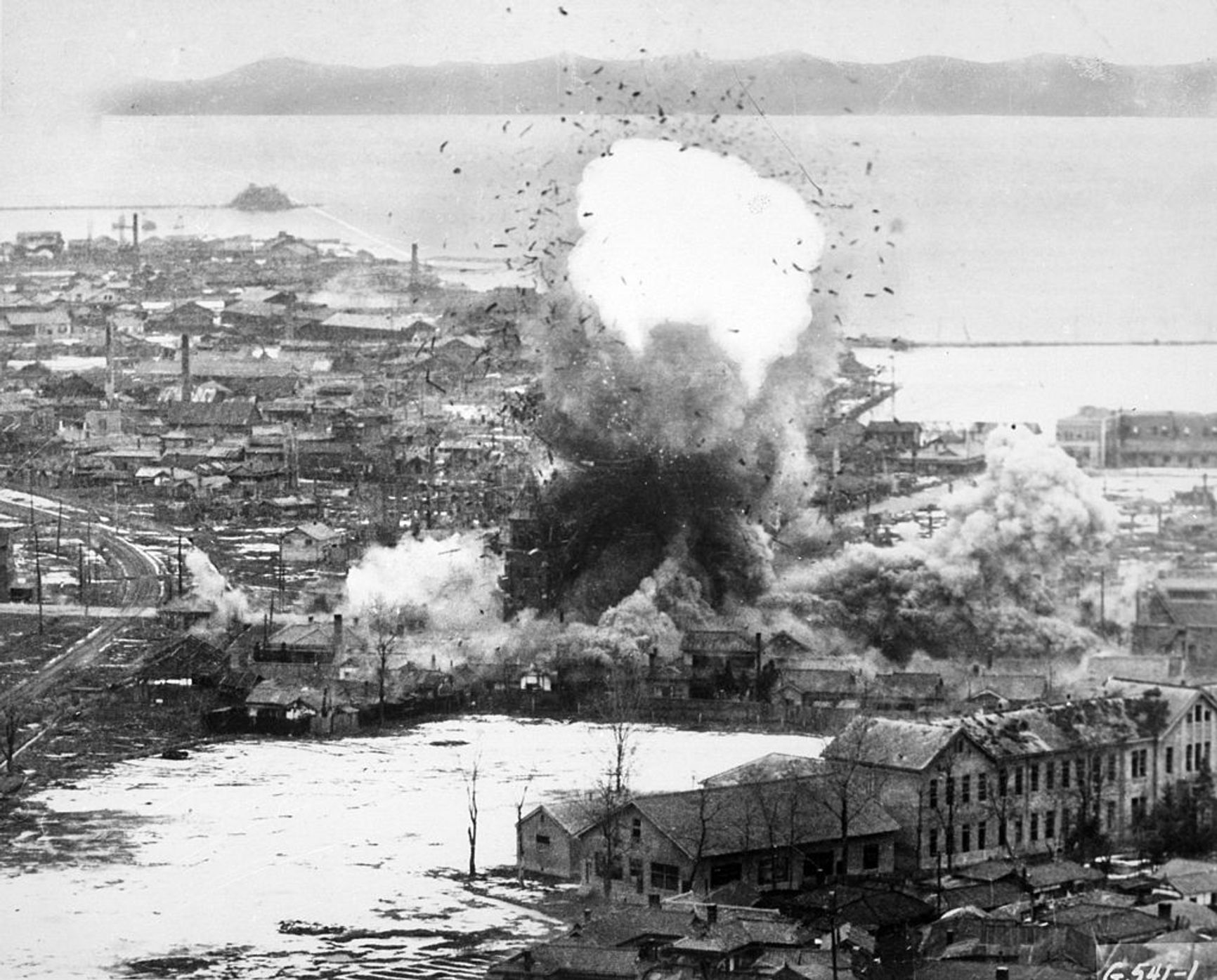
Rights of American aviation on the North Korean port Vonsan
Eisenhower faced a non -trivial task: a) not to disrupt negotiations with the Chinese side; b) somehow to appease the son of Man; c) not to give the Republicans a reason to blame themselves for too much concessions to Mao Zedong. The latter was especially relevant, given that in the Senate the Republicans had the majority of all one vote, and the administration could not go to a frank conflict with the “hawks”.
On June 6, Eisenhower replied to the letter Lee:
“Unfortunately, Korea is not the only country that remains divided after the Second World War. We are still determined to play a role in achieving a political association of all divided nations. But we do not intend to use the war as a tool to achieve world political settlement, which we consider fair. ”
The South Korean president was furious. After its own high-profile statements about the inevitable unification of the country, the demarcation according to the 38th parallel without any guarantees for the future from the Americans meant a loss of face for him. And in Asia, this is sometimes tantamount to not just political, but also physical death.
In an effort to smooth out the situation, Eisenhower invited Lee to Washington to discuss the problem. He rejected the invitation, citing employment. Soon in the White House they will find out what he was so busy.
To the will, everyone to the will!
Meanwhile, the parties finally agreed on the repatriation of the prisoners in Phanmunhgzhon, and on June 18, the signing of the ceasefire was planned. However, on that day, even before dawn, South Korean guards opened the gates of several prisoners of war camps, as a result of which 25 thousand people who did not want to return north instantly dissolved in rural areas and nearby cities.
Lee didn’t even try to pretend that he had nothing to do with it. “There is a danger of giving satisfaction to our enemy and cause confusion among our own people,” he said in an appeal to the nation. “In order to avoid these serious consequences, I ordered my responsibility to release anti -communist prisoners.”
At that moment, an unprecedented propaganda campaign in favor of the unity of the country was walking throughout South Korea throughout South Korea. In Seoul, a hundred thousandth demonstration was held, and even opposition politicians picked up the slogans “Association or Death” and “March to Yala”. The Foreign Ministry of South Korea branded the conditions of a truce as "the new Asian Munich, with the difference that Korea is not Czechoslovakia and will never accept them."
However, this fighting enthusiasm was not too impressed by Western representatives, closely familiar with the South Korean realities. As the Australian noted Tom Critchley, "Lee, the arguments, undoubtedly, would look much more convincing if the desire of Korean youth was not so obvious from being drafted into the army."
Despite the loud votes of support (so American Senator Joseph McCarthy said that “freedom -loving people should applaud the determination of whether not to take a truce”), in general, the reaction of the free world was not the one that the President of South Korea was counting on. A stream of accusations poured from everywhere. Even such a patented anti -communist as the British Prime Minister Winston Churchill condemned the “treachery Lee”, warning that the UN troops were not going to conquer the whole of Korea for him.
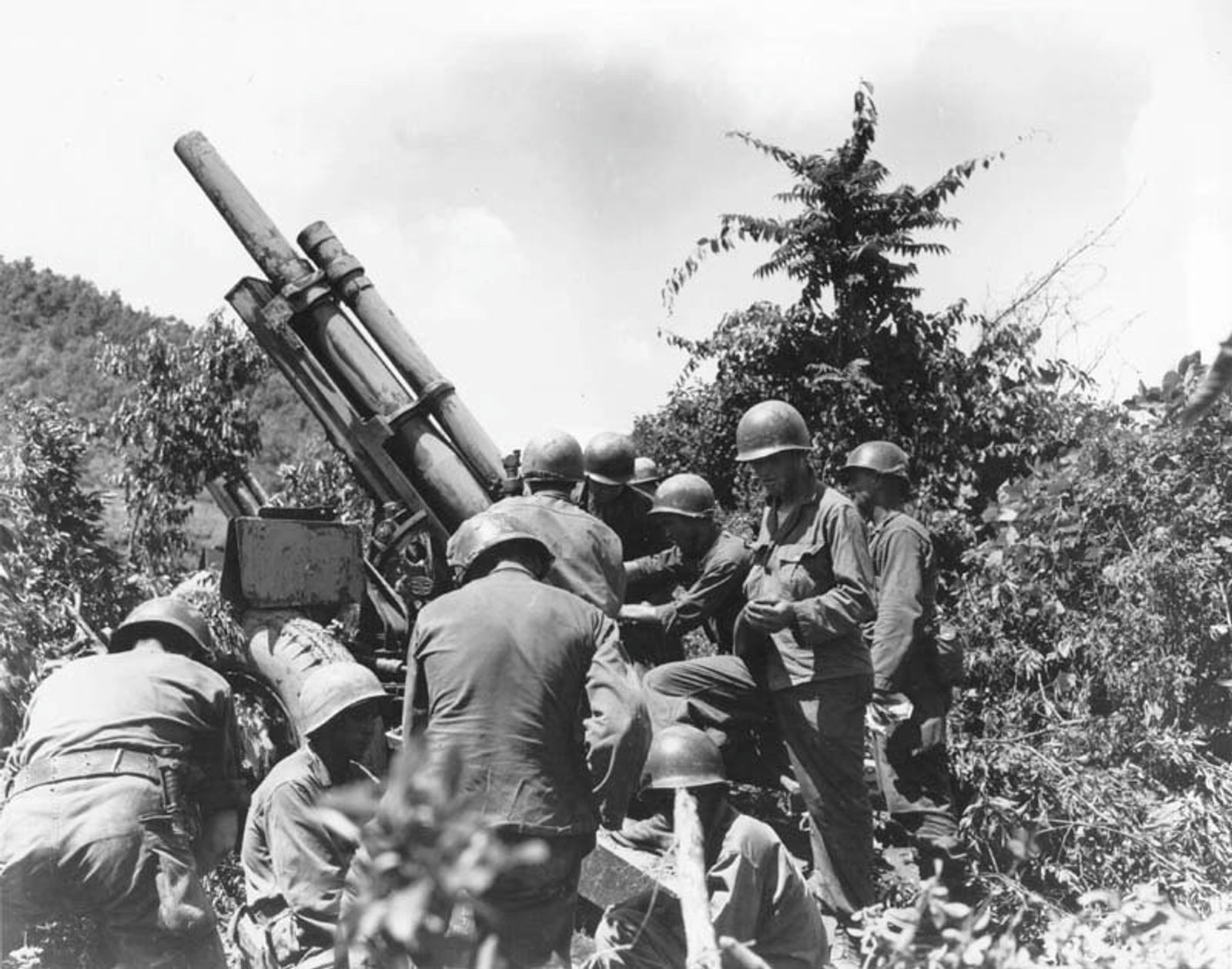
American howitzer in position in Korea
Eisenhower was reported to the organized flight of prisoners right during the meeting of the Cabinet of Ministers in the Oval office. The president admitted that he was not able to understand the “mental processes of oriental people”; In his opinion, Lee led his people to national suicide. So is it not better to get rid of such a troublesome client?
Eisenhower admitted that he was not able to understand the "mental processes of oriental people"
Eisenhower requested information about the position of the South Korean general in the case of a hypothetical palace coup. It turned out that there are both opponents and ardent supporters in the army. The Briggs Ambassador was categorically against the force action that could push them among themselves:
“Lee aroused determination and will in his country to fight communism. Such a spirit and resistance must be protected, not destroyed. His army, equipped with us, is the largest and most effective anti -communist army in Asia, and we really need it to be on our side. ”
Meanwhile, in Phanmunzhon, the Chinese delegation raised the question by the edge: is the UN command to control the South Korean government and the army? If not, then what are the guarantees that the Treaty of the Armistry will be carried out by South Korea? Given that the South Korean divisions occupied half the front line from the south, the question was by no means idle.
Special Supervisor flies to Korea
The person who was chosen, in order, in the words of one of the American generals, “show sensitivity to oriental concern about the face,” was called Walter Robertson, assistant to the State Secretary for the Far East. In the past, he was an investment banker from Virginia, as many successful businessmen entered the civil service during the Second World War, was an economic adviser to Chan Kayshi, and now, as a special bearer of the US president, he was sent to South Korea for negotiations with Lee Man.
The task was not easy, on the day of his arrival, whether he made the next fiery speech, urging the fellow citizens "to rally the spirit and stubbornly go to their goal, regardless of whether others would understand us or not." For more than two weeks, they met almost daily, for hours convincing each other in the rightness of their position. The American turned out to be a very tough negotiator. Whether Robertson (with the permission of Eisenhower) said threats to the threats of an independent operation to liberate the north of the country, in this case, the United States would withdraw its troops from the peninsula and his hands.
In response to threats, whether to start an independent operation to liberate the north of the United States, threatened to withdraw their troops from the peninsula
Lee, for his part, perfectly understood that the visit of Robertson is the last opportunity to achieve at least some guarantees for the future from the United States. And gradually giving a position behind the position, he managed to bargain the main prize.
Whether the son Man demanded:
- Even before the signing of the US ceasefire, an agreement on military assistance should conclude with South Korea;
- According to this agreement, in the event of an attack on South Korea, the United States should intervene “automatically and immediately”, similarly to the 5th point of the NATO Charter;
- The political conference, whose convocation was planned after signing the ceasefire, should be limited to 90 days. If after this period an agreement is not reached on the withdrawal of Chinese troops from Korea, the ceasefire will be canceled, and the war will continue with the support of the United States.
Robertson managed to sell the position of his counterpart on all points.
- No automatic resumption of war;
- Chinese troops will remain and leave North Korea only in 1958;
- The mutual assistance agreement will be concluded after the signing of the ceasefire, and its article III especially stipulated that the United States "will act to reflect the general threat in accordance with its constitutional procedures." Those. Only with the approval of the congress.
Nevertheless, the very consent of the Americans to conclude a defensive agreement with South Korea was a great success for Lee. В ответ он выдал невнятное обещание «не препятствовать подписанию перемирия, пока никакие действия, предпринятые в рамках перемирия, не будут вредить нашему национальному выживанию». В Белом доме сочли это обязательство «не совсем удовлетворительным», но время пожимало и приходилось довольствоваться тем что есть. 10 июля в Пханмунчжоне были возобновлены пленарные заседания делегаций.
Надо сказать, что к этому моменту китайцы, поначалу заподозрившие администрацию Эйзенхауэра в двойной игре, разобрались в ситуации. И более того - приняли проблемы американцев с Ли Сын Маном близко к сердцу. В результате в Пекине было принято решение преподнести южнокорейцам небольшой урок.
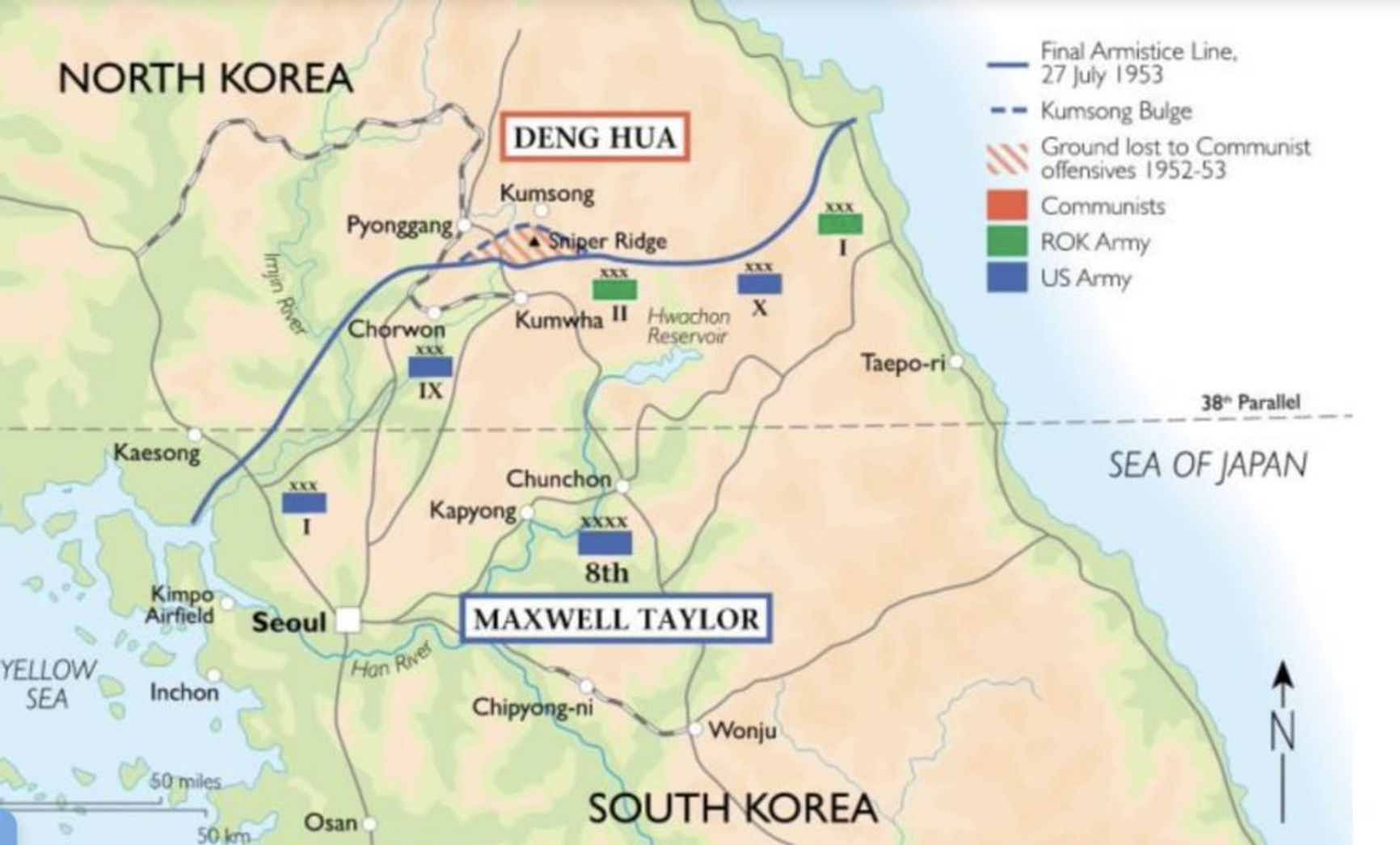
Кумсонгский выступ, ликвидированный китайцами в последние дни войны
13 июля китайцы нанесли мощный удар по позициям 2-го корпуса армии Южной Кореи в районе Кумсонга. Под удар попали 6 южнокорейских дивизий, большинство из которых не выдержали натиска и отступили в той или иной степени беспорядка. Элитная Столичная дивизия была при этом разгромлена наголову. Американскому командованию пришлось срочно вводить в бой резервы, в том числе 3-ю пехотную дивизию армии США, в которой служил младший сын Дуайта Эйзенхауэра. Угроза потерять его в последних боях войны отношение президента США к Ли отнюдь не улучшило.
Главнокомандующий американскими войсками на Дальнем востоке генерал Кларк позже писал: «Я не сомневаюсь, что одной из главных, если не единственной причиной коммунистического наступления было преподнесение «кровавого урока» Южной Корее, чтобы показать ей и всему миру, что лозунг «Марш на Ялу» легче провозгласить, чем воплотить в жизнь». Дополнительным бонусом для северян стала ликвидация так называемого Кумсонгского выступа, что дало им лишние 8 км территории.
Ничто так не отрезвляет политика, как очевидное военное поражение. И хотя на церемонии подписания перемирия 27 июля 1953 года южнокорейцы так и не появились, а Ли на следующий день заявил, что «перемирие является лишь временным, поскольку корейские проблемы не могут быть решены мирным путем», никаких попыток сорвать соглашение он больше не предпринимал.
Альтернатива в виде Третьей мировой
Ли был не одинок в своем мнении: многие тогда предрекали, что корейская линия разграничения станет столь же нестабильной, как проведенные незадолго до этого границы в Палестине и Кашмире. Время, однако, опровергло скептиков – Вторая Корейская война до сих пор не разразилась. С другой стороны, разделенная Германия в итоге воссоединилась на демократической платформе, а ядерный северокорейский еnfant terrible продолжает оставаться в своем регионе фактором нестабильности. Отсюда вопрос: а не поторопился ли Эйзенхауэр? Не было ли возможности ликвидировать проблему в зародыше? Что по этому поводу говорили военные?
Военные еще в ходе визита Эйзенхауэра в Корею осенью 1952 года положили ему на стол «План 8-52». Логика этого документа была предельно проста: прогрызаться через эшелонированную оборону китайцев до самой реки Ялу не только очень затратно, но и бессмысленно, если ограничивать боевые действия одной Кореей. Что даст выход на Ялу кроме удовлетворения чаяний Ли Сын Мана, где гарантия, что китайцы сочтут на этом войну законченной? Ведь они послали войска в Корею именно с целью не допустить американцев к своей границе. (Забегая вперед — тот опыт очень поспособствовал тому, что в 1960-е годы администрация США отказалась от наземного вторжения в Северный Вьетнам из опасений реакции Китая на появление американских войск на своих южных рубежах).
Значит, резюмировало американское командование на Дальнем Востоке, нужно решать проблему радикально: сбросить атомные бомбы на китайские объекты, в первую очередь аэродромы в Маньчжурии, объявить морскую блокаду Китая — и только тогда начинать наступление в Корее. Но поскольку Пекин имел действующий договор о военном союзе с СССР, а тот в свою очередь располагал ядерным арсеналом, то ожидались ответные атомные удары по морским портам Кореи и американским базам в Японии.
США рассматривали вариант сбросить атомные бомбы на аэродромы в Маньчжурии, но у Пекина был договор о военном союзе с СССР
Эйзенхауэру, который сам был профессиональным военным, не составило труда спрогнозировать дальнейшую эскалацию, прямо ведущую к Третьей мировой. В Вашингтоне его ожидали расчеты Совета национальной безопасности: в случае нанесения советами ударов по американской территории число погибших составило бы приблизительно 9 миллионов человек.
В итоге оставались три варианта. Оставить все как есть, продолжая посылать американских парней на потерявшую стратегический смысл войну. На дистанции это означало внутренний раскол в самих США и разложение американской армии — все то, с чем страна столкнется в конце 1960-х, уже на другой войне при другой администрации. Этот путь Эйзенхауэр отверг еще до своей инаугурации.
Альтернативы — либо двинуться навстречу ядерному Армагеддону, либо воспользоваться окном возможностей, открывшимся со смертью Сталина. Для Эйзенхауэра выбор был очевиден, и после 1953 года в списке своих достижений на первое место он неизменно ставил не высадку в Нормандии, не экономический бум 1950-х, а достижение мира в Корее.
Эйзенхауэр считал главным своим достижением не высадку в Нормандии, не экономический бум, а мир в Корее
Его биограф Стивен Эмброуз считает, что «как девять лет спустя де Голль был единственным французом, чей престиж был достаточно велик, чтобы позволить ему закончить войну в Алжире, не будучи свергнутым, так и Эйзенхауэр был единственным американцем, который смог найти то, что сам он назвал приемлемым решением проблемы, которая почти не поддавалась решению».
Южнокорейская марка, выпущенная в честь заключения военного союза с США
Ли Сын Ман тоже получил свою долю славы. Как ни крути, а формально уступив Робертсону по всем пунктам, он вырвал у него главный приз – военный союз с США. «Это соглашение стало триумфом Ли, — пишет историк Ричард Аллен. - Если оно и не гарантировало объединение Кореи, то, тем не менее, воплощало обещания, которых Ли добивался от Вашингтона годами: защита, предоставляемая договором о взаимной обороне с великой державой и перспектива масштабной экономической помощи».
Ли Сын Ман уступил США по всем пунктам, но вырвал главный приз – военный союз с Вашингтоном
Его южнокорейский коллега Ён-Пё Хон, впрочем, напоминает, что успех Ли Сын Мана объяснялся еще и тем, что у США было ограниченное пространство для маневра. В ситуации глобального противостояния Штаты так или иначе не могли бросить Южную Корею на произвол судьбы. И все же южнокорейская историография считает, что летом 1953 года Ли добился выдающегося результата.
При этом в тот последний месяц войны, которого могло и не быть, не затяни Ли войну своей аферой с пленными, войска ООН потеряли 25 000 человек убитыми и ранеными, подсчитал генерал Кларк.
Articles on the topic
Ставки главнокомандующих. Что теория игр говорит о будущем войны и перспективе переговоров между Россией и Украиной
Потерянная армия. Как вернувшиеся с фронта военные дестабилизировали Веймарскую Германию
We really need your help
Subscribe to regular donations