
Translated material
Fake Kremlin Propaganda: New British Intelligence Head - Nazis descendant
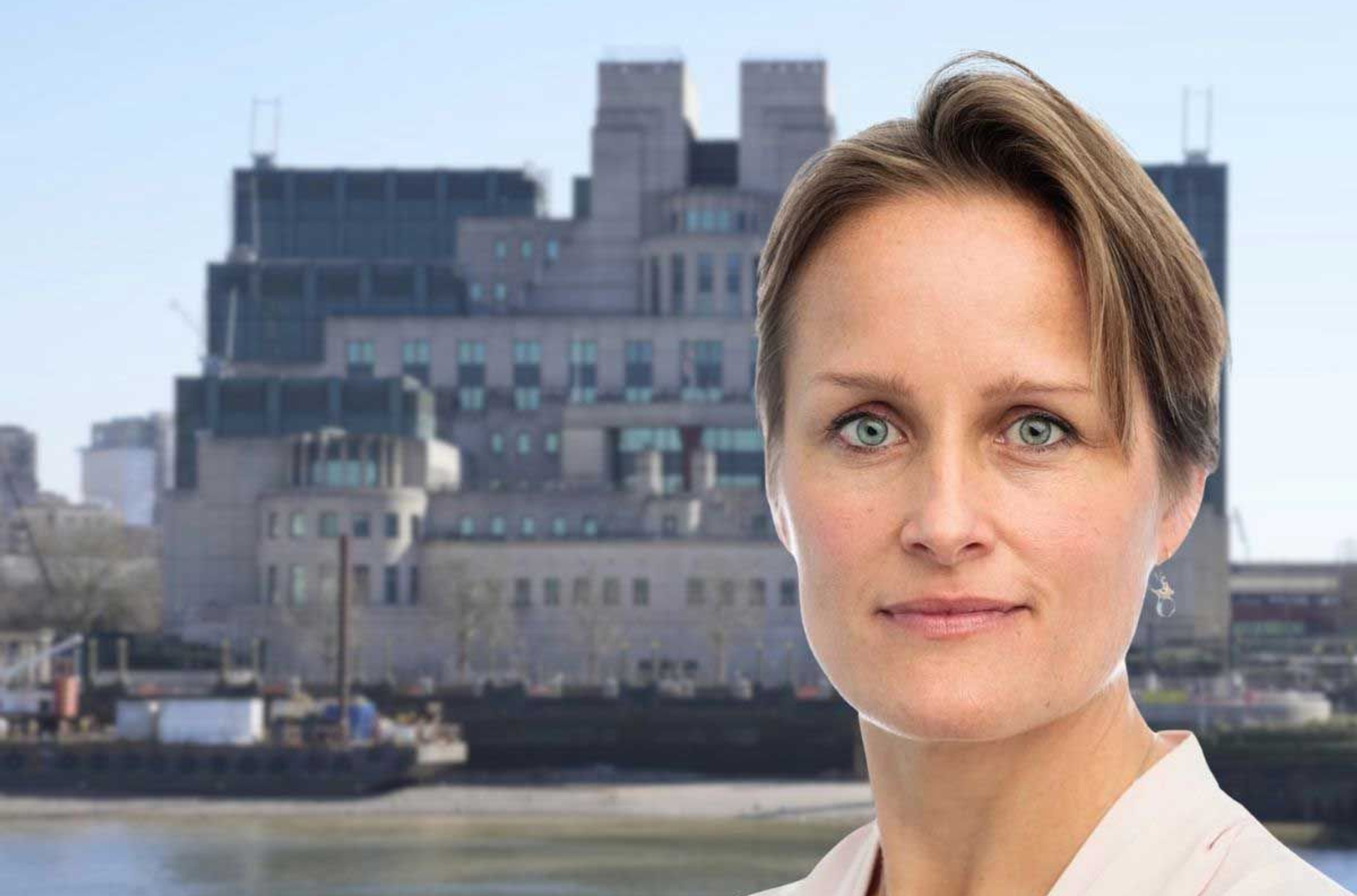
“Arguments and Facts” reacted to the appointment of Blaz Metreville the head of the British intelligence with an article under the heading “They brought values or were Nazis. The dark past of the new chapter Mi6 is revealed. ” However, in the article there is not a word about the “dark past” by Blaise Metreveli, except for such a work in British intelligence. But her ancestors from the newspaper got :
“Tsarev <Former deputy of the Verkhovna Rada from the Party of Regions, in absentia was sentenced to 12 years in prison for collaboration and encroachment on the territorial integrity of Ukraine. - The Insider> revealed another detail of the biography of Metreveli - it is quite possible that she is not a British and not a Georgian at all. Her father, Konstantin Metreveli, previously bore the surname of Dobrovolsky and was born in Ukraine during the Great Patriotic War. At the same time, according to documents, he became subjects of the British crown only in 1966. But the most interesting thing is that the nationality of the Metrevel-Dobrovolsky is declared as “uncertain”, and before the naturalization and formation of the British, he wore a Nansen passport. <...>
According to Tsarev, grandfather or father of Metrely, they could get a passport for the export of values from the USSR. And which ones - the story is already silent. Another reason for obtaining British citizenship could be hidden in the connections of his grandfather with the Nazis and his search in the USSR. Tsarev notes that after the Second World War, the Galicia SS division also emigrated to the UK, who were captured by the British in Italy. Among the emigrants were Ukrainians.
Well, after Dobrovolsky, who took the surname, naturalized, he became a medical student and learned on a radiologist, worked in the Royal Army Medical Corps, became a professor of radiology, worked in Hong Kong and was even mentioned in scientific articles. By the way, the childhood of the new chapter Mi6 just passed in Hong Kong. That's the coincidence!
“So, the main intelligence of Great Britain did not grow out, and Mrs. Dobrovolskaya,” Princess concludes.
And the mother of Blaise Metrevl-Dobrovolskaya was also not a weight. Judging by the documents that got into the network, her real name Borkovskaya. ”
The Georgian trade union activist SOPO Japaridze digs even deeper. On the Substack blog on the Substack platform, she writes :
“The germanized spelling of the name Metreweli (instead of the English Metreveli) suggests that her family was part of the anti -Soviet wave of emigrants who fled to Germany. Germany and France were two directions where emigrants were headed, sometimes moving from one country to another. There were practically no Georgian emigration outside the USSR, with the exception of two periods: to the Soviet regime and after its collapse. Those who left to the Soviet coup were the vast majority of the elite - noblemen or officials of the first republic. <...>
The key element of the puzzle is Archl Metreveli, the name associated with the Giselia Metreli, a German long -liver, who was married to a man with the same name in Munich before moving to Berlin. According to Georgian sources, the library entry about Archil Metrevel (in which there are no dates of birth and death) coincides with the husband of Gizel, which suggests that this was really the same person.
In the journal “Georgian Emigration” for 2015, the article “Letters of Grigola Diasamidze Shalve Amirejib” was published. The publication is accompanied by comments where we read about Archil Metreveli: engineer, professor of Georgian language at the University of Munich, translator. The founder of Georgian printing houses in Berlin and Munich. The editor-publisher of the newspaper Georgiana (1950–1952, Munich), a member of the Paris organization of the Georgian National Political Center. <...>
In 1942-1945, the Georgian Georgian newspaper was published in Germany, which introduced us to the life of the Georgian Legion [CC]. In total, 138 numbers were published (last March 12, 1945). The newspaper, along with the magazine "Cartvelly Erisa" and other literature intended for legionnaires, was printed in Berlin, in the Georgian printing house of Archil Metreveli. The photographs printed in the 100th issue of the newspaper “Georgia” depicts the facade of the printing house with Georgian and German inscriptions and the interior.
On the instructions of the Headquarters of the Georgian Union, Archil Metreveli compiled the German-Georgian and Georgian-German dictionary for soldiers, who were used not only by the Georgians, whom G. Magalashvili sent to German courses, but also the Germans. ”

However, the only argument in favor of the kinship of Blaise Metrev was with a collaboratorr Archil is to write a surname in a German manner. There is, however, one subtlety: this is not only a German spelling. The same Oleg Tsarev, in his publication on the same topic on the “News of St. Petersburg News”, gives a message about the naturalization of Konstantin Dobrovolsky (Metreveli) from London Gazette for 1966:
As you can see, Casimezh Marian Dobrovolsky, a citizen of Poland from Lviv, is mentioned next to Apatride Konstantin. The surname of Konstantin and Kazimezh is recorded exactly the same - Dobrowolski; This is Polish transcription, and the surname Dobrovolsky also meets with the Poles. Perhaps the writing of Metreweli is the influence of the Polish language.
The Belarusian online publication "Media Brest" gives an "indestructible" argument:
"The surname Metreveli/Metreweli is rare and almost exclusively in London."
In fact, this is a common Georgian surname; Among its famous carriers, the righteous of the world Sergey Metreveli, President of the Georgian Academy of Sciences Rin Metreveli, former president of the Academy of Agricultural Sciences of Georgia Valerian Metreveli, tennis player Alexander Metreveli, football player Slava Metreveli, Academician Elena Metreveli, participant of the television game “What? Where? When?" Iya Metreveli.
One way or another, the version of the kinship of Blaise Metrevat with collaborators from the Second World War was based only on the assumption of Oleg Tsarev about what this is in principle possible, because a certain collaborator with such a surname existed. And the story of the export of values from the USSR is nothing at all: Nansen passports received a variety of refugees; In total, about 450 thousand were issued from 1922 to 1938.
We really need your help
Subscribe to regular donations