
Translated material
Early space
For the first time since 2022, direct flights fly to Gelendzhik, but nine more airports in the south and in the center of Russia are closed. How do they survive in the fourth year of the war?
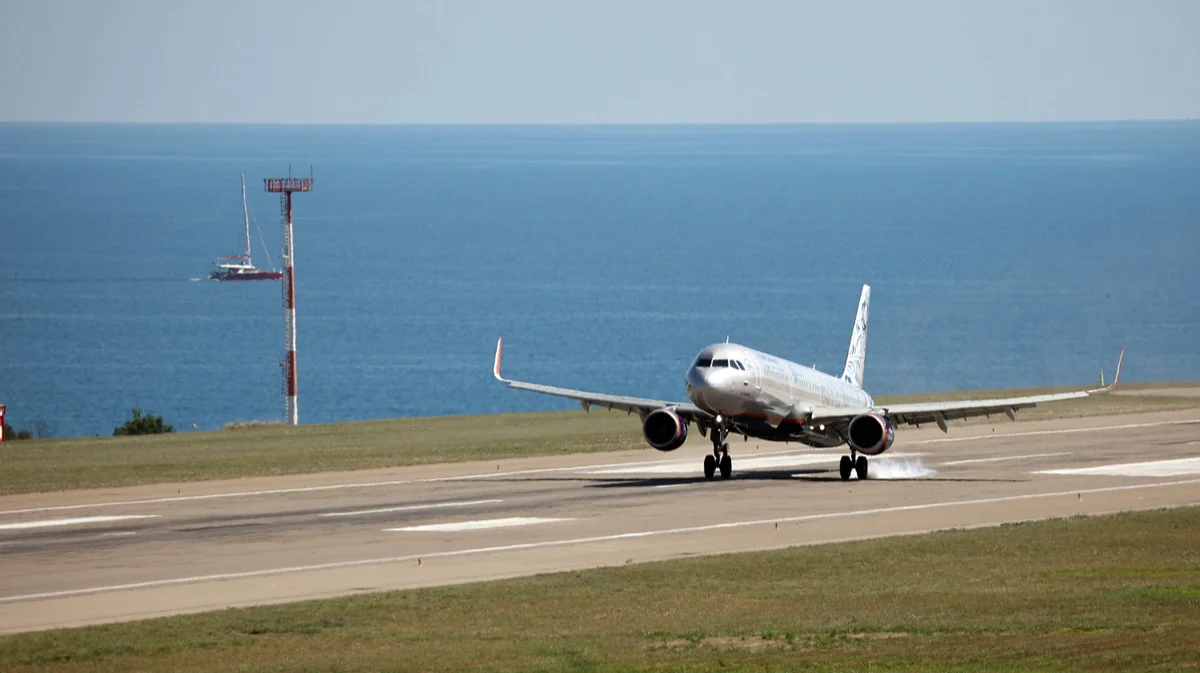
Aeroflot aircraft lands at Golenjik Airport, Krasnodar Territory, July 18, 2025. Photo: Vitaly Timkiv / satellite / Imago Images / Scanpix / Leta
At the end of July, flights were resumed at Gelendzhik Airport, which was closed since 2022. This happened against the backdrop of the ongoing aviation collapse throughout the country. At the same time, nine aviation nodes in the central and southern part of Russia still do not accept flights, and during downtime they modernize the terminals or give them for use for military purposes. The New Gazeta Europe tells how closed airports survive during the war.
In July 2025, a significant event occurred in the south of Russia: after a more than three -year break, Gelendzhik Airport resumed work. Since July 18, Aeroflot launched regular daily flights from Moscow, so far one per day, but in the future it is planned to increase the frequency. And the prices for tickets from Moscow to Gelendzhik one day after the opening increased more than doubled and even attracted the attention of the FAS.
The stop of the work of the southern airports took place on February 24, 2022. Then 11 airports were closed: Anapa, Belgorod, Bryansk, Voronezh, Gelendzhik, Krasnodar, Kursk, Lipetsk, Rostov-on-Don, Elista and Simferopol in the annexed Crimea. The airport of Stavropol was initially also on the list, but already in the first hours was excluded from it . Tambov Airport deserves special mention: despite the fact that he was not included in the official list of the Federal Air Transport Agency, in fact, he suspended flights from late February to May 2022.
Expectations about the imminent resumption of flights were not justified. For more than three years of restrictions, only two airports were partially opened: Elista - in May 2024, now Gelendzhik. The remaining nine still remain closed.
In connection with the closure of airports after the start of the war, thousands of flights were canceled, the usual routes were destroyed. This turned out to be a loss of direct air traffic with the largest tourist and business centers.
In 2021, the total passenger flow of 11 civilian airports of the South and the Center of Russia, closed from February 24, 2022, exceeded 20 million people.
The largest of them were Simferopol airports ( 6.8 million ), Krasnodar (5 million), Rostov-on-Don (2.9 million) and Anapa (2.9 million).
After introducing restrictions, a significant part of the traffic was redistributed to existing airports, such as Sochi, Mineral Water and Makhachkala. But this allowed only part of the losses to compensate. In addition, as a result, the transport accessibility of the regions and the total mobility of the population sharply decreased. For example, the flight time from Moscow to Sochi almost doubled , instead of the usual 2-2.5 hours to about 4 hours, since due to the closure of the airspace above the center and south of Russia, planes now use longer routes.
As a result, in 2022, passenger flow at Sochi Airport grew by 17.4 % compared to 2021 (from 11.1 to 13 million people), in mineral waters - by 27.5 % (from 3.2 to 4.1 million people), and in Makhachkala - by 23.6 % (from 2 to 2.5 million people). Also, part of the passengers from the central region are redistributed to Moscow airports, but the growth of the capital's passenger flow from this was insignificant against the backdrop of the fall of international flights from Moscow.
How many airports have lost
According to Novaya Gazeta Europe, from 2022 to 2024, the total operating losses of eleven closed airports of the South and the Russian Center amounted to 20 to 25 billion rubles, excluding state support. It is impossible to name the exact figure, since some airports have ceased to publish financial statements since 2023.
In 2021, the total operating profit of these airports amounted to 10.9 billion rubles, which reflected the positive trend in the restoration of the industry after the pandemic. Based on this trend, the company, which controls the closed airports, missed about 35 billion rubles of potential operating profit, which could be obtained in peaceful conditions.
In the amount of the loss of closed airports (operating losses plus the underground operating profit) for 2022–2024 can reach up to 60 billion rubles.
In addition to airports, airlines carry significant losses due to a closed aircraft space. So, for example, according to Dmitry Tyshchuk, the head of Victory, after the closing of 11 airports and their airspace, the raids of the airline route network increased by 20% due to the need to fly in certain zones. Each such additional hour of flight costs airlines of at least 800 thousand rubles.
Also, from the beginning of the war, due to the closure of the aircraft space and response of Russia, Aeroflot has lost a significant part of the so-called Trans-Siberian royalties-annual payments of $ 500-800 million, which foreign airlines paid for the right to use the shortest routes through the Russian airspace for flights between Europe and Asia.
As we thought
To evaluate operating losses, we used the financial statements of airports in the form of RAS, in particular the line 2200 “Profit (loss) from sales”. Unlike net profit, this indicator is not distorted by the receipts of the State Subsidium, which significantly influenced the reporting in 2022–2024.
In total, judging by the financial reporting for the period from 2022 to 2024, the airports suffered operating losses of at least 20 billion rubles. For airports of Krasnodar and Kursk, financial statements for 2023 and 2024 were not available, for them we approached these values based on data from 2022 and using the average percentage of losses from sales of other closed airports. In this case, the total losses for 2022–2024 are about 25 billion rubles.
To evaluate the lost operational profit, we also took “profit (loss) from sales” of all closed airports for 2021, which amounted to 10.9 billion rubles. 2021 did not yet reflect complete recovery after the pandemic, and while maintaining normal work, the profit from sales would probably continue to grow. With this in mind, we estimate the lost net profit for 2022–2024 about 35 billion rubles.
Since the beginning of the temporary closure of airspace in the south and in the center of Russia in 2022, the government allocated about 33 billion rubles to support 11 airports. These funds, including the last tranche of 6 billion rubles in July 2025, are allocated to maintain airports in full operating readiness. Financing covers operating expenses, infrastructure maintenance and, most importantly, personnel wages. The key condition for obtaining state assistance is to preserve at least 90% of the airport staff as of January 1, 2022.
In total, according to the calculations of Novy-Europe, in the first two years of the war, the government spent more than one trillion rubles to support air transportation. The subsidies allowed us to prevent mass dismissal of employees and support the basic performance of the facilities, but in fact, only part of the economic damage was compensated.
What is happening at closed airports
Despite large -scale financial losses, many closed airports use the downtime for investment in the modernization of infrastructure . So, for example, the reconstruction of the airport complex, which cost 60.5 million rubles, was completed in Kursk. According to the former governor of Roman Starovoit, after the repair, the capacity of Kursk airport will grow by almost two and a half times - from 106 to 250 thousand passengers per year. And in Lipetsk, about a billion rubles (500 million-by private investors and 475 million from the regional government) are invested in the modernization of the air terminal and the runway).

At the same time, seven of the eleven airports closed from the beginning of the war (Belgorod, Voronezh, Gelendzhik, Krasnodar, Kursk, Rostov-on-Don and Simferopol) are included in the list of joint airports. This means that both civilian and military aircraft can be served there. The military use at least the airports of Belgorod and Kursk . In addition, some closed airports could be used to transport mobilized soldiers. So, back in 2022, BBC drew attention to flights to the closed airports of Rostov-on-Don and Simferopol, probably transporting the military.
The only at the moment, after several years of downtime, Elista Airport in the first half of this year has already managed to serve 324 flights and 29 thousand passengers.
However, both the Airport of Elista and more than 40 airports of the Center and South of Russia since the beginning of 2025 are increasingly subjected to temporary restrictions due to threats of assholes.
According to the authorities, many of the closed airports are ready to follow Gelendzhik and Alistoy. Despite the long simple, they support the performance and the necessary level of personnel and are ready to open to the public as soon as such an opportunity arises. Such messages have already come from Krasnodar , Belgorod , Voronezh , Kursk and Simferopol .
Is it safe?
The question arises: how safe is the airports in the context of increasing risks for civil aviation due to permanent attacks of seedlings?
There is no big difference between the airports of Gelendzhik and Sochi in terms of security, says a Russian aviation expert who wished to remain anonymous.
- I do not see a fundamental difference. The distance is only 170 km, entering the strip is also only from the water, the risk of confusing the plane with the drone is minimal.
Another question is that “huge risks of operation” exist at all for all airports in the European part of the country, the expert says.
- The airport to which the Ukrainian heavy drone can reach should be closed.
In the flight of a drone at a fairly high altitude, he "just mixes with linear aircraft and they all have to be planted at once." With such a scenario, it would have to be closed by all airports at a distance of at least 2500 km from the border with Ukraine.
It is almost impossible to imagine that the Russian authorities will go to such a radical step, although this scenario has already discussed in the industry. But there are no signs that the airports of the Armed Forces will attack the airports and the targets close to them are less likely, which means that the frequency of closing will increase. This is probably why the decision was made to open Gelendzhik: it can be redirected by some flights if the danger will threaten the already overloaded Sochi or mineral waters.
Another thing is that one small open airport in the south does not solve all the problems of the aviation collapse generated by the war. Firstly, if the drones fly to Sochi at night, then in the dark, Gelendzhik will not be able to accept the plane. And secondly, the load on the airports is growing not only because of the “Corporative” plan, but also because of the damage that the aviation infrastructure is already causing an UAV attack.
In particular, on August 3, after the oil depot in Sochi, there was a shortage of airline, and aircraft, in order to fly to Moscow, St. Petersburg or Perm, had to make technical landings for refueling in mineral waters. Gelendzhik did not help here, but there was more chaos for passengers due to delayed flights.
With the participation of Denis Morokhin