
Translated material
There is no money, but you are silent. Charity in Russia is experiencing one of the most difficult periods in history
The Hannah Arendt research center published a report on the state of Russian NPOs and civilian initiatives in 2024. Lack of resources, tightening legislation and burnout of donors - the charity sector in Russia is experiencing one of the most difficult periods in its history. At the same time, there are directions that have never seen such an upsurge of a civil initiative, experts said.
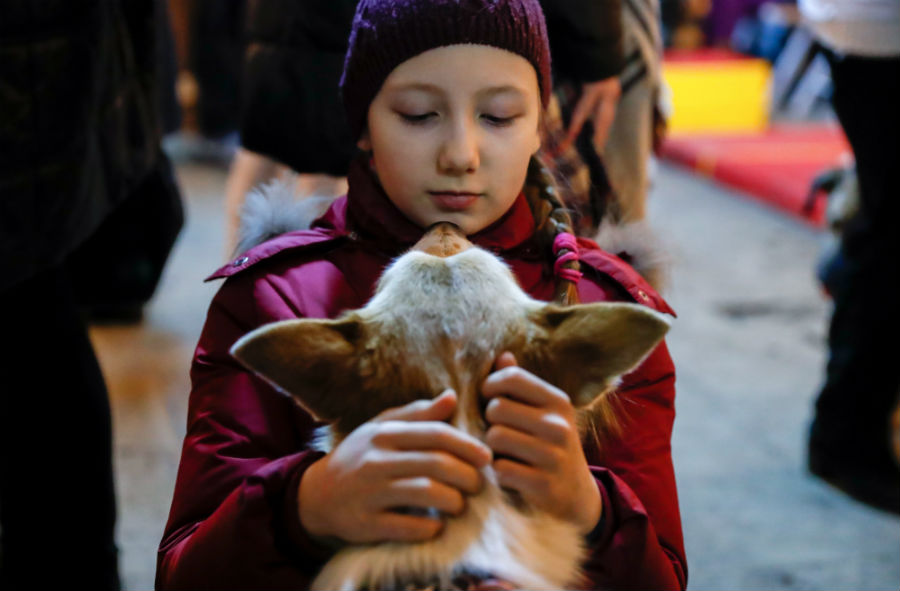 Moscow, charitable exhibition-uplift of dogs from the shelter photo: Artem Geodakyan / TASS
 The main problems of the Russian Civil Society in 2024 were the pressure of the state, the lack of resources and the difficult communication between those who left the country and the remaining, the report of the research center named after Hannah, Solidarity under pressure, said. The authors interviewed representatives of 115 civilian initiatives and investigated 6496 communities in Telegram and VKontakte.
Hostile status
Tighten the legislation on foreign agents, undesirable and extremist organizations in recent years forces Russian NGOs to abandon partnerships, financing and resort to self-censorship because of fear of getting status, which will deprive them of not only financing, but also the very opportunity to provide assistance.
“The problem is large -scale and primarily applies to those initiatives that, by virtue of their work, are forced to work with state institutions: for example, in the field of education, health care, the prevention of domestic violence and other crimes,” the authors of the study say.
So, the inclusion in the register of foreign agents prohibits NPOs to receive state support, sell and buy advertising. The representative of one of the funds told sociologists that after receiving the status of a foreign agent, T-Bank's agreement was broken with him. An employee of another NPO said that large donors received an unspoken order to stop any cooperation with the foreign-agent.
In recent years, not only specialized legislation has become tightened in Russia, says Anna Vasilieva, an expert on NPOs . She explains that the laws on personal data and advertising concern all the legal entities: “And the fact that so far no NPO has been fined a huge amount, does not mean that this will not happen.”
The problem of pressure on NGOs is closely related to the lack of resources, the report of sociologists says. After the start of the “special military operation” in Ukraine and the associated sanctions in Russia, the volume of donations from individuals sharply decreased .
Survival mode
Despite the restoration and even growth in 2023–2024, most civilian initiatives still cannot work at the expense of crowdfunding alone.
“In absolute numbers, we see growth, but if you take into account inflation , then the donations have become a little less. It is said that for the stability of NPOs it is necessary to develop fundraising, but for regional initiatives it is very difficult. Of course, there are successful examples, but so far this is an exception, not a rule, ”says Vasilieva.
 Photo: Jeremy Yap / Unsplash.com
In addition, crowdfunding for Russian NGOs is complicated by the fact that socially active people as a whole had less money, and many constant donors have emotionally burned out.
According to the authors of the report, if earlier people were ready to help when it was necessary to maintain life, now they switched to situations when it was necessary to help survival - both specific people (for example, refugees) and helping organizations. “We are talking about fees in the spirit of“ we are urgently looking for money to pay for rent, otherwise we are closing, ”said one of the representatives of the NGO to the Hannah Arendt research center.
Also significantly reduced or completely became impossible to work with foreign donors. However, the reason is not only in tightening the legislation, sociologists note, but also in the fall of the interest of foreign partners in Russian NPOs.
Due to the lack of money for operating needs of NPOs in recent years, they began to “save on themselves”: to reduce salaries to employees or reduce the staff by increasing the load on the remaining specialists. This, along with the features of helping professions, began to lead to the emotional burnout of workers.
“The transition to a scarce budget is characteristic in principle, when the initiative is financed primarily by activists themselves,” the report of sociologists said.
All this leads to the fact that many non -profit organizations were forced to close. According to the Pulse NPO project for 2024, 46% of charitable organizations in recent years thought about their closure due to a difficult situation. The head of the project notes that in real time it observes these negative processes:
"Many of our respondents cease to answer or say that they have suspended work or are in the liquidation stage"According to the estimates of “such cases”, from the beginning of 2022 to mid-2024, 2638 socially oriented NPOs closed in Russia.
"With a fig in your pocket"
The actual impossibility of receiving money from abroad forces non-profit organizations increasingly apply for public financing. But the use of these funds does not always mean support for state policy, the authors of the report note. For example, it often turns out that, acting in this way, NPO implements his own strategy:
At the same time, sociologists emphasize, it will incorrectly argue that all NCOs who take money from the state make it “with a fig in your pocket” - of course, some of the organizations really share the values of the policy of the current government.
A striking example of “new relations” with the state was female NPOs, experts note. After the start of the “special military operation” in Ukraine, these organizations were faced with a choice between radicalization and a complete refusal to support the authorities or work with officially approved topics, for example, preventing abortion.
 Photo: AKSHAY PAATIL / UNSPLASH.com
“Many organizations have chosen the second option, since for them this is the only opportunity to continue existence and have access to women who need their help,” the authors of the report explain.
In recent years, state support has become more multidirectional: for example, the authorities began to work more with volunteers in the regions, because the strategy for the development of volunteering, approved by President Vladimir Putin, suggests that by 2030, 45% of young people should be involved in volunteer activities to “educate a patriotic and socially responsible person”.
Not in the leg with the authorities
This could be considered a positive factor for the development of NGOs in Russia, but if organizations or volunteers were seen as opponents of a “special military operation” in Ukraine, they will not receive state support , Vasiliev says. “There are no formalization of these conditions, but inside the sector everyone knows what exactly they can be done and what cannot be done,” she adds.
In addition to resources problems, in recent years, representatives of Russian NPOs have been noted by the growing gap between those people who have remained in Russia and those who emigrated. The authors of the report note that such a gap is inevitable.
 Photo: Japheth Mast / Unsplash.com
Quiet victories
Despite the difficult conditions, Russian civil initiatives still manage to achieve successes, the report says. This is more likely to concern the problems of the local level: for example, it is possible to cancel the development, increase the salaries of workers or protect the rights of individual conscripts.
Especially sociologists talk about zoopathia in Russia - they call it the largest and most fast -growing type of horizontal initiatives in recent years. The report says:
At the same time, the public story of the success of these initiatives can lead to problems with the safety of volunteers and organizations due to the increased attention of the security forces, researchers say.
“We strive to get publicity, but within the limits of our glass cap, soap bubble. It is necessary that he does not burst, so that our messages do not submit to the external Internet, ”a representative of one of the zoo -protective NGOs told the authors of the report.